Science Phenomena Banner | NGSS Classroom Display & Bulletin Board DecorQuick View
roseski22

Science Phenomena Banner | NGSS Classroom Display & Bulletin Board Decor

(0)
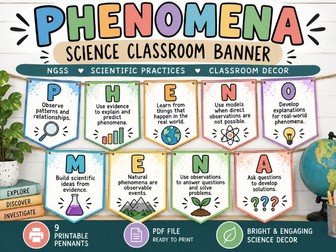
Create a science classroom display that is decorative and instructional with this PHENOMENA Science Banner. The resource includes 9 individual pennants, one for each letter in PHENOMENA. Each pennant pairs a colorful science-themed design with a short statement that reinforces important scientific practices and phenomenon-based learning. Students are reminded to: Observe patterns and relationships Use evidence to explain and predict phenomena Learn from things that happen in the real world Use models when direct observations are not possible Develop explanations for real-world phenomena Build scientific ideas from evidence Recognize natural phenomena as observable events Use observations to answer questions and solve problems Ask questions to develop solutions This display works well for: NGSS classrooms Science bulletin boards Phenomenon-based instruction Middle school science classrooms Elementary science rooms Back-to-school classroom décor Science hallway displays STEM classrooms What’s Included 9 PHENOMENA banner pennants with colorful science-themed graphics and student-friendly science statements. Suggested Grades Grades 4–8 Keywords science phenomena, phenomena banner, NGSS classroom, science classroom decor, science bulletin board, phenomenon based learning, science posters, STEM classroom decor, middle school science, science practices, classroom banner
Is Dad an Alien? CER Practice | Claim Evidence Reasoning Science ActivityQuick View
roseski22

Is Dad an Alien? CER Practice | Claim Evidence Reasoning Science Activity

(0)
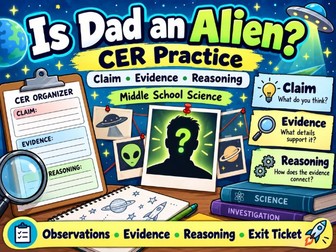
Make CER practice more engaging with this “Is Dad an Alien?” Claim-Evidence-Reasoning activity. Students evaluate a series of unusual clues about a girl’s dad and decide whether the evidence actually supports the claim that he is an alien. The lesson encourages students to distinguish between what they observe and what they infer, while practicing how to support a scientific claim with relevant evidence and logical reasoning. Students can reach different conclusions as long as they use accurate evidence and clearly explain how that evidence connects to their claim. Students will practice: Writing a clear scientific claim Identifying relevant evidence Explaining reasoning Distinguishing evidence from reasoning Differentiating observations from inferences Evaluating the strength of evidence Restating a conclusion Supporting an argument with multiple pieces of evidence Included in this resource: CER Graphic Organizer CER Exit Ticket / Review Teacher Answer Key Sample strong CER response Suggested scoring guide Teacher notes and common misconceptions The teacher answer key includes examples of acceptable evidence and reasoning, guidance for alternate claims, and a suggested 8-point scoring system. This activity works well for: Introducing CER CER review Scientific argumentation Observation vs. inference Evidence vs. reasoning practice Beginning-of-year science skills Middle school science inquiry Formative assessment Recommended for: Grades 5–8 / Middle School Science. Important before you upload There is one thing I would fix before listing this on TES: the folder does not currently contain the video or a student lesson presentation. The answer key clearly refers to students watching a video. So I would not write “video included” in the TES description unless you add a legal link/instructions to the external video. If the video is publicly available, you can say something such as “Designed to accompany a short online video; video not included.” Also, the two student files are still Google Docs. Download the folder first so Google converts them to Word files, or export them as PDFs before uploading to TES. The answer key is already a PDF.
Boho Classroom Expectations Posters | Classroom Management & SEL DecorQuick View
roseski22

Boho Classroom Expectations Posters | Classroom Management & SEL Decor

(0)
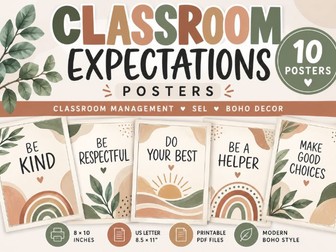
Create a welcoming classroom environment while keeping important behavior expectations visible with this set of 10 Boho Classroom Expectations & SEL Posters. Designed with a soft, modern boho aesthetic, these printable posters provide students with clear visual reminders while coordinating with neutral classroom décor. Perfect for classroom management, social-emotional learning, back-to-school displays, advisory spaces, and year-round behavior reminders. This resource includes: 10 classroom expectations and SEL posters 8 × 10 inch version US Letter 8.5 × 11 inch version High-quality printable PDF files Printing instructions Classroom-use terms The US Letter version places the 8 × 10 artwork in the center of an 8.5 × 11 page with white margins, making it easy to print using standard home or school printers. Use these posters for: Classroom expectations Classroom management SEL displays Back-to-school setup Advisory classrooms Behavior reminders Calm classroom décor Bulletin boards Middle school or upper elementary classrooms For best results, print at Actual Size / 100% on heavyweight paper or cardstock and laminate for repeated use. Please note: This is a digital printable resource. No physical product is included. TES categories I would start with Whole School / Classroom Management or the closest TES category available. A second strong category would be Social Emotional Learning / Personal, Social and Health Education if TES offers it. Keywords boho classroom decor, classroom expectations, classroom rules, classroom management, SEL posters, social emotional learning, behavior expectations, classroom posters, neutral classroom decor, back to school, middle school decor, classroom display
Scientific Investigation & CER Introduction | Scientific Method Lesson + WorksheetsQuick View
roseski22

Scientific Investigation & CER Introduction | Scientific Method Lesson + Worksheets

(0)
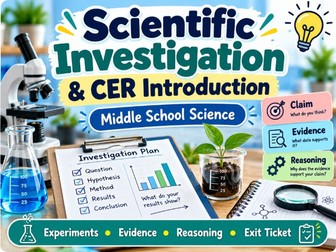
Introduce students to the foundations of scientific investigation and Claim-Evidence-Reasoning (CER) with this ready-to-use middle school science lesson. This resource is designed as an introductory lesson that helps students understand what makes a strong scientific investigation while beginning to develop the skills needed to support scientific claims with evidence and reasoning. Students examine experimental designs, make observations, evaluate evidence, and practice applying scientific investigation skills. Students will practice: Understanding the purpose of a scientific investigation Comparing strong and weak experimental designs Identifying features of a fair investigation Making scientific observations Developing a claim Identifying supporting evidence Connecting evidence to a claim through reasoning Applying scientific investigation skills Reflecting on their understanding with an exit ticket Included: 17-slide instructional presentation Which Experiment Is Best? collaborative activity Observation, Claim, Evidence & Reasoning worksheet Science Investigation Skills worksheet Day 1 Exit Ticket The Which Experiment Is Best? activity asks students to compare several investigations about sunlight and plant growth and rank them from strongest to weakest, encouraging discussion about variables, controls, sample size, and fair testing. This lesson works well for: Beginning-of-year science skills Scientific method units Experimental design CER introduction Science inquiry skills Middle school science review Substitute or structured lesson plans Recommended for: Grades 5–8 / Middle School Science.
Bubble Lab Science Investigation | Scientific Method, Variables, Data & CERQuick View
roseski22

Bubble Lab Science Investigation | Scientific Method, Variables, Data & CER

(0)
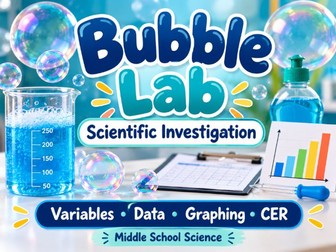
Engage students in a hands-on investigation while reinforcing essential scientific inquiry skills. In this Bubble Lab, students investigate: Does the brand of dish soap affect bubble size? Students work through the scientific investigation process from hypothesis to conclusion. The activity provides an accessible, high-interest way to practice variables, constants, measurement, repeated trials, data analysis, graphing, and evidence-based reasoning. Students will practice: Writing a testable hypothesis Identifying the independent and dependent variables Identifying constants Following an experimental procedure Measuring bubble diameter Recording quantitative data Completing multiple trials Calculating and comparing results Graphing experimental data Analyzing patterns in results Using evidence to support a conclusion Applying CER-style scientific reasoning Included in this resource: Bubble Lab instructional slides Teacher Guide Student Data Sheet Complete Answer Key The investigation compares different brands of dish soap to determine whether soap brand affects the size of bubbles produced. This resource works well for: Scientific method units Experimental design Variables and constants Data collection and analysis Measurement practice CER/conclusion practice Beginning-of-year science skills Review of scientific investigations The files are provided as PDFs and are ready to print or display. Recommended for: Middle school science / approximately Grades 5–8.
MIDDLE SCHOOL GEOLOGY UNIT Rocks • Minerals • Plate TectonicsQuick View
roseski22

MIDDLE SCHOOL GEOLOGY UNIT Rocks • Minerals • Plate Tectonics

(0)
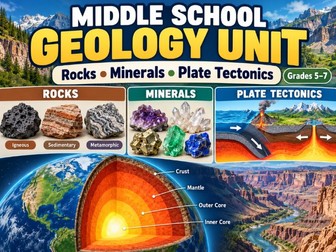
Designed primarily for Grade 6 science, this ready-to-teach geology unit provides approximately 12–15 class periods of instruction. The unit combines teacher presentation slides, student readings and activities, investigations, review materials, and a complete assessment. Students build their understanding of Earth’s structure and systems before moving into continental drift, plate tectonics, rock formation, the rock cycle, weathering and erosion, and mineral identification.
Geology Unit: Rocks, Minerals & TectonicsQuick View
roseski22

Geology Unit: Rocks, Minerals & Tectonics

(0)
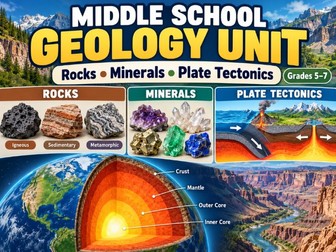
Complete middle school geology unit for Grades 5–7 covering Earth’s layers, Earth systems, plate tectonics, rocks, the rock cycle, and minerals. Designed primarily for Grade 6 science, this ready-to-teach geology unit provides approximately 12–15 class periods of instruction. The unit combines teacher presentation slides, student readings and activities, investigations, review materials, and a complete assessment. Students build their understanding of Earth’s structure and systems before moving into continental drift, plate tectonics, rock formation, the rock cycle, weathering and erosion, and mineral identification. What is included: • 38-slide geology teaching presentation • 29-page student packet • Teacher guide with pacing and preparation information • Complete student answer guidance and answer keys • 40-question multiple-choice unit test • Unit test answer key • Four Earth layers gallery walk cards • Four-page geology study guide • Mineral investigation and recording pages • Mineral reference chart • Original diagrams and models • Vocabulary, readings, practice and review activities Topics covered: • Earth’s crust, mantle, outer core and inner core • Composition and physical state of Earth’s layers • Geosphere and lithosphere • Atmosphere, hydrosphere, biosphere and geosphere • Interactions among Earth systems • Pangaea and continental drift • Evidence for past continental connections • Plate tectonics and plate movement • Divergent, convergent and transform boundaries • Subduction and continental collision • Igneous, sedimentary and metamorphic rocks • Rock cycle pathways • Magma and lava • Cooling and crystal formation • Weathering, erosion and deposition • Compaction and cementation • Characteristics of minerals • Mineral luster, hardness, streak and magnetism • Mohs hardness scale • Evidence-based mineral identification Student activities include: Students create and revise models of Earth, complete an Earth layers gallery walk, analyze evidence for continental drift, interpret plate-boundary diagrams, model multiple rock-cycle pathways, distinguish weathering from erosion and deposition, and complete a hands-on mineral investigation. The mineral investigation asks students to observe samples, test properties such as hardness, streak and magnetism, and use multiple pieces of evidence to make a tentative mineral identification. The unit concludes with a four-page study guide and a 40-question multiple-choice assessment covering vocabulary, application, evidence and diagram interpretation. Suggested use: Approximately 12–15 class periods of 40–50 minutes. Recommended age/grade range: Grades 5–7 / approximately ages 10–13 Primary target: Grade 6