Can energy be used up? Do food and fuels contain energy?Quick View
Keithaross

Can energy be used up? Do food and fuels contain energy?

(0)
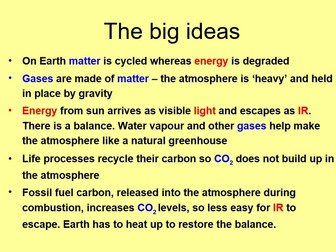
The word energy is a part of our everyday language: it has come to represent an ability to do something useful and is best represented in science lessons as ‘useful’ or ‘high-grade’ energy. As this ‘energy’ is ‘used’ it degrades into waste heat, so we have to come back for more. This contrasts with the idea that the amount of energy, measure in Joules, remains constant. We also look at why we think that food and fuels ‘contain’ energy (they don’t) – it stresses that oxygen is necessary for energy transfer but is usually ignored because it is invisible and freely available from the air. This resource is mainly useful as it stands for INSET or teacher education. Modified it can be used in the classroom. Comments on how you have used it would be welcome.
Structure triangle:  a periodic table for compounds?Quick View
Keithaross

Structure triangle: a periodic table for compounds?

(0)
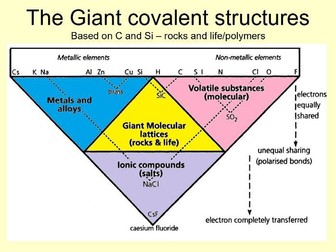
The periodic table is for elements, but can we make sense of the millions of compounds in our environment? The answer explained in this PowerPoint presentation is to classify them according to their physical properties, the same properties we use when we recycle – 1: metals, 2: ceramics (glass), 3: plastic and organic waste, paper, 4: volatile waste we send up the chimney or down the drain; 5: ionic substances like ash. We have just five different sorts of compound. We find the same five groups when we look at the ways elements bond. Forget classifying substances into solid, liquid or gas and go, instead, for these five types: metals, ceramics, life polymers (both biodegradable and plastics), volatile and ionic. We tend to teach bonding as if there are three distinct ‘kinds’: covalent, ionic and metallic, whereas these are just extreme cases. They all start with two atoms sharing electrons. With two non-metallic elements this results in (polarised) covalent bonding, either building up individual molecules (volatile materials) or building up giant structures (rocks , life and polymers) with two metallic elements you can never fill the outer electron shells so the atoms close pack with ‘free’ electrons (metals and alloys) with a metal and non-metal the bond is very polarised and you get ionic bonding (salts etc.)
Why  are printer and TV screen colours differentQuick View
Keithaross

Why are printer and TV screen colours different

(0)
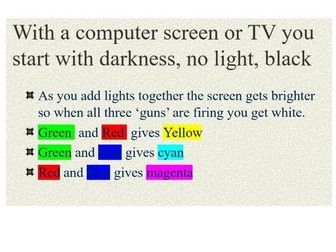
There is often a confusion when teaching Physics that the ‘primary’ colours of physics, Red Green and blue and different from those of the artist (red yellow and blue) This PowerPoint and practical lesson explains why Three colour receptors in retina: red green and blue All other colours we perceive are combinations of these three Artists and colour printers use yellow cyan and magenta, but computer and TV screen have the same colour ‘guns’ as we have receptors in our eyes. We shall see why!
Observation - understanding atoms is difficultQuick View
Keithaross

Observation - understanding atoms is difficult

(0)
This PowerPoint helps students realise the importance of the existing ideas we have in our heads when trying to understand data from our visual or any other of our senses. It explains why understanding atoms as unchanging particles is so difficult for our students. Read the notes attached to each slide for more detail. It shows the value of our existing ideas in interpreting what we see. It is why babies have no memory of their early days, because they have no images in their brains to make any sense of what they sense. It’s like going to a foreign country when you can made no sense of the words you hear, but after several weeks or months you gradually begin to understand – as the words get into your memory. It was used initially with PGCE students but useful for GCSE and post-16 studies. See Ross et al “Teaching Secondary Science” 4th Edition Routledge 2015 Chapter 4 Learning through Language and observation And Chapter 14 Difficult idea in chemistry, esp pages 120-126 Review of particle misconceptions and ideas for challenging them After showing the PowerPoint students can experience (round the lab) many different models of atoms, molecules, matter, and many phenomena that need to be explained using particle models. Particle Models: Making a Lego model then using the bricks to make something new – the bulk object changes but the particles remain the same. Atomic models, bubble raft (metals), fluidised bed of beads for melting, etc. Phenomena (to be explained using particle models): A syringe of water and of air – only the air can be compressed. Burning gas (or candle) and collecting water condensing in a cool jar Iron fibre burning on a balance getting heavier Etc. Keith Ross 2025 keithaross@gmail.com
Model for photosynthesis and respirationQuick View
Keithaross

Model for photosynthesis and respiration

(0)
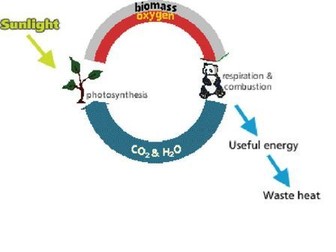
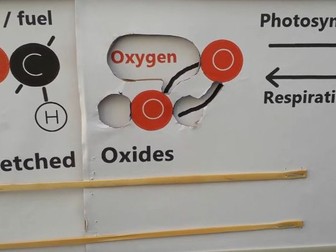
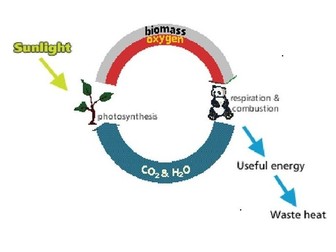
This model shows how energy is stored when sunlight shines on green plants and how it is released during respiration. It shows the importance of oxygen because energy is NOT stored in the food, but in the fuel-oxygen system. Use this model to accompany https://www.tes.com/teaching-resource/resource-11094177 We say “food ‘contains’ energy” however it is only when it combines with oxygen that energy becomes available. Digestion gets food into the blood, breathing gets oxygen in the blood, these two combine in the cells of our bodies to provide energy: the products are carbon dioxide and water. So our food exits our body mainly through the nose! Oxygen is a dangerously reactive gas, with weak chemical bonds holding the atoms together. Fuels and food by contrast are strongly bonded. The energy from respiration comes from replacing the weak bonds in oxygen with the strong bonds in carbon dioxide and water - these are the products of respiration and the starting materials for photosynthesis. During photosynthesis the spring is re-set as this model shows.
Digestion--respiration--charring-and-combustion---unpicking-the-confusionQuick View
Keithaross

Digestion--respiration--charring-and-combustion---unpicking-the-confusion

(0)
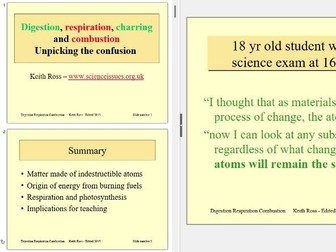
A bit about those indestructible particles we call atoms which don’t change even when things melt or burn. Then questions about what happens when things burn and where the energy comes from when we respire food. Finally some new ways of thinking about respiration and combustion to help understanding of the role of oxygen. Powerpoint to accompany the resource “Science Issues” (a free download) and some spectacular demonstrations, illustrating the role played by oxygen. Used for school science 14-18 yr olds and also for teacher education. Use with the simple model of photosynthesis and respiration which emphasises the role of oxygen https://www.tes.com/teaching-resources/dashboard/resource-management/add-resource/13287196/
Introduction to a constructivist approach to teaching scienceQuick View
Keithaross

Introduction to a constructivist approach to teaching science

(0)
PowerPoint: Intended for science teacher professional development. Examples of misconceptions (insulation, burning, force) and how to challenge them in class through intervention activities. Finally the importance of giving pupils TIME to make sense of it all - active learning techniques. Included are two recordings of children discussing insulation and a candle burning. Transcript is in the PowerPoint.
Pavarotti - audio version in French -the story of a French catQuick View
Keithaross

Pavarotti - audio version in French -the story of a French cat

(0)
This is a beautifully read audio of the French version of Pavarotti “Un Chat Francais” with music and sound effects. It will help with French pronunciation as your students study the written text. Read by Marco Gimenez, Haute Pyrenees, France To obtain the books (English and French) go to [https://www.tes.com/teaching-resource/resource-12551391]
English & French dual language story of Pavarotti a French catQuick View
Keithaross

English & French dual language story of Pavarotti a French cat

(0)
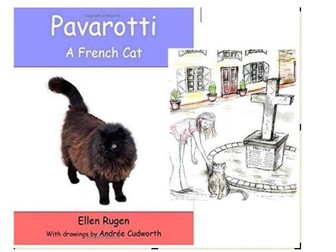
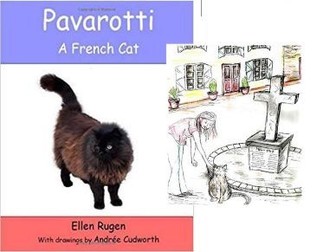
Beautifully illustrated true story of a French cat in English and French versions for upper primary and secondary students learning French. The two versions are matched page for page but they are written in idiomatic English and French so there is not a word-for-word match. The cat, called Pavarotti because of his loud voice, has an exciting life, full of dangers and troubles, but it ends happily. You would need to purchase the two editions (English and French) separately. Get the pupils to read the story in English first then they can try to make sense of the French text without referring to the English. Finally they can put the two together. NEW: we have recorded a voiced version of the French text to help with pronunciation. Available as a free download on this site. Go to https://www.tes.com/teaching-resource/resource-12635598