Point Evidence Explanation lesson using an extract from Oliver Twist.Quick View
Parkside11

Point Evidence Explanation lesson using an extract from Oliver Twist.

(0)
Keystage2/3/4. (Originally created for a Year 8, low ability, English set) The 13 slide presentation, allows the teacher to model the technique of writing Point, Evidence, Explanation paragraphs by 'scaffolding' the process as well as encouraging the students to use the techniques of 'skimming and scanning' and 'highlighting key words or phrases' when searching for 'evidence'. Also included are copies of both plain and annotated copies of the extract in which Dickens describes the poor conditions and cruelty experienced by Oliver and the other boys. As a starter or extended task, there is a copy of a handwriting practice/spelling worksheet.
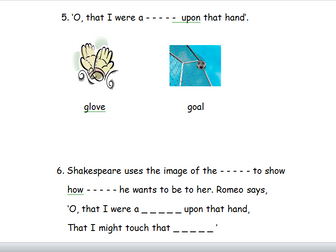
Romeo and Juliet - Balcony Scene - Differentiated Workbook (Y8/9 - Low Ability)Quick View
Parkside11

Romeo and Juliet - Balcony Scene - Differentiated Workbook (Y8/9 - Low Ability)

(0)
Key Stage 3 - Differentiated, five page assessment/workbook to allow students with cognitive and learning difficulties to be integrated fully into the classroom environment; to enable access to the Year 8 curriculum and to show understanding and an ability to answer the following essay style questions (set for all abilities) at a level appropriate to ability: - a) How does Romeo describe his feelings about Juliet at the beginning of the scene? b) How does Juliet describe her feelings about Romeo? c)Why is Juliet worried about their meeting and how does Romeo react to this? d) How does Juliet insist that Romeo shows he really loves her? Also accompanying the booklet are: two worksheets, one focussing on Shakespeare's Language (definitions activity); the other focusing on imagery and a Shakespeare jigsaw activity created on the Tarsia website. The jigsaw template will need to photocopied several times and the sections cut up. When completed the jigsaw will be in the shape of a hexagon. The workbook is 'Dyslexia Friendly' (images/comic sans font/font size 16/pastel coloured background).
Macbeth (DIFFERENTIATED WORKBOOK) Act 2 Scenes 1 and 2.Quick View
Parkside11

Macbeth (DIFFERENTIATED WORKBOOK) Act 2 Scenes 1 and 2.

(0)
Keystage 3. Differentiated workbook to allow students with cognitive and learning difficulties to be integrated fully into the classroom environment; to enable access to the Year 9 curriculum and to answer this essay style question - ' How do Macbeth's words in Act 2 Scene one and Act 2 Scene 2 reveal his thoughts and feelings. The workbook is 'Dyslexia Friendly' (comic sans font/font size 20/pastel coloured background). The workbook includes: coloured images/questions/cloze procedures/information sheets/speech bubbles/'odd one out' activity/glossary etc.
Paragraphs lesson using collaborative learning styles.Quick View
Parkside11

Paragraphs lesson using collaborative learning styles.

(0)
Key Stage 2/3 (originally created for a small, low ability, year 8 group) Lesson Objective: to understand that a paraghraph marks a change of focus Assessment Focus: (Writing AF4) to construct paragraphs and link them together effectively Collaborative learning styles including: 'Think, Pair, Share' and 'Quiz, Quiz, Trade' Dyslexia friendly powerpoint presentation together with question and answer cards - to be printed