24 slides on the theories on religious language in the 20th century.
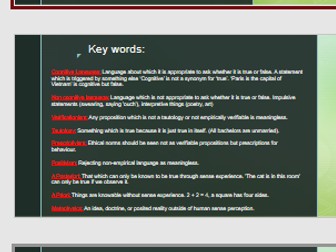
Includes keywords for the topic
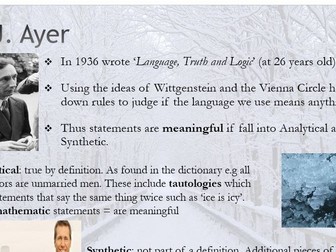
Covers verificationism
Falsification
Eschatological Verification
Language Games
Includes strengths and weaknesses for all arguments.
I think it’s really detailed, and could last a long time.
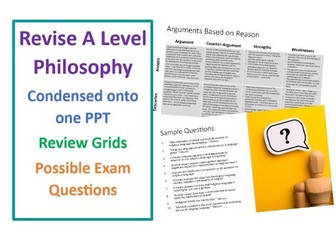
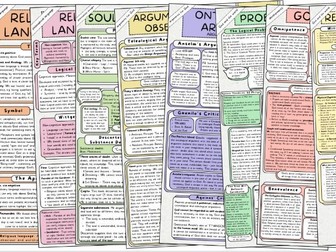
This extensive revision PPT revises the whole of OCR A Level Philosophy, helpfully summarising each topic into one revision grid. After each unit, ten sample questions (based on the language of the spec) are there to focus revision and prepare for possible exam questions on the topic.
Topics include:
Ancient Philosophical Influences
Soul, Mind and Body
Arguments from Observation
Arguments from Reason
Religious experience
Problem of Evil
Nature of God
Religious Language
20th Century Perspectives
Created with the OCR RS AS/A Level in mind, though can be applied across specifications and qualifications.
Please give feedback! I am always happy to respond to comments - whether positive or constructive - this will help to improve the quality of my resources in the future and, more importantly, the quality of pupils’ RE/RS education in general - which is what we’re all here for!
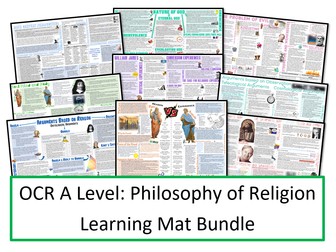
These engaging and colourful learning mats are indented for independent study or revision for the topic of Philosophy of Religion, as part of the OCR AS/A Level specification, although it can be applied across specifications. Each learning mat is downloaded as an A3 Word document and an A4 PDF, for compatibility.
Topics include:
Ancient Philosophical Influences
Soul, Mind and Body
Arguments from Observation
Arguments from Reason
Religious experience
Problem of Evil
Nature of God
Religious Language
20th Century Perspectives
Created with the OCR RS AS/A Level in mind, though can be applied across specifications and qualifications.
Please give feedback! I am always happy to respond to comments - whether positive or constructive - this will help to improve the quality of my resources in the future and, more importantly, the quality of pupils’ RE/RS education in general - which is what we’re all here for!
Suitable for teaching KS3 - ideally Y9 due to the content of the lesson;
"Does genocide exist today?"
Students will look at examples of genocide in the 20th century;
Holodomor, Ukraine
Cambodia
Bosnia and Herzegovina
Rwanda
Armenia
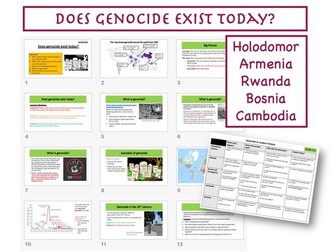
Using information sheets (provided) students will complete a table (differentiated) on the different genocides. Students will then be asked to reflect on what they have learnt;
Who is responsible for genocide?
Are other people responsible if they do not try to stop the genocide?
Why do people treat other human beings in ways like these?
What would you do if you were in a situation where a group was being targeted?
What can we do to stop genocide from happening in the future?
This can open up some fantastic and thoughtful discussions.
I use this lesson after teaching the Holocaust, as often I find other genocides tend to be forgotten about in the curriculum.
All resources needed are included - please consider teaching this important lesson! Feedback is welcome.
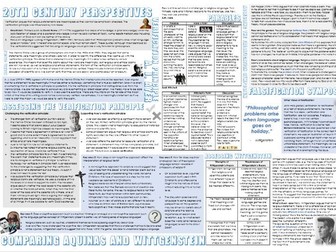
This is a learning mat indented for independent study or revision for the topic of Philosophy of Religion: 20th Century Perspectives, as part of the OCR AS/A Level specification, although it can be applied across specifications. Document can be downloaded as an A3 Word document and as an A4 PDF, for compatibility.
Resource Includes:
Vienne Circle
A J Ayer
Verification Principle
Falsification Principle
Aquinas on Language
Wittgenstein
Popper
Hare
Flew
Mitchell
Created with the OCR RS AS/A Level in mind, though can be applied across specifications and qualifications.
Please give feedback! I am always happy to respond to comments - whether positive or constructive - this will help to improve the quality of my resources in the future and, more importantly, the quality of pupils’ RE/RS education in general - which is what we’re all here for!
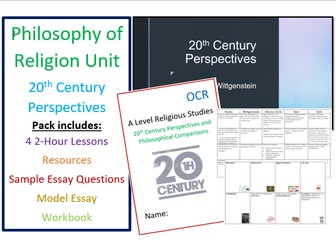
This is a unit of 4 two-hour lessons for the OCR unit on Philosophy of Religion: 20th Century Perspectives. Lessons cover a variety of tasks, activities and learner styles, geared towards the final exam.
FREE with this unit - 29 page Unit Workbook for revision and self-study
Lessons are:
Verification Principle
Falsification Symposium
Wittgenstein (Language Games)
Comparing Aquinas and Wittgenstein / Model Essay
Each lesson also includes assessment of the arguments proposed and an essay-style question for discussion and development.
Please give feedback! I am always happy to respond to comments - whether positive or constructive - this will help to improve the quality of my resources in the future and, more importantly, the quality of students’ Philosophy education in general - which is what we’re all here for!
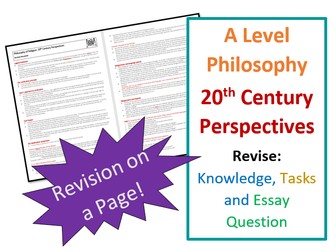
This resource is for revision and exam preparation. It is based on the topic-by-page programme I do with my students.
Each topic comes with knowledge (AO1), questions to develop understanding (AO1), questions to develop analysis and evaluation (AO2) and an essay-style question.
This resource is indented for the OCR AS/A Level specification, although it can be applied across specifications using alternative marking schemes.
Please give feedback! I am always happy to respond to comments - whether positive or constructive - this will help to improve the quality of my resources in the future and, more importantly, the quality of pupils’ RE/RS education in general - which is what we’re all here for!
This comprehensive revision pack provides clear, concise, and student-friendly summaries for every topic in the OCR A-Level Philosophy of Religion component. Perfect for revision, consolidation, and exam preparation, these resources help students master the key content with confidence.
Topics Covered
Each summary sheet focuses on the essential ideas, scholars, and arguments for:
Ancient Philosophical Influences
Soul, Mind and Body
Arguments from Observation
Arguments from Reason
Religious Experience
The Problem of Evil
The Nature and Attributes of God
Religious Language
20th Century Perspectives
Why Students Love These Resources
Concise, easy-to-digest outlines of every key topic
Clearly structured with scholars, key terms, and evaluative points
Ideal for quick revision, recap lessons, or essay planning
Supports independent study and boosts confidence before exams
Proven Impact
Used successfully to support high attainment and consistent ALPS 1–2 outcomes in A-Level Religious Studies, these revision outlines are a must-have for both teachers and students aiming for top grades.
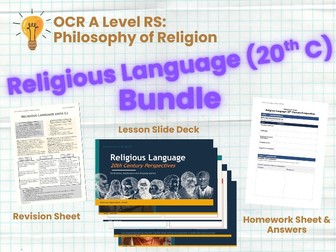
A complete topic resource pack for Religious Language: Twentieth Century Perspectives, part of the OCR A Level Religious Studies Philosophy of Religion component (H573/01), Section 6.
The slide deck works equally well as a standard lesson or a focused revision session, covering the content students need for the exam before moving into activities designed to consolidate and stretch their thinking. Resources are designed to make learning interactive, purposeful, and enjoyable — giving students the best possible chance of achieving the grades they are capable of.
Includes:
A 60-minute lesson slide deck (PowerPoint) structured around a Hook → Build → Challenge → Apply arc, with AO1 and AO2 explicitly mapped throughout. Content covers Ayer’s verification principle, Flew’s falsification challenge, Hare’s blik, Mitchell’s response, and Wittgenstein’s language games and forms of life
A homework sheet covering key term definitions and an evaluation task
A homework answer sheet
A comprehensive one-page revision sheet covering key thinkers and concepts, core content, AO2 debates with arguments for and against, and exam practice questions
Fully aligned to the OCR H573/01 specification and levels of response mark scheme.
For the complete Philosophy of Religion pack — including all nine topics plus a bonus essay planning template and grading criteria summary — please see the full bundle listing in my shop.
Resource packs for Religion and Ethics (H573/02) and Developments in Christian Thought (H573/03) are in development and will be available in due course.
This lesson pack is designed to cover the OCR New Spec requirements for teaching A2 Religious Language: Verification, Falsification and Language Games in 8.00 teaching hours. It includes all worksheets and activities and are downloadable immediately.
What makes these unique?
I currently teach around 100 R.S A level students, with up to 26 mixed ability students in a class. This is how I cover the spec in the tight time frame we have. There is also a power point, which can be viewed on YouTube or purchased separately, that complements this lesson pack. There are no bells and whistles, no activities that take hours to prepare or a physics degree to understand. Why? Because as a full time teacher, battling a new spec, there is no time.
Once downloaded they are yours to keep and adapt for your students as necessary.
Tried and Tested!
This power point is designed to cover the OCR New Spec requirements for teaching A2 Religious Language: Verification, Falsification and Language Games.
What makes this unique?
I currently teach around 100 R.S A level students, with up to 26 mixed ability students in a class. This is how I cover the large amount of content required by the new spec in the tight time frame we have. There is a lesson pack with worksheets and activities, which can also be purchased, that complements this power point. The power point and lesson pack are designed to cover the spec within 8.00 contact hours.
Once downloaded this power point is yours to keep and adapt for your students as necessary.
Tried and Tested!
This is a guided reading sheet aimed at A-level OCR Developments in Christian Thought and the unit on Gender and equality.
It useful to support student knowledge, checking understanding, revision or independent study.
This one is on Family life in 20th Century
This is a challenging set of 21 research questions for a 20th Century American History class studying the decade 1950-1959. It has a strong focus on events during the Cold War and the American Civil Rights Movement.
The questions are organized chronologically. Here is what is GREAT about this assignment: it's fully customizable! For instance, you might use only 10 of these questions instead of the 21 in the packet. You might choose 5 of the questions and ask students to conduct in-depth research for a full-length report. The possibilities are endless!
I decided to make a research assignment that required strong critical thinking skills and better research skills and - above all - taught an appreciation for 20th Century American history.
This set of notes is ideal for CCEA A2 Music students studying the New Directions in 20th Century Music option. These notes focus on Steve Reich, his background, his mastery of minimalism, his innovation and his importance. (contains examples of scores).
This set of notes is ideal for students studying the 20th Century Music. These notes focus on Steve Reich, his background, his mastery of minimalism, his innovation and his importance. (contains examples of scores).
looked on internet tonight to find the address of my friend Professor John Hick, to send him an invitation to A Moment's Peace although I know he may not be able to travel that far. When I saw him last - about a year ago, his back was bad and restricting his travelling.
Instead of finding the address I found this obituary. It will be useful, interesting and inspiring to look at with G and T KS4 and with KS5 pupils.
I also include an outline of a conversation we had with him when I took our A'level students to ask him about Death and the Afterlife in Christianity.
A set of knowledge organisers for A-Level Religious Studies focusing on the philosophy strand. They have been designed for the OCR specification but are likely appropriate for other exam boards too.
The knowledge organisers cover the whole OCR philosophy specification:
Plato and Aristotle
Soul, Mind and Body
Arguments from Observation - Teleological and Cosmological
Arguments from Reason - Ontological
Problem of Evil
Religious Experience
God’s Nature
Religious Language 1 - Negative, Analogy and Symbol
Religious Language 2 - 20th Century Perspectives
They cover the AO1 content needed, such as Aquinas’ fifth way and Paley’s watch; Anselm’s ontological argument and Gaunilo’s criticisms; the theory of the forms; the debate between God being eternal or everlasting; the various ideas in the Falsification Symposium; Augustine’s theodicy vs. the soul-mkaing theodicy, and much more! They each cover every part on the content section of the specification in a good level of detail.
A great revision tool for students about to approach exams or to consolidate knowledge of a unit.
These would make brilliant posters and also work very well on a phone screen to share with students!
If you like these, please leave a review and happy teaching!
These are very condensed and concise revision notes, useful to easily remember and quick to learn, with the information to write an A* essay on any question on the given topic. These notes were invaluable to my revision and attaining an A/A* in Religious Studies. The knowledge in these revision notes are sufficiently detailed and have are able to fill the scope/demand of any essay question within the topic.
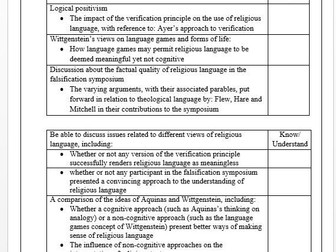
These notes contain detailed information of all aspects of verification (Ayer and Vienna Circle with opposing critics and alterative views), falsification (all contributors to Symposium) and Wittgenstein with a non-cognitive analysis (Don Cupitt) and Cognitive analysis (D.Z Phillips).


 Quick View