An original and humorous class assembly script based on the Ancient Greeks including such characters as Zeus, Hercules, Athena, Medusa and Odysseus! Includes around 20 speaking roles, although ‘CH’ (short for child) lines could be easily stretched to a class of 30.
Also includes all music files for appropriate class songs and character entrance music suggestions and a PowerPoint presentation slide if needed.
Your Assembly will include;
Full script, suitable for up to 30 children
PowerPoint Presentation slide, to use as a background picture to the assembly
Sound effects/excerpts for character entrances (battle sounds, Chariots of fire excerpt, Zero to Hero excerpt, Friend in Me excerpt)
Assembly Songs for the class to sing;
- Respect, Aretha Franklin
- Go the Distance, from the Disney film ‘Hercules’
An overview timeline of Ancient Greece and Rome on one slide to help contextualise key events in the ancient world.
Download includes and editable PPTX file which can be added into PowerPoint presentations and adapted to the needs to the class. It also includes a printable PDF file which can be a useful reference resource for pupils to refer back to.
This resource was originally created to support the GCSE Classical Civilisation course so might not have all of the events that you require for your course. Furthermore, some of the dates are debated, so adapt as you see fit.
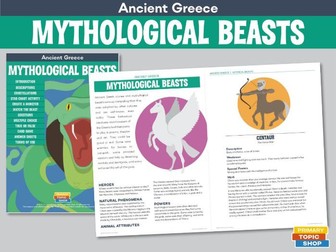
In this lesson, students learn about Greek mythological creatures. Twelve of the main Greek beasts, creatures and monsters are explored in listings, Centaur, Cerberus, Chimera, Cyclops, Harpy, Hydra, Medusa, Minotaur, Pegasus, Phoenix, Satyr and Siren. Each listing features an original illustration, facts and a short myth. The introduction includes interesting facts about ancient Greek mythological beasts including heroes, natural phenomena, animal attributes and powers. There is also a page exploring three constellations named after mythological beasts. Activities include differentiated reading response, create a monster activity, match the beast activity, constellation task cards and a printable memory card game.
Pages: 38 (including 7 answer sheets)
Contents:
12 Illustrated Listings
Research a Beast Activity
Constellation Page
Constellation Task Cards
Star Charts
Create a Monster Activity
Match the Beast Activity
Printable Memory Card Game
Questions / Multiple Choice / True or False (Differentiated Reading Response)
Questions or comments? Contact me at admin@primarytopicshop.co.uk
All text and illustrations are by Christa Galloway, Primary Topic Shop.
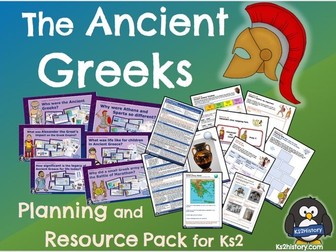
Ancient Greeks: 10 lessons for KS2
A fully-resourced unit of 10 history lessons for KS2, covering the Ancient Greece topic.
What you get:
10 lesson Powerpoint files
10 detailed lesson plans
Teachers’ notes, including curriculum coverage
Pupil activity sheets for all lessons
About the Unit
The ten sessions in this unit aim to give an overview of life in Ancient Greece, including a focus on its achievements and influence on the western world. As with all of the KS2History unit plans, there is an emphasis on allowing pupils to consider the sources of evidence that form our understanding of this period of world history.
Aims of the Unit
To gain an overview of significant people, places and events from Ancient Greece
To contrast daily life in Ancient Greece with modern day lifestyles ! To consider broader historical context, particularly with regards to the expansion of the Ancient Greek empire and lasting legacy
To become familiar with historical sources, debates and accurate vocabulary relating to Ancient Greece
Lessons in the Pack
Who were the Ancient Greeks?
Why were Athens and Sparta so different?
What was Alexander the Great’s impact on the Greek empire?
Why did a small Greek army win the Battle of Marathon?
What were the Ancient Greek gods known for?
What happened at the Ancient Greek Olympic Games?
What were the Ancient Greek philosophers famous for?
Did the events of the Trojan Horse story really happen?
What was daily life like for children in Ancient Greece?
How significant is the legacy of Ancient Greece for life today?
This pack contains everything you need to teach this unit, including differentiated activity ideas so that it can be adapted to the needs of your class. The Powerpoint text is also editable.
This pack is brought to you from Ks2history
For your class assembly or project on Ancient Greece.
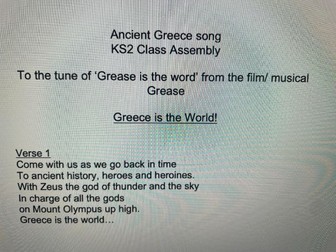
Words written by me and set to the tune of ‘Grease is the word’ from the film/ musical Grease.
Verse 1
Verse 2
Chorus
Verse 3
Chorus
Bridge
Song can be stopped after the bridge or repeat the first verse.
This is a 6 lesson art unit teaching printmaking. It is linked the the text Mythologica by Victoria Topping so fits in really well when children are learning about ancient Greece.
The unit includes:
-Studying/comparing artworks
-Sketching lesson
-Learning about printing blocks and how to make them
-Printing
-Embellishing
-Reflecting
Resources include:
-Planning
-Worksheets
-In depth powerpoint
-Teacher ‘cheat sheet’ on artworks
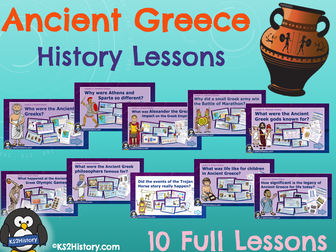
Download our popular Ancient Greece lesson planning bundle containing 10 full lessons.
This resource contains a bundle of history lessons for KS2 (ages 7-11) that make up a complete unit covering the Ancient Greece topic. Each file contains a detailed lesson plan, Powerpoint slides and printable activity sheets.
The planning pack covers the following lessons:
Who were the Ancient Greeks?
Why were Athens and Sparta so different?
What was Alexander the Great’s impact on the Greek empire?
Why did a small Greek army win the Battle of Marathon?
What were the Ancient Greek gods known for?
What happened at the Ancient Greek Olympic Games?
What were the Ancient Greek philosophers famous for?
Did the events of the Trojan Horse story really happen?
What was daily life like for children in Ancient Greece?
How significant is the legacy of Ancient Greece for life today?
These lessons are written for KS2 and are aligned to the National Curriculum in the UK but can be easily adapted to other curriculums too. The lesson plans include differentiation ideas to adapt the activities for the needs of your class.
This bundle is brought to you by KS2History.
This clear, detailed and visually-appealing resource offers a complete reference point for students learning or revising knowledge relating to the Ancient Egyptians. It contains comprehensive sections on:
Ancient Greece map (annotated);
Ancient Greek Gods;
Ancient Greece timeline;
Ancient Greek people;
Ancient Greek places;
Ancient Greek daily life.
The resource is designed to be printed onto A3, and is provided as both a PDF and a Word version (so that you can edit if you want to). All images used are licensed for commercial use and are cited on a separate document (included). It is most suitable for children in KS2 and KS3.
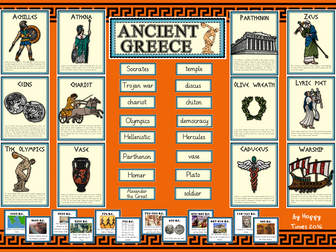
Everything you need for a display on Ancient Greece.
* Header (can be enlarged or printed as A3)
* 12 posters with short descritptions
* 12 Ancient Greece timeline cards (2 per page)
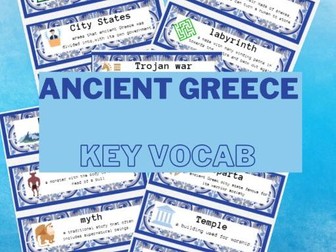
* 60 Keywords (not all shown)
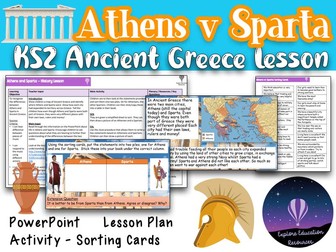
Fully resourced lesson plan, PowerPoint and sorting activity | Ofsted-rated Outstanding
This Athens and Sparta lesson is perfect for teaching children in KS2 about the key differences between these two powerful city-states of Ancient Greece. Ideal for history units, formal observations, or interview lessons, this resource uses engaging visuals, discussion, and active learning to promote historical understanding and comparison skills.
Originally used as an Ofsted observation lesson, this pack is designed to be flexible, inclusive and memorable.
What’s included:
✔ Detailed lesson plan with clear learning objectives and plenary discussion prompts
✔ PowerPoint presentation with visuals and facts to hook and guide pupils
✔ Athens vs. Sparta sorting cards (standard and lower ability versions included)
✔ Clear differentiation built into the main activity
✔ Plenary reflection questions to assess understanding and encourage discussion
Lesson focus:
To understand key differences between Athens and Sparta
To compare and contrast lifestyles, values and priorities of each city-state
To develop historical thinking and express personal viewpoints through discussion
Why it works well:
✔ Designed for observations, interviews or curriculum lessons
✔ Supports collaborative learning and class discussion
✔ Easy to differentiate with pre-prepared support materials
✔ Helps pupils form opinions based on historical evidence
✔ Links well with broader KS2 topics on Ancient Civilisations and Democracy
Perfect for:
KS2 History lessons
Year 4, Year 5 or Year 6 interview or observation
Ancient Greece topic units
Cross-curricular English links through discussion and persuasive argument
Group tasks and mixed ability classwork
Also available:
Looking for a full topic sequence? Try the complete Ancient Greece Unit:
KS2 Ancient Greece Unit - 7 Outstanding Lessons
Search terms: Ancient Greece KS2 | Athens vs Sparta | KS2 history interview lesson | Ofsted history lesson | Year 5 history | city states Ancient Greece | comparison activity history | Ancient Greece for children | Ancient Civilisations KS2 | Sparta vs Athens
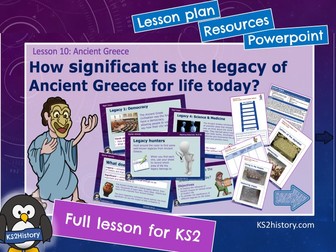
A lesson for KS2 about the lasting legacy of Ancient Greece, including a detailed lesson plan, Powerpoint and printable activity sheets.
This lesson is part of our popular Ancient Greece Pack for Key Stage 2.
Lesson: How significant is the legacy of Ancient Greece for life today?
In this lesson, pupils will explore some of the key legacies from Ancient Greece that influence life today. They will consider the significance of each legacy in terms of its impact on their own life, before working in a group to complete a ranking challenge to decide the most significant legacy.
Objectives:
To explore the influence of Ancient Greece on various areas of modern life
To consider the significance of different legacies on life today
You may also like:
Ancient Greeks Lessons Pack for KS2: A fully-resourced unit of 10 history lessons for KS2, covering the Ancient Greece topic.
This primary history resource has been created by KS2History.
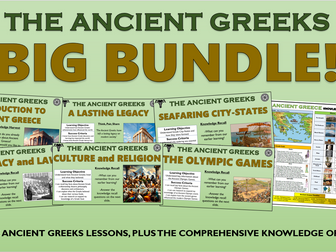
THIS ANCIENT GREEKS BIG BUNDLE CONTAINS ALL OF THE ANCIENT GREEKS LESSONS, PLUS THE DETAILED, VISUALLY-APPEALING KNOWLEDGE ORGANISER.
The engaging and purposeful series of lessons has been designed to enable children to gain develop an in-depth understanding of Ancient Greece. There is a particular focus on the achievements of the Ancient Greeks and how these have influenced the world.
Children are guided towards answering the enquiry question: ‘How have Ancient Greek achievements influenced the world?’
The lessons included are:
Introduction to Ancient Greece
Seafaring City-States
Democracy and Law
The Olympic Games
Culture and Religion
A Lasting Legacy
In each lesson, the learning is guided by a clear and colourful PowerPoint presentation, which guides students through the step-by-step learning journey. Also included are all worksheets, templates and additional resources required to teach the lessons - everything needed to teach is included.
In the past, I have used these lessons with children in lower KS2 (years 3 and 4), however this was an advanced class and these resources could easily be used with upper KS2. The key learning is aligned with KS2 curriculum expectations for history. All images are licensed for commercial use.
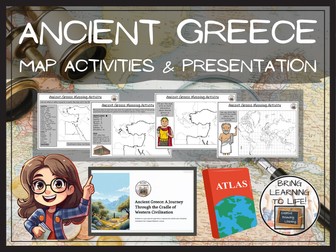
Explore the Ancient World with our Ancient Greece Mapping Activities!
Step into the incredible early civilization with this engaging Ancient Greece Map Activity and Teacher Presentation! Designed for Year 3 through to Year 6, this hands-on resource brings history and geography to life. Students will explore the ancient lands of Greece and beyond, uncover the secrets of cities like Athens, Sparta and Delphi, and trace the mighty empire.
This comprehensive resource includes:
Modern and Ancient Maps to connect past and present.
Interactive Mapping Tasks that encourage research and critical thinking.
A focus on key geographic features like seas, cities, and countries.
A wordsearch puzzle to reinforce vocabulary and historical knowledge.
A detailed Teacher Presentation to guide learning.
Aligned with the curriculum and perfect for topic, geography, and history lessons, this activity fosters skills like map reading, research, and spatial awareness. It’s ideal for homeschooling, classrooms, and history enrichment programs.
Engage your students with this exciting and educational journey into one of the world’s most influential ancient civilizations! Download now and inspire a lifelong love of history and geography!
⎻⎻⎻⎻⎻⎻⎻⎻⎻⎻⎻⎻⎻⎻⎻⎻⎻⎻⎻⎻⎻⎻⎻⎻⎻⎻⎻⎻⎻⎻⎻⎻⎻⎻⎻⎻⎻⎻⎻⎻⎻⎻⎻⎻⎻⎻⎻⎻⎻⎻⎻⎻⎻⎻⎻⎻⎻⎻
This resource is great for:
In class learning
Independent work
Homework
Guided reading sessions
Assessment practice
Reading interventions
Emergency sub plans
⏚⏚⏚⏚⏚⏚⏚⏚⏚⏚⏚⏚⏚⏚⏚⏚⏚⏚⏚⏚⏚⏚⏚⏚⏚⏚⏚⏚⏚⏚⏚⏚⏚⏚⏚
For more great resources follow my store ⇉⇉ CLICK HERE
A worksheet to be filled out alongside a video game, Assassin’s Creed Odyssey.
.
.
.
Australian Curriculum - Stage 4 - Depth Study 2: The Mediterranean World - Topic 2b. Greece
Syllabus dot points covered
Roles of key groups in the ancient society, including the influence of law and religion (ACDSEH032, ACDSEH035, ACDSEH038)ACDSEH003, ACDSEH004)
—>describe the geographical setting and natural features of the ancient society
—>explain how the geographical setting and natural features influenced the development of the society
Roles of key groups in the ancient society, including the influence of law and religion(ACDSEH032, ACDSEH035, ACDSEH038)
—>describe the everyday life of men, women and children in the ancient society
Contacts and conflicts within and/or with other societies, resulting in developments such as the conquest of other lands, the expansion of trade and peace treaties (ACDSEH034, ACDSEH037, ACDSEH040)
—>identify contacts and conflicts of peoples within the ancient world
describe significant contacts with other societies through trade, warfare and conquest
.
.
.
If you have any questions about this product or using this product, we are continuously seeking to improve the quality of our materials. Every effort has been made to make this unit error-free. Should you find any errors, please contact us via email at mrmsmohistory@gmail.com and we will ensure that you receive a corrected copy. Your feedback is greatly appreciated.
.
.
.
Keywords: Ancient Greece, Sparta, Thebes, Athens, hoplites, Delphi, Artemis, Artemis Orthia, acropolis, Spartans, Poseidon, Hephaistos, agora, Piraeus, port, Aspasia, Herodotus, Adrestia, Thermopylae, sanctuary, Apollo, Delian League, Peloponnesian League, polis, poleis
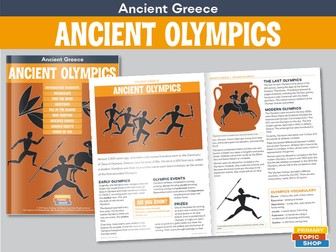
Original illustrations accompany this lesson which covers the early Olympics, Olympic events, prizes, the last ancient Olympics, modern Olympics and vocabulary. There is a vocabulary activity, differentiated reading response activities and an art activity.
Pages: 11 (including 3 answer sheets)
Contents:
Two Information Handouts
Find The Word Activity
Reading Response Questions
Multiple Choice
Fill in the Blanks
Design a Vase
Questions or comments? Contact me at admin@primarytopicshop.co.uk
All text and illustrations are by Christa Galloway, Primary Topic Shop.
A ppt (including differentiated activity printouts) that gives an overview to where modern day Greece is located, the make up of the land and climate. It then includes major cities and reference points of ancient Greece. (All images/maps sourced via Google images) This is for KS 2 and has supported a Year 5 introduction to ancient Greece, alongside timeline lessons and more general introductions.
Who were the ancient Greeks? This cloze activity can be used as an extra resource when teaching the topic Who were the ancient Greeks? Children read the sentences and fill in the missing words from the word bank.
This resources are focused on learning about children's lives in the city states of Athens and Sparta in Ancient Greece and the Greek Gods and Goddesses. Feel free to chop and change to suit your class!


 Quick View