A lesson created for KS3 middle ability class which can easily be adapted to KS4 Geography. Examines the different landforms that form from coastal deposition including: beaches, spits, bars and tombolos. Includes a recap starter on constructive, destructive waves and on some of the coastal erosion landforms. Activity worksheet created to be completed in sections throughout the lesson before pupils have the choice of postcard to complete activity. Lesson ends with a plenary in which pupils must decide whether the photograph shows features that have formed from coastal erosion or deposition.
IGCSE Cambridge
Theme 2: Natural Environment - Coasts
L3: How Do Coastal Depositional Landforms Form?
Lesson 1 FREE:
This SoW is designed in detail and is both differentiated and engaging and allows you to move pupils through content efficiently. As a result, lessons can take around two periods to deliver and are sequenced to flow through this period comprehensively.
Made to the highest standard and constructed using current research, both dual coding and retrieval practices are at the heart of this unit. A colour scheme also runs throughout to ease both your delivery and students’ comprehension.
Theme 2: Natural Environment - Coasts
L1: How Do Waves Shape the World’s Coastlines?
L2: How Do Subaerial Processes and Erosion Shape Coastal Areas?
L3: How Do Coastal Depositional Landforms Form?
L4: How does Erosion Create Coastal Features?
L5: How do Sand Dunes Form on the Coast?
L6: How do Coral Reefs form?
L7: What Benefits do Mangrove Forests Bring?
L8: How Does Coastal Management Reduce Erosion?
Any question please do feel free to get in contact:
teachercentralltd@gmail.com
Best FREE Resources (The Geography Shop)
https://www.tes.com/teaching-resource/-12899088 (Climate Change SoW)
https://www.tes.com/teaching-resource/-12899440 (Development SoW)
https://www.tes.com/teaching-resource/-12638984 (Waste SoW)
https://www.tes.com/teaching-resource/-12451443 (Britain Globalisation SoW)
https://www.tes.com/teaching-resource/-12741793 (Local Area Investigation SoW)
https://www.tes.com/teaching-resources/bundler/12949461 (Cambridge International)
https://www.tes.com/teaching-resource/-12922653 (Israel & Palestine)
https://www.tes.com/teaching-resource/resource-12485457 (What is Geography?)
I hope you find this SoW useful. If you have, I have created a series of resources.
This resource relates to the AQA specification for GCSE (UK) exams from 2018 onwards. In this short lesson, pupils look at prompt images and try to think of reasons why the sediment has been deposited. A simple experiment is then used to highlight how energy influences deposition.
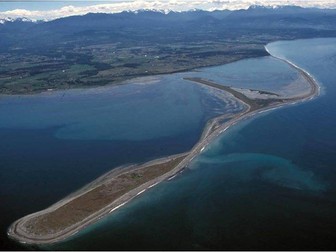
A fully-resourced lesson looking at the landforms created along the coast due to deposition and transportation. This lesson covers longshore drift, beaches, a big focus on the formation of spits as well as acknolwedging the formation of bars and tombolos too. This is primarily designed to be delivered to KS4 but could easily be used in a KS3 coasts lesson.
Landforms along the coast that form as a result of deposition include beaches, spits, bars, salt marshes and sand dunes. This differentiated grid has a higher and middle ability version to allow students a head start if they need it. The sheet is deisgned to be used with ICT / internet so students can follow the weblinks on the sheet to get the required information of landform characteristics and and how they form. This would make an ideal revision/ intervention task for paper 1 ’ UK Physical Landscapes’.
'What landforms are created by coastal deposition?' - A visual lesson used to help students describe and explain the depositional features found at the coastline (spit, bar, salt marsh). Enables students to access more 'remote' or complex ideas and the lesson includes:
1. Early discussion - spits, bars, LSD
2. Video - LSD and deposition
3. Moving image - how spits are formed
4. Multiple choice plenary
This lesson teaches students about the formation of Bars and Spits.
Students learn how Bars and Spits are formed via a worksheet, video and teacher talk.
2 x lessons designed for 50 minutes to 1 hour of teaching. Originally made for the new GCSE AQA A Geography module Physical Landscapes in the UK. Covers erosional processes, landforms, types of coastline, beaches, spits.
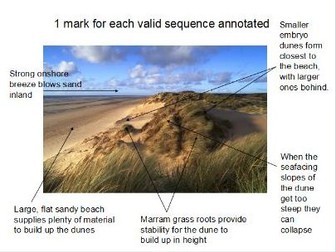
A full lesson which can be done with internet research or with textbooks/ revision guides. Student are introduced to a range of landforms and must summarise their formation onto a worksheet grid with links to relevant sites. A detailed annotation task of sand-dunes is included.
Hi,
This is the fifth in a sequence of lesson written for the AQA Section C Coasts topic.
All resources are included.
See my bundle for discount on full sequence.
Scheme of work on coasts made for year 8 but could work for any ks3 class. Lessons based on Hodder’s KS3 Progress in Geography textbook. Includes fully resourced lesson which could be taught by a non-specialist. Can be bought as part of a bundle for the whole SOW.
L1- What are coasts?
L2- Weathering and geology
L3- Erosion
L4- Erosional landforms
L5- Transportation
L6- Deposition
L7- Holderness
L8- Coastal management
Assessments and mark scheme
Various resources from a Year 8 topic on Coasts (but could be adapted for any KS3 Geography class). Included are PowerPoint presentations (with diagrams, photos, links to animations and questions) on landforms created by erosion/deposition. Also included are two worksheets: the first is a quick starter where students need to match up the processes of erosion with the description; the second is a homework task on erosion, where students have to provide longer responses.
Lesson on the processes of transportation and deposition at the coastline. Aimed at high ability year 8 students and therefore easily adaptable for year 9. Includes a detailed lesson plan and presentation (with notes under slides).
Lesson Summary: Coastal Transport and Deposition
This lesson focuses on how material moves along the coastline and how it is eventually deposited to form coastal features. It builds on prior knowledge of coastal processes such as erosion, transportation, and deposition, and emphasises how these processes work together as part of a coastal system.
Students begin with a starter activity to review key terminology (e.g. erosion, attrition, hydraulic action) and consider factors that influence erosion rates, such as rock type, wave energy, and human activity.
The main part of the lesson introduces coastal transportation, explaining how sediment is moved by waves, tides, and currents. Students learn the four types of transportation:
Traction
Saltation
Suspension
Solution
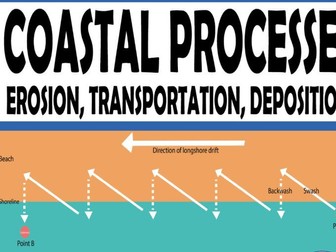
A key focus is longshore drift, including:
How waves approach the beach at an angle
The role of swash and backwash
How sediment is moved along the coast
The impact of longshore drift on beach formation and the use of groynes
Students complete diagram-based tasks to reinforce understanding of these processes.
The lesson then explores deposition, explaining:
When and why material is deposited (low-energy environments)
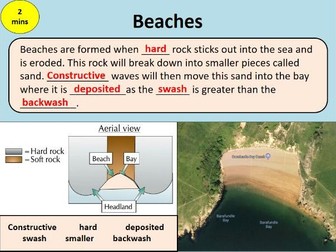
How beaches form when swash is stronger than backwash
Landforms created by deposition, such as sand dunes, spits, and salt marshes
Finally, students apply their knowledge through field sketching and written tasks, including identifying the direction of longshore drift and summarising how deposition occurs.
This lesson looks at how the coast transports it load (Longshore drift) and then explains the depositional features that have been created from this (Spit, tombolo, bar, beach). It finishes off by looking at a past examination question based on this.


 Quick View