Scheme of 5 x 100 minute lessons (if you have 50 minute lessons, this could split across 10-12 lessons).
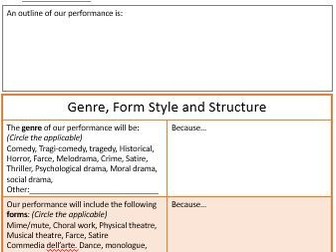
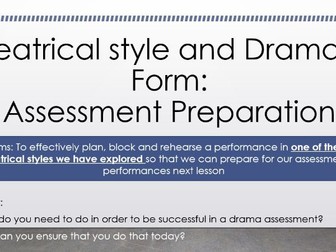
KS3 drama scheme of work focused on Theatrical Style and Dramatic Form including the following styles: Melodrama, Pantomime, Butoh and Clowning. The 5th lesson is an assessment preparation lesson where students pick their favourite style and perform according to an assessment brief and a title given to all styles.
All can be adapted to suit your needs.
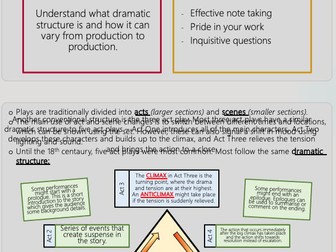
An accessible guide to dramatic structure in theatre, covering acts and scenes, plot, conflict, climaxes, resolution, subplots, and different structural forms (three-act, episodic, cyclical, one-act, linear and non-linear). Uses clear explanations, playwright examples, and finishes with a structured quiz and answer key.
MP3 audio files on J. B. Priestley's An Inspector Calls. Dramatic Style: Dramatic Irony, Exits & Entrances, Lighting and Stage. Forms part of the TES English collection on the text. Directions.SPOILER ALERT. All of the audio files contain information that might spoil students’ enjoyment of the play.
Click &'Play&'; to launch the MP3 player.
Hello All,
Within this resource you will be able to access a practical Dramatic Elements SoL with:
1 x SoL
9 x Fully prepared PowerPoint lessons
2 x Assessment tasks and feedback sheet
1 x Display Poster
1 x Extended learning booklet
All handouts that go with the lessons.
Within this unit of work, students will learn about the fundamental dramatic elements needed for any performance. They will focus on building their use of the elements and working independently and in groups to create performances. Moreover, it introduces students to writing about the use of key physical and vocal skills. This unit of work furthermore builds each student’s confidence and enjoyment in performing and shows them how to use their performance space effectively to get the most out of each rehearsal and session.
My resources have been published by National Drama the UK’s leading national professional association for drama teachers and I am apart of the core team of drama matters. I hope you enjoy this resource and if you need any assistance with it, please feel free to contact me.
Regards,
Ryan
There are two 40-45 min lesson plans included. This workshop aims to explore the relationship and integration of the body and mind through imagination and concentration thus strengthening both the physical and mental instruments in a valuable way. One of the functions of movement within drama is to help achieve complete mastery of one’s physical self, which includes the emotional wellbeing of the body and so through these activities, learners will explore the senses and functions of the physically body in a creative and challenging way.
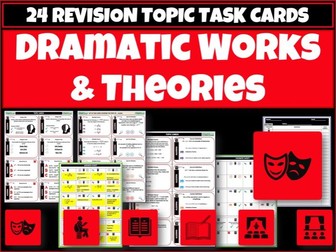
These 24 Dramatic Works and Theories task cards are perfect for your Drama (or English) lesson plans and topic. They are suitable for secondary students. They feature different activities including knowledge retrieval practice, multiple choice and spot the mistakes amongst other Drama related activities.
Contents of Drama Knowledge Retrieval Topic Task Card bundle
1 x Set of 24 Different topic Task Cards with a range of activities and styles in editable and PDF versions
1 x Teacher answer sheet - All answers covered
2 x Student fill in activity sheets that can be used with the cards (optional)
Each topic task card is matched to the theme of the set and includes numbering and answers designed by our Drama specialist . Can be printed in colour or black and white.
How to use Knowledge Retrieval Topic Task Cards?
These cards are perfect as an extension task, starter or plenary and as a means of testing knowledge upon completion of a unit. For a short task (extension/starter/plenary), you can simply give them one or two cards and differentiate which cards are given according to the students level or their areas needing improvement. For an end of unit, you could hand the cards out to different groups and have them switch the cards after a certain period of time (e.g. one group gets multiple choice, one group gets spot the mistakes, one group gets photocards, etc.).
Benefits of using this new style of T&L activity
Set of retrieval activities
Motivating for students
Bitesize English tasks
Fun way to revise a topic
Allow for differentiation
Copy, cut and laminate – use over and over again
Versatile and can be used in many different ways
If you leave a nice review to email us at thecre8tiveresources@gmail.com for a Drama treat for your students Product code C8/TS/109
You may want to check out some of our other great DRAMA resources:
Dramatic Works and Theories
Christmas Drama Escape Room
Stage Production
Drama Christmas Bundle
Greek Theatre
Top Selling Drama Escape
Twelfth Night
Why is reading Important Assembly
Set sail for adventure with this exciting Pirates Dramatic Bundle for Kids, combining a fast-paced 15 to 20 minute adaptation of Treasure Island and a swashbuckling tale of a bumbling crew, with a collection of engaging pirate-themed monologues designed especially for young performers.
This bundle offers both structured performance material and flexible teaching resources, making it ideal for KS1/2 drama lessons, literacy links, Pirate themed days, or school productions.
Examples of dramatic devices used in Romeo & Juliet with reasons why these devices are used by Shakespeare. An opportunity for students to research further and gain their own insights.
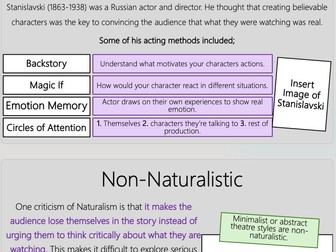
An accessible overview of major theatre styles, exploring how different styles influence acting, design, and audience engagement. Covers a range of styles such as naturalism, realism, epic theatre, physical theatre, and more. Students learn key characteristics, intentions of practitioners, and the impact of style on performance. Includes clear explanations, examples, and tasks to support understanding and exam preparation.
This introductory set of 3-4 lessons covers an introduction to the KS5 A Level Literature text ‘A Streetcar Named Desire’. It includes a contextual background with notes on the author and links to the play, and a comprehensive study of dramatic form (expressionist, naturalist and Williams’ ‘Plastic’ theatre styles). A great way into the study of this play from an analytical viewpoint.
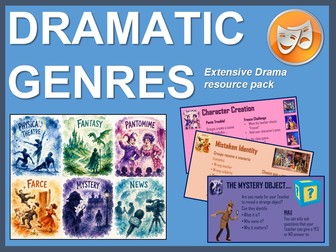
Take your pupils on an exciting journey through six engaging and highly practical drama genres with this detailed Dramatic Genres scheme of work. This unit introduces learners to a variety of theatrical styles while developing the fundamental skills required to become confident, creative, and collaborative performers.
Each lesson focuses on a different genre and includes engaging practical activities, discussion opportunities, performance tasks, and reflection exercises. The lessons have been designed to maximise participation and encourage pupils to explore drama through movement, characterisation, storytelling, improvisation, and communication.
All lessons come complete with detailed powerpoints and supporting resources, so no planning is needed and you are ready to go!
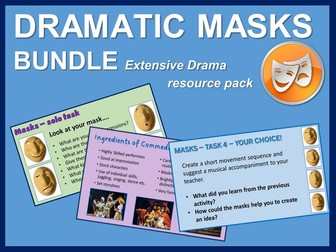
Do you have some masks in your Drama department that you feel are currently collecting dust and not getting the use that they could??
Here is a MASK bundle to provide inspiration, ideal for Year 5-9 classes, which offers the chance to explore a wide variety of techniques and opportunities.
Having Fun With Masks (Years 5-7)
Greek Theatre (Years 6-8)
Commedia D’ell Arte (Years 7-9)
This extensive tried-and-tested bundle includes:
Lesson Powerpoints
Schemes of work
Lesson plans
Assessment criteria levels
Cover lesson activities
Unit Overviews
Assessment Guides
106 slides containing (at least) 18 lessons of socially distanced Drama, ready for the new school year. It covers 10 Dramatic Devices commonly used in Theatre, using a variety of different stories as stimuli.
Includes definitions and activities for; monologue, still image, slow motion, freeze frame, thought tracking, cross cutting, mime, narration, placards and song & dance.
Designed for Year 8, but could work with a variety of contexts. Lessons for sitting behind a desk, lessons for socially distanced practical assessments, and ideas for Distance Learning (some suggestions through-out).
Home Learning tasks suggestions included, as well as reminders for returning graded work, and prompts for where to include the Grading Criteria for each task.
Also includes 7 typed up resources to support learning, with each resource linked directly to a lesson.
50p a lesson, with enough lessons to get you to Christmas, at the earliest.
Designed to follow on from the Schemes of Work that I am creating for Year 7, the first of which is already available on TES for £12.50.
Comment if you want any specific topics covered.
A comprehensive guide to understanding what ‘Total Dramatic Effectivness’ is and how to structure live theatre answers using TDE.
What Total Dramatic Effectivness is
A description of the PET acronym
Examples of PET provided from the performer perspective, using characters from the NT production of Small Island
Further examples using a tight ‘question focus’
A 6-7 lesson scheme of work that covers a number of contrasting genres and performance styles to get students creating and re-imagining in different theatrical registers. The scheme includes musical theatre, verbatim/docudrama, satire, melodrama and physical theatre.
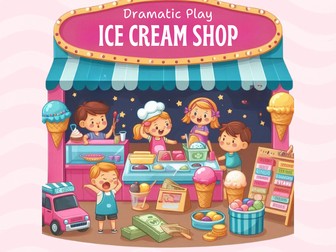
Set up a sweet adventure with this Ice Cream Shop Dramatic Play pack! Perfect for preschool, kindergarten, and early elementary classrooms. This 16-page resource includes menus, order forms, signs, labels, play money, and more to create a fun, realistic ice cream shop experience. Supports social skills, math, and language development through imaginative play. Pages are ready to print and use, sized for standard 8.5x11 inch paper. Ideal for dramatic play centers, summer themes, or special classroom events. File type: PDF. Keywords: ice cream dramatic play, pretend play, classroom centers, printable dramatic play, preschool activities.
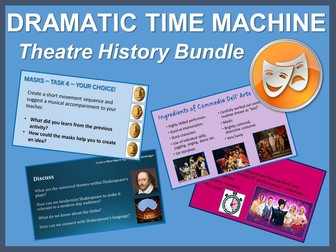
Are you looking for a fun Drama project which explores some key historical influences on theatre?
Check out this selection of schemes which include Greek Theatre, Commedia D’ell Arte, Pantomime and Shakespeare’s Romeo & Juliet.
These 4 schemes are ideal for combining into 1 larger project, offering a wide range of themes to explore and all come with detailed powerpoints, so it is good-to-go.
This extensive pack includes the following:
Powerpoints
Schemes of work
Lesson plans
Scripts
Unit overviews
Assessment criteria
Evaluation forms
Cover lesson activities
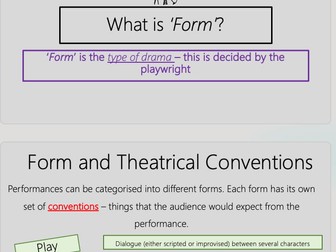
A detailed overview of theatrical form and genre, explaining the difference between the two and exploring major genres such as tragedy, comedy, melodrama, and documentary theatre. Includes key terminology (e.g. catharsis, stock characters, verbatim), historical context, examples from practitioners, and an end-of-lesson quiz with answers.


 Quick View