Economic ActivitiesQuick View
emercullen

Economic Activities

3 Resources
3 PowerPoint presentations - primary, secondary and tertiary economic activities. Each PPT has the same design and layout- easy to read and follow. Comic sans font used to facilitate students with dyslexia. Each PPT contains images, maps and 'to do' slides with exam questions. Some slides direct students to questions in their text book but this can easily be adapted to suit the class. Each PPT also available individually in my shop.
Government Intervention in Markets - A level EconomicsQuick View
ResourcifyEducation

Government Intervention in Markets - A level Economics

(0)
Comprehensive lesson containing a full presentation and worksheet. Model answers for the worksheet included The lesson outlines all the specification points of Government intervention in markets within the A level Edexcel Economics course (useful for other exam boards too) This lesson teaches the following content: Purpose of intervention with reference to market failure and using diagrams in various contexts: o indirect taxation (ad valorem and specific) o subsidies o maximum and minimum prices Other methods of government intervention: o trade pollution permits o state provision of public goods o provision of information o regulation Click on the links below to check out some of our FREE resources: Free Worksheets: Introduction to Economics Worksheet The Economic Problem Worksheet Production Possibility Frontiers Worksheet Specialisation & the Division of Labour Worksheet Types of Economy Worksheet Price Determination Worksheet National Income Worksheet Free Lessons: Introduction to Economics Lesson The Economic Problem Lesson Production Possibility Frontiers Lesson Specialisation & the Division of Labour Lesson Types of Economy Lesson Price Determination Lesson National Income Lesson We appreciate your feedback! If you found this resource helpful, please leave a review — it helps us continue creating high-quality materials. For questions, contact resourcifyeducation@gmail.com
AQA Economics A-Level diagramsQuick View
llywelynmorris

AQA Economics A-Level diagrams

3 Resources
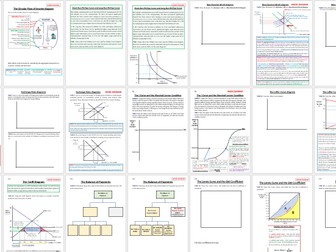
This bundle covers all the AQA Economics A-Level diagrams that students need to master. This easy-to-use document allows students to easily practice and compare their diagram against the model diagram. A true grade-enhancer of a document!
AQA GCSE Changing Economic World FULL SOWQuick View
nealxs

AQA GCSE Changing Economic World FULL SOW

(3)
An engaging, in-depth full scheme of work of 30 lessons. It includes a variety of learning tasks, videos, exam practice and interleaving of knowledge. Exemplar uploaded so that you can preview the type of content. Supported by Oxford Press textbook. Breakdown of lessons What is development? Limitations of development measures DTM Development and population Differences in development Consequences of development: inequality Consequences of development: migration The development gap Reducing the development gap: aid Reducing the development gap: intermediate technology Reducing the development gap: free and fair trade (2 lessons) Reducing the development gap: debt relief and micro finance Reducing the development gap: Tourism in Jamaica case study Exam technique Exploring Nigeria (2 lessons) Nigeria: political and global links Nigeria: TNCs Nigeria: TNC environmental impact Aid and quality of life Review UK: Changing UK economy UK: Post industrial economy UK: Science parks UK: Environmental impact of industry UK:Changing rural landscapes UK: Transport improvements UK: North-south divide UK: Links to wider world
The Urban World: Economic Opportunities in Rio de JaneiroQuick View
markthegeographer

The Urban World: Economic Opportunities in Rio de Janeiro

(0)
AQA GCSE Geography lesson for Unit 2A: In this lesson we examine how the industrial areas of Rio have provided a stimulus for economic development. We start with a retrieval practice based upon the Rio lessons previously taught. We then start by looking at the formal and informal economy. The students write the definitions but also the characteristics of each type of employment. We then look at the multiplier effect. We then look at the economic opportunities for growth and the students rate each opportunity according to how productive it is for the economy. They then explain their scoring. We then move onto using grid references to locate key economic areas of the city. This is more a skills task, but also helps the students to familiarise themselves with the layout of the city. We then look at the Ternium Steelworks at Sepetiba Bay and the students complete a highlighting task on a text extract, by looking at advantages and disadvantages of the project. We finish with 6 mark GCSE-style question and the students have some tips and guidance on how to answer it if required. Hope this saves you some valuable planning time. https://www.tes.com/teaching-resources/shop/markthegeographer
A Level Economics (A) Edexcel  Exam Technique GuidanceQuick View
mikepaulus1991

A Level Economics (A) Edexcel Exam Technique Guidance

(1)
This document explains how to approach all types of questions . I have tweaked and improved this over a number of years based on feedback from other schools and other top educational organisations . This has been a life saver for my students and all of them have a copy of it in their folders and refer to it when practising questions and preparing for exams. It explains the exact breakdown of what to do for each question type for the Edexcel Economics course (all three papers). It explains what makes a perfect paragraph, the levels for 10+ mark questions and how marks are allocated for different question types, as well as the overall paper structure for the three A Level papers. Included at the end is a good check for understanding worksheet for students to assess their own understanding of the exam requirements. I print those last two pages our regularly to reinforce this. All my students love this resource and so will yours! Happy shopping!
Economic Growth Worksheet - A Level EconomicsQuick View
ResourcifyEducation

Economic Growth Worksheet - A Level Economics

(0)
A Level Economics worksheet activity containing questions about the lesson: Economic Growth (2.1.1) Model Answers Included This is tailored for the Edexcel specification, however, the versatile nature of this resource makes it suitable for other exam boards too. This resource is designed to help students apply their knowledge to questions. This active revision technique ensures that the worksheet will be very useful for students, and will act as a vital revision tool. Click on the links below to check out some of our FREE resources: Free Worksheets: Introduction to Economics Worksheet The Economic Problem Worksheet Production Possibility Frontiers Worksheet Specialisation & the Division of Labour Worksheet Types of Economy Worksheet Price Determination Worksheet National Income Worksheet Free Lessons: Introduction to Economics Lesson The Economic Problem Lesson Production Possibility Frontiers Lesson Specialisation & the Division of Labour Lesson Types of Economy Lesson Price Determination Lesson National Income Lesson We appreciate your feedback! If you found this resource helpful, please leave a review — it helps us continue creating high-quality materials. For questions, contact resourcifyeducation@gmail.com
Demand & the demand curve (AS-level Economics)Quick View
smith_michael

Demand & the demand curve (AS-level Economics)

(0)
AS Microeconomics lesson (Edexcel) covering demand & the demand curve. Full 1-hour lesson includes: PowerPoint Activities Worksheet 7-lesson bundle covering all chapters on consumer behaviour, demand, and supply can be found here: https://www.tes.com/teaching-resource/resource-12535155 8-lesson bundle for previous chapters (the economic problem; factors of production; functions of money; specialisation/division of labour; production possibility frontiers etc) is here: https://www.tes.com/teaching-resource/resource-12528890
Pearson Edexcel IGCSE Economics 1.2 Business EconomicsQuick View
mmarianapopa

Pearson Edexcel IGCSE Economics 1.2 Business Economics

11 Resources
Pearson Edexcel IGCSE Economics 1.2 Business Economics This bundle contains the following lessons: Pearson Edexcel IGCSE Economics Lesson 14 The factors of production and sectors of the economy Pearson Edexcel IGCSE Economics Lesson 15 Productivity and division of labour Pearson Edexcel IGCSE Economics Lesson 16 Business costs, revenues and profit Pearson Edexcel IGCSE Economics Lesson 17 Economies and diseconomies of scale Pearson Edexcel IGCSE Economics Lesson 18 Competitive markets Pearson Edexcel IGCSE Economics Lesson 19 Advantages and disadvantages of large and small firms Pearson Edexcel IGCSE Economics Lesson 20 Monopoly Pearson Edexcel IGCSE Economics Lesson 21 Oligopoly Pearson Edexcel IGCSE Economics Lesson 22 The labour market Pearson Edexcel IGCSE Economics Lesson 23 The impact of changes in the supply and demand for labour and trade union activity in labour markets Pearson Edexcel IGCSE Economics Lesson 24 Government intervention All presentations have complete information and contain editable slides. These presentations will save your time and will give you everything you need to teach or to study for a low price. Thank you for your purchase! A short review would be much appreciated!
YEAR 12  ECONOMICS CAMBRIDGE PRESENTATIONS: Powerpoint notesQuick View
tmuchiri

YEAR 12 ECONOMICS CAMBRIDGE PRESENTATIONS: Powerpoint notes

(0)
This resource comprises 34 PowerPoint presentations containing Year 12 (AS Level) Economics notes, organized according to the latest syllabus for candidates sitting exams in 2026, 2027, and 2028. The presentations are as follows; Basic Introduction Economic methodology Factors of production Economic systems Production possibility curves Classification of goods and services Demand Supply Changes in Demand Changes in supply Price elasticity of demand Income elasticity and cross elasticity of demand Price elasticity of supply The interaction of demand and supply Consumer and producer surplus Reasons for government intervention in markets Methods and effects of government intervention in markets Methods and effects of government intervention in markets Addressing income and wealth inequality National income statistics Circular flow of income Aggregate Demand analysis Aggregate Supply analysis Economic growth Unemployment Price stability Government macroeconomic objectives and Fiscal policy Monetary policy Supply-side policy The reasons for international trade Protectionism Current account of the balance of payments Policies to correct a current account disequilibrium Exchange rates Master AS Level Economics with ease using this comprehensive set of 34 PowerPoint presentations, tailored to the latest syllabus for the 2026, 2027, and 2028 exam sessions. Each presentation breaks down key concepts clearly and systematically, making it an ideal resource for students and teachers alike. Stay ahead with structured, syllabus-aligned content designed to build understanding and exam confidence.
Economics - Revenue, costs, and profitsQuick View
richard-L-E

Economics - Revenue, costs, and profits

(1)
Interactive ‘walk through’ PowerPoint on costs, revenue and profits. Cost and revenue curves explained, including marginal and average cost. Profit, sales , and revenue maximisation explained. Definitions, formulae, worked examples, exercises and diagrams. Can be used for online or class teaching. Written for A Level and AS Level Economics – also useful for Business Studies. 47 slides
Exchange Rates - A Level EconomicsQuick View
ResourcifyEducation

Exchange Rates - A Level Economics

(0)
Comprehensive lesson containing a full presentation and worksheet. Model answers for the worksheet included The lesson outlines all the specification points of Exchange Rates within the A level Edexcel Economics course (useful for other exam boards too) This lesson teaches the following content: -Exchange rate systems: floating, fixed -Distinction between revaluation and appreciation of a currency -Distinction between devaluation and depreciation of a currency -Factors influencing floating exchange rates -Government intervention in currency markets through foreign currency transactions and the use of interest rates -Competitive devaluation/depreciation and its consequences -Impact of changes in exchange rates: o the current account of the balance of payments (reference to Marshall-Lerner condition and J curve effect) o economic growth and employment/unemployment o rate of inflation o foreign direct investment (FDI) flows Click on the links below to check out some of our FREE resources: Free Worksheets: Introduction to Economics Worksheet The Economic Problem Worksheet Production Possibility Frontiers Worksheet Specialisation & the Division of Labour Worksheet Types of Economy Worksheet Price Determination Worksheet National Income Worksheet Free Lessons: Introduction to Economics Lesson The Economic Problem Lesson Production Possibility Frontiers Lesson Specialisation & the Division of Labour Lesson Types of Economy Lesson Price Determination Lesson National Income Lesson We appreciate your feedback! If you found this resource helpful, please leave a review — it helps us continue creating high-quality materials. For questions, contact resourcifyeducation@gmail.com
Global politics - global governance political and economicQuick View
kellym123

Global politics - global governance political and economic

10 Resources
Designed for the new Edexcel Politics A level. Inlcudes all you need for the global governance political and economic section (human rights and environment coming soon) It took me ages to make these so why not save yourself the time.
Indirect Taxes & Subsidies Worksheet - A Level EconomicsQuick View
ResourcifyEducation

Indirect Taxes & Subsidies Worksheet - A Level Economics

(0)
A Level Economics worksheet activity containing questions about the lesson: Indirect Taxes and Subsidies (1.2.9) Model Answers Included This is tailored for the Edexcel specification, however, the versatile nature of this resource makes it suitable for other exam boards too. This resource is designed to help students apply their knowledge to questions. This active revision technique ensures that the worksheet will be very useful for students, and will act as a vital revision tool. Click on the links below to check out some of our FREE resources: Free Worksheets: Introduction to Economics Worksheet The Economic Problem Worksheet Production Possibility Frontiers Worksheet Specialisation & the Division of Labour Worksheet Types of Economy Worksheet Price Determination Worksheet National Income Worksheet Free Lessons: Introduction to Economics Lesson The Economic Problem Lesson Production Possibility Frontiers Lesson Specialisation & the Division of Labour Lesson Types of Economy Lesson Price Determination Lesson National Income Lesson We appreciate your feedback! If you found this resource helpful, please leave a review — it helps us continue creating high-quality materials. For questions, contact resourcifyeducation@gmail.com
Economics A level Revision resourcesQuick View
TGT8923

Economics A level Revision resources

(0)
Revision resources for each part of the specification Retrieval grids Knowledge organisers Thinking hard grids Revision sheets 4.1.1.1 Economic methodology 4.1.1.2 The nature and purpose of economic activity 4.1.1.3 Economic resources 4.1.1.4 Scarcity, choice and the allocation of resources 4.1.1.5 Production possibility diagrams 4.1.2.1 Consumer behaviour 4.1.2.2 Imperfect information 4.1.2.3 Aspects of behavioural economic theory 4.1.3.1 Determinants of demand for goods and services 4.1.3.2 Price, income and cross elasticities of demand 4.1.3.3 Determinants of supply of goods and services 4.1.3.4 Price elasticity of supply 4.1.3.5 The determination of equilibrium market prices 4.1.4.1 Production and productivity 4.1.4.2 Specialisation, division of labour and exchange 4.1.4.3 Costs of production 4.1.4.4 Economies and diseconomies of scale 4.1.4.5 Average revenue, total revenue and profit 4.1.5.1 Market structures 4.1.5.2 The objectives of firms 4.1.5.3 Perfect competition 4.1.5.4 Monopolistic competition 4.1.5.5 Oligopoly 4.1.5.6 Monopoly and monopoly power 4.1.5.7 Price discrimination 4.1.6.1 The demand for labour 4.1.6.2 The supply of labour 4.1.6.3 The determination of relative wage rates and levels of employment in competitive and non-competitive labour markets 4.1.6.4 The influence of trade unions in the labour market 4.1.6.5 The national minimum wage 4.1.6.6 Discrimination in the labour market 4.1.7.1 The distribution of income and wealth 4.1.7.2 Poverty 4.1.7.3 Government policies to influence the distribution of income and wealth and to alleviate poverty 4.2.1.1 The objectives of government economic policy 4.2.1.2 Macroeconomic indicators 4.2.1.3 Uses of index numbers 4.2.1.4 The circular flow of income 4.2.1.5 The use of real data to measure economic performance 4.2.2.1 Aggregate demand (AD) 4.2.2.2 Aggregate supply (AS) 4.2.2.3 The interaction of aggregate demand and aggregate supply 4.2.2.4 The multiplier 4.2.3.1 Economic growth 4.2.3.2 Inflation and deflation 4.2.3.3 Employment and unemployment 4.2.3.4 Balance of payments 4.2.4.1 The structure of financial markets and financial assets 4.2.4.2 Commercial banks and investment banks 4.2.4.3 Central banks and monetary policy 4.2.4.4 The regulation of the financial system 4.2.5.1 Fiscal policy 4.2.5.2 Supply-side policies 4.2.5.3 The distinction between monetary policy, fiscal policy and supply-side policy
Human Development Index (HDI), GDP, GNI, PPP, Economic Development, Economic Growth A-level BookletQuick View
llywelynmorris

Human Development Index (HDI), GDP, GNI, PPP, Economic Development, Economic Growth A-level Booklet

(0)
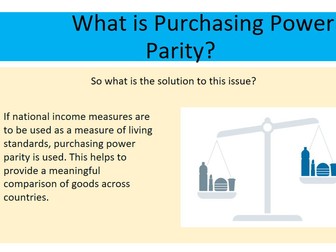
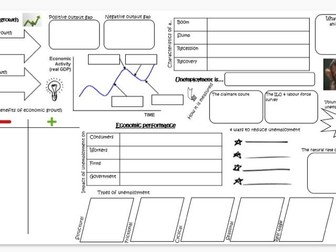
Outstanding Economics A-Level Worksheets / Booklet covering: The Costs and Benefits of Economic Growth. The Strengths and Weaknesses of using GDP data to compare Living Standards between countries. The Strengths and Weaknesses of using GDP data to compare Living Standards over time. The difference between GDP and GNI. Purchasing Power Parity (PPP). The Human Development Index (HDI). The relationship between ‘Economic Growth’ and ‘Economic Development’. The tasks develop students’ understanding. Many of the exercises have contexts designed such that students can deduce the strengths and weaknesses of using GDP data by themselves. The booklet contains 7 pages of top-quality revision notes, and a Model Essay Answer to a past paper question. I3 pages of Model Answers / Answer Sheets are also provided, so that you can be confident of what the answers are. This wonderfully edited and comprehensive booklet is a bargain! Suitable for both Edexcel and AQA.
EconomicsQuick View
MakeMeGenius

Economics

(2)
Use this great resource from www.makemegenius.com. Visit the website for more information and resources.