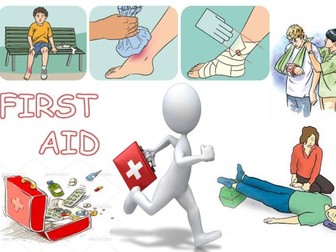
First Aid Part 5: Life Support - New for the 2024/25 Academic Year!
This brand-new lesson is the fifth and final instalment of our progressive First Aid curriculum, which begins in Year 3 and continues through to Year 6.
Other lessons in this series:
First Aid Part 1 - Burns and Scalds
First Aid Part 2 - Allergies and Anaphylaxis
First Aid Part 3 - Asthma and Allergies
First Aid Part 4 - Common Injuries
Developed as part of our enhancement to the primary PSHE scheme of work, this lesson follows our Year 6 lesson on hazards and personal safety.
The lesson includes a starter activity, retrieval task, key terms introductions, a practical activity, a creative main task as well as an assessment-based plenary.
As always, our resources are fully editable, detailed, engaging, and ready to use! Our materials support an adaptive teaching style, offer reflective assessment opportunities, and include scaffolded resources. They are ambitious and challenging, ensuring all students have the opportunity to excel.
x64
An Essentials of First Aid Training powerpoint that would be appropriate for use in KS2/KS3/KS4 classroom or Home Education.
This Powerpoint covers 3 main modules/lessons that look into some of the most common elements in First Aid such as common illnesses and injuries, signs and symptoms, what you can do in certain situations and who to go to for professional help.
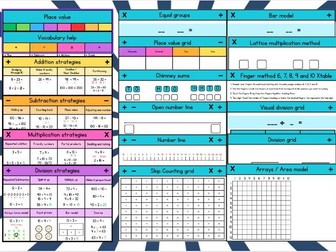
Help your learners build confidence in mental maths and develop a deep understanding of number operations with this Number Talks Maths Strategies Flip Book – perfect for daily use in the classroom or targeted interventions.
This write-on, reusable flip book is packed with clearly explained strategies for all four operations (addition, subtraction, multiplication, and division) and is designed to support active Number Talks and small group maths work.
What’s Included:
A4 flipbook layout ready to print, laminate, and ring-bind
Addition, subtraction, multiplication & division strategies clearly explained with visual examples
Vocabulary lists for each operation to build mathematical language
Strategies such as:
Bridging through 10 and 60
Partitioning and compensation
Doubling and halving
Reordering, counting up/back, and friendly numbers
Arrays, bar models, lattice & grid methods
Open number lines, place value grids, skip counting, and more
Bonus: Finger multiplication method and visual division models
Perfect for:
Number Talks sessions
KS1–KS2 learners or First/Second Level (Scotland)
ASN/SEN support and EAL learners
Maths interventions and strategy teaching
Daily warm-ups, plenaries, or independent practice
Simply print, laminate, and assemble – learners can write on with whiteboard pens for an interactive, hands-on experience.
A must-have maths tool to support fluency, strategy choice, and meaningful number sense in your classroom.
KS2 First Aid - Primary PSHE
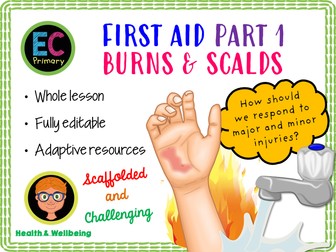
First Aid Part 1 - Burns and Scalds
This brand new lesson is the first instalment of our progressive First Aid curriculum, which begins in Year 3 and continues through to Year 6, culminating in lessons on life support and CPR.
Other lessons in this series:
First Aid Part 2 - Allergies and Anaphylaxis
First Aid Part 3 - Asthma and Allergies
First Aid Part 4 - Common Injuries
First Aid Part 5 - First Aid Emergencies - Coming Soon
Developed as part of our enhancement to the primary PSHE scheme of work, this lesson is designed to fit seamlessly into our Year 3 module on personal safety, risk, and fire safety.
The lesson starts by building on previous content, focusing on identifying common hazards that can cause burns or scalds. It then introduces key terms, includes a video clip with reflection questions, and features a partner-based problem-solving task where students create a flow diagram to demonstrate how to respond to minor or severe burns and scalds.
As always, our resources are fully editable, detailed, engaging, and ready to use!
Who are EC Resources?
EC Resources are the top TES PSHE providers and are a group of teachers who work together to create easy to use, high quality and editable lessons and units of work. We have created lessons for The bank of England, The Children’s Commissioner, The Bank of England, MACS Charity, Tes, LikeToBe Careers, the Criminal Cases Review Commission (UK Gov) and have also completed PSHE and Citizenship commissions for schools across the UK.
You can contact us at info@ecpublishing.co.uk
Teaching PSHE, RE or Citizenship GCSE next year? Why not join our Citizenship and PSHE teachers Facebook group, with 7000 other teachers, for guidance, advice and resource sharing.
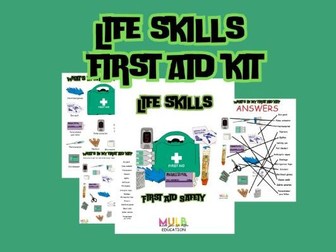
PSHE: Life skills within the Home (First aid safety worksheets)
11 page interactive work booklet on life skills and basic first aid knowledge (including answers sheets)
This booklet includes various fun and in-depth questioned worksheets on first aid safety and building the basic knowledge around this topic.
TARGETED AT SEN CHILDREN, HOMESCHOOL, TUTORING, NON-INTIMIDATING MATERIALS TO EASE CHILDREN INTO LEARNING
*Estimated 1-5 hours of lesson activities, varied questions and open discussion covering roughly 1 weeks of planned topic content
Contents:
Front page
What’s in my first aid kit? Inventory poster
What’s in my first aid kit? Match the item to name
What’s in my first aid kit? In-depth questions
What’s in my first aid kit? In-depth questions
What’s in my first aid kit? In-depth questions
Answers
Can cover 11 individual topics/awards in the AQA Unit Award Scheme
Codes: 70303 / 116436 / 117282 / 75519 / 123496 / 41509 / 77629 / 91449 / 114095 / 110372 / 110623
Use this Hazards in the Home Picture Pack to help children recognise the risks and hazards in the home environment and build knowledge on first aid and items commonly used when a person is injured and seeking medical help.
KS1, KS2, KS3 and Special educational needs.
WORK BOOKLET CAN BE REWRITTEN USING PHONIC COLOURED WORDS IF REQUIRED - at extra cost of £5)
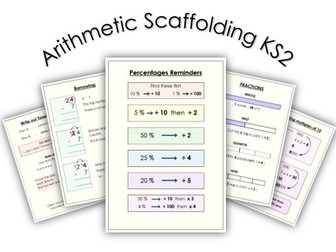
Scaffolding, memory aid help sheets to encourage independent work and progression, and to improve active learning skills.
This resource is aimed at KS2 maths students, particularly for Year 6 SATs, but they can be used for any year group that needs reminders. They are particularly good for SEN / low ability groups or PP pupils. The cards support teaching by having reminders available for pupils to access themselves.
The cards contain examples or help tips, or the first steps for a question. Some have more than one version depending on degree of scaffolding required or alternative methods.
Includes 7 packs of help cards: (pages in each pack)
Addition (8)
Subtraction (12)
Multiplication (20)
Division (12)
Percentages (9)
Fractions (24)
Other/mixed including BIDMAS, partitioning, mixed operations (13)
Word document
I call them ‘help cards’ because that’s how I use them. They are on white sheets so they can be printed on coloured card or paper.
A4 size, but can be printed or enlarged for posters.
Can be printed/reduced onto A5 card for revision or classwork.
Could be printed into booklets.
Document can be used as teaching aid on computer/interactive whiteboard as examples.
I designed this resource to aid memory and encourage independent work. There are many reasons why many pupils can find this difficult - slow processing, low motivation/confidence, memory difficulties, poor concentration - and the adults are very often repeating the same instructions over and over. I feel that if the pupils look at help cards themselves they are more active in their learning.
Also, quite often, their own work books can be difficult to look back at for help as they can be full of gaps/unorganised work. I want to get them out of the habit of just saying “I don’t know” and not doing anything, or hiding and waiting for us to notice them or be free to help.
Our year 6 class do a practice arithmetic paper every week but not as a test. We put the help cards at the back of the room, along with the answers. After three questions the pupils get up to mark their work and find a card to help themselves (movement break!) Obviously this is less chaotic in a small class.
We also look at their papers every week and if they are making the same silly errors, or avoiding certain questions, we give them a help card on their desk for the next paper.
Also, to extend some, they can look at the help card for a topic they haven’t done yet to see if they can work it out. This form of self pre-teach can make the pupils familiar with the question when we do explain it, and feel pleased when they understand and progress by themselves.
I have also used the cards with year 5 pupils, when explaining an arithmetic question, to show them an example without having to make one up quickly on a whiteboard.
These cards help pupils to not be afraid to TRY SOMETHING!
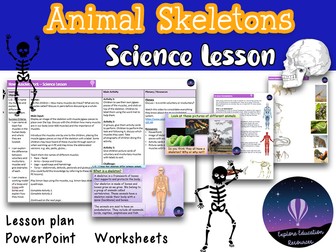
This Key Stage 2 lesson on identifying and comparing different types of skeletons in animals is a comprehensive resource that includes a lesson plan, PowerPoint presentation and 5 activity sheets. The lesson is designed to help students understand the different types of skeletons in animals, including endoskeletons, exoskeletons, and hydrostatic skeletons.
The lesson starts with a discussion on whether all animals have a skeleton, followed by a recap on endoskeletons. The lesson then moves on to animals that have a skeleton on the outside, which are called exoskeletons. Students will watch a video to learn more about exoskeletons and discuss the features of these animals.
Next, students will explore invertebrates in more detail by watching another video and looking at information cards about different types of invertebrates. They will learn how to use a classification key to identify different types of invertebrates.
In the first activity, students will sort images of animals according to their characteristics. In the second activity, they will use the information cards to list the key features of different invertebrates. In the third activity, they will follow the instructions on the classification key and solve it. For the challenge, students will create their own classification key.
Finally, the lesson will end with a fun game called ‘What am I?’.
Here are the highlights of this resource:
★ Lesson Plan: A detailed guide for a smooth teaching experience.
★ PowerPoint: An attractive visual aid to reinforce concepts and spark curiosity.
★ Activity 1: Sorting animal cards and titles to sort
★ Activity 2: Features of animals worksheet and information cards
★ Activity 3: Classification key worksheet and instructions
You may also be interested in…
LKS2 MAGNETS and FORCES Science Unit - 6 Outstanding Lessons
KS2 LIGHT and SHADOWS Science Unit - 5 Outstanding Lessons
KS2 ELECTRICITY Science Unit - 7 Outstanding Lessons
Customer Support:
Encountering any challenges or have specific requests? Contact our support team directly at explore_education@outlook.com for a swift response.
Special Offer:
Enjoying this resource? Leave a review and receive a complimentary resource of your choice! Email us your purchase receipt and a screenshot of your review to avail this offer.
Tags:
Science Lesson, Skeletons in Animals, Vertebrates, Invertebrates, Classification Key, Educational Resources, Key Stage 2, Engaging Activities, Exoskeletons, Hydrostatic Skeletons, Interactive Learning, Critical Thinking, Hands-On Science, Curriculum-Aligned, Fun Learning, What Am I Game.
Understanding Diabetes (First Aid) Lesson/Training powerpoint that would be appropriate for use in KS2/KS3/KS4 classroom or Home Education.
This Powerpoint covers:
What is diabetes?
Signs and Symptoms
Management and Treatment
First Aid
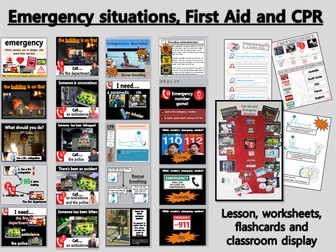
A lesson introducing emergency situations, CPR and Rescue Breathing to EFL students.
Activity 1- students brainstorm emergency scenarios using picture prompts on ppt.
Activity 2- Introduce the term ‘emergency call’ and ‘the fire department’, the police’ and ‘ an ambulance. Students then look at pictures of different emergencies and say which should be called for each different situation.
Activity 3- Students match pictures to the vocabulary by writing A, B, C, D in the corresponding boxes. (worksheet)
Activity 4- In teams, students use the vocabulary learnt in the lesson to write their own emergency call. (worksheet) and the perform it in front of the rest of the class.
Activity 5- Students practice CPR and Rescue Breathing on their manikins using the hand out and PPT. Select students to demonstrate correct procedure to the rest of the class.
Activity 6- Link in PPT to a Mr. Bean YouTube video. Students assess what he does wrong in the emergency scenario and what they would do differently.
Activity 7- Reading comprehension. Can be printed and students read through and answer questions on the PPT.
Activity 8- Team guessing game. Students guess which emergency number belongs to which country. (also included as a worksheet where students draw a line to match them)
Activity 9- Link to British comedy ‘The IT Crowd) video clip on YouTube. Students watch and then answer questions.
Also included: two worksheets, CPR handout, resources needed to create the First Aid classroom display,
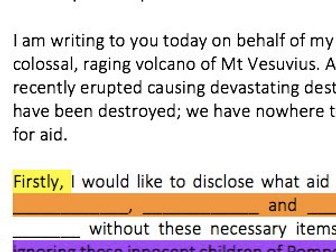
A formal letter from the people of Pompeii (or from people living near Mt Vesuvius now) asking for aid. First paragraph given then following paragraph given as structure. Includes KS2 SPaG. Given in word document so easily editable.
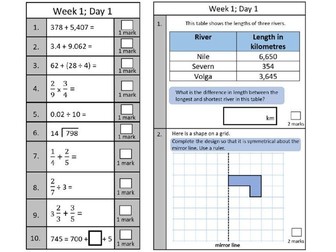
This resource contains daily arithmetic and reasoning questions for every day in a 6 week half-term. There are 330 individual questions in total. There are 10 arithmetic questions per day (other than Fridays which have 5 questions…I gave my class a little break on Fridays!), and 2 reasoning questions.
The questions have been structured to look like the same format as the actual SATs papers. I have found that there is some psychological advantage to this, as the children get used to not thinking of this as being a scary test, but rather something they are used to seeing on a daily basis.
Over the course of a week, children will encounter virtually all arithmetic question types (I based the questions on the KS2 papers from 2017, 2018 and 2019). They will also focus on 2 areas of reasoning.
The format of the arithmetic questions stays the same for each day of the week: Week 1; Day 1 questions will be the same structure and Week 2; Day 1 questions, and so on. Children can therefore use their previous learning from this resource to aid them. For example, once they know that Question 4 on a ‘Day 1’ is a multiplying fractions question, they can look back at their previous Daily 10s to help them.
The reasoning questions follow the same type for the duration of the week, and I have found that this really helps children to answer these difficult questions. For example, in the first week, the first reasoning question will always involve data in a table, and the second reasoning question will be about reflection.
This resource does take some time to set up to begin with, but I definitely found it worth while! I set up separate maths books that I called ‘Additional Maths Learning’. Though I have them a little longer to begin with, eventually I gave children 15 minutes to complete their 12 questions: 10 minutes for the arithmetic and 5 for the reasoning. I then spent another 15 minutes going through the questions thoroughly, with children marking and correcting their own work. Although allocating 30 minutes daily sounds a lot, I found this to be more valuable in the lead up to SATs than the actual maths lessons! Children definitely enjoyed these questions in the end, as they became proud of competing with themselves and seeing their score go up.
THIS RESOURCE CONTAINS THREE ATTACHMENTS: THE DAILY ARITHMETIC QUESTIONS; THE DAILY REASONING QUESTIONS; AND AN EXAMPLE OF A CHILD’S WORK FROM MY CLASS.
NEED HELP OR HAVE QUESTIONS?
If you encounter any downloading/formatting issues or need minor custom modifications, please feel free to reach out directly through our shop support!
Tip: If a file doesn’t start downloading immediately, try refreshing your page or checking your browser’s download settings.
We are dedicated to delivering high-quality, classroom-ready SEL resources—your satisfaction is always our top priority!
My Emotional First Aid Kit: Social-Emotional Learning (SEL) & Coping Skills Activity
Help your students develop healthy coping mechanisms and emotional self-regulation with this engaging, premium-designed resource!
This “No-Prep” activity is perfect for PSHE lessons, school counseling, morning check-ins, or mindfulness sessions. It encourages children to identify safe spaces, supportive people, and comforting actions before they experience emotional distress.
What is included in this premium download:
• Page 1: Eye-Catching Cover Page – Sets a professional and welcoming tone for the lesson.
• Page 2: Student Activity Worksheet – A creative first-aid kit themed layout where students can write or draw their coping strategies (Safe Space, Helping Hand, Comforting Action, and Kind Words).
• Page 3: Teacher’s Guide & Sample Answers – Provides clear learning goals, teacher notes, and realistic sample responses (highlighted in red) for quick reference or classroom display.
Key Features:
• Ink-Saving Design: Clean black and white line art, perfect for mass printing.
• No Prep Required: Just print and go!
• Age Range: Ideally structured for KS2 (Years 3-6) / Ages 7-11.
Equip your students with the tools to heal and handle big emotions today!
This is a stand-alone lesson which introduces pupils to the First World War with a humanitarian and religious response.
It takes the perspective of Faith in Action and how The Salvation Army supported people during WW1.
These themes can be explored further on this webpage www.salvationarmy.org.uk/uki/primary-ww1
A sequence of lessons that provide a pathway through six projects, ideal for getting started with the micro:bit. Students develop their use of some core computing concepts by coding and making practical projects including step counters, night lights, and games.
The sequence comprises six lessons:
Name badge
Beating heart
Emotion badge
Step counter
Night light
Rock, paper, scissors
Learning objectives
Students can understand and apply the fundamental principles and concepts of computer science, including abstraction, logic, algorithms and data representation.
Students can analyse problems in computational terms and have repeated practical experience of writing computer programs in order to solve such problems.
Design, write and debug programs that accomplish specific goals, including controlling or simulating physical systems; solve problems by decomposing them into smaller parts.
Use sequence, selection, and repetition in programs; work with variables and various forms of input and output.
Use logical reasoning to explain how some simple algorithms work and to detect and correct errors in algorithms and programs
Supplied resources
Lesson plans (Word)
Lesson slides (PowerPoint)
Student handouts
Sample micro:bit program files
England KS2 computing curriculum links
Students can understand and apply the fundamental principles and concepts of computer science, including abstraction, logic, algorithms and data representation.
Students can analyse problems in computational terms and have repeated practical experience of writing computer programs in order to solve such problems.
Design, write and debug programs that accomplish specific goals, including controlling or simulating physical systems; solve problems by decomposing them into smaller parts.
Use sequence, selection, and repetition in programs; work with variables and various forms of input and output.
Use logical reasoning to explain how some simple algorithms work and to detect and correct errors in algorithms and programs
Completely editable word documents for writing up science investigations in KS1 and KS2, which can be personalised to suit any science investigation.
The accompanying publisher documents are a great visual aid helping teachers talk through the investigation cycle in the first place.
Flashcards 1 to 12
Ruler game: the first one to point at the number wins
addition and substractions, write the answers in French (differentiated)
spinner game in pairs: Spin it, say the number in French (use a paper clip and a pencil)
Creative clips from Krista Wallden : thank you
Here are 4 worksheets in black and white for children who are moving up or on to a new class or school.
The questions will help them to think about things that are important to them from this year, as well as look forward to the next step of their learning journey.
The picture and shape outlines provide a writing scaffold with minimal writing for those who would find this difficult.
Suitable for SEN pupils.
Children can draw, write key words, captions or sentences as appropriate for them.
Questions include important dates, people, happy thoughts and visits, three best moments, 4 feelings and what to put in a first aid kit when moving on.
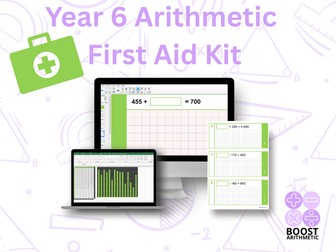
Targeted arithmetic intervention with structured short intervention lessons to build fluency and confidence for KS2 SATs.
By following a structured scheme such as Boost Arithmetic, the majority of Year 6 pupils can aim for 35+ marks on the KS2 Arithmetic Paper. However, for some children, extra targeted practice is needed. The Boost Arithmetic First Aid Kit provides focused, carefully selected questions to help these pupils build fluency, confidence, and accuracy in key arithmetic concepts.
Each lesson contains input slides and 9 independent practice questions, designed to be manageable and structured for maximum impact. The pack also includes a mini assessment paper and a question-level analysis tool to help track progress before, during, or after intervention sessions.
12 sequenced lessons including:
Column addition
Column subtraction
Mixed practice: column addition and column subtraction
Short division
Dividing by 10/100/1000
Mixed practice: short division and dividing by 10/100/1000
Short multiplication
Multiplying by 10/100/1000
Mixed practice: short multiplication and multiplying by 10/100/1000
BODMAS
The inverse
Mixed practice: BODMAS and the inverse
What’s included
Input slides for direct modelling (PowerPoint and SMART Notebook)
Activities for independent practice
Answer booklet
Mini assessment paper to identify gaps
Question-level analysis tool to monitor progress
Fully resourced and ready to use for intervention sessions
Why use the First Aid Kit
Provides focused support for pupils who struggle with arithmetic
Builds fluency, confidence, and accuracy in preparation for SATs
Carefully selected questions target the 20 marks most commonly assessed on KS2 Arithmetic papers, based on analysis of past papers from 2016 onwards
Complements Boost Arithmetic SATs Packs 1–3
This pack is designed for pupils who are not yet working securely at the expected standard and require urgent, foundational intervention before further arithmetic preparation can be effective.
You might also like:
Year 6 Arithmetic SATs Intervention Pack – EXS (£8.95)
Structured fraction and percentage lessons to get pupils confidently to 30 marks and above.
Year 6 Arithmetic SATs Intervention Pack – Greater Depth (£6.95)
Challenge pupils who are ready to push beyond the expected standard.
Year 6 KS2 Arithmetic SATs Preparation Packs 1–3 (12 Lessons each)
For complete revision coverage, see the full preparation packs.
Year 6 KS2 Arithmetic SATs Revision Bundle – Packs 1–3 + Practice Papers (£29.95)
Full SATs revision with all lessons and practice papers in one bundle.


 Quick View