This bundle contains 7 lessons and an end of unit assessment
Each lesson follows the AQA Physics: A Level Year 1 and AS textbook https://amzn.to/3BGFsD5
The lessons are complete and designed to be taught over a period of 90 minutes. They are fully animated and contains fully worked out answers to every question.
The format
A recall starter activity to help store key definitions and ideas to long term memory.
Clear slides presented in a logical order, which can be used to talk through and explain the key concepts of the lesson.
Questions and example slides, which can be used to model perfect exam ready answers.
Summary questions to practice and consolidate the new knowledge gained from the lesson.
This is an end of chapter assessment intended to test the knowledge and skills of the students after completing this unit of work,
1 hour
50 Marks
AQA past paper questions
Mark scheme included
Composition of Forces
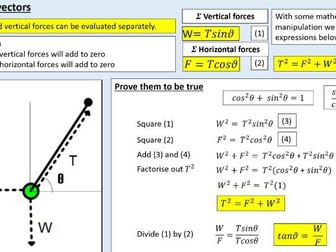
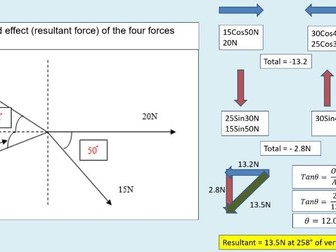
Combining two or more forces into a single resultant force ®
Cases include:
Same direction → add forces
Opposite direction → subtract
Perpendicular → use Pythagoras
Angled → use cosine rule
Resolution of Forces
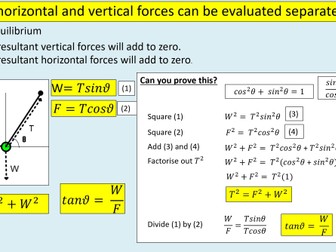
Splitting a force into components:
Horizontal
Vertical
Equilibrium of a Particle
Coplanar Forces
Forces acting in the same plane
Resolve into x and y directions to find resultant
Types of Forces
Weight (gravity) = mg
Tension (strings)
Normal reaction (surface force)
Friction (opposes motion)
Friction
Increases until limiting equilibrium
Depends on surface type
Inclined Plane Problems
Resolve weight into:
Parallel:
Perpendicular:
Applications
Tension in strings
Objects on slopes
Multi-force equilibrium problems
Used with my mixed ability Y7 Class.
LOs :
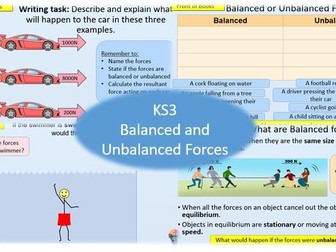
1. Define equilibrium
2. Describe the forces on an object in equilibrium
3. Drawing accurate force arrow diagrams
Each lesson follows the AQA Physics: A Level Year 1 and AS textbook https://amzn.to/3BGFsD5
The lesson is complete and designed to be taught over a period of 90 minutes. It is fully animated and contains fully worked out answers to every question.
Learning objectives
Explain what condition must apply to the forces on an object in equilibrium
Explain what condition must apply to the turning effects of the forces
Describe how we can apply these conditions to predict the forces acting on a body in equilibrium
The format
A recall starter activity to help store key definitions and ideas to long term memory.
Clear slides presented in a logical order, which can be used to talk through and explain the key concepts of the lesson.
Questions and example slides, which can be used to model perfect answers exam ready answers.
Summary questions to practice and consolidate the new knowledge gained from the lesson.
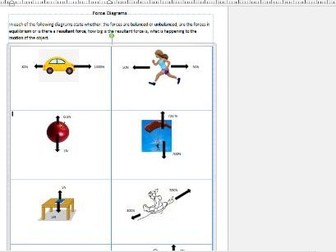
2 Worksheets with challenging questions and answers for determining resultant force of non-parallel vector forces and determining forces in equilibrium suited for students in KS4.
This resource pack contains a pdf file with 119 slides that can be worked through with the students to cover the content.
Also included in this pack are four homework packs made up for past paper exam questions with hand-written solutions covering:
Resolving Forces
Forces in Equilibrium
Friction
Moments
Enjoy!
This PowerPoint resource is a comprehensive guide for teaching students how to calculate the resultant force when two forces act at an angle. It is designed for high school physics lessons focusing on forces, vectors, and equilibrium.
Key learning objectives:
Understanding the concept of resultant force and its relationship to balanced and unbalanced forces.
Learning to calculate the resultant force when two forces act on an object at an angle using vector diagrams.
Applying the parallelogram method to determine the magnitude and direction of the resultant force.
Resource features:
The lesson begins with a starter activity to review foundational concepts, including resultant force, equilibrium, and the difference between contact and non-contact forces. Students then explore the parallelogram of forces method through step-by-step instructions, supported by clear diagrams.
Key elements include:
How to construct a parallelogram with two force vectors.
Using scale drawings to determine the resultant force’s magnitude and direction.
Examples where forces act at right angles and non-right angles, emphasizing the importance of accurate measurements.
Interactive practice questions allow students to calculate resultant forces in different scenarios, including balanced systems (where the resultant force is zero) and unbalanced systems (where forces combine to produce motion). The resource also includes real-world applications, such as analyzing the forces on an inclined plane or the tension in ropes.
File details:
This editable ‘.pptx’ file aligns with physics curricula and supports classroom instruction and independent study. It features clear visuals, practical examples, and guided exercises, making it an excellent tool for mastering vector addition and the parallelogram of forces.
This 4 lesson unit covers the A level topic of Electric Fields. Each lesson comes with a powerpoint and at least 3 activities.
I hope you find the resources useful.
Each lesson follows the AQA Physics: A Level Year 1 and AS textbook https://amzn.to/3BGFsD5
The lesson is complete and designed to be taught over a period of 90 minutes. It is fully animated and contains fully worked out answers to every question.
Learning objectives
Explain the difference between stable and unstable equilibrium
Assess when a tilted object will topple over
Explain why a vehicle is more stable when its centre of mass is lower
The format
A recall starter activity to help store key definitions and ideas to long term memory.
Clear slides presented in a logical order, which can be used to talk through and explain the key concepts of the lesson.
Questions and example slides, which can be used to model perfect answers exam ready answers.
Summary questions to practice and consolidate the new knowledge gained from the lesson.
This Resource is a lesson designed to continue the A Level Physics Topic of Forces in Equilibrium, following on with this lesson on Stability. It contains:
A Powerpoint to provide a general lesson structure and explanations
A starter activity featuring an exam style question on moments
An activity requiring students to draw diagrams and identify stable and unstable equilibria
An activity featuring exam style questions on tipping and toppling
I hope you find these resources useful.
Vectors and scalars
Balanced forces
The principle of moments
Stability
Equilibrium rules
Statics calculations
Revision questions
and more
Other topics also available!
Each lesson follows the AQA Physics: A Level Year 1 and AS textbook https://amzn.to/3BGFsD5
The lesson is complete and designed to be taught over a period of 90 minutes. It is fully animated and contains fully worked out answers to every question.
Learning objectives
Explain why we have to consider the direction in which a force acts
Demonstrate when two or more forces have no overall effect on a point object
Explain the parallelogram of forces
The format
A recall starter activity to help store key definitions and ideas to long term memory.
Clear slides presented in a logical order, which can be used to talk through and explain the key concepts of the lesson.
Questions and example slides, which can be used to model perfect exam ready answers.
Summary questions to practice and consolidate the new knowledge gained from the lesson.

This Resource is a lesson designed to begin the A Level Physics Topic of Forces in Equilibrium, opening with this lesson on Vectors and Scalars. It contains:
A Powerpoint to provide a general lesson structure and explanations
A starter activity on displacement and distance
An activity on resolving vectors into separate components and calculating resultant vectors
An activity featuring questions on vectors in equilibrium scenarios
I hope you find these resources useful.
This Resource is a lesson designed to continue the A Level Physics Topic of Forces in Equilibrium, following on with this lesson on Equilibrium. It contains:
A Powerpoint to provide a general lesson structure and explanations
A starter activity on tilting
An activity on constructing free body force diagrams
An exercise featuring exam style questions on equilibrium
I hope you find these resources useful.
This Resource is a lesson designed to continue the A Level Physics Topic of Forces in Equilibrium, following on with this lesson on Moments. It contains:
A Powerpoint to provide a general lesson structure and explanations
A starter activity forces in equilibrium
An activity featuring problems on single support moments
An activity featuring more advanced multiple support questions
I hope you find these resources useful.
This knowledge card set includes 10 cards that provide an overview of the law of the lever. It covers key topics such as the principle of moments, the relationship between force, distance, and torque, types of levers (first, second, and third class), real-world examples, and applications in mechanical systems. The text and images were generated with AI.
Each lesson follows the AQA Physics: A Level Year 1 and AS textbook https://amzn.to/3BGFsD5
The lesson is complete and designed to be taught over a period of 90 minutes. It is fully animated and contains fully worked out answers to every question.
Learning objectives
Define a vector quantity
Describe how we represent vectors
Explain how we add and resolve vectors
The format
A recall starter activity to help store key definitions and ideas to long term memory.
Clear slides presented in a logical order, which can be used to talk through and explain the key concepts of the lesson.
Questions and example slides, which can be used to model perfect exam ready answers.
Summary questions to practice and consolidate the new knowledge gained from the lesson.