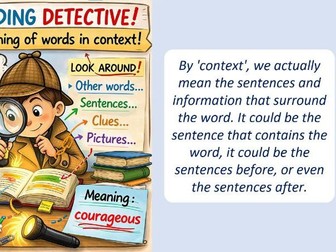
Slides to help children learn how to read words in context as well as a short extract to analyse with children and answer SATs style questions. Also includes a comprehension sheet.
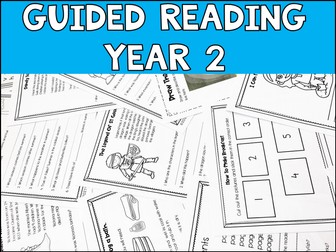
100 independent reading activities suitable for 6-7 year olds. Save yourself time and stress with this with these no prep reading printables - enough to last you the whole year.
These reading activities are designed for children to be able to complete independently, as part of a guided reading carousel, as an independent activity whilst the class teacher is reading with a group or even as homework.
This product includes 100 pages of activities that children can do independently whilst still improving their reading skills and their understanding of books and stories.
There is a variety of activities including word work, spellings, grammar, cut and paste, word searches, as well as 42 reading comprehensions. Plenty of variety to keep children engaged, as well as covering plenty of different skills. Simply print and go, no prep required. Print the whole product at the beginning of the year and you will always have reading activities to hand.
Some of the activities are also linked to the year 2 curriculum eg the lifecycle of a frog, materials, plants, recycling, historical figures. Perfest to use them alongside your topic work.
Many aspects of the year 2 reading National Curriculum covered. Also perfect for lower ability children in year 3 and up.
Also includes a reading journal cover and a tick list of National Curriculum reading standards for assessment. This will help you keep on track with assessing children’s reading skills.
Product Includes:
42 Reading Comprehensions
plus
My Reading Journal front cover
National Curriculum Reading Standards Tick List for Year 2
Find the plant words
Find the materials words
Prefix Re
Suffix -less and -est
Build compound words
Alphabetical order x 2
Describe dog and cupcake
Add Adjectives
le at the end of a word - cut and paste activity
el at the end of a word - cut and paste
dge making the j sound - cut and paste
dge making the j sound - drawing activity
r spelt wr - drawing
j/g - cut and paste
c making the s sound - cut and paste
al at the end of a word - word search
ge at the end of a word - word search
n sound spelt with gn/kn - dice game
n spelt with gn/kn - cut and paste
I can read ing words - cut and paste
contractions x 2
recycle materials - cut and paste
materials 2-4 syllables sort - cut and paste
word sort 2-4 syllables - cut and paste
Ordering how to make a pizza - cut and paste
Ordering how to make breakfast - cut and paste
Little Red Riding Hood ordering sentences - cut and paste
Draw fairy tale characters
Goldilocks ordering pictures - cut and paste
Jack And The Beanstalk ordering pictures - cut and paste
3 Little Pigs ordering pictures - cut and paste
Draw a front cover
Design a front cover
Draw the best part of a story
Draw and label characters
Review your favourite book
All about the book
Book review
Read and draw x 2
I can make inferences x 3
Make a healthy me poster
Make a camping poster
Word of the day
Write a book quiz
Draw the characters
Contents page
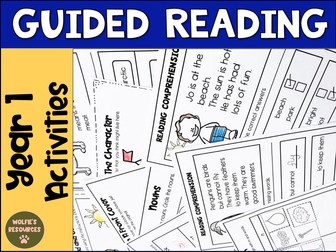
Independent reading activities. Over 120 pages of guided reading activities to save you time and stress! Suitable for children aged 5-6 years old. Year 1 UK.
These updated reading activities are designed for children to be able to complete independently, as part of a guided reading carousel or even as homework.
I have put together over 120 pages of activities that children can do independently whilst still improving their reading skills and their understanding of books and stories.
There is a variety of activities starting with very simple phonics activities for lower abilities. The activities get more advanced for use throughout the school year.
Some of the activities are also linked to the year 1 curriculum eg the lifecycle of a sunflower, seasons and keeping healthy.
All aspects of the year 1 reading National Curriculum covered.Also perfect for lower ability children in year 2 and up.
Included in this product:
reading journal book cover
year 1 national curriculum statements for assessment
guided reading timetable
35 reading comprehensions
initial sounds cut and stick
b or d cut and stick
m or n cut and stick
c or k cut and stick
missing letters
draw the word x 3
2 syllable words
draw the caption x 3
mixed up sentences x 6
draw the book cover x 2
draw the characters x 2
draw your favourite part x 2
draw the ending x 2
write the tricky words x 2
find the digraph x 2
write the noun x 2
design a new front cover
find the nouns/weather words/plant words
reading questions
all about the book
book review x 2
read and colour x 3
read and draw x 3
describe the setting x 2
draw and describe the character x 2
draw the character x 4
draw the setting x 4
where is cat?
inference questions x 4
sunflower life cycle
make a foldable book
label a snail
make a wanted poster
decode words x 4
word endings x 2
missing words
syllables x 2
sequence story x 2
contractions
what happens next?
12 VIPERS guided reading lessons based on Beowulf (Usborne Young Reading version).
Suitable for year3/4. Or can easily be adapted for UKS2.
The lessons focus on the first 3 chapters. SEN and challenge resources for each lesson.
Whole class guided reading for Charlotte’s Web. This is 7 weeks worth of planning. Each lesson contains 1 PowerPoint and 1 worksheet. This was taught in LKS2. Planning uses reading vipers and each week focuses on 1 reading viper.
Week 1 - Prediction
Week 2 - Vocab
Week 3 - Inference
Week 4 - Summarise
Week 5 - Vocab
Week 6 - Inference
Week 7 - Summarise
Each lesson’s structure is as follows:
A think about it question
Vocab with word classes
Teacher reads
Speed retrieval
Independent reading
Main task (linked to reading viper)
I have labelled page numbers on worksheets and ppt, page numbers may different depending on copy of Charlotte’s Web.
Please leave a review if you found this useful. Thank you.
This pack includes guided reading plans for the following text:
Cosmic by Frank Cottrell Boyce (Years 5/6)
In total there are 18 guided reading lesson plans, covering each of the sections in the book. Each plan contains a 'reading and responding to the text' activity which is designed to be completed with the class teacher with the reading group. There are then follow up independent activities which the children can then complete during the remainder of the week. All of these activities are closely linked to the new National Curriculum objectives and these are listed at the beginning of each plan.
Each plan also has a list of difficult words which the children can check the meaning of before the teacher led session, space to list the names of the children who are working on the text and a space for a teacher notes and evaluation. The plans have been written by an experienced primary school teacher and have been tried and tested in the classroom.
Guided Reading: St Patrick’s Day – Reading Comprehension Resource
Celebrate learning and Irish culture with this engaging St Patrick’s Day guided reading comprehension! Perfect for elementary students, this resource combines reading practice with cultural education.
Students will read an informative passage about St Patrick, Ireland’s patron saint, and learn about his teachings on kindness, forgiveness, and working together. The text also explores St Patrick’s Day traditions, from shamrocks and green clothing to parades, music, and celebrations around the world.
Key Features:
Engaging Reading Passage: Learn about St Patrick and the history of the holiday in a clear, student-friendly format.
Comprehension Questions:
Literal: Check basic understanding (e.g., dates, symbols, and celebrations).
Inferential: Encourage thinking and connecting ideas (e.g., the significance of the shamrock).
Evaluative: Promote reflection on community and cultural learning.
Optional Extension Tasks: Creative follow-up activities such as:
Making a St Patrick’s Day Fact Booklet with illustrations.
Designing a Parade Float featuring shamrocks, green decorations, and Irish symbols.
This resource is perfect for guided reading sessions, classroom discussions, or independent practice. It supports comprehension, critical thinking, and creativity while celebrating a fun and meaningful cultural holiday.
Ideal for Grades: 2–3 (adaptable for other elementary levels or EAL)
These activities are suited to KS2 for guided reading sessions or for use in English lessons to show response to the text.
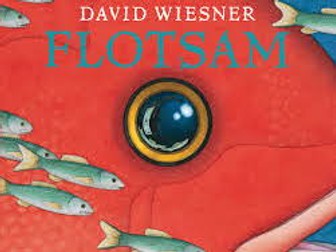
4 different worksheets with boxes for ‘wonder’, ‘observe’ and ‘infer’ (the 4 images are different ones from the book)
Wonder- Children write questions that come to mind when they look at the image
Observe - What can they see - be specific, expand your ideas, explain clearly
Infer- Children make inferences using clues from the image
1 worksheet comparing an image of a child from the past with the boy in the story. Encouraging children’s use of inference and also to encourage them to explore the differences between the characters.
I will be uploading planning and resources for my entire Flotsam unit shortly. Check out my other resources.
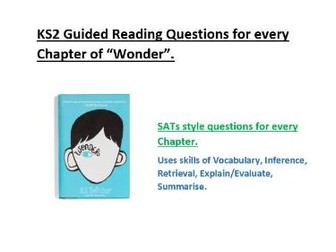
This resource is intended to be used to help teach the skills of the KS2 National Curriculum for Reading, by domain.
Included:
• Comprehension questions for the first twelve chapters of the book.
• A teaching PowerPoint with an introduction to the author, their other works and copies of the questions.
This resource works best if the chapter is read, talked about and discussed in one day, then comprehension questions are given the day after.
This resource has been used with both Year Five and Year Six classes to great effect and has boosted their reading skills and their comprehension scores.
Reading is an essential skill that needs to be accomplished by everyone. Here is around 6 weeks of reading and questioning that will support the children in covering all of the VIPERS skills.
The questions are aimed at KS2 children but it can be adapted.
Guided reading tasks based on the book “Dear Earth”. This explores the theme of looking after the environment and is told through the eyes of a child. Great for year 2.
This guided reading sheet on Hyperinflation in Germany in 1923 is perfect for AQA GCSE History students and increasing opportunities to develop literacy. It can be used in the classroom or as homework. Students need to read through the adapted resource from the historian and answer comprehension questions. There is also a section for further research. Used in conjunction with
This bundle of guided / shared reading material, and the page numbers referenced therein, relates to “Oliver Twist” by Charles Dickens; specifically, the edition retold by Gill Tavner and published by Real Reads Ltd in 2018. Used initially with a lower ability Year 4 set.
Split over 6 weeks, each week works on a format where;
Day 1 is a first read using a word detective exercise which allows pupils to explore some of the more unusual vocabulary they encounter. A simple version of this is also included as differentiation.
Days 2 & 3 allow for further reads of the same section of the text, employing diverse sets of questions presented in a SATs style format with an indication in brackets of the VIPERS focus involved (ie. Vocabulary, Inference, Predict, Explain, Retrieve, Summarise).
Day 4 requires a further read of the same section of the text, encouraging pupils to generate their own questions with a VIPERS focus.
Day 5 allows for a contrasting non-fiction text to be considered (PLEASE NOTE THIS IS NOT PROVIDED)
In addition, the standard questions for days 1 – 4 are all combined in a PowerPoint presentation.
A guided reading worksheet to introduce or recap Ramadan. The first page of the work sheet is the task, and the second page is the answers so students can mark the work themselves.
Guided reading questions for Cosmic by Frank Cottrell-Boyce. Questions focus on vocabulary, retrieval, inference,author intent, author technique and giving explanations for answers using evidence from the text. Many questions written in KS2 sats reading style. Questions are labelled in red to show skill required e.g V = vocabulary, E = explain etc. Very useful for record keeping and analysing which skills children need more work on. As the chapters in the book are short (and we were aiming to build some reading stamina) questions are set across 2 or 3 chapters at a time. There are 6 or 7 questions in each section - 110 questions in total. Successfully used in Year 6 - children read chapters at home and completed questions in group work. Would be suitable for Year 5 and possibly Year 4 able readers too.
This 7-week VIPERS planning pack for the Roald Dahl classic George’s Marvellous Medicine is completely ready-to-teach!
With 7 teacher-led sessions and follow up independent tasks, all complete with answers, this unit will support your children’s comprehension skills by covering all of the 6 VIPERS skills (vocabulary, inference, prediction, explanation, retrieval and summarising).
This resource is completely editable, meaning you can adjust it as needed to suit the children in your class.
This resource is intended to be used to help teach the skills of the KS2 National Curriculum for Reading, by domain. Domains 2b and 2d are weighted more in these comprehensions to match the weighting of the end of KS2 Reading Comprehension assessment.
Included:
• SATs style comprehension questions for the prologue/preface and the twenty-seven chapters of the novel.
• A teaching PowerPoint with an introduction to the author, their other works and copies of the questions.
This resource works best if the chapter is read, talked about and discussed in one day, then comprehension questions are given the day after.
This resource has been used with both Year Five and Year Six classes to great effect and has boosted their reading skills and their comprehension scores.
Please let me know if you found this resource useful. It should save you hours and hours of time.
3 whole class reading comprehension lessons based on chapter one and two of ‘The Wild Robot’ by Peter Brown.
Vocabulary, about the author, whole class reading, paired reading
Reading Skills foci: word’splore (exploring how word choices enhance meaning), infer, summarise
28-page dyslexia-friendly PowerPoint, 3 x printable PDF activities
Extract included.
Suitable for age 7+
I have produced a selection of worksheets for my year 1/2 mixed ability guided reading sessions in order to develop their comprehension and understanding. They are all based on ideas from the national strategy guidance. I use them within my guided reading sessions, as independent work in school and also as homework tasks.
This guided reading activity is aimed at 10-13 year olds. It focuses on the London Blitz in World War Two.
It is part of my ‘Diaries of World War Two’ resource which is available for £1 from TES.
Questions and answers are provided. I hope you and the children you teach find it useful.