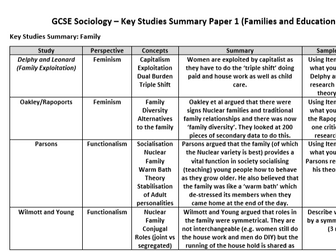
This document summarises the key studies required in the specification for paper one (Education and Families).
The summary is in the form of a table with the sociologists names, the perpective they write form (if there is one) and a brief summary of what they say. There is aslo a sample exam question for each key study.
These studies will feature in the ffinal exam - students must know them!
An 18 slide PowerPoint presentation and a fill-in sheet of 22 key terms all based around the Key Concepts and Processes topic in GCSE Sociology Paper 1. This is a new resource for 2024 and is ideal to help prepare students for this Summer’s exams.
The resource is designed to be delivered to students in a ‘lead from the front’ revision session and should take approx. 60 mins to deliver.
It includes:
Key information on the question types and marks
Guidance on how to answer the questions to maximise marks
Full information and advice on 1 mark questions, including examples, exemplar answers and mark schemes
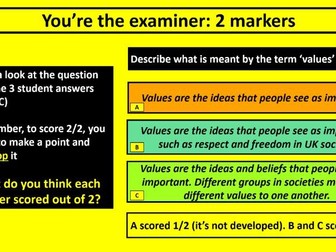
Full information and advice on 2 mark questions, including examples, exemplar answers and mark schemes
Full information and advice on 4 mark questions, including examples and mark schemes
Fully animated PowerPoint to chunk and build information
A separate handout for students to tick off / explain 22 key terms from the Key Concepts and Processes topic
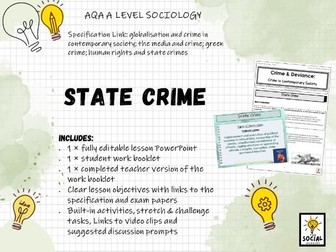
Topic: Crime & Deviance
Specification link: globalisation and crime in contemporary society; the media and crime; green crime; human rights and state crimes
Focus: State Crime
What’s included:
• 1 × fully editable lesson PowerPoint
• 1 × student work booklet (fillable during lessons)
• 1 × completed teacher version of the work booklet
• A range of engaging tasks including stretch & challenge for differentiation
• Links to video clips and suggested discussion prompts
• Clear lesson objectives with links to the specification and exam papers
Perfect for AQA A-Level Sociology Paper 3: Crime and Deviance, this resource pack covers State Crime. It’s ideal for teaching the specification section on globalisation and crime in contemporary society; the media and crime; green crime; human rights and state crimes. With a detailed PowerPoint, a student workbook, and plenty of built-in activities, this lesson is ready to deliver straight away.
The pack includes one lesson PowerPoint, designed for 60–90 minutes of teaching time depending on the number of activities selected. The lesson features a combination of teacher-led tasks, independent student activities, and video clips, along with embedded stretch and challenge opportunities to support differentiation.
The lesson is designed to run alongside a work booklet, provided in two versions:
• a student copy for learners to complete during lessons
• a completed copy for teacher reference or additional student support
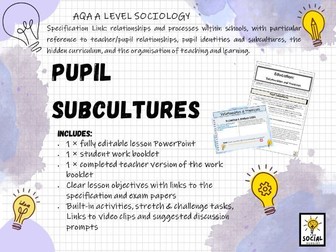
Topic: Education
Specification link: relationships and processes within schools, with particular reference to teacher/pupil relationships, pupil identities and subcultures, the hidden curriculum, and the organisation of teaching and learning.
Focus: Pupil Subcultures
What’s included:
• 1 × fully editable lesson PowerPoint
• 1 × student work booklet (fillable during lessons)
• 1 × completed teacher version of the work booklet
• A range of engaging tasks including stretch & challenge for differentiation
• Links to video clips and suggested discussion prompts
• Clear lesson objectives with links to the specification and exam papers
Perfect for AQA A-Level Sociology Paper 1: Education, this resource pack covers Pupil Subcultures. It’s ideal for teaching the section on relationships and processes within schools, with particular reference to teacher/pupil relationships, pupil identities and subcultures, the hidden curriculum, and the organisation of teaching and learning. With a detailed PowerPoint, a student workbook, and plenty of built-in activities, these lessons are ready to deliver straight away.
The pack includes one lesson PowerPoint, designed for 60–90 minutes of teaching time depending on the number of activities selected. The lesson features a combination of teacher-led tasks, independent student activities, and video clips, along with embedded stretch and challenge opportunities to support differentiation.
The lesson is designed to run alongside a work booklet, provided in two versions:
• a student copy for learners to complete during lessons
• a completed copy for teacher reference or additional student support
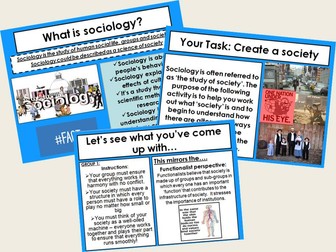
This taster lesson is designed to introduce prospective students to sociology. It covers what the subject of sociology is, what the A level exam entails and the types of topics that are studied. It includes some ‘lesson samples slides’ which are mini tasks taken from typical A level lessons. It also includes a ‘build a society’ task which allows students to begin to explore the different perspectives.
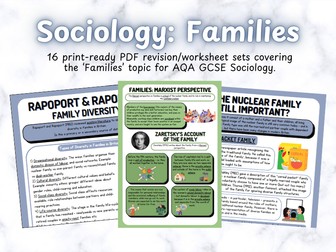
This is a large pack of resources for learning and revision of the “Families” section of AQA Sociology GCSE. The pack includes:
The Functionalist Perspective
The Marxist Perspective
The Feminist Perspective
Different Families
Rapoport & Rapoport
Conjugal Role Relationships
Changing Families
Changing Households
Wider Family Relationships
Marriage and Divorce
Theories of Divorce
Criticisms of Families
Is the Nuclear Family Still Important?
Knowledge Organisers
Practice Exam Questions
A comprehensive and fully editable AQA A Level Sociology Education Homework & Revision Booklet.
This resource provides detailed reading, retrieval and revision activities across the Education topic, including:
• Class differences in achievement – internal and external factors
• Ethnic differences in achievement
• Gender differences and subject choice
• The role of education in society
• Educational policy and inequality
• Key sociologists, studies and theories
• Exam skills and essay planning
Students are supported through a range of activities including key-term tasks, sociologist grids, gap fills, matching activities, true/false questions, word searches, short-answer questions, evaluation tasks and exam practice, including 10- and 30-mark questions.
The booklet also includes an Exam Skills Toolkit, PEEL/PEEEL guidance and essay planning support to help students strengthen their AO1, AO2 and AO3 skills.
Ideal for homework, independent study, revision, catch-up work or intervention throughout the A Level course.
Detailed lesson with lots of scaffolding based on adaptive teaching that help students identify and describe issues related to families in contemporary society, such as the quality of parenting, the relationships between teenagers and adults, care of the disabled/elderly and arranged marriage.
Helps students consider the impact of and reasons for these family related issues in contemporary society on family relationships and roles.
Covers the difference between arranged marriage and forced marriage and why forced marriage is illegal in Britain.
Includes a teaching to all activity
-Includes three videos
-ANSWERS FOR SOME ACTIVITIES INCLUDED
Includes ‘identify and describe’ 3 marker and ‘identify and explain’ 4 marker
Covers the following key terms: Arranged marriage, Forced marriage
-Covers the following sociologists: Duncan (2006), Garrod (2005), Ginn and Arber (1992), The Joseph Rowntree Foundation (2007)
Makes reference to the following key terms students might know to promote a spiral curriculum: Social policy - Contemporary society - Socialisation - Underclass - Dependency culture - The New Right - Cultural deprivation - Cultural capital - Primary socialisation - Secondary socialisation - Norms - Values - Culture - Pupil subcultures - Class differences in education achievement - Immigration - Monogamy
Starter activity recaps marketisation from the education unit, with a full check, correct and develop answer slide.
-Item-based progress checks with instant answer reveals
-Extension task on the factors that might cause each contemporary family issue.
Resources can be found at the end of the PPT
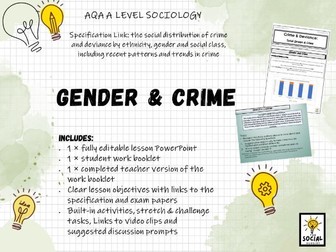
Topic: Crime & Deviance
Specification link: the social distribution of crime and deviance by ethnicity, gender and social class, including recent patterns and trends in crime
Focus: Gender & Crime
What’s included:
• 1 × fully editable lesson PowerPoint
• 1 × student work booklet (fillable during lessons)
• 1 × completed teacher version of the work booklet
• A range of engaging tasks including stretch & challenge for differentiation
• Links to video clips and suggested discussion prompts
• Clear lesson objectives with links to the specification and exam papers
Perfect for AQA A-Level Sociology Paper 3: Crime and Deviance, this resource pack covers Gender and Crime. It’s ideal for teaching the specification section on the social distribution of crime and deviance by ethnicity, gender and social class, including recent patterns and trends in crime. With a detailed PowerPoint, a student workbook, and plenty of built-in activities, this lesson is ready to deliver straight away.
The pack includes one lesson PowerPoint, designed for 60–90 minutes of teaching time depending on the number of activities selected. The lesson features a combination of teacher-led tasks, independent student activities, and video clips, along with embedded stretch and challenge opportunities to support differentiation.
The lesson is designed to run alongside a work booklet, provided in two versions:
• a student copy for learners to complete during lessons
• a completed copy for teacher reference or additional student support
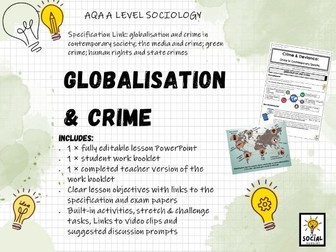
Topic: Crime & Deviance
Specification link: crime, deviance, social order and social control
Focus: Globalisation and Crime
What’s included:
• 1 × fully editable lesson PowerPoint
• 1 × student work booklet (fillable during lessons)
• 1 × completed teacher version of the work booklet
• A range of engaging tasks including stretch & challenge for differentiation
• Links to video clips and suggested discussion prompts
• Clear lesson objectives with links to the specification and exam papers
Perfect for AQA A-Level Sociology Paper 3: Crime and Deviance, this resource pack covers Globalisation and Crime. It’s ideal for teaching the specification section on globalisation and crime in contemporary society; the media and crime; green crime; human rights and state crimes. With a detailed PowerPoint, a student workbook, and plenty of built-in activities, this lesson is ready to deliver straight away.
The pack includes one lesson PowerPoint, designed for 60–90 minutes of teaching time depending on the number of activities selected. The lesson features a combination of teacher-led tasks, independent student activities, and video clips, along with embedded stretch and challenge opportunities to support differentiation.
The lesson is designed to run alongside a work booklet, provided in two versions:
• a student copy for learners to complete during lessons
• a completed copy for teacher reference or additional student support
A set of thorough and comprehensive revision booklets for all three A Level sociology exams, which cover all content they need to know. It includes information for students, and loads of activities ranging from crosswords to essay planning. Last year I published booklets which only included the advanced info, so I have updated them this year to include everything! They worked really well last year to make sure that students were revising early on, and I’m sure they will be as succesful this year too.
There is a booklet for each of the following topics: education, families, media, crime, and theory and methods
I have been using these as home learning and in lessons- students find they structure their revision really well.
I really hope this is useful to you!
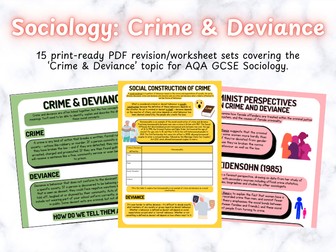
This is a pack of resources for learning and revision of the “Crime & Deviance” section of AQA Sociology GCSE. The pack includes:
Introduction to Crime and Deviance
Social Construction of Crime
Gender and Crime
Feminist Perpsectives on Crime
Social Order
Merton’s Perspective and Anomie
Media and Public Debate
Ethnicity and Crime
Becker’s Interactionist Perspective
Why do people commit crime?
Data on Crime - Victim Surveys & Self Report Studies
Data on Crime - Statistics
The Prison System
Crime & Deviance Vocabulary Sheet & Studies Organiser
Practice Exam Questions
This comprehensive bundle is designed in line with the latest AQA A-Level Specification - 2025
It provides everything you need to teach the Media topic in an engaging and structured way, with each lesson PowerPoint having an accompanying booklet for you to print.
Included Lessons:
New Media
Ownership & Control of the Media
Globalisation
Selection & Presentation of the News
Media Representations
Relationship Between the Media, their Content, Presentation and Audiences
Lesson’s include:
‘Do Now’ knowledge checks
Contemporary examples
Active learning activities
Promts for class discussions
Each lesson is created with student cognitive load in mind. The PowerPoint slides are clear and use lots of images, with teacher elaboration points in the notes section.
For more details, please see individual lesson descriptions.
If you have any questions, need assistance with resources, or would like to provide feedback, please reach out at thrivesocialscience@gmail.com
The content that we look at in lessons has so many applications to the world around us, and so I have set up an instagram where I will be sharing both historical and current examples. I will be using this in lessons as either a ‘Do Now’ or plenary activity - with the aim of making student think critically about the world around them. I hope this will be a useful, free resource for teachers. Link below:
https://www.instagram.com/thrivesocialstudies
Please leave a review and I will send you a resource of the same price for free :)
A Level Sociology resource for the ‘Globalisation’ topic within the ‘Media’ unit on Paper 2
Lessons include:
• Globalisation & Culture
• Marxism / Cultural Imperialism / Pessimistic Globalists view on globalisation and popular culture
• Postmodernist / Pluralism / hyperglobalist optimism view on globalisation and popular culture
This resource has been made for teachers to easily pick up use. Each Powerpoint includes answers / additional teacher information in the notes section.
The accompyoning booklet follows each lesson activity, allowing students to structure their notes and stay organised – great for those who may have missed a lesson, to stay on track with their learning.
Download the free ‘media topic checklist’ to use alongside your teaching of this unit.
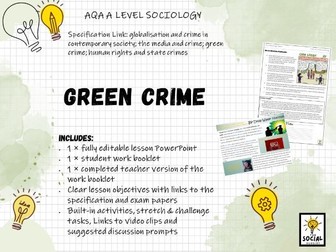
Topic: Crime & Deviance
Specification link: globalisation and crime in contemporary society; the media and crime; green crime; human rights and state crimes
Focus: Green Crime
What’s included:
• 1 × fully editable lesson PowerPoint
• 1 × student work booklet (fillable during lessons)
• 1 × completed teacher version of the work booklet
• A range of engaging tasks including stretch & challenge for differentiation
• Links to video clips and suggested discussion prompts
• Clear lesson objectives with links to the specification and exam papers
Perfect for AQA A-Level Sociology Paper 3: Crime and Deviance, this resource pack covers Green Crime. It’s ideal for teaching the specification section on globalisation and crime in contemporary society; the media and crime; green crime; human rights and state crimes. With a detailed PowerPoint, a student workbook, and plenty of built-in activities, this lesson is ready to deliver straight away.
The pack includes one lesson PowerPoint, designed for 60–90 minutes of teaching time depending on the number of activities selected. The lesson features a combination of teacher-led tasks, independent student activities, and video clips, along with embedded stretch and challenge opportunities to support differentiation.
The lesson is designed to run alongside a work booklet, provided in two versions:
• a student copy for learners to complete during lessons
• a completed copy for teacher reference or additional student support
Introduce students to A Level Sociology with this engaging and interactive Introduction / Taster Lesson.
Perfect as a first lesson, transition activity, induction session or introduction to the subject, this resource introduces students to key sociological concepts while developing discussion, analytical thinking and early exam skills.
Students explore how sociologists explain behaviour and begin to understand the expectations of studying Sociology at A Level.
Part 1: Introducing Sociology
Lesson objectives:
• Know the meaning of the key terms: culture, norms, values, socialisation, status and role
• Understand the importance of culture and socialisation in explaining human behaviour
Part 2: Developing Sociology Skills
Lesson objectives:
• Understand Sociology assessment objectives
• Develop confidence using the P.E.E.L structure in Sociology responses
What’s included:
• Easy to deliver PowerPoint presentation with helpful teaching tips in the notes
• Student friendly activities and discussion opportunities
• Worksheets formatted and ready to print
• Stretch and challenge activities included
• Focus on literacy and key sociological concepts
• Strong links to exam skills and assessment criteria
• High-level questioning and opportunities for written application
Resources are made for the AQA A Level Sociology specification, but may be tailored for use with other exam boards.
Textbook page numbers and references are made to AQA A Level Sociology Book One and AQA A Level Sociology Book Two.
Check out our other great Sociology resources in our TES shop.
For any inquiries or support using any of the resources please feel free to email:
Lovelysystemz@gmail.com
WJEC AS Level Sociology, Unit One: Introductory Core
This is a list of concepts that the student should understand and be able to explain using relevant examples and with reference to sociological knowledge.
This list can be printed for student folders and display
What you may need to be familiar with in studying this course.
A guide to students as to what they will be learning over the course and what they need to learn.
This could also be used by teachers as a guide to planning lessons.
A booklet that can be used alongside PowerPoints created by myself (see shop and shared Google Drive), introducing students to the first Eduqas module.
The booklet is full of activities, model answers and exam questions.
A clear introduction to Sociology designed to support students who are new to the subject at KS4 or KS5.
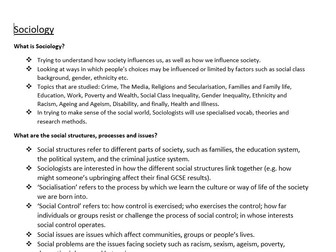
This resource outlines key sociological ideas, including social structures, social processes and social issues, as well as core concepts such as culture, norms, values and socialisation. It also introduces the foundational ideas of Karl Marx, Émile Durkheim and Max Weber, helping students understand how sociologists explain society and social behaviour.
Ideal as an introductory lesson, bridging content, or independent reading, particularly for students beginning GCSE or A‑Level Sociology.
This resource is offered for free as an overview of key sociological thinking and may support future learning across Sociology and related subjects.
This is just the very basics as a start point.


 Quick View