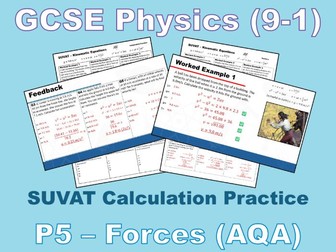
Help your students master using SUVAT and the equations of motion with this shed load of practice worksheet with full solutions and worked examples. This worksheet scaffolding the problem solving process with model answers shown on complementary powerpoint slides.
Questions require identifying variables from a worded question and then identifying and utilising the equations: v=u+at, s=ut+½at² and v²-u²=2as.
Ideal for in-class activities, homework, cover or revision, this will stretch high ability students and allow them to enjoy independent practice which supports application of substitution, unit conversion and rearrangement.
Ready for AQA Physics and Combined Science P5 Forces, easily adaptable for other exam boards and specifications.
Includes:
Word version of worksheet (editable)
PDF version
Powerpoint slides for worked examples and full solutions.
Related Resources:
P5 Forces - SLOP Calculations
s=vt (Free Taster)
F=ke
W=mg
a=v/t
F=ma
W=Fs
P5 Forces - Independent Practice
Resultant Force Diagrams
Newton’s Laws - Recall, Describe, Explain
P5 Forces - Disciplinary Literacy
Physics of Sport (Science in Society)
Newton’s Laws
History of Gravity
Leave a review and follow us on instagram, Facebook and Twitter to find out about sales and new releases.
Each lesson follows the AQA Physics: A Level Year 1 and AS textbook https://amzn.to/3BGFsD5
The lesson is complete and designed to be taught over a period of 90 minutes. It is fully animated and contains fully worked out answers to every question.
Learning objectives
Explain why the acceleration of a projectile is always vertically downwards
Identify the horizontal component of a vertical vector
Describe the effect of gravity on horizontal speed
The format
A recall starter activity to help store key definitions and ideas to long term memory.
Clear slides presented in a logical order, which can be used to talk through and explain the key concepts of the lesson.
Questions and example slides, which can be used to model perfect exam ready answers.
Summary questions to practice and consolidate the new knowledge gained from the lesson.
This bundle contains 8 lessons and an end of unit assessment
Each lesson follows the AQA Physics: A Level Year 1 and AS textbook https://amzn.to/3BGFsD5
The lessons are complete and designed to be taught over a period of 90 minutes. They are fully animated and contains fully worked out answers to every question.
The format
A recall starter activity to help store key definitions and ideas to long term memory.
Clear slides presented in a logical order, which can be used to talk through and explain the key concepts of the lesson.
Questions and example slides, which can be used to model perfect exam ready answers.
Summary questions to practice and consolidate the new knowledge gained from the lesson.
These PowerPoints form full lessons of work that together cover the new A level Maths course for all exam boards. Together all the PowerPoints include;
• A complete set of notes for students
• Model examples
• Probing questions to test understanding
• Class questions including answers
• Individual whiteboard work
• Links to exercises in ‘The Textbook by CGP’ these can easily be edited for your textbook
The PowerPoints can be used in the lesson and also given to students that have missed a lesson
I have added ‘AS level maths 13 – Circles’ for free download
Kinematics covers;
Understand and use fundamental quantities and units in the S.I. system: length, time, mass
Understand and use derived quantities and units: velocity, acceleration, force, weight
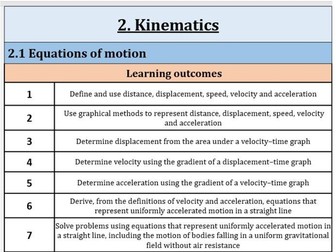
Understand and use the language of kinematics: position; displacement; distance travelled; velocity; speed; acceleration
Understand, use and interpret graphs in kinematics for motion in a straight line
Displacement against time and interpretation of gradient
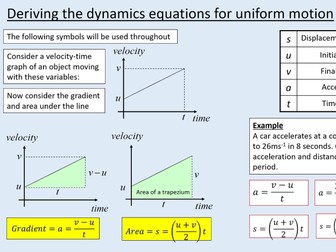
velocity against time and interpretation of gradient and area under the graph
Understand, use and derive the formulae for constant acceleration for motion in a straight line
Use calculus in kinematics for motion in a straight line
This product from my Tes shop contains everything you need to teach the four kinematic equations with one dimensional horizontal motion. The kinematic equations are used to analyze the motion of objects that are experiencing constant uniform acceleration. In this product you get: a full sheet of handout notes including an explanation and two useful examples, three sets of exercises with answer keys and a detailed presentation for use during instruction or that your students can view outside the classroom.
No Preparation Necessary! Just Download and Go! Everything included as PDF files and editable Keynote, PowerPoint and Word files.
At the top of the worksheets there is a link to the related video from my YouTube Channel, Step-by-Step Science. If your students need help understanding the concepts or completing the worksheets, they can simply click on the link and watch the YouTube video where everything is explained in detail. An outstanding resource for students who are not able to attend class.
Contains:
(1) Handout notes
(2) Three sets of exercises for your students to practice what they have learned.
(3) Answer keys for all exercises.
(4) Presentations in Keynote and PowerPoint.
(5) Ready to go PDF files for all materials.
Lesson that has differentiated tasks for pupils to complete, in groups (enough questions for 4 groups to have different questions of increasing difficulty). Pupils then present their answer and class critique it.
Kinematics is the branch of physics that studies motion of objects without considering the forces causing it.
Linear Motion
It describes motion in a straight line using three main quantities:
Displacement (s) – distance in a specific direction
Velocity (v) – rate of change of displacement
Time (t)
For constant velocity:
Motion is uniform (same speed and direction)
Displacement is proportional to time:
s = ut
Graphs:
Displacement–time → straight line
Velocity–time → horizontal line
Motion with Constant Acceleration
Acceleration is the rate of change of velocity.
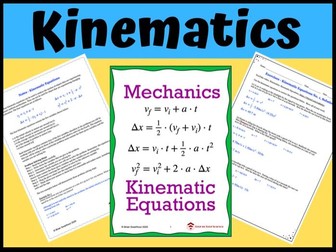
Main equations (SUVAT):
v = u + at
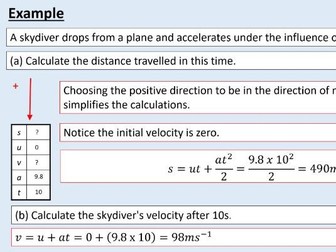
s = ut + ½at²
v² = u² + 2as
Used when speed changes (speeding up or slowing down).
Graphs in Motion
Velocity–time graph → area = displacement
Slope of graph → gives velocity or acceleration
Helps analyze motion visually (shown clearly in diagrams on pages 2–3)
Vertical Motion (Gravity)
Objects move under gravity with acceleration g ≈ 10 m/s²
Cases:
Falling (downward acceleration)
Thrown upward (slows → stops → falls back)
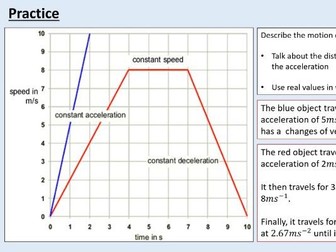
Multi-stage Motion
Motion can include:
Acceleration
Constant speed
Deceleration
(Explained with combined graphs on page 7)
Calculus in Motion
Velocity = rate of change of displacement
Acceleration = rate of change of velocity
Integration is used to find displacement from velocity
In One Line
Kinematics explains how objects move using equations, graphs, and relationships between displacement, velocity, and acceleration.
A real-life link lesson introducing the SUVAT equations, meanings of letters, learning to select the correct equation for the question, and rearranging to solve. Uses popular car data to see relevant applications in real-life. Includes a starter on Speed = Distance / Time, diagnostic questions using RAG&White, examples and practice, then Nando's themed differentiated questions (with answers) and a literacy plenary to write to their future selves what mistakes to avoid and to explain in their own words - "metacognition" or something!
Please let me know what you think :)
This well thought out booklet has been structured to increase in difficulty gradually, beginning with scaffolded intro examples and building up to challenging extension questions that really get them thinking.
Under the hood
Worded questions where students must use the kinematics formulas starting with v = u + at in the first few examples to build confidence.
Progression onto the displacement equations
Rearranging the kinematics formulas
Thorough, comprehensive, and carefully designed to boost confidence and grades.
Answers included
Not completely convinced? Download a free preview of the sheet here.
https://www.tes.com/teaching-resource/resource-12369001
This bundle contains all the kinematic worksheets, kinematic quizzes and kinematic tests that I use in the Grade 11 Physics Motion Unit. All these physics evaluations and physics worksheets INCLUDE ANSWERS and combined are 60 pages long.
The topics on the physics assessments include using the kinematic equations to calculate velocity, calculate speed, calculate time, calculate acceleration, solve for time, calculate displacement, calculate distance and the theory of acceleration. The assessment includes constant linear acceleration problems, gravity problems, UALM, projectile motion problems and displacement time graph problems or speed time graph problems, solving for parallel vectors, perpendicular vectors, vectors that are not parallel or perpendicular, resultant velocity, relative velocity problems and using the equation v = d/t to solve for distance, displacement, speed, velocity or time.
The physics worksheets include: significant digits worksheet scientific notation worksheet rearranging equations worksheet acceleration worksheet kinematic equation worksheet gravity worksheet parallel vector worksheet perpendicular vector worksheet vector components worksheet constant velocity worksheet uniform motion worksheet relative velocity worksheet theory projectiles worksheet projectile motion worksheet kinematics review worksheet position time graph worksheet velocity time graph worksheet.
My name is Darrin Mathewson and I have a PhD in organic chemistry. I have been teaching physics and chemistry for over 15 years. All the Power Points, quizzes, tests, multiple choice questions, short answer questions and worksheets that I post are properly formatted and ready to print. They have been checked for mistakes and typos!
If you want to save 20-25% on my products, buy them as a bundle! The links to some of my grade 11 physics bundles are included below.
https://www.tes.com/teaching-resource/resource-12586015 (tests)
https://www.tes.com/teaching-resource/resource-12595734 (worksheets)
https://www.tes.com/teaching-resource/resource-12586203 (multiple choice)
https://www.tes.com/teaching-resource/resource-12586180 (short answer)
https://www.tes.com/teaching-resource/resource-12587430 (kinematics power points)
https://www.tes.com/teaching-resource/resource-12587429 (dynamics power points)
https://www.tes.com/teaching-resource/resource-12587428 (work and energy power points)
https://www.tes.com/teaching-resource/resource-12587427 (waves power points)
https://www.tes.com/teaching-resource/resource-12587424 (electricity & magnetism power points)
KEY WORD SEARCHES TO USE TO NAVIGATE MY STORE:
type “grade 11 physics power point” to view
grade 11 physics power points
type “grade 11 chemistry power point” view
grade 11 chemistry power points
type “grade 12 chemistry power point” view
grade 12 chemistry power points
type “grade 10 science power point” to view
grade 10 science power points
type “test package grade 11 physics” to view
grade 11 physics tests
type “test package grade 11 chemistry” to view
grade 11 chemistry tests
type “test package grade 12 chemistry” to view
grade 12 chemistry tests
type “test package grade 10 science” to view
grade 10 science tests
type “worksheets grade 11 physics” to view
grade 11 physics worksheets
type “worksheets grade 11 chemistry” to view
grade 11 chemistry worksheets
type “worksheets grade 12 chemistry” to view
grade 12 chemistry worksheets
type “worksheets grade 10 science” to view
grade 10 science worksheets
type “short answer grade 11 physics” to view
grade 11 physics short answer
type “short answer grade 11 chemistry” view
grade 11 chemistry short answer
type “short answer grade 12 chemistry” view
grade 12 chemistry short answer
type “short answer grade 10 science” to view
grade 10 science short answer
type “multiple choice grade 11 physics” view
grade 11 physics multiple choice
type “multiple choice grade 10 science” view
grade 10 science multiple choice
type “multiple choice grade 11 chemistry” to
view grade 11 chemistry multiple choice
type “multiple choice grade 12 chemistry” to
view grade 12 chemistry multiple choice
Free preview - This well thought out booklet has been structured to increase in difficulty gradually, beginning with scaffolded intro examples and building up to challenging extension questions that really get them thinking.
Under the hood
Worded questions where students must use the kinematics formulas starting with v = u + at in the first few examples to build confidence.
Progression onto the displacement equations
Rearranging the kinematics formulas
Important: This is a free preview file. The full HQ sheet with answers included can be found here on TES by clicking the link below.
https://www.tes.com/teaching-resource/resource-12827709
Thorough, comprehensive, and suitable for both KS3 and KS4. Our resources are carefully designed to boost confidence and grades.
Presenting a comprehensive resource package tailored for teaching and assessing Kinematics (Topic A-1) in line with the IB Physics Syllabus.
This all-inclusive package features:
In-Depth Presentation Resource-Pack (61 pages):
Delve into an extensive presentation that intricately explains the entire chapter. This engaging resource comprises teaser questions, illustrative worked examples, captivating demonstrations, recommended hands-on experiments, interactive simulations, instructive videos, and meticulous explanations. The presentation is thoughtfully structured, and the note section of each slide outlines the lesson flow, ensuring a coherent teaching experience.
Complementary Student Handout:
Enhance the learning process with a student-friendly handout distributed during the lesson. This handout is designed to save students’ time, allowing them to absorb the lecture content without the pressure of extensive note-taking. The handout encapsulates the questions addressed in class, facilitating teachers in identifying any gaps in students’ comprehension. Importantly, it serves as a comprehensive chapter summary that students can reference when revisiting the topic.
In-Depth Worksheet (80 pages):
Enrich the learning journey with an 80-page worksheet meticulously crafted to reinforce understanding. The worksheet offers a curated selection of 35 multiple-choice questions and 4 structured questions extracted from past papers, accompanied by their respective mark schemes. The questions have been thoughtfully chosen to maintain relevance to the Kinematics topic and exclude content not yet covered.
Please note that the utilization of this resource is estimated at 4 lesson hours, complemented by 2 hours of homework. This comprehensive package optimizes both teaching and learning efforts, ensuring a thorough grasp of Kinematics concepts in alignment with the IB Physics Syllabus.
Kinematics recap covering questions on constant acceleration equations, vertical motion under gravity and motion graphs with a past paper exam question at the bottom for an extension. Answers for the main questions included.
his kinematics worksheet is designed specifically for CAIE AS Level Physics (9702) students. It includes both multiple-choice questions and structured exam-style problems covering displacement, velocity, acceleration, motion graphs, and the equations of uniformly accelerated motion. A full marking scheme is included to support self-assessment, peer marking, or quick teacher feedback.
The resource is ideal for classroom practice, homework, revision sessions, or exam preparation. Questions are aligned with the CAIE exam style and help students develop both conceptual understanding and problem-solving skills required for Paper 1 and Paper 2.
Teachers can use this worksheet for formative assessment, targeted practice before tests, or as structured revision material. It is also suitable for tutoring sessions and independent student study.
A Kinematics PowerPoint presentation that covers:
Units of distance, time, speed
Speed
Distance, speed & time
Gradients of graphs
Distance-time graphs (and finding speed from gradient)
Scalar & vector quantities
Acceleration (including acceleration worked examples)
Velocity-time graphs (including acceleration from gradient, and distance from area)
This resource works well with the worksheets in my Kinematics bundle. I use these resources for KS4/IGCSE, but they are appropriate for equivalent qualifications.
Please leave a review if you like this resource!
Unit: Kinematics
Number of lessons: 7
This bundle includes all seven lessons in my unit Kinematics. It is specifically linked to the OCR Physics A Specification, but should apply to most A Level Physics courses.
The lessons cover the following points:
1) Speed & velocity
2) Displacement
3) Acceleration
4) Motion graphs (displacement-time and velocity-time)
5) Equations of motion for constant acceleration (SUVAT)
6) Conventions for graphs and tables (relating to Practical Endorsement)
7) Free fall (acceleration due to gravity)
8) Experimental determination of g
9) Mathematics of graphs in physics (equation of a line)
10) Independence of horizontal and vertical motion
11) Projectile Motion
There are detailed teacher notes in the 'Notes' section of each slide, including answers where required.
My first unit of lessons (Physical Quantities & Units) is available free of charge for you to see the style I employ.
These 2 resources cover all the required knowledge and techniques for the topic of kinematics, as required for AS part of the new A level. In each section it contains notes, explanations and examples to work through with your class followed by an exercise of questions for students to attempt themselves (answers included).
The first resource is a 39-page booklet which covers the following:
1.Motion on a straight line (constant acceleration)
2.Standard and non-standard units
3.Using differentiation (non-constant acceleration)
4.Using integration (non-constant acceleration)
5.Displacement-time graphs and velocity-time graphs
6. Using and refining models
The second resource is an 14-question assessment that can be used as a homework or test. Fully worked solutions to this assessment are provided.
This projectable and printable resource will save you having to create or write out any notes/examples when teaching the topic, and will make things easier for your students as they can just work directly on the given spaces provided for solutions. The comprehensive set of exercises contains around 70 questions for your students to complete. Answers to all exercises are included.
Here is an example of one of my A level resources that is freely available:
https://www.tes.com/teaching-resource/differentiation-and-integration-with-exponential-and-trigonometric-functions-new-a-level-11981186
This product from my Tes shop contains everything you need to teach free fall motion. Objects experiencing free fall are moving only under the force of gravity and air resistance is ignored. This product includes: a full sheet of handout notes for your students including an explanation and two useful examples, three sets of exercises with answer keys and a detailed presentation for use during instruction or that your students can view outside the classroom.
No Preparation Necessary! Just Download and Go! Everything included as PDF files and editable Keynote, PowerPoint and Word files.
At the top of the worksheets there is a link to the related video from my YouTube Channel, Step-by-Step Science. If your students need help understanding the concepts or completing the worksheet, they can simply click on the link and watch the YouTube video where everything is explained in detail. An outstanding resource for students who are not able to attend class.
Contains:
(1) Handout notes
(2) Three sets of exercises for your students to practice what they have learned.
(3) Answer keys for all exercises.
(4) Presentations in Keynote and PowerPoint.
(5) PDF files for all material