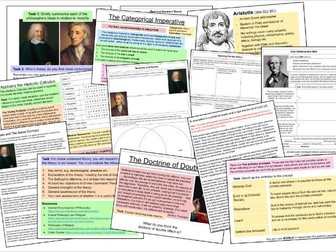
This is a complete resource and unit of work for the IB Philosophy study of the ethics optional unit. This resources covers the ‘normative ethics’ aspect of the specification.
It is a complete unit of work inclusive of powerpoints and student booklets to accompany each powerpoint - this greatly encourages student-led learning. It also includes information sheets and an example essay. The unit covers at least 20 hours of teaching (though I usually take a little longer as I teach this from September through to February!).
The resource covers six main normative theories, including explanations and evaluation of each one. It includes the points on the specification of moral principles, virtue / character based theories and deontological versus teleological theories, explored through the following theories:
Aquinas’ Natural Law
Divine Command Theory
Utilitarianism
Virtue Ethics
Kantian Ethics
Social Contract Theory
If you like this resource, please leave a review.
Happy teaching!
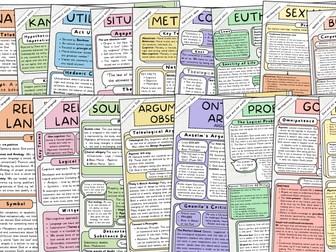
This is a bundle for both the ethics and philosophy knowledge organisers.
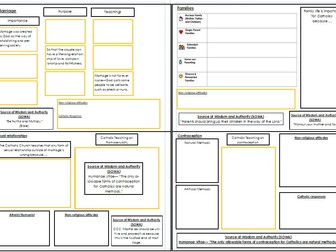
A set of knowledge organisers for A-Level Religious Studies focusing on the philosophy and the ethics strands only. They have been designed for the OCR specification but are likely appropriate for other exam boards too.
The knowledge organisers cover the whole OCR philosophy specification and the whole of the OCR ethics specification.
A great revision tool for students about to approach exams or to consolidate knowledge of a unit.
These make brilliant posters and also work very well on a phone screen to share with students!
For a complete list, please see the individual resources.
If you like these, please leave a review and happy teaching!
A comprehensive revision booklet covering both Judaism units (beliefs and teachings / practices) from the GCSE Edexcel Spec A course as well as both Philosophy and Ethics units (existence of God / relationships and family in the 21st century). For each of the four Edexcel units the booklet contains:
A specification checklist
A bullet point information sheet with accompanying comprehension questions (aimed at lower ability students)
An information sheet outlining the meaning and importance for each topic (aimed at addressing part B and C questions)
A source of wisdom and authority sheet with the exam board recommended SOWAs for students to fill in
Two A3 sized mind maps with a breakdown of each topic for students to populate
A key terms list with space for students to write definitions
All previous exam questions from the first specification paper until the 2022 paper.
This ‘Fun Philosophy Lesson’ explores the fascinating topic of identity, encouraging students to reflect on and debate philosophical and ethical questions about personal, social, and collective identity. This resource is suitable for students aged 8-16 and is ideal for Philosophy, Ethics, PSHE (Personal, Social, Health, and Economic Education), and Social Studies classrooms. It also supports your school’s SMSC (Spiritual, Moral, Social, & Cultural) education goals. Designed for universal use, it is perfect for educators in any country.
This download uses our innovative new format for philosophy education, you can download a FREE SAMPLE by clicking here. It is one of over fifty new philosophy & ethics teaching resources that uses this format. The resource cannot be edited.
This interactive, multi-use session is particularly engaging for teachers of Philosophy, Ethics, and Social Studies. It covers a broad range of captivating topics, including:
What it means to have a personal identity
The influence of culture, society, and relationships on identity
The concept of identity over time: are we the same person throughout our lives?
Collective identity: what defines a group or nation?
The philosophical puzzle of “what makes you, you?”
The big question posed in this session is, “What defines you as an individual?”
Students will explore other intriguing philosophical and ethical questions, such as:
Are we defined by our choices, our genetics, or our environment?
How do our relationships shape who we are?
Can identity change, and if so, how?
Is there a “true self,” or do we have many identities?
What happens to identity in a digital world?
Students will analyse and evaluate a range of philosophical claims, such as:
“Identity is fluid and constantly changing, not fixed or stable.”
“It is important to conform and fit in with everyone else”
"My identity has been influenced more by technology than by my parents”
“If I lost my memories, I would lose my identity entirely”
“It is impossible to ever really know someone else”
This session uses our signature teaching format, featuring an integrated menu with options for starters, mains, plenaries, assessments, and end-of-lesson reflections. The diverse activities—debates, discussions, and philosophical reflections—make the resource reusable for multiple lessons. Ideal for P4C (Philosophy for Children) sessions, it provides students with an engaging and thought-provoking opportunity to examine one of philosophy’s most timeless questions.
The file is provided as a non-editable PowerPoint Show, requiring no planning or preparation. Simply run the file, and the intuitive menu system ensures that delivering this inspiring philosophy session is straightforward and impactful!
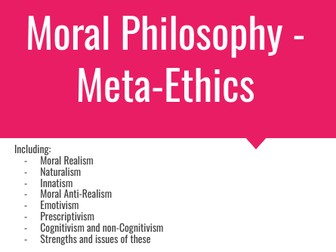
This resource contains all relevant materials for the ‘Meta-Ethics’ section of Moral Philosophy for the AQA A-Level Philosophy course. All theories, criticisms and defences are included alongside exam materials and questions to probe students for deeper thinking. For further activities, please use the official AQA A-Level Philosophy textbook.
Resource includes:
Moral Realism
Naturalism
Innatism
Moral Anti-Realism
Emotivism
Prescriptivism
Cognitivism and non-Cognitivism
Strengths and issues of these
Please note: any additional materials or images/videos use herewithin are not mine and I claim no ownership of them. Please use the URL to direct you to the original designer/creator.
This is a revision bundle on Kantian Ethics from the AQA A Level Philosophy Specification. It includes 4 lessons, covering Categorical and Hypothetical Imperatives; Kant and Duty; Applied Kantian Ethics; and Weaknesses of Kantian Ethics.
The sessions be used as either standard lessons or extra-curricular revision sessions. The lessons cover the content that students need to know for the exams and then has activities designed to consolidate learning.
Exercises include Tweet the Definition (where students examine key terms); Newsround (a mind map activity); The Weakest Link (a quiz); Thought for the Day (a blogpost writing activity); and the Big Questions (a debating exercise). There is also a homework assignment which you can use to assess learners’ progress.
These resources should make learning interactive, productive, and enjoyable, giving your students the chance to get the grades they deserve.
Help students understand how their learning in Philosophy/RS prepares them brilliantly for a diverse range of careers. Each job role includes a targeted description for what the subject does for us as workers. A brilliant way of attracting students in the post-AI job-market.
There are two versions available, one uses the term ‘Religious Studies’ and one uses the term ‘Philosophy’ throughout.
Included careers:
Law
Tech and AI
Academia
Government
Business
Finance
Journalism
Intelligence
Humanitarian
Education
Marketing
Ministry
Medicine
This resources contains all materials needed for Aristotelian Virtue Ethics, as part of the ‘Moral Philosophy’ section of the AQA A-Level Philosophy course. All theories, criticisms and defences are included, alongside relevant exam practice and questions to probe student understanding. For additional activities, please use the official AQA A-Level Philosophy textbook.
Resources includes:
Function of the soul
Moral responsibility
Virtue and vice
Doctrine of the Mean
The role of practical wisdom/reasoning
Eudaimonia
Strengths and issues
Application to the eight suggested scenarios
Please note: any additional materials or images/videos contained herewithin are not owned by me and I claim no ownership of them. Please follow the URL for direction to the original designer/creator.
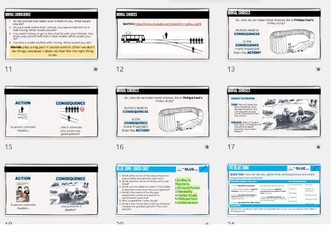
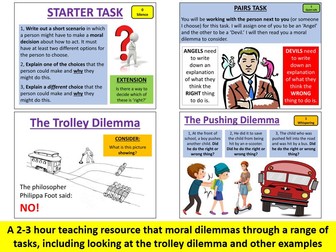
This resource helps students to consider the concept of moral dilemmas. There are tasks in which students are asked to consider how they would approach various dilemmas, Phillipa Foot’s ‘Trolley Dilemma’ is discussed in relation to absolutist vs situationist approaches and ideas around judging morality based on consequences or intentions are discussed. There is also a basic consideration of how religious groups may approach these ideas.
Overall, the (fully editable) PowerPoint is 32 slides in length and likely to take 2-3 lessons to complete. It was originally created to cover two 1-hour lessons, but always seems to take longer if you let the debates run!
A NOTE ABOUT MY POWERPOINTS:
All slides have information for delivery provided in the ‘Notes’ section.
Gold boxes contain information that can be read to the class; it’s also a good opportunity to select a student to read for literacy.
Blue ‘TASK’ boxes are always tasks to be completed (these may link to an extra resource that has been provided, such as a worksheet). There will also be a ‘sound level icon’ suggested for these (there is also a slide at the end full of sound levels icons that you can use to edit). Some tasks also have key careers/employability skills indicated.
Orange ‘CONSIDER’ boxes are questions that can be discussed as a class or in groups.
Green ‘EXTENSION’ boxes are extra work/challenge for those who complete the main blue box tasks or are otherwise ready for something more difficult.
Red boxes generally have some information hidden behind them and will reveal as you click through the PowerPoint.
NON SPECIALIST FRIENDLY PICK UP AND GO LESSON.
Thomas Aquinas and Natural Moral Law: KS3 Ethics / Religious Education (RE) / Religious Studies (RS) Lesson (PowerPoint)
Overview:
This fully-resourced KS3 lesson introduces students to the ethical theory of Natural Law developed by Catholic philosopher Thomas Aquinas. Students explore the Five Primary Precepts, the concept of morality, and how Aquinas’ ideas can be applied to real-life moral dilemmas. The lesson encourages critical thinking about absolutism, religious ethics, and the role of reason in decision-making.
What’s Included:
A 23-slide PowerPoint presentation with structured activities
DO NOW starter quiz with key vocabulary and moral definitions
Introduction to Aquinas’ life, beliefs, and the Five Primary Precepts
Vocabulary development around key terms like Natural Law, morality, ethics, precept, sanctity of life, and absolutism
Structured writing support using PEE (Point, Example, Explain)
A Blue Zone independent writing activity with success criteria, key words, and a challenge question
Model answer for review and improvement
Discussion prompts and real-world examples to deepen understanding
Learning Objectives:
Understand the ethical theory of Natural Law and its religious foundations
Explore how Aquinas’ Five Precepts guide moral decision-making
Reflect on the relevance of Natural Law in modern society
Develop extended writing skills through structured response tasks
Target Audience:
Key Stage 3 (KS3) students
Suitable for Year 9 or high-ability Year 8
Can be used as a standalone resource or part of a wider Ethics / Religious Education (RE) / Religious Studies (RS) curriculum
OCR A-Level Religious Studies A* Essay Plans: The Challenge of Secularism
✓ 4 Comprehensive Essay Plans
✓ Created by OCR A* Achiever
✓ AO1 Focused for Exam Success
✓ Specification-Aligned Content
Key Features:
• In-depth analysis of secularism and its challenges to religion
• Covers key thinkers like Freud, Dawkins, and McGrath
• Structured for logical argument development
• Incorporates all “learner should know” specification points
• Standalone resource - no additional notes needed
Perfect for A-Level students targeting top grades in OCR Philosophy & Ethics. Elevate your understanding of secularism with proven A* insights!
Fifth lesson in unit of work exploring what ethics is. Students will be exposed to the philosophies of Joseph Fletcher and his beliefs in Jesus’ teaching of “Love your neighbor”.
Features - On screen task management board for SEN students. Differentiated questioning for HAT/MAT/LAT students by Gold, Silver, Bronze task. Worksheets included in powerpoint ready to print.
OCR A-Level Religious Studies
Religion and Ethics, Philosophy of Religion and Development in Christian Thought
Summary/Revision A3 Sheets
Based on the OCR H573 Specification
Each A3 sheet refers to a topic found on specification
Each sheet contains a summary of the topic with strengths and weaknesses of each argument including other scholars views and quotes.
Notes made by me an undergraduate who completed the A-Level in 2019 with an A*.
Fun and exciting revision game for Philosophy and Ethics.
Life-sized 'Trivial Pursuit'-style game. Pupils move around the board game (floor space required!) and collect tokens (similar to the cheeses) for each of the 7 sections. The sections are:
1. Key Words
2. Exam Technique
3. Bible Quotes
4. Relationships (Issues of)
5. Life and Death (Issues of)
6. Human Rights (Issues of)
7. Good and Evil (Issues of)
The first team with all 7 tokens wins the game. Prizes dependent on you, of course!
You will need in addition to this pack: Dice, floor space and a sense of fun :)
Instructions are included in the download pack! Any other questions, please do not hesitate to get in touch!
Created with the WJEC / Eduqas RS GCSE in mind, though can be applied across specifications and qualifications. As an examiner for this specification, I have used what I know of the course to create this resource.
Please give feedback! I am always happy to respond to comments - whether positive or constructive - this will help to improve the quality of my resources in the future and, more importantly, the quality of pupils' RE/RS education in general - which is what we're all here for!
A complete collection of resources needed for studying Deontological Kantian Ethics for the AQA A-Level Philosophy course. This contains all relevant theories, criticisms and and defences. Whilst questions and activities are provided, please use the official AQA A-Level Philosophy textbook for additional activities.
Resource includes:
The Categorical Imperative
The Universal Law Formulation
The Humanity Formulation
Strengths and issues
Application to the eight suggested scenarios
Please note: any additional resources or images/videos contained herewithin are not mine and I claim no ownership of these. Please refer to the URL for direction to the original designer/creator.
Hi all,
Teaching META ETHICS for the first time here.
Here are my lessons on it. Each session contributes in my teaching about 2 hours each. So lessons could be cut down further if the the teacher needs too.
This unit was hard! But enjoyable in the end.
NON SPECIALIST FRIENDLY PICK UP AND GO LESSON.
What’s the Right Thing to Do?: KS3 Ethics / Religious Education (RE) / Religious Studies (RS) Lesson (PowerPoint)
Overview:
This fully-resourced KS3 lesson introduces students to moral decision-making through real-life case studies and philosophical thought experiments. Students explore whether consequences matter more than actions, using the famous Trolley Study by Philippa Foot and the historical case of Dudley & Stephens. The lesson encourages critical thinking, ethical debate, and personal reflection.
What’s Included:
A 22-slide PowerPoint presentation with structured activities
DO NOW starter quiz with moral statements for discussion
Case study: Dudley & Stephens (1884) – survival, murder, and moral justification
Thought experiment: Philippa Foot’s Trolley Study – sacrifice and the greater good
Vocabulary development around key terms like morality, consequence, action, superego, and justified
Structured writing support using PEE (Point, Example, Explain)
A Blue Zone independent writing activity with success criteria, key words, and a challenge question
Model answer for review and improvement
Video links and discussion prompts to deepen understanding
Learning Objectives:
Understand how philosophers and courts approach moral dilemmas
Explore the difference between actions and consequences in ethical decision-making
Reflect on personal values and how they influence moral choices
Develop extended writing skills through structured response tasks
Target Audience:
Key Stage 3 (KS3) students
Suitable for Year 9 or high-ability Year 8
Can be used as a standalone resource or part of a wider Ethics / Religious Education (RE) / Religious Studies (RS) curriculum
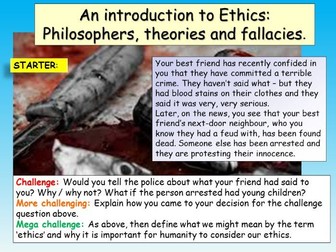
An introduction to ethics at A-Level, discussing the differences between deontological and teleological decision making processes. Some examples adapted from a previous TES resource.
Based around the question 'What is Philosophy and Ethics?', this display looks at RE/ Philosophy & Ethics from different viewpoints: politics, maths, history, writing, science etc to show why RE/ Philosophy & Ethics is important today!
A detailed scheme of work created for our [Introduction to Religion, Philosophy and Ethics Unit] which covers one term’s resources and includes an assessment and mark scheme. This was created for our Complete Year 8 RE package, which can be found on Tes here.
Who are EC Resources?
EC Resources are the top TES PSHE providers and are a group of teachers who work together to create easy to use, high quality and editable lessons and units of work. We have created lessons for The Bank of England, The Children’s Commissioner, MACS Charity, Tes, LikeToBe Careers, the Criminal Cases Review Commission (UK Gov) and have also completed PSHE and Citizenship commissions for schools across the UK.
Complete KS3 PSHE and RSE
Complete KS4 PSHE and RSE
One Year of KS5 PSHE and RSE
One Year of Citizenship and British Values
Complete Year 7 and 8 RE
Complete Careers and Employability
AQA Citizenship GCSE Mega Pack
You can contact us at info@ecpublishing.co.uk
Teaching PSHE, RE or Citizenship GCSE next year? Why not join our Citizenship and PSHE teachers Facebook group, with 8000 other teachers, for guidance, advice and resource sharing.