How Plants Use GlucoseQuick View
OuttheBoxScience

How Plants Use Glucose

(0)
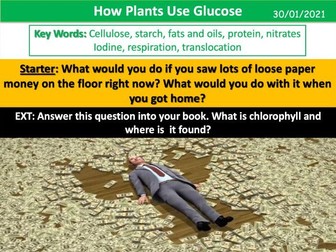
AQA Combined Science Trilogy unit ‘Bioenergetics: Photosynthesis’ Full lesson ready to use straight ‘out of the box’. Though designed for teachers to deliver (specialist and non-specialists), the lessons are structured in an intuitive way for students to navigate for independent/ remote learning/ homework covering missed content/recap Similar structure to my other power points following the input - activity - review phasing plenary sections for progress checking Clear learning objectives and outcomes Modern and engaging layout Little adaptation needed Covers an hour lesson of content matched to the specification 33 ppt slides Please give constructive feedback :D
What Plants NeedQuick View
tecimener

What Plants Need

(0)
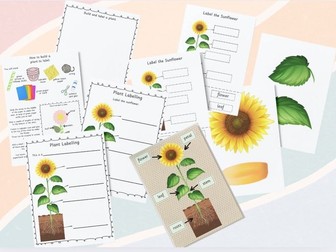
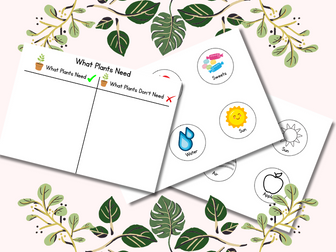
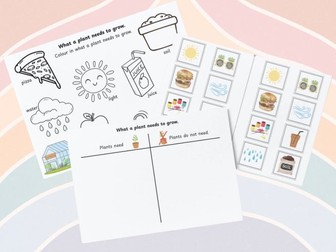
Contains sorting mat with sorting cut out objects: soil water sun air sweets apple paint cake cut out discs
Tissues and Organs in PlantsQuick View
OuttheBoxScience

Tissues and Organs in Plants

(2)
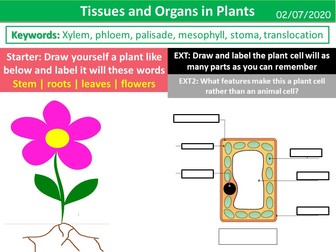
AQA Combined Science Trilogy unit ‘Organising Animals and Plants’. Full lesson ready to use straight ‘out of the box’. Similar structure to my other power points following the input - activity - review phasing Plenary section for progress checking Differentiated worksheets Clear learning objectives and outcomes Modern and engaging layout Little adaptation needed Covers an hour lesson of content matched to the specification 31 ppt slides Constructive feedback welcome :D
A Level Biology: Plant Responses (Plant Hormones)Quick View
beckystoke

A Level Biology: Plant Responses (Plant Hormones)

(2)
A visually appealing and well laid out A level worksheet pack focusing on plant responses and the plant hormones involved. There are three worksheets included in the pack, designed for pupils to work through independently. Once completed these worksheets will create a set of useful and detailed revision notes for students. Worksheets cover the following: Overview of plant responses and the roles of the 5 main plant hormones. This worksheet comes with 5 information sheets, one for each hormone, that pupils can use to complete the table element of the worksheet. Plant responses to the environment Types of plant response (tropisms) Answer sheets are provided for all three worksheets.
Eukaryotic, Prokaryotic, Animal and Plant CellsQuick View
BrainJar

Eukaryotic, Prokaryotic, Animal and Plant Cells

(0)
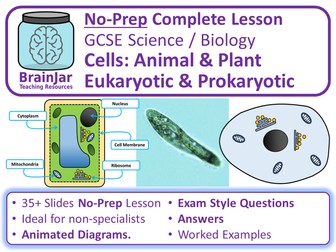
Complete No-Prep lesson with exam questions, tasks and answers on Eukaryotic, Prokaryotic, Animal and Plant Cells for AQA GCSE (9-1) Science / Biology. This lesson covers all of AQA GCSE Biology / Combined Science 4.1.1.1 and 4.1.1.2. except for estimating the size or area of sub-cellular structures, which I have included in the lesson on microscopes later in the sequence. As a Secondary Science teacher, Deputy Headteacher, writer and examiner for many years I make high quality no-prep lessons so busy teachers can teach outstanding lessons without spending hours planning. This high quality lesson includes explanations, different types of in-lesson assessment (all with answers) and unique exam questions. In my lessons I take learners on a journey that builds up their understanding step by step, while still going into a lot of depth. The preview video shows a representative sample of slides from the resource so that you get a good idea of what it includes before you buy. What’s Included: • Teaching notes • Starter / Do Now Activity • Explanation slides in “chunked” sections with animated diagrams. • Worked examples of calculations / questions. • Multiple questions in different question styles and difficulties - no need for worksheets. Each “chunked” explanation section typically includes a set of “learning check / quick questions” followed by a set of in-depth questions on the learning from that “chunk” of the lesson. All questions have answers. • Exam-style questions on the whole lesson at the end of the lesson- these are unique, based on real exam questions but not just copied from exam boards. • Answers for all questions • All easily editable to adapt to your teaching or to use in existing lessons. • Slightly humorous, at points, if you like that sort of thing. The lesson was written for AQA GCSE Science / Biology but is very likely to be applicable to other exam specifications. Please leave a rating / review and all other feedback gratefully received!
Plants and their Reproduction Revision SpreadQuick View
jonathanmitchell

Plants and their Reproduction Revision Spread

(0)
KS3 Science Edexcel Yr8 Revision Spread and Answer Sheet - Biology: Topic 8B Plants and their Reproduction. This A4 revision spread condenses the Edexcel topic 8B onto one A4 sheet which can be printed off and filled in to aid revision and help summarize the topic. A full answer sheet is provided which can be used to mark the filled in revision spread and can also be used as a revision poster.
Xylem and Phloem Worksheet: Plant TransportQuick View
bethgrace2312

Xylem and Phloem Worksheet: Plant Transport

(0)
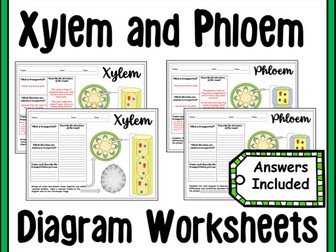
Xylem and Phloem Diagram Worksheets Xylem worksheet and answer sheet Phloem worksheet and answer sheet “Bold summary worksheets which outline everything you need to know about the xylem and phloem at high school level.” The worksheets include questions on the following: Describe vessel structure State which substances are transported Describe the direction of transport in the vessel Describe the process of transportation Compare the xylem and phloem through a Venn diagram Identify xylem and phloem location in the stem Answer sheets are included. The resource is editable and set up in A4 format. Many thanks! - Science House
Year 2 Science Poster - PlantsQuick View
mrajlong

Year 2 Science Poster - Plants

(0)
Please click here for the complete Year 2 Science Posters resource. This is a poster to reinforce the year 2 science topic: Plants. The beautifully designed poster is packed full of information and can be either used for revision or as part of a display in your classroom. PLEASE NOTE: The misalignment in the 2nd preview (the Word version) is not a reflection of how it looks, but a TES issue with generating previews. Objectives covered: Observe and describe how seeds and bulbs grow into mature plants Find out and describe how plants need water, light and a suitable temperature to grow and stay healthy
B6 Plant Structures and their functionsQuick View
nikkikent

B6 Plant Structures and their functions

(0)
Edexcel 9 - 1 B6 Plant structures and their functions Full Powerpoint covering all aspects of this module. Easy to adapt to other specifications Presentation includes Literacy, graph drawing skills and assessments with model answers.
Using plant hormonesQuick View
CMGsSciencelessons

Using plant hormones

(0)
Using plant hormones is a comprehensive lesson designed to help GCSE students develop their understanding of how plant hormones are used in agriculture and horticulture through engaging activities and differentiated instruction. This lesson is the 10th in a series of lessons and covers the content from the AQA 4.5.4.2 Uses of plant hormones lesson (B5 Homeostasis and response unit), and AQA GCSE Biology OUP Scheme B11.10 Using plant hormones lesson (B11 Hormonal coordination chapter). The lesson includes all necessary resources, making it easy to implement in your classroom and the lesson’s text is adaptable, allowing you to adjust the duration and depth of the activities based on your students’ progress and time constraints. Presentation contains (19 slides): ● Lesson Prep and Technician Notes: Guidance notes for teachers to prepare the lesson and technician instructions. ● Bell Work / Do Now Activity: Engaging task to activate student prior knowledge and set the stage for the lesson. ● Clear Lesson Aim, Objectives & Success Criteria: Explicitly defined learning targets to guide students and measure their understanding. ● Discussion Slides: Thought-provoking prompts and questions to introduce the topic. ● Information Slides with Levelled Content: Varied levels of information catering to diverse learning styles and abilities. ● Differentiated Activities (Group Work): Collaborative tasks in small groups to encourage active participation and enhance learning. ● Differentiated Questions with Answers: Comprehensive questions with accompanying solutions for self-assessment and note-taking. ● Student Worksheets/Handouts: Printable materials for students to complete and gather notes. Aimed at a higher ability class covering content 5-9, with two levels of demand to accommodate different learning styles and levels: ● Level 1: Low demand ● Level 2: Standard demand ● Level 3: High demand If you require more assistance, please contact me at- info@cmgsciencelessons.com
Specialised Cells Plant and Animal WorksheetQuick View
bethgrace2312

Specialised Cells Plant and Animal Worksheet

(0)
Specialized Cells - Plants and Animals Activity Worksheet This resource can be used for: An introductory/summary task Homework Independent work Revision task Finisher activity Research task Included in this resource are two specialized cell worksheets: Specialized cells in plants (including root hair cells, palisade cells, xylem cells and phloem cells) Specialized cells in animals (including sperm, egg, blood cells, muscle cells, nerve cells, ciliated cells and villi) The worksheets focus on identifying the specialized cells, adding labels to cells, describing the jobs of the cells and how they are adapted to their function. Both worksheets are completely editable and A4 in size. Comprehensive answer sheets are provided for both worksheets (can be used for teacher or student use). American spellings are used in this resource. Many thanks - Science House
Mass Transport in Plants A-Level BiologyQuick View
gilliancsmith

Mass Transport in Plants A-Level Biology

(2)
Included are three lessons on the mass transport of substances in plants, following the AQA A-Level Biology Specification Reference 3.3.4.2. Lesson 1: Transport in the Xylem Lesson 2: Transport in the Phloem Lesson 3: Investigations and Exam Practice They include suggested tasks that allow students to go above and beyond the specification to develop their skills in reading academic literature and carrying out their own research.
Plant Minerals KS3 Activate ScienceQuick View
ychebbout

Plant Minerals KS3 Activate Science

(0)
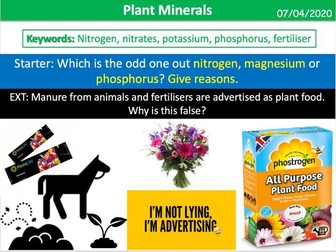
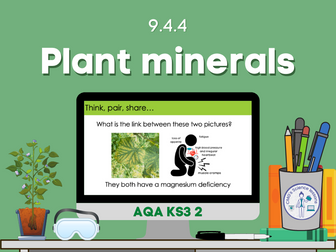
Perfect lesson resource for KS3 Biology! A fully differentiated and resourced lesson that assists students in learning about the minerals plants need to survive. Students will state the four minerals needed for healthy plant growth, describe the function of minerals and symptoms of mineral deficiency, and explain why fertilisers are used by farmers. The resource includes a detailed and engaging lesson PowerPoint with differentiated activities, worksheets, and quizzes for students to complete. This resource is part of the Ecosystem processes topic and has been created for the delivery of the Activate KS3 Science course. Also great for GCSE Science. 18 slides in total for the lesson PPT
Plant and Animal Cells KS3 Activate ScienceQuick View
ychebbout

Plant and Animal Cells KS3 Activate Science

(0)
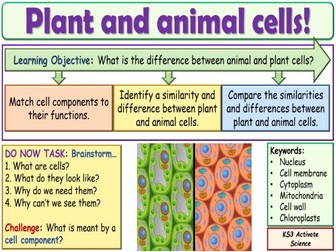
Perfect lesson resource for KS3 Biology! A fully differentiated and resourced lesson that assists students in learning about the difference between animal and plant cells. Students will describe the function of cell components, and compare the similarities and differences between plant and animal cells. The resource includes a detailed and engaging lesson PowerPoint with differentiated activities, worksheets, information sheets and quizzes for students to complete. This resource is part of the cells topic and has been created for the delivery of the Activate KS3 Science course. Also great for GCSE Science. Included: 23 slides in total for the lesson PPT 15 slides for the quiz PPT Cell component information sheets and worksheet for students to complete Literacy and grammar success criteria sheet
Plants Provision Area Skills Adult RoleQuick View
misslucas_eyfs

Plants Provision Area Skills Adult Role

(1)
EYFS and KS1 - Plants Provision Area Skills Adult Role Skills, Adult role and questions for each area in Early Years -Mark marking / writing Phonics Reading Small World Construction Maths Creative Malleable Role play Home corner Investigation Music Sensory Funky fingers Sand Water Mud Kitchen Trikes Natural garden
Plant TransportQuick View
horozuka

Plant Transport

(12)
Assessment for plant transport topic. Covers the vascular bundle (in root, stem, and leaf), water uptake, translocation, and transpiration
Animal and Plant CellsQuick View
fiendishlyclever

Animal and Plant Cells

(22)
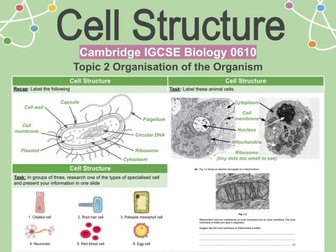
Pupils must identify and label diagrams of animal and plant cells. Like all my worksheets this was intended to be used with SEN students (L1-3). Edit: I have modified this worksheet taking on board the comments left for this resource and improving the terms used.
Plant AdaptionQuick View
fiendishlyclever

Plant Adaption

(3)
Why do different plants live in different places? Pupils must identify the features on these plants which show they have adapted to their environment.