A fully differentiated and resourced lesson that supports students as they analyse two unseen poems and answer both unseen poetry questions (24 marks and 8 marks) in preparation for AQA English Literature Paper 2. With the exam only a few weeks away it is amazing how many schools focus so much of their energies on the anthology poetry in Power and Conflict and Love and Relationships but seem to sideline Unseen Poetry when it is worth 32 marks in total. This lesson is definitely worth getting if you want to help build students’ independence rather than them relying on you to spoon feed them all the necessary information.
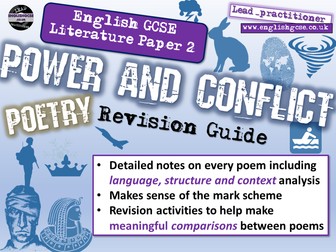
REVAMPED! Power and Conflict revision guide that comes in a fully editable PowerPoint or a printable PDF for students, parents and teachers. A fully differentiated revision guide for KS4 students looking at the AQA Power and Conflict GCSE Poetry Anthology for Literature Paper 2. The revision guide includes differentiated activities for every poem, including:
The Prelude; Storm on the Island; Exposure; The Charge of the Light Brigade; Bayonet Charge; Remains; Poppies; War Photographer; Kamikaze; Ozymandias; London; My Last Duchess; The Émigrée; Checking Out Me History; Tissue.
Now includes revision activites to help compare poems and make meaningful comparisons, as well as a guide to the mark scheme and what the examiners are looking for in your answers.
2025 Unseen Poetry model answer for BOTH questions on Table by Robert Hull and Like a Beacon by Grace Nichols.
This model essay is designed to hit the requirements for Grade 9 for AQA English Literature Paper 2. Includes two answers that weaves together language and structure analysis, relevant comparisons how and why the two writers present their poems in relation to home and family.
Please leave a review if you are able to. Have a query or question? Get in touch at info@englishgcse.co.uk
Please note that this resource pack does not contain the exam paper or the question. This is a teaching aid designed for educators who have access to the papers themselves.
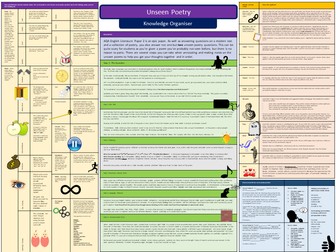
A fantastically detailed unseen poetry knowledge organiser / revision mat that includes a step by step approach to both AQA English Literature Paper 2 unseen poetry questions, language analysis, structure and form analysis, and key content information, as well as detailed info on meter, language, rhyme, scaffolded answers and more. Fantastic revision materials for GCSE students for AQA English Literature Paper 2 students. The resource includes an editable PowerPoint AND a PDF file to make things easier to print out onto A3 paper.
UPDATE: Now includes a four page A4 version for ease of printing and could be used for revision flash cards, too!
Check out our English Shop for loads more free and inexpensive KS3, KS4, KS5, Literacy and whole school resources.
AQA English Language Paper 1 and Paper 2 Knowledge Organisers
AQA English Language Paper 1 Section A package
AQA English Language Paper 1 Sections A and B package
AQA English Language Paper 1 package
AQA English Language Paper 2 Question 5 package
AQA English Language Paper 1 Question 5 package
AQA English Language Paper 2 Section A package
AQA English Language and English Literature revision package
An Inspector Calls whole scheme package
An Inspector Calls revision package
Macbeth whole scheme package
Macbeth revision package
A Christmas Carol whole scheme package
A Christmas Carol revision package
Jekyll and Hyde whole scheme package
Jekyll and Hyde revision package
Romeo and Juliet whole scheme package
Power and Conflict poetry comparing poems package
Power and Conflict poetry whole scheme package
Love and Relationships poetry whole scheme package
Unseen Poetry whole scheme package
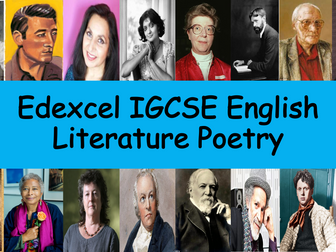
This bundle consists of 16 thoroughly planned lessons that take students through all 16 poems in the Edexcel IGCSE English Anthology.
List of poems covered:
‘If-’ by Rudyard Kipling
‘Prayer Before Birth’ by Louis MacNeice
‘Blessing’ by Imtiaz Dharker
‘Search for my Tongue’ by Sujata Bhatt
‘Half-past Two’ by U A Fanthorpe
‘Piano’ by D H Lawrence
‘Hide and Seek’ by Vernon Scannell
‘Sonnet 116’ by William Shakespeare
‘La Belle Dame sans Merci’ by John Keats
‘Poem at Thirty-Nine’ by Alice Walker
‘War Photographer’ by Carol Ann Duffy
‘The Tyger’ by William Blake
‘My Last Duchess’ by Robert Browning
‘Half-caste’ by John Agard
‘Do not go gentle into that good night’ by Dylan Thomas
‘Remember’ by Christina Rossetti
Also included: a powerpoint outlining the way to structure a comparative essay, model answers and exam practice.
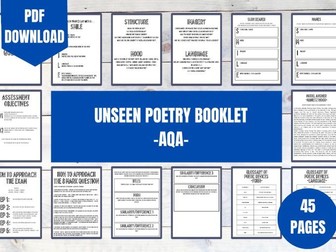
This comprehensive AQA Unseen Poetry Workbook is designed to help students build confidence and excel in their poetry exam. Packed with expert guidance, practical exercises, and useful resources, this workbook provides a clear and structured approach to tackling unseen poetry in the AQA English Literature exam.
Key Features:
Assessment Objectives: A breakdown of the key assessment objectives (AOs) for unseen poetry, helping students understand what the examiners are looking for and how to meet these criteria in their responses.
How to Tackle the Exam: Step-by-step strategies for approaching the unseen poetry exam, from reading the poem carefully to planning and structuring your answer.
24-Mark Question Practice with Scaffolded Guidance: Practice questions based on past exam-style prompts, with scaffolded guidance to help students approach their analysis.
8-Mark Question Practice with Scaffolded Guidance: Similar to the 24-mark question practice, this section includes targeted 8-mark questions with step-by-step guidance on how to effectively respond within a shorter, more focused framework.
Model Answers for Both 24-Marks and 8-Marks: Model answers for both 24-mark and 8-mark questions, showing students how to craft well-developed, coherent, and insightful responses. These examples demonstrate the level of detail and analysis required to achieve high marks.
Form, Structure, and Language Glossary: A useful glossary of key terms related to form, structure, and language. This includes definitions and examples of literary devices, structural features, and language techniques, helping students to confidently discuss how these elements contribute to the meaning and impact of the poem.
With this AQA Unseen Poetry Workbook, students will have all the tools they need to approach their unseen poetry exam with clarity and confidence. Whether you are working through practice questions, reviewing model answers, or learning how to analyze form and language effectively, this workbook is an essential resource for success.
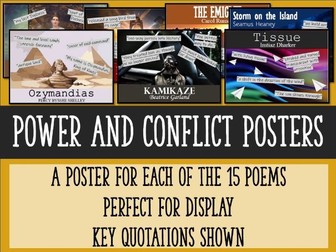
A set of 15 posters for each of the poems in the 'Power and ‘conflict’ cluster. Each poster includes key quotations from the poem. Simply print, laminate and display!
This lesson is an introduction to poetry for KS3 class.
It focues on the meaning of poetry and poetic devices with a small practice poem at the end of the powerpoint to get them used to annotating and analysing poems.
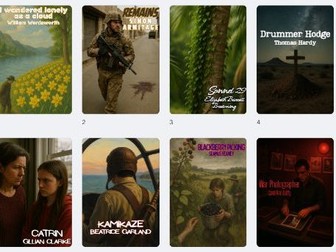
A great visual resource for your display boards - All 15 poems for the new GCSE English Literature poetry anthology by Eduqas brought to life.
Avaiable in both PDF and PNG
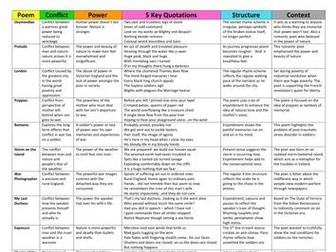
This popular revision sheet that I created back in 2016 has achieved 791 sales. I have updated and expanded it in subsequent years. It contains concise notes for all 15 poems under the following headings:
Power
Conflict
Key quotations
Structure
Context/Message
In addition to the main resource, there are various differentiated suggestions and resources to ensure students use the revision grid effectively.
I have added an enhanced version for 2025 which includes explanations of the top 5 quotations for each poem and a PowerPoint full of ideas about how to use the knowledge organiser to revise.
There are 3 differentiated accompanying worksheets that direct students towards effective use of the revision grid by writing the opening to a range of questions with different levels of prompting.
Includes 15 sample AQA style questions (one per poem) and PowerPoint containing some annotations for every poem.
You may wish purchase this as part of a power and conflict bundle which also includes lots of other revision resources on the poems along with several writing frames.
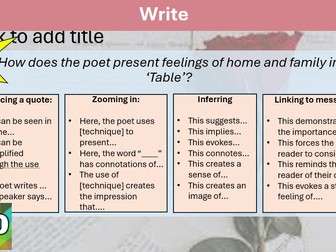
Lesson 1: Unseen Poetry 24-Mark Question – Table by Robert Hull (AQA, June 2025)
Overview
A fully guided lesson designed to help students confidently approach the 24-mark unseen poetry question in the AQA exam. Using the June 2025 set poem Table by Robert Hull, this lesson breaks down the process step by step, providing the perfect balance of support and challenge.
Key Features
Guided walk-through of how to approach the question.
Scaffolded tasks to explore meaning, language, structure and effect.
Clear modelling of how to plan and structure a 24-mark response.
Strategies to build independence and exam technique.
What’s included
✔ Complete PowerPoint lesson
✔ Structured activities with built-in scaffolding
✔ Exam-style question and writing guidance
Why this resource?
Saves planning time with a ready-to-use lesson.
Builds confidence for a challenging exam question.
Suitable for whole-class teaching, cover or focused revision.
Engages students with a supportive, step-by-step approach.
Lesson 2: Unseen Poetry 8-Mark Comparison – Table and Like a Beacon (AQA, June 2025)
Overview
This focused lesson supports students in tackling the shorter, 8-mark unseen poetry comparison. Using Table by Robert Hull and Like a Beacon by Grace Nichols from the June 2025 AQA exam, the lesson models a clear approach to comparing poems under timed conditions.
Key Features
Step-by-step guidance on how to compare ideas and methods.
A model comparison paragraph for students to annotate and evaluate.
Scaffolding to support students in crafting their own response.
Practical exam strategies to maximise marks in limited time.
What’s included
✔ Complete PowerPoint lesson
✔ High-quality model response for annotation
✔ Comparison activities with clear success criteria
✔ Exam-style practice question
**Why this resource?
Provides targeted preparation for the 8-mark question.
Includes a model answer to help students understand exam expectations.
Encourages active engagement through annotation tasks.
Flexible for revision, homework, cover or classroom teaching.
This Poetry Comparison Grid is an essential resource for Edexcel IGCSE English Literature students studying the Poetry Anthology. It provides a structured framework for comparing key poems across thematic links, making it an invaluable revision tool.
Key Features:
Covers major themes such as resilience, fear, identity, childhood, memory, isolation, love, betrayal, suffering, mortality, love and loss, power, and control
Organizes poems thematically to aid comparative analysis
Includes key anthology poems such as Do Not Go Gentle into That Good Night, War Photographer, My Last Duchess, La Belle Dame sans Merci, and more
Supports students in structuring comparative essay responses for Edexcel IGCSE English Literature Paper 1
Ideal for use in lessons, independent study, or revision sessions
This grid helps students identify common themes, develop detailed comparisons, and strengthen their analytical skills for the Edexcel IGCSE exam.
Leave a review and we will email you a FREE resource for poetry comparison . Just get in touch at englishexcels@gmail.com once you’ve left your review.
If you are having access issues to the resources then please don’t leave a review, it’s not the author’s fault! Just email us at englishexcels@gmail.com and we can help :)
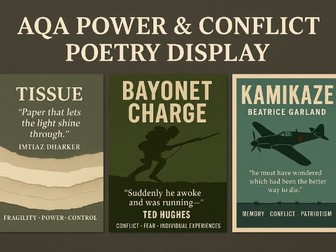
AQA Power & Conflict Poetry Display Pack
Minimalist Posters for GCSE English Literature
Transform your English classroom with this beautifully designed set of A4 / A3 printable posters for the AQA Power & Conflict anthology. Each poster features:
The poem title and poet’s name
A key quotation from the poem
2 - 3 key themes
A clean, modern minimalist design inspired by vintage war and literature posters
Perfect for displays, revisions boards, and classroom discussion, these posters will help students visually connect each poem to its core ideas and message.
Included in this pack:
All 15 Power & Conflict poems (and title page)
Ready-to-print PDF formats
Neutral classroom-friendly colours (no ink-heavy backgrounds)
Matching typography and layout for a cohesive classroom look
Perfect for:
Display boards and revision corners
English literature classrooms
Student study aids and wall visuals
Teachers who want a professional, cohesive display set
A full, differentiated poetry scheme of work for year 7. Covers 18 lessons.
Includes:
Two differentiated PowerPoints for ‘more able’ (MA) and ‘less able’ (LA) with prompts and answers in the ‘Notes’ section
Brief context and history of poetry focusing on earliest poems and purpose/context of nursery rhymes
Introduction to key forms (haiku, free-verse, lyric and narrative)
Introduction to poetic devices
Introduction to key conventions of poetry (form, mood, language and structure)
Application of poetic conventions and analysis to key poems centered around the theme of ‘Growing Up’ (‘Mrs Tilscher’s Class’, ‘I Wandered Lonely as a Cloud’, ‘Nettles’ and ‘Riding Downhill on a Bicycle’)
Worksheets and planning sheets to prepare for an analytical assessment on ‘Riding Downhill on a Bicycle’
Planning sheets for writing their own poem
A medium term plan document
A resource with worksheets providing an introduction to poetry, including different poetic forms and poem types, features, and exercises to students to write their own poems.
Students are shown a definition and example of a poetic technique on the PowerPoint. They need to write down which poetic technique they think is being described. Answers are multiple choice to support lower ability students.
This quiz would suit a high-ability KS3 class, as well as KS4 and KS5 as revision.
Techniques covered:
• alliteration
• symbolism
• metaphor
• sibilance
• enjambment
• simile
• free verse
• assonance
• imagery
• allusion
• personification
• rhyme
• onomatopoeia
• rhythm/meter
• anaphora
• juxtaposition
Did you find this resource helpful? Please consider leaving the resource a quick review to help others decide whether they should download it too. Thanks in advance :)
This resource is a comprehensive, student-friendly guide to the poetry of Elizabeth Bishop, designed specifically for Leaving Certificate Higher-Level English students. It provides structured, accessible analysis of all prescribed poems, with a clear focus on themes, Bishop’s unique style, and how her poetry can be effectively discussed in exam answers.
What’s Included?
Detailed Poem Summaries – Each prescribed poem is summarised in a way that highlights key themes, ideas, and poetic techniques.
Key Quotes & Analysis – Important quotations from each poem, accompanied by clear explanations of their significance.
Exam-Focused Commentary – Each section is written with the Leaving Certificate exam in mind, helping students engage with the material in a way that will benefit them in their essays.
Step-by-Step Essay Guidance – A structured approach to answering common Leaving Cert poetry questions on Bishop, with sample answers coded to highlight key aspects of analysis.
Marking Schemes & Assessment Criteria – Includes a breakdown of how Bishop questions are marked, giving students and teachers a clear understanding of what examiners are looking for.
Practice Questions – A selection of past exam questions and new questions designed to encourage deeper thinking about Bishop’s poetry.
Why This Resource?
This booklet saves time for both students and teachers by presenting all necessary material in one structured document. It encourages students to engage meaningfully with Bishop’s poetry while developing their ability to write strong, focused exam answers. The language is clear, the analysis is insightful, and the layout is designed for ease of use in both classroom teaching and independent study.
Perfect for teachers preparing their classes or students looking for a solid, reliable study guide to boost their confidence in answering poetry questions on Elizabeth Bishop.
A collection of poems with questions getting gradually more difficult as students work their way through. Aimed at KS4 for unseen poetry analysis practice. Guidance on how to revise and where to find more unseen poems at the end of the booklet.


 Quick View