This 12 slide PowerPoint explores the essential elements of The Paper Birds Theatre style.
With practical tasks as well as in-depth information, these lessons (which can spand over 4 hours) will help ensure students fully understand his style.
The lessons are structured to help students not only understand the style, aims and techniques but also how to devise their own work within the style.
Essential for any GCSE/ BTEC/ A Level/ IB Drama and Theatre student.
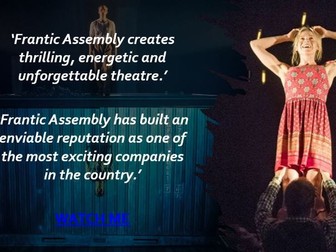
This 18 slide PowerPoint explores the essential elements of Frantic Asssembly’s theatre including Round-by-Through, Hymns Hands etc!
With practical tasks as well as in-depth information, these lessons (which can spand over 4 hours) will help ensure students fully understand this style.
The lessons are structured to help students not only understand the style, aims and techniques but also how to devise their own work within the style.
Essential for any GCSE/ BTEC/ A Level/ IB Drama and Theatre student.
This is an excellent resource to display in any Drama studio and Drama classroom. They outline several important theatre practitioners and the key elements that make up their approach to creating theatre.
Excellent for KS4, A-level, B-Tec and even degree level.
They look fantastic blow up to either A3 or A2.
16 of the world’s leading theatre companies and practitioners.
Berkoff
Brecht
Paper Birds
Artaud
Boal
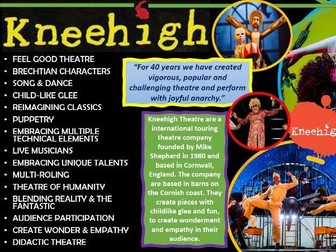
Kneehigh
Wise Children
Frantic Assembly
Told by an Idiot
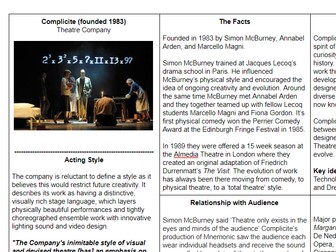
Complicite
Frantic Assembly
John Godber
Rashdash
Spymonkey
Splendid Productions
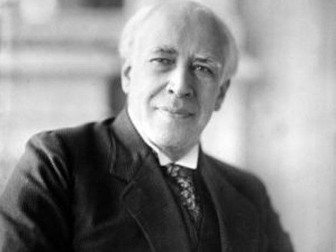
Stanislavski
Gecko
Stanislavski "NATURALISM" drama poster to use as a handout or as a poster. US and UK spelling both included. This resource also comes as part of a drama poster bundle with the following theatre / theater practitioner posters included:
1. Artaud THEATRE / THEATER OF CRUELTY
2. Stanislavski NATURALISM
3. Strasberg METHOD ACTING
4. Brecht EPIC THEATRE / THEATER
5. Grotowski POOR THEATRE / THEATER
6. Meyerhold BIOMECHANICS
7. Bogart VIEWPOINTS
8. Boal THEATRE / THEATER OF THE OPPRESSED
UPDATED SEPTEMBER 2026
Now includes a new 14-sheet printable Student Resource Pack, five neutral duologues, a revised 50-mark assessment and a complete teacher marking guide. Existing purchasers can download the updated files through their TES purchases.
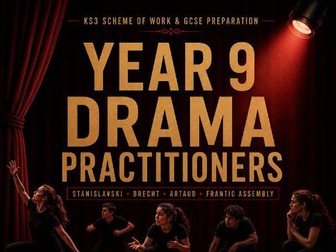
A ready-to-teach eight-lesson Year 9 Drama scheme introducing students to four influential practitioners and theatre companies through practical rehearsal, devising and performance.
Designed to bridge KS3 Drama and GCSE study, the unit explores:
Stanislavski: realism, Magic If, objectives and subtext
Brecht: Epic Theatre, gestus, placards and direct audience address
Artaud: sensory theatre, atmosphere and audience impact
Frantic Assembly: physical theatre, Chair Duets and movement motifs
Included:
Complete scheme overview
Eight detailed lesson plans
74-slide student-facing PowerPoint
14 printable worksheets, planners and activity cards
Four practitioner fact sheets
Five neutral duologue scenes
Revised 50-mark examination
Teacher answers and marking guide
Practical safety and adaptation guidance
Suitable for Year 9 Drama, practitioner units, devising work and KS3-to-GCSE preparation. Built from practical classroom and rehearsal-room experience, the scheme develops performance skills, collaboration, reflection and confident use of drama terminology.
Continue the Practitioner & Devising Pathway
Direct Like a Practitioner
Year 9 Drama Directing Toolkit
Advanced Drama Practitioners Bundle
GCSE Drama Devising Phases System
If this resource supports your classroom or rehearsal process, a short review helps other Drama teachers discover practical practitioner resources.
A power point outlining the key concepts, historical information and practical activities of 5 practitioners.
Stanislavsky, Brecht, Lecoq, Berkoff, Artaud.
The information has been collated from various my experiences, books and information online.
It was created with the year 13 unit 4 preparation in mind. Specifically for section A on Lysistrata.
It can be adapted to suit any group.
It’s a 200+ page comprehensive guide designed to support Early Years Lead Practitioner apprentices and practising early years leaders in England.
It covers key areas including:
child development
safeguarding and child protection
SEND and inclusion
the EYFS
theories of learning and play
pedagogy and enabling environments
reflective practice
leadership and managing change
partnerships with families and professionals
quality improvement and inspection
legislation and professional practice
It also includes practical guidance, chapter summaries and reflection questions throughout.
Fact sheets for each practitioner covered by the new Edexcel course for component 1.
This includes Brecht, Berkoff, Stanislavski, Joan Littlewood, Complicite, Kneehigh, Boal, Punchdrunk, Artaud and Frantic Assembly.
SOW introducing the students to the theatre practitioners Stanislavski, Brecht, Berkoff and Artaud. Students will spend two lessons on each practitioner rehearsing their influences on theatre to enable them to reach the higher levels should they continue with Drama at GCSE level. Students are assessed on Devising, Performance and Writing in this half term.
Texts and resources needed:
Self-Assessment sheets, SOW Assessment grids,
Assessment outcomes and criteria:
• Written Assessment: Students in 9Ldr1 – 9Ldr3 will be expected to keep a log book of everything they have completed in lessons before completing comparison questions on the practitioners. Students in 9Ldr4 – 9Ldr6 will just be completing a written self assessment this half term.
• Practical Assessment: Students to be assessed on their performing ability in front of the class and their ability to perform in the style of a theatre practitioner. Assessment is practical and as part of mixed ability group.
• Devising Assessment: Students to be assessed on their ability to devise a performance.
• Variety of peer and self-assessment opportunities when practicing and performing during lessons.
The resource pack includes a range of unique, creative and engaging A-Level practitioner workshops on Kneehigh, Complicite, Brecht and Frantic Assembly.
It also includes a breakdown of the A-Level devising component and a range of engaging and thought-provoking stimuli to spark creative ideas.
The package is complete with lesson plans which will take your pupils through the entire devising process. It comprises retrieval practice starters, fun warm-up activities, improvisation games, practical tasks and homework that will allow pupils to develop their ideas throughout the devising process.
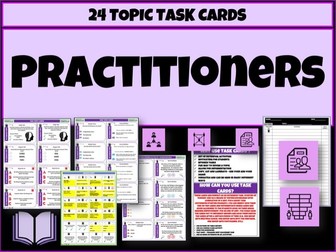
These 24 Practitioners task cards are perfect for your Drama (or English) lesson plans and topic. They are suitable for secondary students. They feature different activities including knowledge retrieval practice, multiple choice and spot the mistakes amongst other Drama related activities.
Contents of Drama Knowledge Retrieval Topic Task Card bundle
1 x Set of 24 Different topic Task Cards with a range of activities and styles in PDF
1 x Teacher answer sheet - All answers covered
2 x Student fill in activity sheets that can be used with the cards (optional)
How to use Knowledge Retrieval Topic Task Cards?
These cards are perfect as an extension task, starter or plenary and as a means of testing knowledge upon completion of a unit. For a short task (extension/starter/plenary), you can simply give them one or two cards and differentiate which cards are given according to the students level or their areas needing improvement. For an end of unit, you could hand the cards out to different groups and have them switch the cards after a certain period of time (e.g. one group gets multiple choice, one group gets spot the mistakes, one group gets photocards, etc.).
Benefits of using this new style of T&L activity
Set of retrieval activities
Motivating for students
Bitesize English tasks
Fun way to revise a topic
Allow for differentiation
Copy, cut and laminate – use over and over again
Versatile and can be used in many different ways
You may want to check out some of our other great DRAMA resources:
Dramatic Works and Theories
Christmas Drama Escape Room
Stage Production
We offer a full teaching curriculum for the following subjects;
PSHE
Careers
Sixth Form Personal Development
GCSE Citizenship
You can also get more FREE tips, resources and curriculum ideas by joining one of our teacher CPD Support groups
Search ‘Cre8tive Resources’ for support with our library of resources or send us an email to TheCre8tiveResources@gmail.com
Explore all our resources on TES
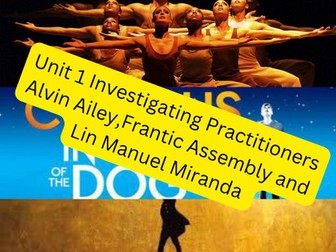
A full academic year (Sep - May) worth of Powerpoints for the BTEC Level 3 Unit 1 Investigating Practitioners exam.
Term 1 - Writing Skills
Term 2 - Activity 1
Term 3 - Activity 2
Term 4 - Activity 3
All Powerpoints include Mock Questions, Exam examples, and tasks for the students to complete based on the practitioners Lin Manuel Miranda, Alvin Ailey, and Frantic Assembly.
This is a unit of work that looks at three contemporary theatre companies, it includes all the resources necessary and an assessment. The six week SOW is adapted from workshops designed by the Curious Theatre Company. The lessons are designed for two hour sessions and would be suitable for high ability KS3 or even KS4.
*I do not own any of the images, media, music, videos used in the PowerPoint or for resources*
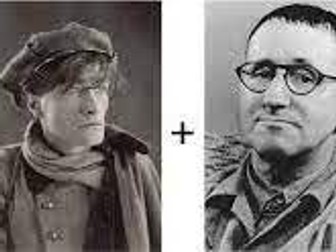
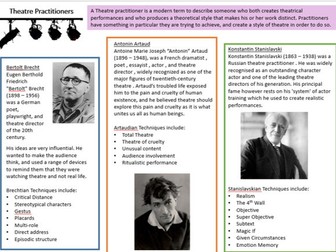
This scheme of work explores three key practitioners; Bertolt Brecht, Konstanin Stanislavski and Antonin Artaud.
The lessons explore each practitioners style, aims and allows students to compare them to one another.
There is a predominant focus of Brecht to help students develop deeper understanding in preparation for GCSE.
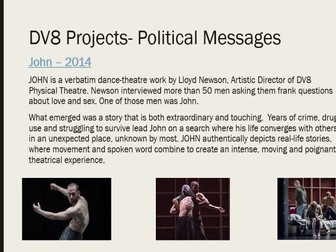
A workshop on the history, artistic policy and techniques of DV8. The workshop was designed to be used over three lessons although could be adapted to suit more or less. It consists of information about DV8, warm ups, short tasks based on their techniques that include music and links to DV8 videos. It looks into 4 different DV8 projects and includes links to short clips.
The workshop culminates in students creating their own piece in the style of DV8.
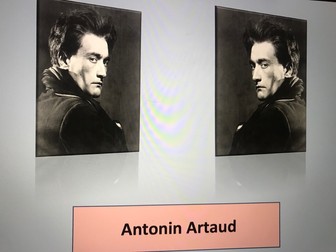
6 lessons exploring Artaud, his history and tasks revevant to his practice. This work is designed to be delivered to Year 12 but could be shown to a high ability year 11
It is ready for action, starters, lesson objectives and plenaries
Excellent SOW and full lessons on the practitioners: Arteud, Stanislavski, Knee-high and Brecht. A minimum of 4 lessons, however usually lasts 8 lessons and can be expanded. Makes practitioner work accessible through fun exercises. Can be used for Y9, 10, 11.
A good Starter bundle focusing on Drama Practitioners.
Contains Powerpoints and starter activities on various the Drama Practitioners.
It includes:
John Godber
Augusto Boal
Bertolt Brecht
Frantic Assembly
Jerzy Grotowski
Mike Leigh
Constantin Stanislavski
Antonin Artaud


 Quick View