A presentation suitable for KS4 looking at scientific theories. Presentation includes multi-choice questions to engage students and get them thinking about the subject throughout the presentation.
Learning Objective(s):
Explore the difference between hypotheses and theories.
Main Skills: Interpret written text and diagrams.
Duration: Approximately 30 mins
23 slides covering:
• From Hypothesis to Theory
• Development of Scientific Theories
• Example 1: Cold Fusion
• Example 2: The Expanding Universe
A presentation suitable for KS4 looking at evaluation of scientific explanations. Presentation includes multi-choice questions to engage students and get them thinking about the subject throughout the presentation.
Learning Objective(s):
Explore how to evaluate scientific explanations.
Main Skills: Interpret written text, diagrams, charts and graphs, make decisions and predict outcomes.
Duration: Approximately 45 mins
40 slides covering:
• Evaluation Methods
• Using Empirical Evidence
• Using Logical Reasoning
• Using Experimental Testing
• Observational Testing
• Examining All Sides of Evidence
A presentation suitable for KS4 looking at the analysis of scientific explanations. Presentation includes multi-choice questions to engage students and get them thinking about the subject throughout the presentation.
Learning Objective(s):
Explore how to analyse scientific explanations to identify the key factors.
Main Skills: Interpret written text, make decisions and predict outcomes.
Duration: Approximately 45 mins
41 slides covering:
• Scientific Explanations
• Analysis
• Analytical Methods
• Empirical Evidence
• Logical Reasoning
• Experimental Testing
• Observational Testing
• Examining All Sides of Evidence
KS3/KS4 Working Scientifically Unit that retrieves and develops on from year 7 & 8 understanding.
Similar structure to my other power points following the input - activity - review phasing
Plenary sections for progress checking
Clear learning objectives and outcomes
Modern and engaging layout
Little adaptation needed
Each lesson covers at least an hour of lesson time
Each lesson has practice questions and mark schemes
LESSONS:
L1 Performing an Investigation
L2 Anomalous results and Means
L3 Displaying Results
L4 Relationships and Conclusions
L5 Evaluating Data and Methods
L6 Maths in Science
Please leave constructive feedback
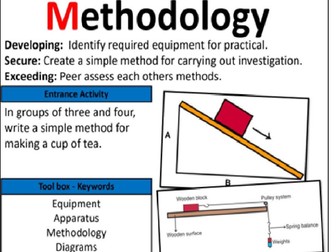
This resource can be use in conjunction with the scientific methods booklet or as a stand alone lesson. In this lesson students look at method writing and ultimately have the chance to produce a method for their investigation.
2 worksheet versions, one includes drawing the scientific diagrams for each piece of equipment while the other is just naming and describing functions. Answers included.
A presentation suitable for KS4 looking at planning investigations. Presentation includes multi-choice questions to engage students and get them thinking about the subject throughout the presentation.
Learning Objective(s):
Explore investigative procedures to enable you to plan your own investigations.
Main Skills: Interpret written text, make decisions and predict outcomes.
Duration: Approximately 45 mins
34 slides covering:
• Asking Questions
• Preparing for Investigations
• Variables
• Preparing Equipment
• Equipment - Scientific Glassware
• Equipment - Electronic Balances
• Equipment - Consumable Chemicals
• Equipment - Technological (Calculators, Probes and Computers)
From the aim all the way too the conclusion, a complete set of booklets for students to work through. Includes practical investigations and worksheets.
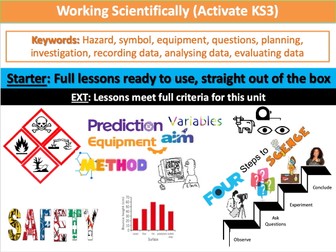
KS3 new for the Activate 1 resource, ‘Working Scientifically’.
Full lessons ready to use straight ‘out of the box’. You’ll struggle to find a set of as many planned lessons this cheap and of similar quality.
Free lessons available here L1 Safety in the Lab https://www.tes.com/teaching-resource/safety-in-the-lab-11712866
L8 Scientifici Investigation https://www.tes.com/teaching-resource/scientific-investigations-11712899
Lessons meet the full criteria for this unit
Similar structure to my other power points following the input - activity - review phasing
Plenary sections for progress checking
Clear learning objectives and outcomes
Modern and engaging layout
Little adaptation needed
Each lesson covers at least an hour of lesson time
LESSONS
L1 Safety in the Lab (FREE)
L2 Asking Scientific Questions
L3 Planning Investigations
L4 Bunsen Burners (BONUS)
L5 Recording Data
L6 Analysing Data
L7 Evaluating Data
L8 Scientific Investigations (BONUS FREE)
Please leave constructive feedback
A presentation suitable for KS4 looking at planning descriptive investigations. Presentation includes multi-choice questions to engage students and get them thinking about the subject throughout the presentation.
Learning Objective(s):
Find out how to plan descriptive investigations.
Main Skills: Interpret written text, make decisions and predict outcomes.
Duration: Approximately 45 mins
30 slides covering:
• Investigations
• Descriptive Investigations
• Planning
• Habitat Investigation
• Equipment
• Using a Journal
• Collecting Data
• Writing a Report
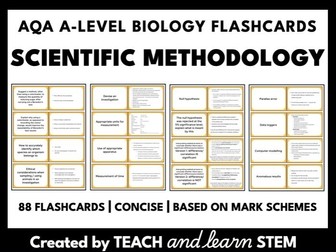
Set of 88 flashcards covering scientific methodology/general practical skills. Suitable for all exam boards.
Covers topics such as:
Different types of variable
Accuracy / precision / repeatability etc
Uncertainty
Range / standard deviation
Choice of statistical test
Choice of graph
Basic practical skills such as scientific drawing rules, eye piece graticule calibration etc
There is some ambiguity when it comes to mark schemes on questions such as accuracy/precision - with different exam boards sometimes having slightly different answers. I have tried to include the most appropriate answer on the flashcards.
This download is the same as the Module 1 OCR A-level Biology flashcards.
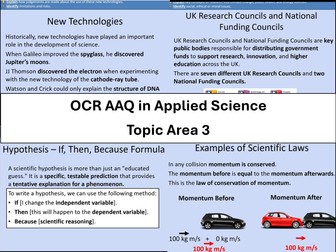
Course: OCR Level 3 Alternative Academic Qualification Cambridge Advanced Nationals in Applied Science.
Unit F181: Science in society
Topic Area 3: Scientific developments
3.1 Hypothesis, theory, and law
3.1.1 Scientific use of terms
3.1.2 Scientific theory vs scientific law
3.2 Using new technologies in science
3.2.1 New technologies play an important part in continuing scientific development
3.2.2 Limitations and risks of new technologies in society
3.3 Implications and limitations of scientific developments
3.3.1 Considerations for scientific developments
3.3.2 Contemporary issues that science will need to solve in the future
Know how to write a hypothesis and predictions
How a hypothesis may become a theory
How the term theory is used in science and in everyday language
The role of assumptions, estimations and approximations in science
Know how a law is different from a theory
Both theories and laws require evidence and can be open to change and revision
Robotics and automation.
Computer-aided design (CAD).
Artificial intelligence (AI) and machine learning.
Quantum computing.
Big data analytics.
Advanced imaging technologies.
Augmented and virtual reality.
Know the importance of funding in science
The role of private companies, charitable foundations or governments in scientific research
Factors that affect research that is carried out
How scientists receive funding for research
What issues might arise and how they are classified as social, ethical or moral issues
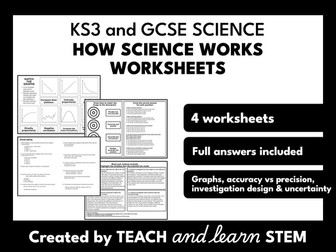
4 worksheets included - great for revision, homework or cover work.
Worksheet 1: students cut out graphs and descriptions, then match them up (activity is designed to increase recognition of key graph trends e.g. positive correlation, directly proportional, inversely proportional etc).
Worksheet 2: tests student’s knowledge of accuracy and precision.
Worksheet 3: 4 methods for different investigations are given, students must highlight the mistakes in the methods. Extension questions are also included where students must explain how a mistake would affect the results, explain how to change the method to produce valid results & suggest an improvement to increase the accuracy).
Worksheet 4: 10 questions on uncertainty (using the equation: range/2)
FULL ANSWERS are provided to allow the lesson to be supervised by a non-subject specialist.
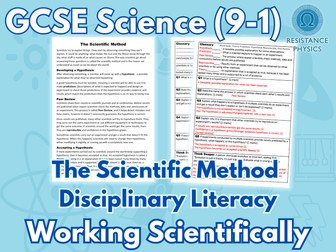
AQA GCSE Science and Combined Science | The Scientific Method | Working Scientifically Disciplinary Literacy
Build the scientific literacy and tier-3 scientific vocabulary of your students with this disciplinary literacy task telling the story of how scientific theories are developed, tested and supported through the scientific method.
Designed for KS4 Science, this reading comprehension task introduces key concepts from the Working Scientifically section of the AQA specification that often slip through the net in schemes of work: Understand how scientific methods and theories develop over time (WS 1.1) and Peer Review (WS 1.6) .
Suitable for mixed ability year 10 and 11 students across Biology, Chemistry and Physics with an approximate reading age of 13-14 years old.
This is ideal for in-class activities, at the beginning of a topic for homework, or independent study, this resource will help students appreciate the evidence backing the theories that we take for granted as correct.
What’s included:
Editable and Ready-to-print 350-word passage (.doc and .pdf)
Glossary of key terms to support student understanding.
5 Reading comprehension questions plus a deeper thinking extension task
Answer sheet for easy feedback
Designed to help you to:
Develop Literacy with an extended piece of reading and comprehension of tier-3 vocabulary
Support learners with a glossary to help them understand key terms
Build your scheme of work to cover a subtle and technical part of the specification
Spark deeper thinking and develop student’s interest into how science works
Develop scientific thinking and literacy in your students
Ideal as a standalone lesson activity, a homework task, revision for GCSE or as a precursor to a lesson about models and theories.
Related Resources
GCSE Science - Working Scientifically - Errors and Uncertainties Practice with Answers
P2 War of Currents AC/DC - Disciplinary Literacy
P4 Radioactivity - Disciplinary Literacy
P4 Atomic Structure Revision Quiz
P5 Isaac Newton and the History of Gravity - Disciplinary Literacy
This five part resource explores social science methodologies and their application in social science research:
1. What is social science research?
2. What makes good research?
3. Case study. The family: Continuity and change
4. Doing research ethically
5. Questions, references and further reading
Powerpoint and worksheet on using microscopes. This is a practical lesson where the students use microscopes and draw scientific diagrams. I used prepared slides, as creating their own slides is a separate lesson. Used as part of Sctivate 1 SOW.
Reviews are much appreciated, I will gladly edit my work if there are any errors.
This is a powerpoint I use with my year 8 to familiarise them with the scientific method and analysing data and writing conclusions with evaluations. It sits nicely with my other powerpoint on maths in science for year 8 and results and graphs.
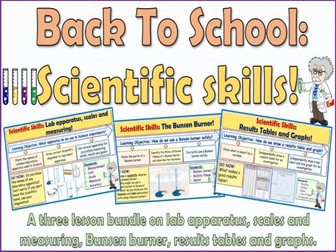
Perfect resource for the start of the academic year to welcome new Science classes! A fully resourced set of three lessons that focuses on helping students to develop their scientific skills. Great as an introduction topic for KS3 Science classes and can easily be modified for GCSE Science classes.
This bundle comes complete with fully differentiated and resourced lessons. This includes:
1: Lab apparatus, Scales and Measuring - students will learn about common laboratory apparatus used in Science. They will draw correct scientific diagrams to represent apparatus and use various apparatus in a practical activity.
2: The Bunsen burner - students will learn about the parts of a Bunsen burner and how to safely use a Bunsen burner during a Science experiment. They will identify the three different flames and describe the features of each one.
3: Results Tables and Graphs - students will learn about variables, and how to independently draw results tables, bar charts and line graphs for investigations.
(approx 4-5 hours in total)
The resource includes a detailed and engaging lesson PowerPoint with differentiated activities, worksheets, quizzes and class practical activities for students to complete.
Included:
84 slides in total for the lesson PPT
Differentiated worksheets x6
Handouts
Series of 7 lessons designed for a high ability year 8 group (but useable at GSCE)
Students go through the whole process of an investigation. Includes
1) Definition of Variables
2)Designing Tables
3) drawing graphs
4) risk assessment
5) writing a Hypothesis
6) writing a method
7) Analysis of results and conclusions
8) evaluating results
9) definition of HSW keywords.
In order to promote pedagogically informed use of technology, educators need to develop an active, inquisitive, design-oriented mindset. Design Patterns have been demonstrated as powerful mediators of theory-praxis conversations yet widespread adoption by the practitioner community remains a challenge. Over several years, the authors and their colleagues have facilitated many workshops in which participants shared experiences, captured these as design narratives, extracting design patterns, and applied them to novel teaching challenges represented as design scenarios.