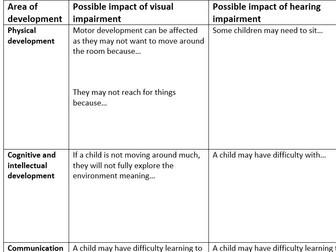
This is a set of two printable sheets, one with no support and one with sentence starters to help students write about the impact of sensory impairments on a child’s development.
I created this for students on the BTEC Child development course as part of their revision for Component 3.
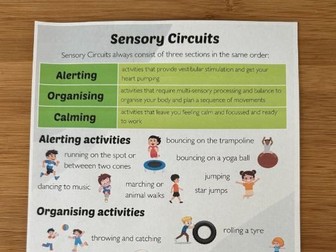
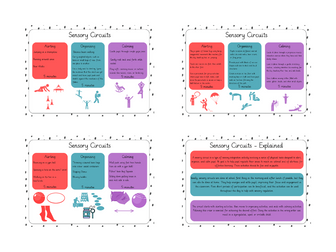
A useful poster to remind users about the three sections of Sensory Circuits and suggested activities for each. Can be used by adults to plan Sensory Circuits sessions or by a young person to choose the activities for their own Sensory Circuit.
This resource is a comprehensive toolkit designed to help class teachers implement strategies and activities that promote emotional regulation, focus, and a sense of calm among students in the classroom.
Included
Sensory circuit toolkit supported by Occupational Therapy recommended structure to support sensory regulation and focus.
2 pages of alerting, organising and calming activities for children to select and choose from.
Approved by OSSME, a local charity supporting local autistic children and learners.
Visuals created using Boardmaker 7.
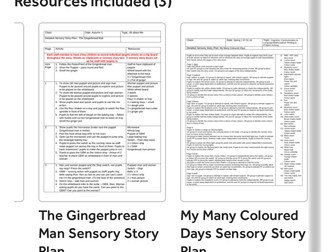
3 sensory story plans inckuding a list of resources required.
My Many Coloured Days
The Journey Hone From Grandpa’s
The Gingerbread Man
suitable for SEN Early Years/Ks1 classes.
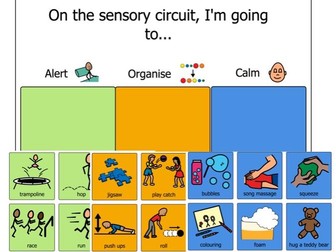
A sensory circuit prompt that children can use independently. It takes the children through the 3 different stages and uses Widgits to support understanding.
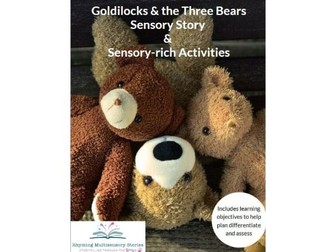
Goldilocks Blurb
Join Goldilocks on her adventures with this fully resourced, step‑by‑step sensory story and collection of sensory‑rich activities.
Designed for SEND, PMLD, EYFS and inclusive classrooms, this immersive resource supports multisensory engagement, creativity, and connection with sensory learners.
By weaving together tactile props, sounds, scents, rhythms, and movement, the story and activities encourage meaningful communication, choice‑making, and sensory exploration. Rooted in a commitment to accessibility and sensory engagement, each couplet offers a clear sensory prompt, guiding the story participant through a gentle journey where every sense is welcome, and every response is valued.
Inside, you’ll find:
A Fully Resourced Sensory Story – with step‑by‑step facilitation to support confident, inclusive delivery.
The Goldilocks Storytelling Orchestra – recreate the story through instruments.
Oat Bear Art – a tactile, creative exploration.
Hard and Soft Sensory Bin – hands‑on investigation and sensory exploration.
Oat Milk Recipe – a calming, process‑based activity encouraging sequencing and participation.
Oat Mask Sensory Play – soothing, tactile exploration.
Bear Hugs Regulation Invitations – grounding, proprioceptive moments to support co‑regulation.
Learning About Bears – sensory‑led discovery of bear sounds, feelings, and habitats.
Whether used as a full unit for a half term or dipped into across the week this resource offers practitioners a ready‑to‑use, inclusive toolkit that nurtures curiosity, communication, and connection bringing warmth, rhythm, and multisensory magic to a much‑loved traditional tale, creating a space where learners can explore through a multisensory lens.
Thank you for looking.
You questions, queries, comments and feedback are always welcome!
This is the first unit of my English planning. It is intended to support staff working children with high and complex support needs in mainstream schools. It can be delivered to an individual or a small group of learners by a teacher or an LSA.
Free sample of English/Literacy planning https://www.tes.com/teaching-resource/-13241635
The activities are motivating and attention grabbing. The first two blocks are based on the principles of Attention Autism to build the required attention to focus on the activities. Timings are not included, spend as long on a block as you feel your learner needs and revisit if necessary.
At the end of each of the 6 blocks you will find assessment objectives linked to my Special Needs Skills Ranges and Objectives for Assessment https://www.tes.com/teaching-resource/special-needs-skills-ranges-and-objectives-for-assessment-13234289
All printable resources such as symbols and ALD’s (Aided Language Displays) are included.
This resources contains a detailed page by page sensory story plan for the story The Journey Home from Grandpas. It has three different levels of resources/activities to complete during each page of the book, and a full resource list.
I used this story plan for a PMLD KS1 class of pupils.
Sensory Circuits resource: a toolkit designed to enhance classroom learning through three distinct circuits. Sensory Circuits Resource with examples, planned circuits and images
Alerting Activities: Energise students with jumping jacks, running, and skipping to stimulate their senses and prepare for learning.
Organising Activities: Promote coordination and spatial awareness with balance beam walking, animal walks, and obstacle courses.
Calming Activities: Guide students to relaxation with deep breathing, gentle rocking, and sensory bottles to reduce stress and anxiety.
Clear instructions and colorful images make implementation easy. Perfect for teachers, therapists, and caregivers supporting students with diverse sensory needs. Elevate your classroom experience and empower your students to thrive with Sensory Circuits.
**
Work designed through research and understanding of Jane Horwood’s book on Sensory Circuits**
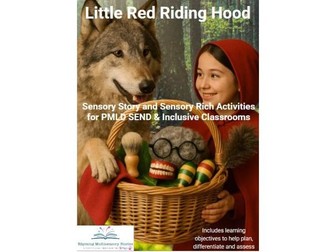
This fully resourced, step‑by‑step sensory story of Little Red Riding Hood includes clear facilitation guidance and carefully crafted learning objectives to help practitioners plan, differentiate, and assess.
The resource is designed to support PMLD, SEND and sensory learners in inclusive classrooms and EYFS learners through rich sensory experiences, anticipation, and meaningful opportunities for communication and engagement.
Alongside the main story, this collection offers a wide range of sensory‑rich companion activities that deepen exploration and extend learning. Practitioners can immerse learners in a woodland soundscape, play listening games, explore themed sensory bins, follow a story scent trail, and enjoy red‑themed sensory investigations.
Additional activities such as mirror play, reflections, and self‑portraits link beautifully to an All About Me topic or theme.
Together, these activities create a flexible, engaging, and imaginative resource inviting learners to explore the story through a multisensory lens, supporting connection, curiosity, and shared storytelling across a variety of sensory pathways.
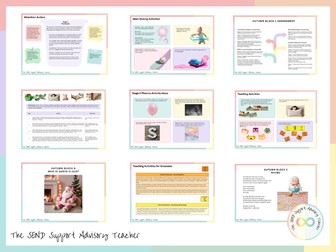
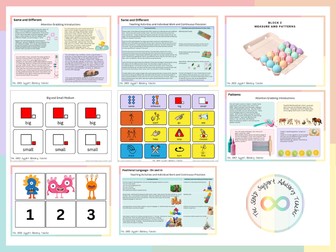
This is the first unit of my Maths planning. It is intended to support staff working children with high and complex support needs in mainstream schools. It can be delivered to an individual or a small group of learners by a teacher or an LSA.
For a free sample of maths planning see https://www.tes.com/teaching-resource/-13242315
The activities are motivating and attention grabbing. Timings are not included, spend as long on a block as you feel your learner needs and revisit if necessary.
Autumn Block 1 - Match, sort & compare - same & different and big & little.
Autumn Block 2 - Block 2 measure & patterns - empty & full and patterns.
Autumn Block 3 - Recognising and subetising digits 1 to 3.
Autumn Block 4 - Shapes - recognising circles and triangles.
Autumn Block 5 - positional language - on and in.
At the end of each of the 5 blocks you will find assessment objectives linked to my Special Needs Skills Ranges and Objectives for Assessment https://www.tes.com/teaching-resource/special-needs-skills-ranges-and-objectives-for-assessment-13234289
All printable resources such as symbols and ALD’s (Aided Language Displays) are included.
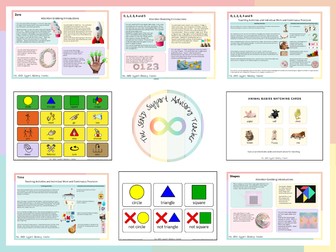
This is the second unit of my Maths planning. It is intended to support staff working children with high and complex support needs in mainstream schools. It can be delivered to an individual or a small group of learners by a teacher or an LSA.
For a free sample of maths planning see https://www.tes.com/teaching-resource/-13242315
The activities are motivating and attention grabbing. Timings are not included, spend as long on a block as you feel your learner needs and revisit if necessary.
Spring Block 1 - Recognising and subitizing digits 0 to 5
Spring Block 2 - Mass and capacity - heavy and light
Spring Block 3 - Length - long and short
Spring Block 4 - Time - times of the day and timers.
Spring Block 5 - Shapes - recognising circles, triangles and squares.
At the end of each of the 5 blocks you will find assessment objectives linked to my Special Needs Skills Ranges and Objectives for Assessment https://www.tes.com/teaching-resource/special-needs-skills-ranges-and-objectives-for-assessment-13234289
All printable resources such as symbols and ALD’s (Aided Language Displays) are included.
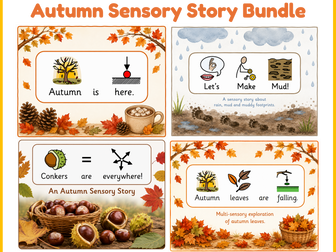
A set of four Simple Sensory Stories for autumn, designed for pupils working within or just above Engagement Model.
Autumn Is Here
Autumn Leaves
Conkers are Everywhere
Muddy Footprints
Pupils will explore common features of autumn in a multi-sensory way.
Written with Widget symbols and images using repetitive vocabulary and Gestalt phrases.
Includes:
Powerpoint
Lesson Plan
List of resources
Widget chat board
(Only the title pages are AI, everything else is made by a human SEND teacher with 15+ years teaching experience!)
A sensory ladder can be used in conjunction with Zones of Regulation or as a separate resource.
Use this resource to support children in understanding their sensory needs and enhance their independence in regulating their emotion and sensory needs.
Within the resource:
advice on how to use and create sensory ladders
overview of a sensory ladder
prompt questions to use when designing the ladder with your young person.
Lesson includes powerpoint and resources for component 3 in the 2022 Health and Social Care course
Lesson content how physical abilities and sensory impairments affect an individuals health and wellbeing
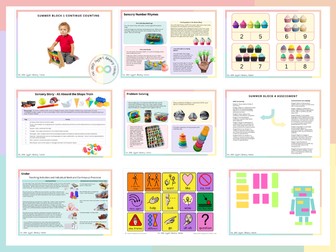
My three planning units for both Maths and English covering lessons for the autumn, spring and summer terms. All activities are motivating and based on an attention grabbing sensory curriculum.
Activities can be carried out in a group or an an individual basis by a teacher or an LSA. Assessment pages are included at the end of each individual block, linking to my Skills Ranges and Objectives Assessment Tool. Each unit contains printable resources.
Free sample of English/Literacy planning https://www.tes.com/teaching-resource/-13241635
This is a sensory story I created for my topic 'seasons'. This was written for a PMLD/ CLDD class.
I have written it with the sentence, the sense, the sensory experience and what I and my TAs are looking for and observing throughout the sessions.
Repeat story throughout the term to enable the child to develop anticipation, investigation, awareness, preference and much more.
Could also be used in an EYFS KS1 class.
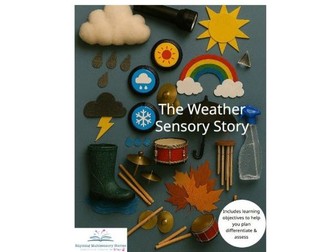
Bring the weather to life with this Weather Sensory Story, designed especially for learners with PMLD, SEND, ideal for inclusive classrooms. This beautifully structured story guides learners through rain, wind, sunshine, and storms using simple language, rhythm, and sensory cues that support engagement, anticipation, and connection.
This sensory story can be used as a standalone sensory experience for exploring a topic or theme or as part of a daily circle time routine, offering learners a rich, multisensory way to explore the topic of the weather or the changing seasons. The gentle rhythm, simple language, and sensory cues help learners connect with concepts such as rain, wind, fog, snow, sunshine, storms and rainbows in a meaningful, accessible way.
Sensory-rich weather-themed activities complement the sensory story as you invite students to create a storm orchestra, explore a weather umbrella or seasonal sensory boxes, create rainbow-themed art, take part in a rainbow’s end treasure hunt amongst other activities.
Ideal for 1:1 sessions, small groups, whole class or circle time weather routines; this resource supports communication, emotional regulation, and early understanding of weather concepts in a sensory and inclusive way.
A versatile, practitioner‑friendly resource that brings joy, calm, drama, and curiosity to any sensory curriculum.


 Quick View
 Quick View
 Quick View
 Quick View
 Quick View
 Quick View
 Quick View
 Quick View
 Quick View
 Quick View
 Quick View
 Quick View
 Quick View
 Quick View
 Quick View
 Quick View