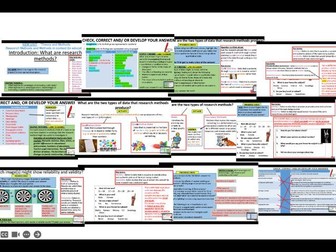
great resource for revision or lessons - these are quick, concise but understandable notes
covers all research methods content - WITHOUT CONTEXT!!
topics:
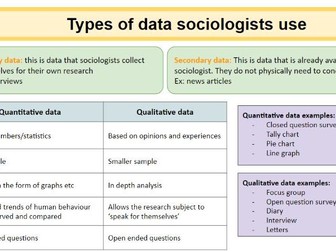
Types of data that sociologists use
Practical issues
Ethical issues
Theoretical issues
Research process
Experiments
Questionnaires
Interviews
Observations
Official statistics
Documents and content analysis
downloaded as a microsoft ppt - with animations
AQA A-level/AS level
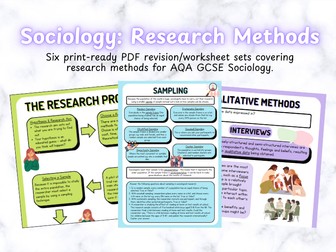
A pack of 6 worksheets to aid with revision and initial understanding of research methods in AQA GCSE Sociology. Aimed towards lower-ability pupils to help develop their understanding of different research methods and their advantages and disadvantages. Includes exam-style and knowledge-check questions. ZIP file containing print-ready PDF files.
Worksheets:
The Research Process
Quantitative Methods
Qualitative Methods
Secondary Sources
Evaluating Research
Research Ethics
Topic: Theory & Methods
Specification link: consensus, conflict, structural and social action theories
Focus: Marxism
What’s included:
• 1 × fully editable lesson PowerPoint
• 1 × student work booklet with an exam work section
• A range of engaging tasks including stretch & challenge for differentiation
• Links to video clips and suggested discussion prompts
• Clear lesson objectives with links to the specification and exam papers
Perfect for AQA A-Level Sociology Theory & Methods 2, this resource pack covers the Marxist perspective including key concepts, strengths and limitations and how this links back to topics studied during A level sociology. Please note that due to the synoptic links, this lesson has been designed to be taught at the end of the course. It also contains some pre-reading activities and tasks which students are expected to complete prior to the lesson (although this is optional).
The pack includes one lesson PowerPoint, designed for 60–90 minutes of teaching time depending on the number of activities selected. It features a combination of teacher-led tasks, independent student activities, and video clips, along with embedded stretch and challenge opportunities to support differentiation. The lesson is designed to run alongside a work booklet, which has a exam section included.
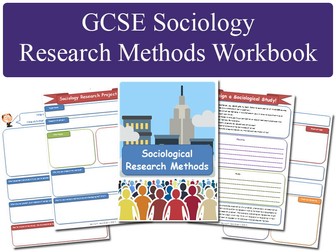
A 17-page colour A4 workbook designed for the Sociological Research Methods component of the AQA GCSE Sociology course.
The work book features tasks that ask students to generate hypotheses and then plan four separate sociological studies: outlining their methods, sampling, secondary sources and justifications for their choices. It also includes a PLC for this section of the course.
This workbook is an ideal homework for students to get on with whilst covering the Research Methods unit. It is relevant to any GCSE Sociology teacher. It can also be used as the focal point of lessons.
Check out our 10-lesson unit for this section f the course! :)
Topic: Theory & Methods
Specification link: the nature of science and the extent to which Sociology can be regarded as scientific
Focus: Sociology and Science
What’s included:
• 1 × fully editable lesson PowerPoint
• 1 × student work booklet with an exam work section
• A range of engaging tasks including stretch & challenge for differentiation
• Links to video clips and suggested discussion prompts
• Clear lesson objectives with links to the specification and exam papers
Perfect for AQA A-Level Sociology Theory & Methods 2, this resource pack covers Sociology and Science including key concepts and how this links back to topics studied during A level sociology. Please note that due to the synoptic links, this lesson has been designed to be taught at the end of the course. It also contains some pre-reading activities and tasks which students are expected to complete prior to the lesson (although this is optional).
The pack includes one lesson PowerPoint, designed for 60–90 minutes of teaching time depending on the number of activities selected. It features a combination of teacher-led tasks, independent student activities, and video clips, along with embedded stretch and challenge opportunities to support differentiation. The lesson is designed to run alongside a work booklet, which has a exam section included.
This lessons covers the internal factors relating to class and achievement
Students explore and evaluate key theories through personal experiences of school and current research:
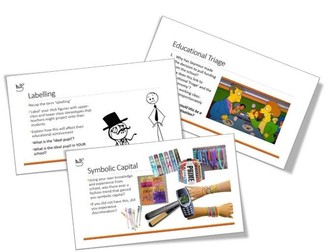
Labelling
Halo Effect
Self-fulfilling prophecy
Setting and streaming
Educational Triage
Subcultures
Activities include:
Groupwork on labelling case studies
Card sorts to show cause and effect
Analysis of Simpsons clip - Principal Seymour
Analysis of Mean Girls clip - cafeteria subcultures
MIchaela School: a case study
Example paragraph and essay plan provided at the end
(Lesson follows a ‘Be more chef’ model - the lesson takes cooking as an analogy for the starter, main and plenary. The ‘Be more chef’ concept pushes students to go beyond the recipe at the end of the lesson, and strive towards additional independent study)
GCSE Sociology 9-1 Specification
This unit of work follows the Introduction unit. I use this as a quick intro to research methods, so that throughout the units I can embed/recall this information like in the exam.
This is the same unit, as the bundle in my shop. I am putting it into 1 resource, so I can bundle the units together to save you money.
Please review if you download
Topic: Theory & Methods
Specification link: sources of data, including questionnaires, interviews, participant and non-participant observation, experiments, documents and official statistics
Focus: Official Statistics
What’s included:
• 1 × fully editable lesson PowerPoint
• 1 × student work booklet (fillable during lessons)
• 1 × completed teacher version of the work booklet
• A range of engaging tasks including stretch & challenge for differentiation
• Links to video clips and suggested discussion prompts
• Clear lesson objectives with links to the specification and exam papers
Perfect for AQA A-Level Sociology Theory & Methods 1, this resource pack covers official statistics as a source of data. It includes the uses of official statistics in general with examples and highlights their strengths and limitations as a research method. The second part of the lesson focuses on how this can be applied to the context of education. With a detailed PowerPoint, a student workbook, and plenty of built-in activities, this lesson is ready to deliver straight away.
The pack includes one lesson PowerPoint, designed for 60–90 minutes of teaching time depending on the number of activities selected. It features a combination of teacher-led tasks, independent student activities, and video clips, along with embedded stretch and challenge opportunities to support differentiation.
The lessons are designed to run alongside a work booklet, provided in two versions:
• a student copy for learners to complete during lessons
• a completed copy for teacher reference or additional student support
There is also an exam worksheet and knowledge organiser allowing the opportunity for students to summarise key points and apply this to a range of exam questions.
Topic: Theory & Methods
Specification link: debates about subjectivity, objectivity and value freedom
Focus: Sociology and Values
What’s included:
• 1 × fully editable lesson PowerPoint
• 1 × student work booklet with an exam work section
• A range of engaging tasks including stretch & challenge for differentiation
• Links to video clips and suggested discussion prompts
• Clear lesson objectives with links to the specification and exam papers
Perfect for AQA A-Level Sociology Theory & Methods 2, this resource pack covers Sociology and Values including key concepts and how this links back to topics studied during A level sociology. Please note that due to the synoptic links, this lesson has been designed to be taught at the end of the course. It also contains some pre-reading activities and tasks which students are expected to complete prior to the lesson (although this is optional).
The pack includes one lesson PowerPoint, designed for 60–90 minutes of teaching time depending on the number of activities selected. It features a combination of teacher-led tasks, independent student activities, and video clips, along with embedded stretch and challenge opportunities to support differentiation. The lesson is designed to run alongside a work booklet, which has a exam section included.
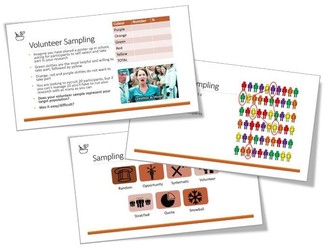
A lesson introducing students to sampling strategies in sociology
Includes: random, opportunity, systematic, volunteer, stratified, quota and snowball sampling, simulated through a ‘Skittles’ game
Part of a ‘Research Methods in Sociology’ scheme of work aimed at Year 12 students. Students work towards designing and carrying out their own piece of sociology research as a final project
Powerpoint and student workbook included
Separate ‘research project log’ available to download (see shop)
(Follows a ‘Be more chef’ model - the lesson takes cooking as an analogy for the starter, main and plenary. The ‘Be more chef’ concept pushes students to go beyond the recipe at the end of the lesson, and strive towards additional independent study)
NEW SPEC AQA OR OCR GCSE SOCIOLOGY
This includes:
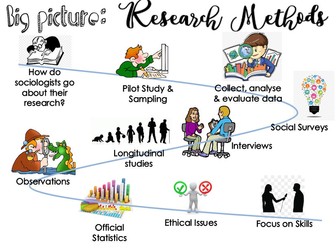
One mind map for research methods that pupils can use to aid their revision.
This can also make a good lesson using different revision techniques alongside this mind map.
All content is in line with the NEW GCSE specifications 2019
Whole pack of lessons/module is also available to buy.
Detailed and differentiated student-led lesson that explores primary vs secondary methods, quantitative vs qualitative methods, validity and reliability as a way to introduce students to the main main research methods.
Key terms covered:
•Hypothesis
•Operationalise (concepts)
•Pilot studies
•Close questions
•Open questions
•Validity
•Reliability
•Standardised
•Primary methods
•Secondary methods
•Quantitative data
•Qualitative data
ANSWERS TO MAIN ACTIVITIES
Can be used for ANY SPEC and GCSE but catered towards A-LEVEL AQA sociology** .
Comes with key term sheet for the lesson.
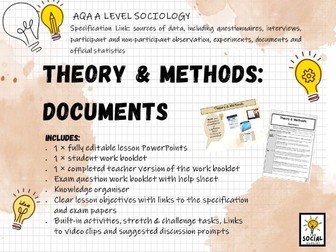
Topic: Theory & Methods
Specification link: sources of data, including questionnaires, interviews, participant and non-participant observation, experiments, documents and official statistics
Focus: Documents
What’s included:
• 1 × fully editable lesson PowerPoint
• 1 × student work booklet (fillable during lessons)
• 1 × completed teacher version of the work booklet
• A range of engaging tasks including stretch & challenge for differentiation
• Links to video clips and suggested discussion prompts
• Clear lesson objectives with links to the specification and exam papers
Perfect for AQA A-Level Sociology Theory & Methods 1, this resource pack covers documents as a source of data. It includes the uses of documents in general with examples and highlights their strengths and limitations as a research method. The second part of the lesson focuses on how this can be applied to the context of education. With a detailed PowerPoint, a student workbook, and plenty of built-in activities, this lesson is ready to deliver straight away.
The pack includes one lesson PowerPoint, designed for 60–90 minutes of teaching time depending on the number of activities selected. It features a combination of teacher-led tasks, independent student activities, and video clips, along with embedded stretch and challenge opportunities to support differentiation.
The lessons are designed to run alongside a work booklet, provided in two versions:
• a student copy for learners to complete during lessons
• a completed copy for teacher reference or additional student support
There is also an exam worksheet and knowledge organiser allowing the opportunity for students to summarise key points and apply this to a range of exam questions.
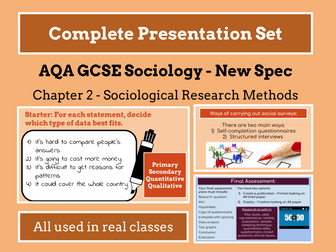
Complete set of presentations for the second unit. All have been tried and tested with real classes. Mini-whiteboards would be ideal alongside student workbooks. Created to fit with with AQA’s recommended scheme of work.
This is a revision session on Research Methods from the AQA A Level Sociology Specification. It can be used as either a standard lesson or extra-curricular revision session. The lesson covers the content that students need to know for the exams and then has activities designed to consolidate learning.
Exercises include Tweet the Definition (where students examine key terms); Newsround (a mind map activity); The Weakest Link (a quiz); Thought for the Day (a blogpost writing activity); and the Big Questions (a debating exercise). There is also a homework assignment which you can use to assess learners’ progress.
This resource should make learning interactive, productive, and enjoyable, giving your students the chance to get the grades they deserve.
Revision booklet for students to fill in and condense their knowledge of this topic. Previously my students have loved these as it has all of their knowledge in one place, and they can create their own revision guides.
For the AQA GCSE Sociology Specification
Topic: Theory & Methods
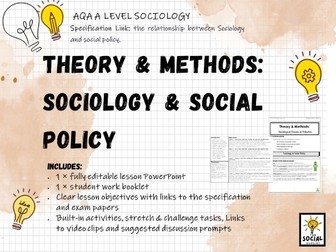
Specification link: the relationship between Sociology and social policy
Focus: Sociology and Social Policy
What’s included:
• 1 × fully editable lesson PowerPoint
• 1 × student work booklet with an exam work section
• A range of engaging tasks including stretch & challenge for differentiation
• Links to video clips and suggested discussion prompts
• Clear lesson objectives with links to the specification and exam papers
Perfect for AQA A-Level Sociology Theory & Methods 2, this resource pack covers Sociology and Social Policy including key concepts and how this links back to topics studied during A level sociology. Please note that due to the synoptic links, this lesson has been designed to be taught at the end of the course. It also contains some pre-reading activities and tasks which students are expected to complete prior to the lesson (although this is optional).
The pack includes one lesson PowerPoint, designed for 60–90 minutes of teaching time depending on the number of activities selected. It features a combination of teacher-led tasks, independent student activities, and video clips, along with embedded stretch and challenge opportunities to support differentiation. The lesson is designed to run alongside a work booklet, which has a exam section included.
Scheme of Work (of powerpoint lessons/worksheets) produced for methods for WJEC/Educas Sociology GCSE - Short Course. I doubt the new spec will be massively different - the lessons are adapatable for AQA and OCR. Quite simple straight forward lessons as well as one 'skittles sampling interactive lesson'. Includes a Homework Booklet too.
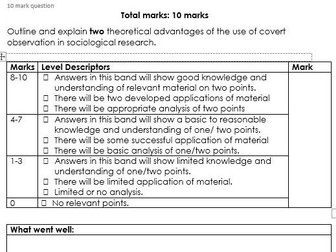
This contains assessments for AQA A Level Sociology (new specification) RESEARCH METHODS.
Each assessment is a 10 mark ‘Outline and explain’ style question, in total there are six assessments, complete with a generic marking grid.
The format can be easily adapted with changes to the question itself to expand the pack to cover all methods.
Included is a 10 mark Outline and explain two advantages of:
Covert observation
Documents
Questionnaires
and a 10 mark Outline and explain two disadvantages of:
Covert observation
Documents
Questionnaires
Some practice questions for the topic on methods in AQA AS sociology. This is tailored to the questions on the AS exam, but the key points of analysis can also be used at AL.
Feel free to add, remove or edit anything you wish.


 Quick View