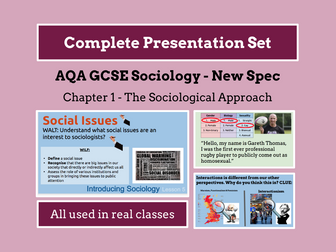
Complete set of presentations for the first unit, tried and tested with real classes. No textbook needed. Includes worksheets and end of unit assessment. Mini-whiteboards would be ideal and access to ICT is required for a couple of lessons - one laptop/computer between two students. Created inline with AQA's recommended scheme of work.
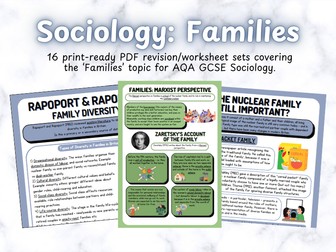
This is a large pack of resources for learning and revision of the “Families” section of AQA Sociology GCSE. The pack includes:
The Functionalist Perspective
The Marxist Perspective
The Feminist Perspective
Different Families
Rapoport & Rapoport
Conjugal Role Relationships
Changing Families
Changing Households
Wider Family Relationships
Marriage and Divorce
Theories of Divorce
Criticisms of Families
Is the Nuclear Family Still Important?
Knowledge Organisers
Practice Exam Questions
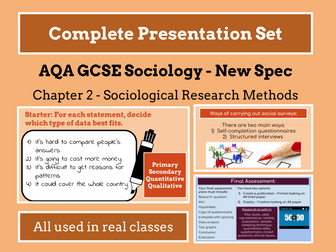
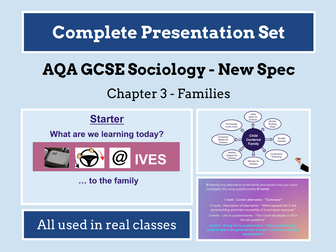
Complete set of presentations for the second unit. All have been tried and tested with real classes. Mini-whiteboards would be ideal alongside student workbooks. Created to fit with with AQA’s recommended scheme of work.
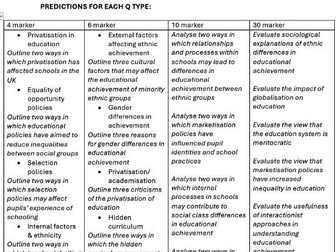
This is a document containing accurate predictions for what might be the 2026 AQA A-level Sociology questions
It includes:
Every past paper question
Each of my predictions for paper 1
Each of my predictions for paper 2 (families and beliefs)
My predictions for each Crime and Deviance question
Each prediction was informed by an AQA examiner and in light of questions from recent years.
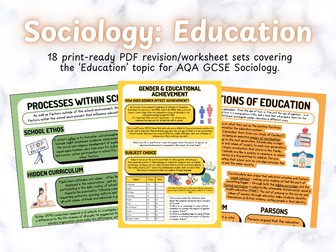
This is a large pack of resources for learning and revision of the “Education” section of AQA Sociology GCSE. The pack includes:
Functions of Education
Education & Capitalism
Feminist Perspective
Types of Schools
Independent vs State Education
Alternative Education
External Factors on Educational Achievement
Education Policies
Processes Within Schools
Social Class & Education
Social Class & Education - Explanations
Gender & Educational Achievement
Gender & Education - Explanations
Perspectives on School Processes
Ethnicity & Educational Achievement
Ethnicity & Education - Explanations
Practice exam questions
Knowledge organisers
Included her are model answers for the following exams:
Paper 1 Education with Methods in Context - Secimen
Paper 1 Education with Methods in Context - 2019
Paper 1 Education with Methods in Context - 2020
Paper 2 Families and Households - Specimen
Paper 2 Families and Households - 2017
Paper 2 Families and Households - 2019
Paper 2 Beliefs in Society - Specimen
Paper 2 Beliefs in Society -2017
Paper 2 Beliefs in Society - 2019
Student reflection areas included but documents fully editable to suit your schools style.
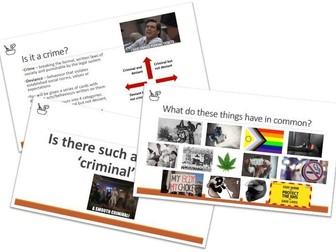
An introduction to the ‘Crime and Deviance’ topic for A-level Year 13 students on the AQA Specification
Students are challenged to think about the concepts of ‘crime’ and ‘deviance’ and how they are socially constructed.
Activities include:
‘Is it a crime?’ card sort
Discussion - is there such as a thing as a criminal act?
Research task - contextual, cultura, historical and generational crimes
Survey - perceptions of deviant acts
Exam questions and example answer included in the powerpoint
(Lesson follows a ‘Be more chef’ model - the lesson takes cooking as an analogy for the starter, main and plenary. The ‘Be more chef’ concept pushes students to go beyond the recipe at the end of the lesson, and strive towards additional independent study)
FULL CRIME AND DEVIANCE BUNDLE AVAILABLE
These revision powerpoints are made to help with last minute revision - they are summaried to a point where it is still easily understood/able to develop. Also comes with a checklist to aid your revision.
This is followed by the A-Level - AQA - Sociology specification
This is for the theory and methods section of the papers - which comes under Paper 1 AND Paper 3
BUT - this is WITHOUT the methods - for the methods I have made a separate sociology revision powerpoint lablelled as ‘research methods’
this powerpoint includes the following topics:
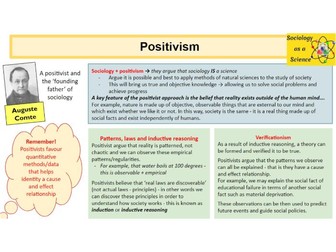
Sociology and science
Objectivity and values in sociology
Functionalism
Marxism
Feminist theories
Action theories
Globalisation, modernity and postmodernity
Sociology and social policy
Topic: Education
Specification link: the significance of educational policies, including policies of selection, marketisation and privatisation, and policies to achieve greater equality of opportunity or outcome, for an understanding of the structure, role, impact and experience of and access to education; the impact of globalisation on educational policy
Focus: Privitisation and Globalisation
What’s included:
• 1 × fully editable lesson PowerPoint
• 1 × student work booklet (fillable during lessons)
• 1 × completed teacher version of the work booklet
• A range of engaging tasks including stretch & challenge for differentiation
• Links to video clips and suggested discussion prompts
• Clear lesson objectives with links to the specification and exam papers
Perfect for AQA A-Level Sociology Paper 1: Education, this resource pack covers Privitisation and Globalisation. It’s ideal for teaching the section on the significance of educational policies, including policies of selection, marketisation and privatisation, and policies to achieve greater equality of opportunity or outcome, for an understanding of the structure, role, impact and experience of and access to education; the impact of globalisation on educational policy. With a detailed PowerPoint, a student workbook, and plenty of built-in activities, this lesson is ready to deliver straight away.
The pack includes one lesson PowerPoint, designed for 60–90 minutes of teaching time depending on the number of activities selected. The lesson features a combination of teacher-led tasks, independent student activities, and video clips, along with embedded stretch and challenge opportunities to support differentiation.
The lesson is designed to run alongside a work booklet, provided in two versions:
• a student copy for learners to complete during lessons
• a completed copy for teacher reference or additional student support
This bundle contains a complete series of workbooks made for GCSE Sociology students. It includes the four new workbooks made for each of the four main sections of the course (Family, Education, Crime & Deviance, and Social Stratification) and, as a bonus resource, my very popular Research Methods workbook.
The workbooks were designed for the AQA specification and adapted for the WJEC/EDUQAS specification (two versions of each workbook are included in this resource pack).
Each of the four main workbooks contains the following:
Student Progress-Check Tasks
A Personal Learning Checklist
Activity 1 - Mind-Map Overview Task
Activity 2 - Reading Comprehension
Activity 3 - Key-Work Match & Listing Tasks
Activity 4 - Online Research Tasks
Activity 5 - Reading Comprehension
Activity 6 - Bare-bones Essay Planning Task
Activity 7 - Creative Tasks (Posters & Poetry)
Activity 8 - Investigate & Report (Newspaper Article Task)
Activity 9 - Reading Comprehension
Activity 10 - Essay-Planning Activity
Activity 11- Essay Assessment
Extension Tasks (Many!)
Each contains 25+ sides of activities and is designed to be printed as a double-sided workbook. The files are in editable Word (.doc) format in-case you wish to make any amendments (e.g. changing the exam questions).
The workbooks are not designed to be a comprehensive: they each include selected readings and cover some (not all) of the topics listed in the specification.
UPDATE: This bundle has now been enhanced with four additional workbooks: these ‘video-learning workbooks’ help students to learn from online video resources more effectively.
Copyright Adam Godwin (2020) - strictly not for redistribution.
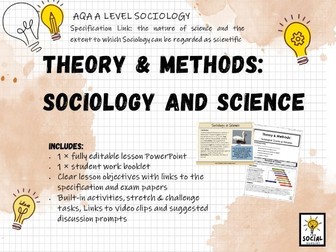
Topic: Theory & Methods
Specification link: the nature of science and the extent to which Sociology can be regarded as scientific
Focus: Sociology and Science
What’s included:
• 1 × fully editable lesson PowerPoint
• 1 × student work booklet with an exam work section
• A range of engaging tasks including stretch & challenge for differentiation
• Links to video clips and suggested discussion prompts
• Clear lesson objectives with links to the specification and exam papers
Perfect for AQA A-Level Sociology Theory & Methods 2, this resource pack covers Sociology and Science including key concepts and how this links back to topics studied during A level sociology. Please note that due to the synoptic links, this lesson has been designed to be taught at the end of the course. It also contains some pre-reading activities and tasks which students are expected to complete prior to the lesson (although this is optional).
The pack includes one lesson PowerPoint, designed for 60–90 minutes of teaching time depending on the number of activities selected. It features a combination of teacher-led tasks, independent student activities, and video clips, along with embedded stretch and challenge opportunities to support differentiation. The lesson is designed to run alongside a work booklet, which has a exam section included.
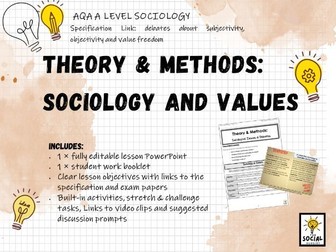
Topic: Theory & Methods
Specification link: debates about subjectivity, objectivity and value freedom
Focus: Sociology and Values
What’s included:
• 1 × fully editable lesson PowerPoint
• 1 × student work booklet with an exam work section
• A range of engaging tasks including stretch & challenge for differentiation
• Links to video clips and suggested discussion prompts
• Clear lesson objectives with links to the specification and exam papers
Perfect for AQA A-Level Sociology Theory & Methods 2, this resource pack covers Sociology and Values including key concepts and how this links back to topics studied during A level sociology. Please note that due to the synoptic links, this lesson has been designed to be taught at the end of the course. It also contains some pre-reading activities and tasks which students are expected to complete prior to the lesson (although this is optional).
The pack includes one lesson PowerPoint, designed for 60–90 minutes of teaching time depending on the number of activities selected. It features a combination of teacher-led tasks, independent student activities, and video clips, along with embedded stretch and challenge opportunities to support differentiation. The lesson is designed to run alongside a work booklet, which has a exam section included.
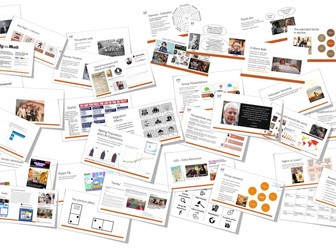
A full scheme of work covering the ‘Families and Households’, AQA A-level Sociology. This includes engaging lesson powerpoints, student activity handbooks, exam questions and example answers.
Topics covered:
Introduction
Functionalism and the Family
Marxism and the Family
Feminism and the Family
New Right and the Family
Postmodernism and the Family
Family Diversity
Family Patterns
Couples
Childhood
Policies
Demographics
(Follows a ‘Be more chef’ model - the lesson takes cooking as an analogy for the starter, main and plenary. The ‘Be more chef’ concept pushes students to go beyond the recipe at the end of the lesson, and strive towards additional independent study)
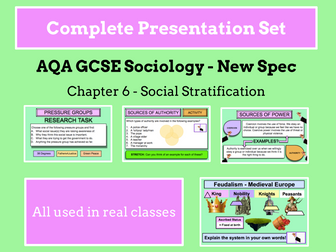
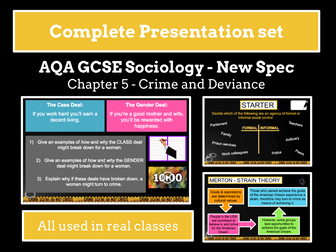
Complete set of presentations for the sixth and final unit of the new AQA specification, tried and tested with real classes. Mini-whiteboards would be ideal and access to ICT is required for a couple of lessons - one laptop/computer between two students. Created to fit with AQA’s recommended scheme of work.
Complete set of presentations for the fifth unit of the new AQA specification, tried and tested with real classes. Mini-whiteboards would be ideal and access to ICT is required for a couple of lessons - one laptop/computer between two students. Created to fit with AQA’s recommended scheme of work.
Complete set of presentations for the third unit of the new AQA specification, tried and tested with real classes. Includes a full assessment of this chapter, and the previous chapter, and a full feedback lesson. Mini-whiteboards would be ideal and access to ICT is required for a couple of lessons - one laptop/computer between two students. Created to fit with AQA’s recommended scheme of work.
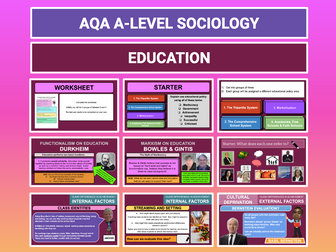
Presentation sets for all six topics of the Education unit for AQA A-level Sociology. Contains key knowledge, a range of engaging activities and assessments. Any questions, email info@thesociologyteacher.com
This pack of lessons includes the whole topic of socialisation and the creation of identity on the Cambridge international specification.
Includes the following:
• The process of learning and socialisation
• Culture, roles, norms, values, beliefs, customs, ideology, power and status as elements in the social
construction of reality.
• The importance of socialisation in influencing human behaviour, including the nurture versus nature
debate.
• Agencies of socialisation and social control, including family, education, peer group, media and religion.
• Social control, conformity and resistance
• The role of structure and agency in shaping the relationship between the individual and society, including
an awareness of the differences between structuralist and interactionist views.
• Factors explaining why individuals conform to social expectations, including sanctions, social pressure,
self-interest and social exchange.
• The mechanisms through which order is maintained, including power, ideology, force and consensus.
• How sociologists explain deviance and non-conformity, including subcultures, under-socialisation,
marginalisation, cultural deprivation and social resistance.
• Social identity and change
• Social class, gender, ethnicity and age as elements in the construction of social identity.
• How social class, gender, ethnicity and age identities may be changing due to globalisation, increased
choice and the creation of new/hybrid identities.
Can be used for other specifications (GCSE and A Level)
Introduce students to A Level Sociology with this engaging and interactive Introduction / Taster Lesson.
Perfect as a first lesson, transition activity, induction session or introduction to the subject, this resource introduces students to key sociological concepts while developing discussion, analytical thinking and early exam skills.
Students explore how sociologists explain behaviour and begin to understand the expectations of studying Sociology at A Level.
Part 1: Introducing Sociology
Lesson objectives:
• Know the meaning of the key terms: culture, norms, values, socialisation, status and role
• Understand the importance of culture and socialisation in explaining human behaviour
Part 2: Developing Sociology Skills
Lesson objectives:
• Understand Sociology assessment objectives
• Develop confidence using the P.E.E.L structure in Sociology responses
What’s included:
• Easy to deliver PowerPoint presentation with helpful teaching tips in the notes
• Student friendly activities and discussion opportunities
• Worksheets formatted and ready to print
• Stretch and challenge activities included
• Focus on literacy and key sociological concepts
• Strong links to exam skills and assessment criteria
• High-level questioning and opportunities for written application
Resources are made for the AQA A Level Sociology specification, but may be tailored for use with other exam boards.
Textbook page numbers and references are made to AQA A Level Sociology Book One and AQA A Level Sociology Book Two.
Check out our other great Sociology resources in our TES shop.
For any inquiries or support using any of the resources please feel free to email:
Lovelysystemz@gmail.com
A work booklet with a range of revision questions covering aspects of the topic of education including: hidden curriculum, setting and streaming, types of school, labelling and self fulfilling prophecies.
Suitable for AQA GCSE or any A Level.
Engage your students with this free, classroom-ready crossword exploring key Sociology concepts through the theme of love, relationships and family life. This resource reinforces important topics such as socialisation, norms, values, gender roles, feminism, patriarchy, social class, culture and social policy, making it ideal for GCSE and A Level Sociology revision.
Perfect for starters, plenaries, revision lessons, cover work or enrichment, this puzzle supports retrieval practice while helping students apply sociological theory to real-life relationships and family structures. It includes a complete word list and answers for easy marking and independent learning.
Created by The Bright Puzzle Company, this resource promotes accessible, engaging and curriculum-focused learning.
Free to download
Includes answers
Reinforces key sociological terminology
Suitable for GCSE & A Level
Valentine’s/relationships-themed enrichment activity


 Quick View