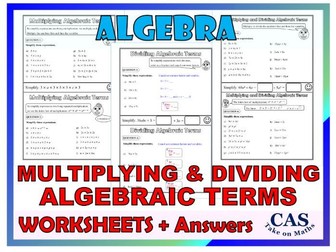
Algebra worksheets and answers to
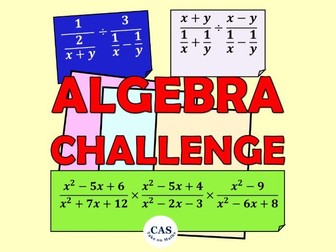
practise simplifying algebraic expressions that involve multiplication and division.
introduce the index law of multiplication.
Level of Difficulty: Beginner (Easy)
Grades: 7th to 9th
Also suitable for Australian Curriculum
Simplify algebraic expressions involving the four operations (ACMNA192)
More Resources:
Colouring Pages
Fun Activity
Topics:
Numbers
Times Table
Fractions
Decimals
Percentages
Significant Figures
Consumer Maths
Financial Maths
Algebra
Measurement and Geometry
Visit my shop :)
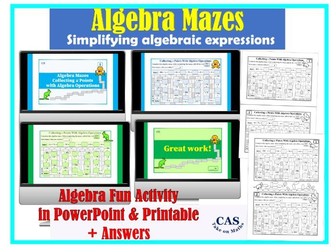
Algebra Mazes for students to practise simplifying algebraic expressions (Adding, subtracting, multiplying and dividing algebraic expressions)
The resource is in Printable (pdf) and PowerPoint Slides.
Level of Difficulty: Beginner (Easy)
Grades: 7th to 9th
Teaching Ideas:
Students work individually or in pairs to complete the algebra mazes then they swap their page with their friend or another pair to check the answers.
Learning Outcomes:
Recognise and use equivalent algebraic expressions (e.g. a + a = 2 x a = 2a, b + b +b +b = 4 x b = 4b)
Recognise like terms and add and subtract them to simplify algebraic expressions, eg a + 2b +3a =4a + 2b
Practise simplifying algebraic expressions that involve multiplication and division.
Simplify algebraic expressions involving the four operations
Also suitable for Australian Curriculum
Simplify algebraic expressions involving the four operations (ACMNA192)
More Resources:
Colouring Pages
Fun Activity
Topics:
Numbers
Times Table
Fractions
Decimals
Percentages
Significant Figures
Consumer Maths
Financial Maths
Algebra
Measurement and Geometry
Visit my shop :)
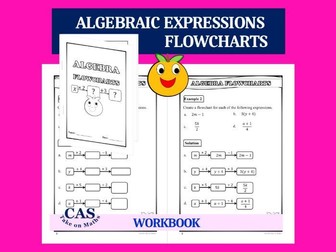
REPRESENT ALGEBRAIC EXPRESSIONS ON FLOWCHARTS WORKBOOK
Scaffolded notes + worksheets + answer keys + mini folded notes + teacher notes to learn and practise:
• The concept of algebra uses variables and numbers
• Represent algebraic expressions using flowcharts
• The concept of variables as a way of representing numbers using letters.
Grades: 7th to 9th
Learning Outcomes:
Understand the concept of algebra uses variables and numbers.
Represent algebraic expressions using flowcharts.
Understand the concept of variables as a way of representing numbers using letters.
Also comply with Australian Curriculum:
Introduce the concept of variables as a way of representing numbers using letters (ACMNA175)
Communicate and connect mathematical ideas using appropriate terminology, diagrams and symbols (MA4-1WM)
Recognise and explains mathematical relationships using reasoning (MA4-3WM)
Generalise number properties to operate with algebraic expressions (MA4-8NA)
More Algebra Resources:
Algebra Mazes | Simplifying Algebraic Expressions
Simplifying Algebraic Expressions
Grades: 6th to 8th
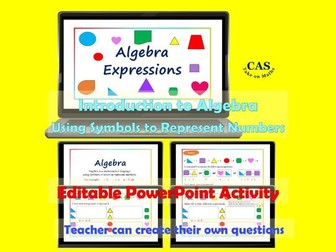
Introduction to Algebra
Using Symbols to Represent Numbers
Algebra PowerPoint activity for students to practise using symbols to create algebraic expressions.
The PowerPoint is editable for teachers can type numbers.
Duplicate the slide to create more questions.
Also Comply with Australian Curriculum
Introduce the concept of variables as a way of representing numbers using letters (ACMNA175)
Create algebraic expressions and evaluate them by substituting a given value for each variable (ACMNA176)
Extend and apply the laws and properties of arithmetic to algebraic terms and expressions (ACMNA177)
More Algebra Resources
Inequalities on a Number Line Worksheets and Answers
Worksheets to keep your learners engaged in math learning and apply
mathematical strategies to complete a variety of question styles about
inequalities on number lines.
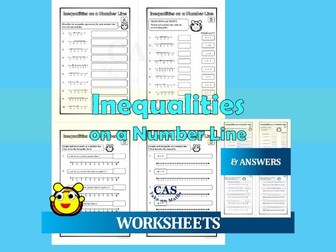
Worksheet A: Describing the inequality represented by each number line.
Worksheet B: MATCHING ACTIVITY
Worksheet C: Graphing inequalities on a number line.
Worksheet D: Graphing inequalities on a number line.
Grades: 6th to 9th
Learning Outcomes:
Describe and write inequalities on a number line
Graph inequalities on a number line
Also comply with for Australian Curriculum
Introduce the concept of variables as a way of representing numbers using letters (ACMNA175).
Communicate and connect mathematical ideas using appropriate terminology, diagrams and symbols (MA4-1WM).
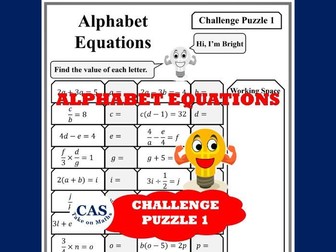
ABC Equations - Algebra Challenge Puzzles and Step-by-Step Solutions
Algebra Challenge Puzzles for students to practise solving equations by substitution method.
**Puzzle 1: **
Find the value of each letter from a to z. (26 questions in one page)
Each question connects with the previous question.
Puzzle 2
Part a: Substitute the value of each letter to find the value of each word, then add all the values.
Part b: Find the letter for each integer to solve the mystery message.**
Easy preparation for math classes. Just print the resource & ready for students to practise algebra.
Also comply with Australian Curriculum
Introduce the concept of variables as a way of representing numbers using letters (ACMNA175).
Communicate and connect mathematical ideas using appropriate terminology, diagrams and symbols (MA4-1WM).
Solve simple linear equations (ACMNA179).
Solve linear equations using algebraic techniques and verify solutions by substitution (ACMNA194).
More Algebra Resources
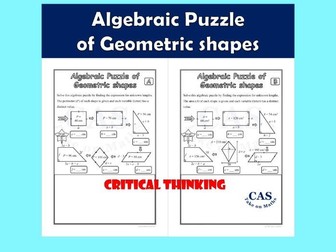
Algebraic Puzzles in Geometric Shapes and Step-by-Step Solutions
Algebraic puzzles to keep your learners engaged in algebra and measurement learning.
The learners use perimeter and area formulas for 2D shapes and apply algebraic techniques such as the balancing method to complete each puzzle.
Puzzle A: find the expression for unknown lengths. The perimeter (P ) of each shape is given and each variable (letter) has a distinct value.
Puzzle B: find the expression for unknown lengths. The area (A ) of each shape is given and each variable (letter) has a distinct value.
Grades: 7th to 10th
Learning Outcomes:
Use the formulas for the perimeter and area of two-dimensional shapes in problem-solving
Create algebraic expressions and evaluate them by substituting a given value.
Solve linear equations using algebraic techniques.
Also comply with Australian Curriculum
Introduce the concept of variables as a way of representing numbers using letters (ACMNA175).
Communicate and connect mathematical ideas using appropriate terminology, diagrams and symbols (MA4-1WM).
Solve simple linear equations (ACMNA179).
Solve linear equations using algebraic techniques and verify solutions by substitution (ACMNA194).
Establish the formulas for areas of rectangles, triangles and parallelograms, and use these in problem-solving (ACMMG159)
More Algebra Resources:
Algebra
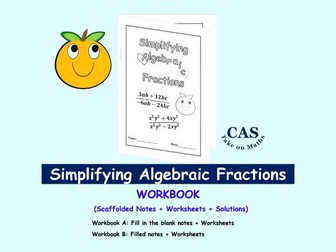
Simplifying Algebraic Fractions Workbook and Step-by-Step Solutions.
Algebra workbook to practise simplifying algebraic fractions using index laws for multiplication and division.
There are 2 styles of workbooks:
Workbook A: Fill in the blank notes + Worksheets
Workbook B: Filled notes + Worksheets
Also comply with Australian Curriculum
Apply the four operations to simple algebraic fractions with numerical denominators (ACMNA232)
More Algebra Resources
FREE Christmas Maths Fun! Download this festive algebra colouring pack and bring joy to your classroom! Perfect for Grades 5–8 (KS2 to KS3), this freebie blends creativity with curriculum-aligned maths. No prep—just print and go!
Grade 5-8 Algebra Christmas Colouring Freebie
Celebrate the festive season with this joyful maths freebie! Perfect for end-of-year fun, this set of three Christmas-themed colouring worksheets introduces students to algebraic thinking through playful letter-value challenges. With snowmen, teddy bears, and candy canes galore, students decode the phrase “MERRY CHRISTMAS” by assigning numerical values to letters and calculating totals—building foundational algebra skills while enjoying a creative break.
This resource includes:
Worksheet 1: Introduction to Algebra – Letters Represent Numbers
Worksheet 2: Candy Count Challenge – Help Teddy Add It Up!
Worksheet 3: Letter Breakdown – MERRY CHRISTMAS Step-by-Step
Learning Outcomes
Students will:
Understand that letters can represent numbers.
Apply substitution to evaluate expressions.
Strengthen mental addition and pattern recognition.
Build confidence in algebraic reasoning through creative engagement.
Comply with Australian Curriculum:
Aligned to ACMNA175 and ACMNA176 from the Australian Curriculum: Mathematics
Year 7 (ACMNA175): Introduce the concept of variables as a way of representing numbers using letters.
Year 7 (ACMNA176): Create algebraic expressions and evaluate them by substituting values.
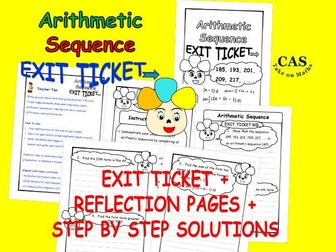
Arithmetic Sequence Exit Ticket & Reflection Pages Formative Assessment for Algebra 1, GCSE, Year 11 Maths
Grade: 11th - 12th
This resource provides a ready-to-use formative assessment for arithmetic sequences, designed to check student understanding of the nth term, common difference and sum formulas.
What’s Included:
Exit Ticket for quick concept check
Reflection Pages for metacognition and deeper thinking
Teacher tips and optional extension questions
Step by Step Solutions for easy review
Perfect for:
- Year 11 Australian classrooms
- GCSE preparation (UK)
- Algebra 1 review (US Common Core)
Learning Outcomes:
Recognise and solve problems involving arithmetic sequences and series
Generate terms of linear sequences and determine the nth term
Apply formulas for the nth term and sum of an arithmetic sequence
Recognise and apply arithmetic sequences in problem-solving contexts
This resource aligns with senior secondary mathematics outcomes across multiple curricula:
Australian Curriculum (Year 11 – General Mathematics / Mathematical Methods)
ACMGM068: Display the terms of an arithmetic sequence in both tabular and graphical form
ACMGM069: Use the formula for the nth term of an arithmetic sequence to solve problems.
ACMGM070: Apply the formula for the sum of an arithmetic sequence to practical situations.
GCSE Mathematics (UK, KS4 – AQA, Edexcel, OCR)
Generate terms of linear sequences and determine the nth term.
Recognise and apply arithmetic sequences in problem-solving contexts.
Common Core – Algebra 1
CCSSHSA-SSE.B.3
Choose and produce an equivalent form of an expression to reveal and explain properties of the quantity represented by the expression.
CCSSHSF-IF.A.3
Recognize that sequences are functions, sometimes defined recursively, whose domain is a subset of the integers.
CCSSHSF-BF.A.1
Write a function that describes a relationship between two quantities.
CCSSHSF-BF.A.2
Write arithmetic and geometric sequences both recursively and with an explicit formula, use them to model situations, and translate between the two forms.
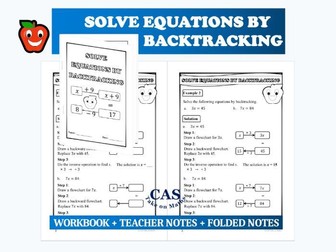
SOLVE LINEAR EQUATIONS USING BACKTRACKING WORKBOOK
to learn and practise:
Solve linear equations using the backtracking method.
The resource contents: workbooks (Scaffolded notes + worksheets) + answer keys + mini folded notes + teacher notes.
Grades: 7th to 9th
Learning Outcomes:
Understand the difference between algebraic expressions where pronumerals are used as variables, and equations where pronumerals are used as unknowns.
Solve linear equations using the backtracking method.
Also comply iwith for Australian Curriculum
Introduce the concept of variables as a way of representing numbers using letters (ACMNA175).
Communicate and connect mathematical ideas using appropriate terminology, diagrams and symbols (MA4-1WM).
Solve simple linear equations (ACMNA179).
Solve linear equations using algebraic techniques and verify solutions by substitution (ACMNA194).
More Algebra Resources:
Algebra Mazes Simplifying Algebraic Expressions
Simplifying Algebraic Expressions
Represent Algebraic Expressions on Flowcharts
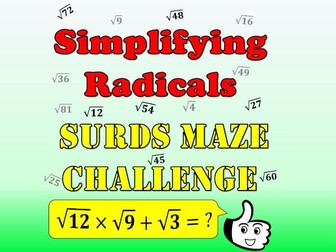
Surds Maze Challenge
Grades: 10–12 63 Questions 3 Differentiated Worksheets
**Make surds joyful! **
This printable maze set helps students simplify radicals and perform surd operations with confidence and in fun way.
Builds fluency through engaging problem-solving
Reflection prompts deepen understanding
Includes student instructions, teacher guidance & step-by-step solutions
No prep—just print & go!
Perfect for revision, group work, or pair tasks
Supports confident, collaborative learning in Year 10–12 classrooms
THIS RESOURCE INCLUDES:
• Surds Maze Challenge Activity + Instructions for individual task or pair task
• Reflection Pages for the Surds Maze Challenge
• Step by Step Solutions
Learning Outcomes:
• Simplify surds and perform operations with radicals (addition,
subtraction, multiplication, division).
• Apply algebraic reasoning to navigate mathematical mazes.
• Reflect on problem-solving strategies and mathematical thinking.
Comply with
Australian Curriculum:
ACMNA231: Solve problems involving surds and fractional indices.
ACMNA230: Apply index laws to numerical expressions with integer indices.
UK GCSE (Key Stage 4)
AQA GCSE Mathematics: Supports outcomes requiring students to simplify surds and perform operations.
Edexcel GCSE Mathematics: Aligns with outcomes requiring students to use surds in exact calculations.
CCSS HSN-RN.A.2
Rewrite expressions involving radicals and rational exponents using the properties of exponents.
CCSS HSA-SSE.A.1
Interpret expressions that represent a quantity in terms of its context.
CCSS HSA-SSE.A.1a
Interpret parts of an expression, such as terms, factors, and coefficients.
CCSS HSA-SSE.A.2
Use the structure of an expression to identify ways to rewrite it.
CCSS HSA-REI.A.2
Solve simple rational and radical equations in one variable, and give examples showing how extraneous solutions may arise.
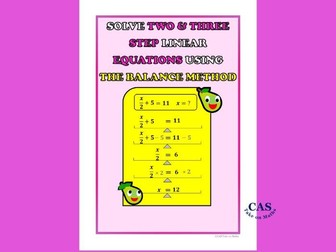
SOLVE TWO & THREE-STEP LINEAR EQUATIONS USING THE BALANCE METHOD WORKBOOK
To learn and practise:
Connect mathematical ideas using appropriate terminology, diagrams and symbols.
Solve two & three-step linear equations using the Balance Method
Solve linear equations and verify solutions by substitution.
The resource contents: workbooks (Scaffolded notes + worksheets) + step by step solutions + folded notes + teacher notes.
Grades: 7th to 9th
Learning Outcomes:
Solve two & three-step linear equations using the Balance Method
Also suitable for Australian Curriculum
Introduce the concept of variables as a way of representing numbers using letters (ACMNA175).
Communicate and connect mathematical ideas using appropriate terminology, diagrams and symbols (MA4-1WM).
Solve simple linear equations (ACMNA179).
Solve linear equations using algebraic techniques and verify solutions by substitution (ACMNA194).
More Algebra Resources:
Algebra Mazes Simplifying Algebraic Expressions
Simplifying Algebraic Expressions
Represent Algebraic Expressions on Flowcharts
Solve One & Two Step Linear Equations by Backtracking Flowcharts
Solve One Step Linear Equations-Balance Method
Visit my shop :)
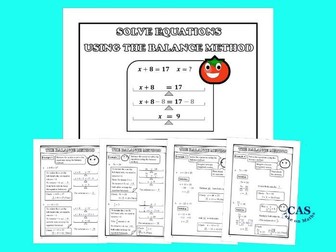
SOLVE LINEAR EQUATIONS USING THE BALANCE METHOD WORKBOOK
To learn and practise:
• Connect mathematical ideas using appropriate terminology, diagrams and symbols
• Solve one-step linear equations using the Balance Method
• Solve linear equations and verify solutions by substitution.
The resource contents: workbooks (Scaffolded notes + worksheets) + answer
keys + folded notes + teacher notes.
Grades: 7th to 9th
Learning Outcomes:
Solve one step linear equations using the Balance Method
Also suitable for Australian Curriculum
Introduce the concept of variables as a way of representing numbers using letters (ACMNA175).
Communicate and connect mathematical ideas using appropriate terminology, diagrams and symbols (MA4-1WM).
Solve simple linear equations (ACMNA179).
Solve linear equations using algebraic techniques and verify solutions by substitution (ACMNA194).
More Algebra Resources:
Algebra Mazes Simplifying Algebraic Expressions
Simplifying Algebraic Expressions
Represent Algebraic Expressions on Flowcharts
Solve One & Two Step Linear Equations by Backtracking Flowcharts
Visit my shop :)
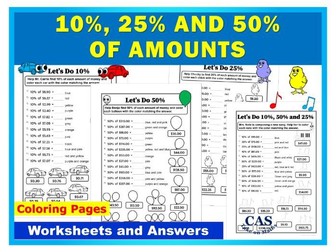
Practise calculating 10%, 50% and 25% of the given amounts and colouring activity.
Students find the answers then colour each object with the colour matching the answer.
Answer keys is included.
Level of Difficulty: Beginner (Easy)
Grades: 4th to 8th
Learning Outcomes:
Practise 10%, 25% and 50% of amounts
Australian Curriculum:
Find percentages of quantities and express one quantity as a percentage of another, with and without the use of digital technologies (ACMNA158)
More Resources:
Colouring Pages
Fun Activity
Topics:
Numbers
Times Table
Fractions
Decimals
Percentages
Significant Figures
Consumer Maths
Financial Maths
Algebra
Measurement and Geometry
Visit my shop :)
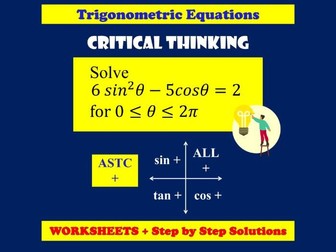
Trigonometry Equations Critical Thinking Problems and step-by-step solutions.
Students think critically to demonstrate knowledge
• Trigonometry involves the unit circle of cos θ, sin θ and tan θ and
periodicity using degrees and radians.
• Apply the appropriate formulas and use mathematical strategies to
solve equations involving trigonometric functions algebraically.
Also comply with Australian Curriculum:
Understand the unit circle definition of cos θ, sin θ and tan θ and periodicity using radians (ACMMM034)
Recognise the exact values f cos θ, sin θ and tan θ at integer multiples of π/6 and π/4 (ACMMM035)
Identify contexts suitable for modelling by trigonometric functions and use them to solve practical problems (ACMMM042)
Solve equations involving trigonometric functions using technology, and algebraically in simple cases. (ACMMM043)
Other Trigonometry resources:
Trigonometry
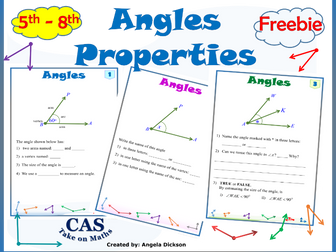
This resources is designed for students’ scaffolded note about angles properties and naming angles.
Level of Difficulty: Beginner (Easy)
Grades: 5th to 8th
Learning Outcomes:
• identify the ‘arms’ and ‘vertex’ of an angle
• Learn to name an angle in four different ways
More Resources
Colouring Pages
Fun Activity
Topics:
Numbers
Times Table
Fractions
Decimals
Percentages
Significant Figures
Consumer Maths
Financial Maths
Algebra
Measurement and Geometry
Visit my shop :)
A fun classroom activity to practise connects fractions, decimals & percentages.
Students colour the matching fraction, decimal & percentage with the same colour.
The answer key is also included.
The activity in two formats: Printable and PowerPoint and in British and American English.
Skills Level: Beginner (Easy)
Grades: 4th to 8th
Learning Outcomes:
– Connect fractions, decimals and percentages and carry out simple conversions.
Also comply with Australian Curriculum:
Connect fractions, decimals and percentages and carry out simple conversions (ACMNA157)
More Resources:
Colouring Pages
Fun Activity
Topics:
Numbers
Times Table
Fractions
Decimals
Percentages
Significant Figures
Consumer Maths
Financial Maths
Algebra
Pythagoras Theorem
Measurement and Geometry
Visit my shop :)
Practice calculating 10%, 50% and 25% of the given amounts and coloring activity.
Students find the answers then color each object with the color matching the answer.
Answer keys is included.
Level of Difficulty: Beginner (Easy)
Grades: 4th to 8th
Outcomes: Students practise 10%, 25% and 50% of amounts
More Resources:
Colouring Pages
Fun Activity
Topics:
Numbers
Times Table
Fractions
Decimals
Percentages
Significant Figures
Consumer Maths
Financial Maths
Algebra
Measurement and Geometry
Visit my shop :)
This resource contains two worksheets of Make numbers. Students use the mathematical operations such as addition, subtraction, multiplication and division to make the target numbers: 5 and 15.
Level of Difficulty: Easy
Grades: 3rd - 8th
More Resources
Colouring Pages
Fun Activity
Topics:
Numbers
Times Table
Fractions
Decimals
Percentages
Significant Figures
Consumer Maths
Financial Maths
Algebra
Measurement and Geometry
Visit my shop :)
Subtracting Like Fractions:
2 Tasks in 1 page for students to practise subtracting like fractions (same denominators) then express the answers in simplest fractions and color the diagrams to show the answers.
Level of Difficulty: Beginner (Easy)
Grades: 4th to 7th
**Learning Outcomes: **
• Subtracting like fractions (Same denominators)
• Writing fractions in their simplest form.
• Using diagrams to demonstrate fractions.
More Resources:
Colouring Pages
Fun Activity
Topics:
Numbers
Times Table
Fractions
Decimals
Percentages
Significant Figures
Consumer Maths
Financial Maths
Algebra
Measurement and Geometry
Visit my shop :)