Lesson created for comprehension skills for KS3 and KS4. Fully differentiated resources - worksheet pack includes differentiated choice-based activity, which the three different levels of Word doc correspond to. Can be used to teach the curriculum skills of inferring / deducing / synthesising which are important to the new AQA GCSE. Uses the idea of the Norse God Thor (popularised by Marvel comics and films) to engage pupils, and they have to solve the riddles in a story from Norse Mythology (which I translated). Interactive, engaging, always a success!
This engaging and thought-provoking double-lesson resource aids students in developing a secure understanding of the chapters 3 to 4 of Emma Carroll’s 'Secrets of a Sun King.’ In this section of the text, Lil meets Tulip and Oz for the first time, and visits her Grandad in the hospital, where she learns of the curse.
The comprehensive and colourful PowerPoint presentation enables students to understand the text through:
-Retrieving information;
-Inferring and deducing hidden meanings;
-Linking ideas from the text to context;
-Sequencing the key events of the chapters.
The sessions include a range of retrieval, vocabulary, inference, explanation and deeper thinking activities. A clear, colourful and comprehensive PowerPoint presentation guides students through the learning.
There’s a lot in the session (20 slides in total) so I would recommend breaking into two lessons. The lessons are most suitable for children in key stage 2, (they were originally used for those in years 4 and 5).
This engaging and thought-provoking triple-lesson resource aids students in developing a secure understanding of the chapters 4 to 6 of Roald Dahl’s ‘Charlie and the Chocolate Factory.’ The chapters covered in these lessons are ‘The Secret Workers,’ ‘The Golden Tickets’ and ‘The First Two Finders.’
The lessons are guided by a comprehensive and colourful PowerPoint presentation, and enables students to understand the text through:
-Retrieving information;
-Inferring and deducing hidden meanings;
-Empathising with characters.
The sessions include a range of retrieval, vocabulary, inference, explanation and deeper thinking activities. A clear, colourful and comprehensive PowerPoint presentation guides students through the learning.
There’s a lot in the session (21 slides in total) so I have always broken the content into 2-3 lessons in the past. The lessons are most suitable for children in lower key stage 2, (they were originally used for those in years 3 and 4).
This is a bundle of my comprehensions together at a reduced price to have your lessons covered for a few weeks.
They include:
*A comprehension on Qatar
This comprehension is based on Qatar as a country and the processes they've put in place in order to host the World Cup 2022. It provides children with an interesting background knowledge of the country while testing their comprehension skills simultaneously.
I have attached comprehension questions/activities for a lower ability, middle ability and higher ability learner, all in the same document.
It worked well for the abilities in my own class, however it can be adapted to suit the needs of your class too.
I have saved it as a word document and a PDF.
*The BFG (chapter 1)
Chapter 1 of the BFG with comprehension questions. My class love the BFG so I decided to create a comprehension on each chapter.
Looks at deducing, inferring and spotting similes.
The BFG (chapter 2)
Chapter 2 of the BFG with comprehension questions. My class love the BFG so I decided to create a comprehension on each chapter.
Looks at deducing, inferring, italics and spotting similes
Text and questions based on deducing and inferring are included.
This engaging and thought-provoking lesson resource aids students in developing a secure understanding of the chapters 1 to 4 of Roald Dahl’s ‘The Twits.’ The chapters covered in these lessons are ‘Hairy Faces’, ‘Mr Twit’, Dirty Beards’ and ‘Mrs Twit.’
The lessons are guided by a comprehensive and colourful PowerPoint presentation, and enables students to understand the text through:
-Making predictions;
-Retrieving information;
-Inferring and deducing hidden meanings.
The sessions include a range of retrieval, vocabulary, inference, explanation and deeper thinking activities. A clear, colourful and comprehensive PowerPoint presentation guides students through the learning. A worksheet/ template is also provided for the creative character creation activity (in both Word and PDF format).
There’s a lot in the session (19 slides in total) so I would recommend breaking into two lessons. The lessons are most suitable for children in lower key stage 2, (they were originally made for children in year 3) but they could also be adapted for slightly older and younger year groups.
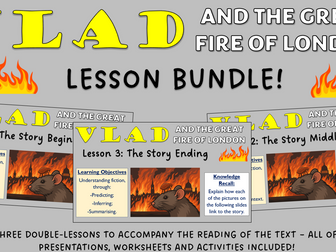
This engaging and thought-provoking series of lessons are designed to accompany class reading of Kate Cunningham’s 'Vlad and the Great Fire of London.’
Three double-length lessons are included - one each to cover the beginning, middle and ending of the text.
The comprehensive and colourful PowerPoint presentations enables students to understand the text through:
-Lesson 1: Making predictions, retrieving, inferring and deducing;
-Lesson 2: Retrieving, inferring, making links with context;
-Lesson 3: Retrieving, inferring and summarising key events.
Everything needed to teach the lessons is included within the resource packs, including worksheets and templates for the ‘deeper thinking activities.’
The resources have been tried and tested in classrooms, and have enabled children to develop a comprehensive understanding of the text and its key meanings. The resources are most suitable for students in upper KS1 (I originally used these resources with a year 2 class), but may be adapted for other age groups, depending upon the individual context of the school and students.
This engaging and thought-provoking triple-lesson resource aids students in developing a secure understanding of the chapters 10 to 12 of Roald Dahl’s ‘Charlie and the Chocolate Factory.’ The chapters covered in these lessons are ‘The Family Begins to Starve,’ ‘The Miracle’ and ‘What it said on the Golden Ticket.’
The lessons are guided by a comprehensive and colourful PowerPoint presentation, and enables students to understand the text through:
-Retrieving information;
-Inferring and deducing hidden meanings;
-Explaining key ideas.
The sessions include a range of retrieval, vocabulary, inference, explanation and deeper thinking activities. A clear, colourful and comprehensive PowerPoint presentation guides students through the learning.
A newspaper template is also included for the deeper thinking task, in which children take on the role of a reporter sharing the story of Charlie finding the golden ticket.
There’s a lot in the session (21 slides in total) so I have always broken the content into 2-3 lessons in the past. The lessons are most suitable for children in lower key stage 2, (they were originally used for those in years 3 and 4).
This engaging and thought-provoking double-lesson resource aids students in developing a secure understanding of the chapter 1 of Anne Holm’s ‘I Am David.’ In this section of the text, David escapes the camp, makes a vast journey by foot, van and boat, and then observes the beauty of the world for the first time.
The comprehensive and colourful PowerPoint presentation enables students to understand the text through:
-Making predictions;
-Retrieving information;
-Inferring and deducing hidden meanings.
The sessions include a range of retrieval, vocabulary, inference, explanation and deeper thinking activities. A clear, colourful and comprehensive PowerPoint presentation guides students through the learning. The lesson also includes an answer key for the retrieval questions, and model answer ideas for the more detailed responses.
There’s a lot here (17 slides filled with questions and activities) so I would recommend breaking into two lessons. The lessons are suitable for students in either upper KS2 or lower KS3, depending upon the individual context of the school and students. I originally used them with year 6 children.
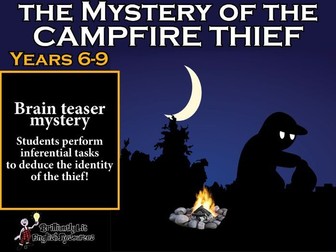
Want your students to practice inference making and close reading skills? This fun brain teaser mystery will entertain your students and give them comprehension tasks to deduce the thief’s identity. It will work well for independent work, homework or home school learning because all of the answers are in a separate PDF from the mystery. To track down the thief students will have to unscramble the answers to jokes and riddles told by riddler Sophie to her friend Matt. They will also work out clues using a numbers-to-alphabet code. A further slice of challenging fun is rooting out the writer’s ‘mistake’- an event in the story that really could not have happened. Students will enjoy the humorous, rapid-fire interaction between Matt and Sophie. He fears he isn’t as speedy at working things out as his clever friend is, but he manages to wow her in this story- and discover who stole her phone!
To complete the activity, students have to complete two short fun writing tasks and a ‘Where’s Wally?’ style drawing to find the missing phone.
A question sheet is included, and a separate PDF answer key. Each student will need their own question sheet. If you are doing this activity in class, for read-aloud fun (and paper saving), you could put the story and answers up on your screen. If this is assigned for homework, you can photocopy the story, questions and answers, and give them to pairs or individuals. The answer key has been put into a separate PDF to allow for teachers to post the mystery first, and then follow it up a few days later by the answers.
Thanks so much for checking out this resource.
If your purchase this resource it would be grand if you could review it. I would be happy to send you a copy of a single resource in my store in my shop as a recognition of your time. You just have to email me and tell me which one you want!
This engaging and thought-provoking double-lesson resource aids students in developing a secure understanding of the chapters 3 and 4 of Katherine Rundell’s 'The Explorer.’
The comprehensive and colourful PowerPoint presentation enables students to understand the text through:
-Retrieving information;
-Inferring and deducing hidden meanings;
-Sequencing key events from the text.
The sessions include a range of retrieval, vocabulary, inference, explanation and deeper thinking activities. A clear, colourful and comprehensive PowerPoint presentation guides students through the learning. The lesson also includes an answer key for the retrieval questions, and model answer ideas for the more detailed responses.
There’s a lot here (18 slides in total) so I would recommend possibly splitting the content of two lessons. The lessons are suitable for students in KS2 (with only minor adaptations, I have used the resources in the past with children from years 3 to 5).
This engaging and thought-provoking triple-lesson resource aids students in developing a secure understanding of the chapters 1 to 3 of Katherine Rundell’s 'Rooftoppers.’
The comprehensive and colourful PowerPoint presentation enables students to understand the text through:
-Making predictions;
-Retrieving information;
-Inferring and deducing hidden meanings.
The sessions include a range of retrieval, vocabulary, inference, explanation and deeper thinking activities. A clear, colourful and comprehensive PowerPoint presentation guides students through the learning. The lesson also includes an answer key for the retrieval questions, and model answer ideas for the more detailed responses.
There’s a lot here (22 slides in total) so I would recommend breaking into two or even three separate lessons. The lessons are suitable for students in either upper KS2 or lower KS3, depending upon the individual context of the school and students. I originally used them with year 5 and 6 children.
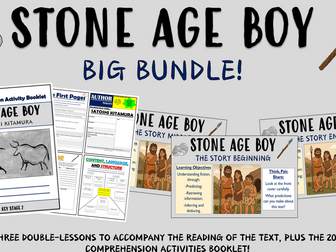
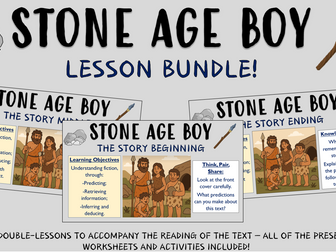
THIS BUNDLE CONTAINS ALL OF THE ‘STONE AGE BOY’ LESSONS, IN ADDITION TO THE 20-PAGE COMPREHENSION ACTIVITIES BOOKLET!
Three double-length lessons are included - one each to cover the beginning, middle and ending of the text.
The comprehensive and colourful PowerPoint presentations enables students to understand the text through:
-Lesson 1: Making predictions, retrieving, inferring and deducing;
-Lesson 2: Retrieving, inferring, making links with context;
-Lesson 3: Retrieving, inferring and summarising key events.
Everything needed to teach the lessons is included within the resource packs, including worksheets and templates for the ‘deeper thinking activities.’
The resources have been tried and tested in classrooms, and have enabled children to develop a comprehensive understanding of the text and its key meanings. The resources are most suitable for students in lower KS2 (I originally used these resources with a year 3 class), but may be adapted for other age groups, depending upon the individual context of the school and students.
This engaging and thought-provoking triple-lesson resource aids students in developing a secure understanding of the chapters 1 to 3 of Roald Dahl’s ‘Charlie and the Chocolate Factory.’ The chapters covered in these lessons are ‘Here Comes Charlie,’ ‘Mr Willy Wonka’s Chocolate Factory’ and ‘Mr Wonka and the Indian Prince.’
The lessons are guided by a comprehensive and colourful PowerPoint presentation, and enables students to understand the text through:
-Making predictions;
-Retrieving information;
-Inferring and deducing hidden meanings.
The sessions include a range of retrieval, vocabulary, inference, explanation and deeper thinking activities. A clear, colourful and comprehensive PowerPoint presentation guides students through the learning.
There’s a lot in the session (21 slides in total) so I have always broken the content into 2-3 lessons in the past. The lessons are most suitable for children in lower key stage 2, (they were originally used for those in years 3 and 4).
Help your students sharpen their inference skills using this engaging, differentiated comprehension activity based on Adele’s emotional ballad Easy On Me. Designed for upper Key Stage 2 and lower KS3, this lesson guides learners in exploring character thoughts, feelings, and motives through a familiar and relatable text — song lyrics.
What’s Included:
Editable lesson flipchart (ActivInspire) and PDF.
Links to websites required.
Differentiated Question Sheets (Editable Word Documents):
LA/Not Sure Questions – Simple retrieval and basic inference (e.g., word meaning, mood)
MA/Confident Questions - Deeper exploration of metaphors, song meaning, and emotional tone
HA/Very Confident Questions – High-level analysis, perspective writing, and thematic reflection
Teacher Answer Guide: Example responses and discussion points provided for all levels
Plenary Prompt: Discussion/reflection question on the theme/message of the song
Key Features:
Differentiated by confidence level – Supports a wide range of learners
Editable and flexible – All worksheets provided in Word format for easy adaptation
Real-world engagement – Uses a globally known artist to capture attention and provoke thoughtful analysis
Focus on inference – Targets key reading objective: deducing thoughts, feelings, and motives from a text
Cross-curricular potential – Links literacy, music, and emotional literacy
Curriculum Links:
English Reading Comprehension (UK National Curriculum):
Inference and interpretation skills
Textual analysis and personal response
Perfect For:
KS2 and KS3 (Years 5–8)
Guided reading, whole-class lessons, or small group intervention
Cover lessons or homework tasks
Emotional literacy & PSHE tie-ins
This engaging and thought-provoking double-lesson resource aids students in developing a secure understanding of the chapters 5 to 6 of Michelle Magorian’s 'Goodnight Mister Tom.’ In this section of the text, Britain declares war on Germany, Tom reconnects with the community and Willie gets to know Zach.
The comprehensive and colourful PowerPoint presentation enables students to understand the text through:
-Retrieving information;
-Making rational predictions;
-Inferring and deducing hidden meanings;
-Analysing characters.
The sessions include a range of retrieval, vocabulary, inference, explanation and deeper thinking activities. A clear, colourful and comprehensive PowerPoint presentation guides students through the learning.
There are a wide range of activities in the slides (there are 18 slides in total) so I would recommend breaking into two lessons. The lessons are suitable for students in either KS3 or upper KS2, depending upon the individual context of the school and students.
This engaging and thought-provoking double-lesson resource aids students in developing a secure understanding of the chapters 12 to 13 of Emma Carroll’s 'Secrets of a Sun King.’ In this section of the text, the children manage to decipher the remainder of Lysandra’s script.
The comprehensive and colourful PowerPoint presentation enables students to understand the text through:
-Retrieving information;
-Inferring and deducing hidden meanings;
-Sequencing key plot events.
The sessions include a range of retrieval, vocabulary, inference, explanation and deeper thinking activities. A clear, colourful and comprehensive PowerPoint presentation guides students through the learning.
There’s a lot in the session (18 slides in total) so I would recommend breaking into two lessons. The lessons are most suitable for children in key stage 2, (they were originally used for those in years 4 and 5).
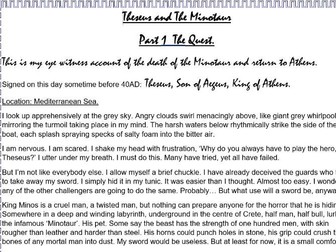
Theseus and the Minotaur Diary example with 24 KS2 comprehension questions.
Set in pre 40AD, Theseus writes about his observations as he travels on his quest to slay the Minotaur. The diary is written in the first person and is separated into two main sections (Part 1: The quest to slay the Minotaur/ Part 2 : The return to Athens). Each part is broken into smaller, readable sections based upon location as Theseus travels through the myth. This recount demonstrates features of a diary and acts as a continuous recount of the event including Theseus’s personal feelings and points of view.
Can be used as a stimulus for Myths and Legends, creative writing and to identify the features and structure of diary writing or as a Recount Checklist activity.
Also attached are two sets of 12 comprehension questions relating to each of the two parts of the text.
Comprehension Learning Objectives:
I can respond to a range of texts.
I can locate ideas and use information.
I can refer to the text when explaining a view or reason.
I can deduce and infer ideas from the text.
I can select sentences or phrases to support my answers.
Can be used in cross curricular topics English -Myths and Legends/ writing a diary or recount, History – The Greeks/ Greek Gods and Goddesses, Mythical Beasts, Geography – Greece. **
This engaging and thought-provoking double-lesson resource aids students in developing a secure understanding of the chapters 3 to 4 of Roald Dahl’s 'Matilda.’ The chapters covered in these lessons are ‘The Hat and the Superglue’ and ‘The Ghost.’
The lessons are guided by a comprehensive and colourful PowerPoint presentation, and enables students to understand the text through:
-Retrieving information;
-Inferring and deducing hidden meanings;
-Analysing the writer’s use of language.
The sessions include a range of retrieval, vocabulary, inference, explanation and deeper thinking activities. A clear, colourful and comprehensive PowerPoint presentation guides students through the learning. There is also a success criteria helpsheet (provided as Word and PDF) included to assist with the end-of-session creative task.
There’s a lot in the session (18 slides in total) so I would recommend breaking into two lessons. The lessons are most suitable for children in key stage 2, (they were originally used for those in years 4 and 5).
This engaging and thought-provoking double-lesson resource aids students in developing a secure understanding of the chapters 1 to 2 of Roald Dahl’s 'Matilda.’ The chapters covered in these lessons are ‘The Reader of Books’ and ‘Mr Wormwood, The Great Car Dealer.’
The lessons are guided by a comprehensive and colourful PowerPoint presentation, and enables students to understand the text through:
-Making predictions;
-Retrieving information;
-Inferring and deducing hidden meanings.
The sessions include a range of retrieval, vocabulary, inference, explanation and deeper thinking activities. A clear, colourful and comprehensive PowerPoint presentation guides students through the learning.
There’s a lot in the session (18 slides in total) so I would recommend breaking into two lessons. The lessons are most suitable for children in key stage 2, (they were originally used for those in years 4 and 5).
This engaging and thought-provoking series of lessons are designed to accompany class reading of Satoshi Kitamura’s 'Stone Age Boy.’
Three double-length lessons are included - one each to cover the beginning, middle and ending of the text.
The comprehensive and colourful PowerPoint presentations enables students to understand the text through:
-Lesson 1: Making predictions, retrieving, inferring and deducing;
-Lesson 2: Retrieving, inferring, making links with context;
-Lesson 3: Retrieving, inferring and summarising key events.
Everything needed to teach the lessons is included within the resource packs, including worksheets and templates for the ‘deeper thinking activities.’
The resources have been tried and tested in classrooms, and have enabled children to develop a comprehensive understanding of the text and its key meanings. The resources are most suitable for students in lower KS2 (I originally used these resources with a year 3 class), but may be adapted for other age groups, depending upon the individual context of the school and students.
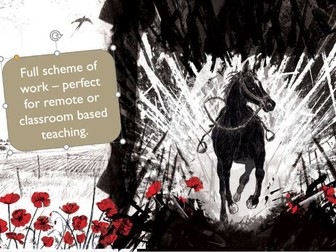
33 resources for 15 engaging and meaningful lessons teaching ‘War Horse’. This scheme of work was adapted for my mixed ability Year 7 class during lockdown for delivery via remote learning. Therefore, it is also ideal for teaching in classrooms with new Covid protocols in place. If you have any pupils self-isolating, resources for each lesson can quickly be emailed or uploaded to your school’s virtual learning environment. Lessons would also be suitable for if you need to set cover.
A wide range of extension tasks and differentiation by choice are included, as well as vocabulary support for most chapters, hyperlinks to clips from the film and audio versions of each chapter, and SPaG practice. Many tasks can be self-assessed.
Pupils study the whole text of ‘War Horse’ and their understanding is built up through a series of structured lessons focusing on the development of reading skills such as retrieving information, extending vocabulary, comprehension, deducing, inferring and interpreting ideas and then commenting on the writer’s use of language and/or structure.
A detailed mark scheme is included for the end of unit teacher marked reading assessment (in the style of GCSE paper 1) including example answers for varying marks.
This scheme of work proved hugely successful with my pupils who had an array of specific learning needs, many requiring additional support or challenge. Pupils especially liked the range of learning tasks, engaging starters, the clarity of the instructions and activities encouraging empathy with the narrator and other characters.