Recently updated with even more tasks!
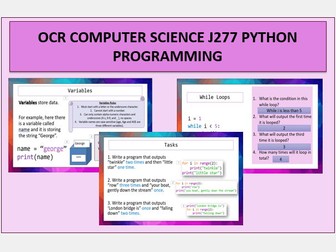
An entire 100+ slide PowerPoint covering Python Programming topics as stated in the OCR GCSE J277 Computer Science Specification.
This set of slides includes theory, examples, coding tasks and answers as well as starter activities for the following topics:
Variables
Comments
Data Types
Casting
Operators
User Input
Strings
String Methods
Concatenation
Booleans
Built in functions
Conditional Statements
FOR and WHILE loops
Lists
2-D Arrays
Functions and Procedures
Worksheet for strings and string methods included
WORKSHEET HAS NOW BEEN ADDED TO FILES.
Table of contents is linked to relevant slides to save you as much time as possible!
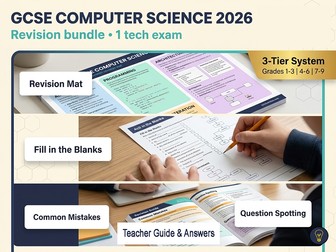
Elevate your GCSE Computer Science results with the ultimate Revision Bundle. This resource is purpose-built to reduce teacher workload while providing students with high-impact, board-specific preparation for AQA (8525), OCR (J277), and Edexcel (1CP2) specifications.
Whether you are looking for a quick starter activity, a homework task, or a full lesson on exam technique, this bundle is designed to be plug-and-play for the modern, busy classroom.
What is included in this bundle?
Comprehensive Revision Mats (PDF): Detailed summary sheets covering every core topic from Algorithms and Data Representation to CPU Architecture and Cyber Security.
Active Revision ‘Fill-in-the-Blanks’ Mats (PDF): Designed for active recall, these sheets challenge students to retrieve knowledge and identify their own gaps.
Master Answer Key (PDF): Full model answers for all sections, including specific “Question Spotting” guidance and common exam pitfalls to avoid.
Teacher Guidance & Implementation Notes (PDF): A strategic guide on using these mats for 10-minute interventions or 60-minute deep-dives.
Professional Resource Cover (JPG): High-resolution, print-ready cover for folder organisation.
Key Features for the 2026 Exams:
3-Tier Differentiation: Every mat is structured to support students aiming for Grades 1-3 (Bronze), challenge those at Grades 4-6 (Silver), and stretch the Grade 7-9 (Gold) high-fliers.
Dyslexia-Friendly Design: All materials use soft cream backgrounds (#fdf6e3) and clear, spaced typography to improve accessibility for SEN and neurodivergent learners.
Board-Specific Accuracy: No more “one size fits all” – we cover the specific Python syntax for Edexcel, the SQL requirements for OCR, and the data structure nuances for AQA.
Question Spotting: We highlight the “Common Mistakes” that lose students’ marks every year, providing “How to Avoid” strategies for each topic.
File Types Included:
.pdf (High-quality, non-editable documents for consistent formatting on any device).
.jpg (8k high-resolution graphics for display and covers).
How to use this resource:
Starters: Use the “Active Mats” for 10 minutes to test previous learning.
Revision: Provide the main materials as a primary study source for mock exam prep.
Homework: Set specific sections for independent study with the Answer Key for self-marking.
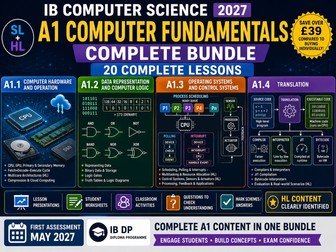
IB DP Computer Science A1 Complete Bundle for the new 2027 syllabus. Includes 20 classroom-ready lessons covering Computer Fundamentals, Data Representation, Computer Logic, Operating Systems, Control Systems and Translation.
IB Computer Science 2027 – A1 Computer Fundamentals
A comprehensive classroom-ready resource bundle for IB Diploma Programme Computer Science, aligned with the new IB Computer Science syllabus for first assessment in May 2027.
This bundle provides complete teaching resources for the entire A1 Computer Fundamentals section.
What is included
20 complete lesson resources covering A1.1–A1.4:
A1.1 Computer Hardware and Operation
A1.1.1 CPU
A1.1.2 GPU
A1.1.3 CPU and the GPU – HL only
A1.1.4 Primary Memory
A1.1.5 Fetch, Decode, Execute Cycle
A1.1.6 Multicore Architectures – HL only
A1.1.7 Secondary Memory
A1.1.8 Compression
A1.1.9 Cloud Computing
A1.2 Data Representation and Computer Logic
A1.2.1 Representing Data
A1.2.2 How Binary Is Used to Store Data
A1.2.3 Logic Gates
A1.2.4 Truth Tables
A1.2.5 Logic Diagrams
A1.3 Operating Systems and Control Systems
A1.3.1–A1.3.2 Operating Systems: Role & Functions
A1.3.3 Scheduling Approaches
A1.3.4 Polling & Interrupt Handling
A1.3.5 Multitasking & Resource Allocation – HL only
A1.3.6–A1.3.7 Control Systems – HL only
A1.4 Translation
A1.4.1 Translation Processes – HL only
Every lesson includes
Lesson presentation
Student worksheet
Classroom activities
Student tasks
Questions to check understanding
Mark scheme / answers
Syllabus coverage
The complete bundle covers:
CPU and GPU architecture
Primary and secondary memory
Fetch-decode-execute cycle
Multicore architectures
Compression
Cloud computing
Data representation
Binary data
Logic gates
Truth tables
Logic diagrams
Operating systems
Process scheduling
Polling and interrupt handling
Multitasking
Resource allocation
Control systems
Sensors and actuators
Feedback
Compilers and interpreters
JIT compilation
Bytecode interpreters
Translation processes
SL and HL coverage
The bundle contains both SL and HL content.
HL-only content is clearly identified throughout the resources, including:
A1.1.3 CPU and the GPU
A1.1.6 Multicore Architectures
A1.3.5 Multitasking and Resource Allocation
A1.3.6–A1.3.7 Control Systems
A1.4.1 Translation Processes
Suitable for
IB Diploma Programme Computer Science
SL and HL
New 2027 syllabus
First assessment May 2027
Secondary students aged 16–18
The resources can be used as a complete teaching sequence for A1 or incorporated into an existing IB Computer Science scheme of work.
Why buy the complete A1 bundle?
This bundle brings together the complete A1 Computer Fundamentals teaching resources in one package.
The individual lessons and smaller section bundles are also available separately. The complete A1 bundle provides a substantial discount compared with purchasing the resources individually.
Please note: This is an original teaching resource and is not affiliated with or endorsed by the International Baccalaureate Organisation.
40% off!!
Buy time and save on planning for your upcoming GCSE Computer Science revision lessons.
Bundle of amazing revision lessons for GCSE Computer Science (OCR).
Normally priced at £7.50.
Do not miss this bargan.
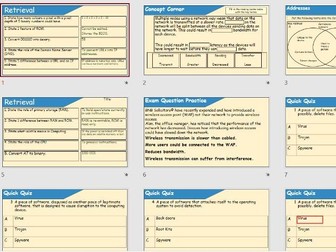
Lessons are created to be interactive and embed the principles of retrieval practice alongside exam question practice (answers provided). Lessons are animated to ease cognitive overload for learners.
Lessons are created on a dyslexic friendly PPT slide template (yellow background, sans font) to be as inclusive as possible.
UPDATED TO INCLUDE 2025 series.
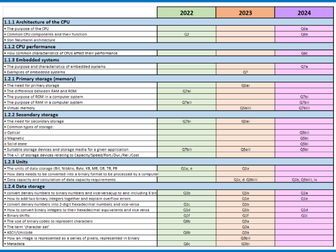
A complete breakdown of the 2022, 2023, 2024 and 2025 exam papers for both components 1 and 2 for the OCR GCSE Computer Science specification (J277).
Each paper has been mapped out to include the specification points covered and the questions asked. Questions have been colour coded to show repetition over the 3 past-papers.
Each paper also has a clear matrix mapped to the specification to help see which specification points are questioned more often, and which have been questioned least often.
I use this as a revision tool with my classes to ensure they know the key knowledge for the types of questions that appear every year. I also use it to try to predict what may appear in the next summer exam series (which worked to great effect in summer 2024 when ‘Operating Systems’ was questioned after seeing it had not appeared on the 2022 or 2023 paper!).
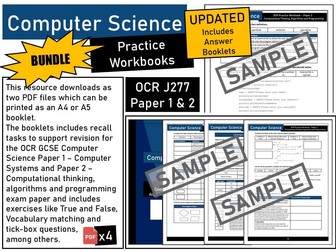
UPDATED - Now includes Answer Booklets in PDF format.
Revision and practice are vital components to any GSCE Computer Science student’s preparation for their examinations. This workbook is filled with just that, a great resource to support learners with recall and to check their understanding of key GCSE Computer Science course content prior to their exams.
This Bundle includes both GCSE OCR (J277) Paper 1 and Paper 2 Workbooks in PDF format which can be printed as an A4 or A5 booklet. The booklets includes recall tasks to support revision for the OCR GCSE Computer Science Paper 1 – Computer Systems and Paper 2 – Computational Thinking, Algorithms and Programming exam papers and includes exercises like True and False, Vocabulary matching and tick-box questions, among others.
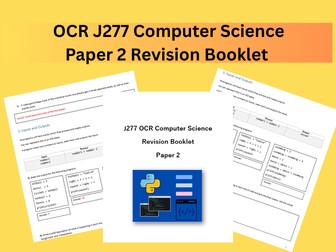
A revision booklet with revision theory and questions for Paper 2 in the OCR J277 Computer Science specification.
A range of questions are included in the booklet, and answers are included.
Topics covered:
Programming
Errors
Variables
Inputs and Outputs
Data Types
Operators
Selection
Iteration
String Manipulation
Flowcharts
Trace Tables
Sorting Algorithms
Searching Algorithms
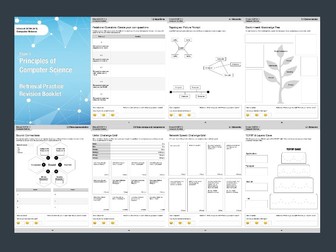
A retrieval practice booklet for Pearson Edexcel GCSE Computer Science (Paper 1).
This booklet contains 48 retrieval practice activities covering the non-programming Computer Science theory content.
Booklet is provided as a high quality, printable PDF.
Included activities:
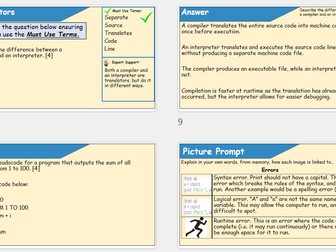
Decomposition & Abstraction: Picture Prompt
Pseudocode & Flowcharts: Brain Dump
Arithmetic Operators: Blockbusters
Relational Operators: Create your own questions
Binary Operators: Challenge Grid
Program Errors: Tell me 4
Sorting Algorithms: Lists
Search Algorithms: Brain Dump
Truth Tables: Brain Dump
Binary vs Denary: Brain Dump
Binary to Denary (and back again): Challenge Grid
Hexadecimal: Tell me 4
Binary to Hexadecimal (and back again): Challenge Grid
Binary Addition: Blockbuster
Binary Shift: Create your own questions
Unsigned & Signed Binary Numbers: Challenge Grid
Characters: Cops & Robbers
Graphics: Brain Dump
Sound: Connections
Units: Challenge Grid
Compression: Cops & Robbers
Von Neumann Architecture: Challenge Grid
Fetch Decode Execute Cycle: Lists
Main Memory: Retrieval Grid
Storage Types: Picture Prompts
Storage Devices: Tell me 4
Embedded Systems: Brain Dump
Operating System: Lists
Utility Software: Blockbusters
Low & High Level Programming Languages: Retrieval Grid
Compliers & Interpreters: Cops & Robbers
LAN and WAN: Blockbusters
The Internet: Retrieval Grid
Wired vs Wireless: Mind Map
Network Speed: Challenge Grid
Protocols: Lists
TCP/IP & Layers: Cake
Topologies: Picture Prompt
Network Hardware: Picture Prompts
Network Security (Threats): Cops & Robbers
Network Security (Prevention): Cops & Robbers
Environment: Knowledge Tree
Personal Data: Connections
Artificial Intelligence: Connections
Legislation (Copyright, Design, Trademarks): Tell me 5
Open Source vs Proprietary Licences: Brain Dump
Cyber Security Threat: Brain Dump
Cyber Security Threat Prevention: Mind Map
A set of 8 full lessons for KS3 (Year 7/Year 8) covering computer basics unit.
Lessons cover:
Lesson 1 - Input & Output. Understand the difference between input and output. Know what an input and output device is. Give examples of different types of input devices. Give examples of different types of output devices. Understand the function of different input and output devices.
Lesson 2 - Internal Components. Understand what is meant by internal. Know what an internal component is. Understand the function of different internal components. Identify the main internal parts of a computer system.
Lesson 3 - Health Issues. What health issues can a computer cause? (Look at: Back Problems, Repetitive Strain Injury (RSI), Eye Strain) How might we prevent these issues?
Lesson 4 - Binary. What is binary? How does a computer use binary? How do we represent a “normal” number as a binary number?
Lesson 5 - Binary. Continue looking at how do we represent a “normal” number as a binary number? Then how do we represent larger “normal” numbers as a binary number? Why do computers use binary? Why is it important? How do we convert binary to ASCII to create messages?
Lesson 6 - Network Components. Know what equipment is required to create a network. Look at: ISP (Internet Service Provider), Modem, Wireless Router, Hubs etc. Undertand the term WiFi. Understand how WiFi and hard wired networks work. Create a user guide to explain how to set up a network.
Lesson 7 - Networks. What does LAN stand for? What does WAN stand for? What is the difference between LAN and WAN? What are network topologies? Bus, ring, star, mesh topologies.
Lesson 8 - End of Unit Evaluation. Know what an evaluation is. Understand what level students have been working at. Evaluate student work - What has gone well, and what needs improving.
Lessons include:
Teacher Slides Powerpoints
Student Activities/Worksheets (Word Documents, Excel, Publisher)
Starter & Plenary Activities (Word Documents or in Teacher Slides Powerpoint)
Extension Tasks (Word Documents)
Helpsheets (Word Documents)
This resources breaks down to students how to think abstractly. It includes answers to the questions discussed on the PowerPoint slides. It also includes a step by step guide to breaking down problems.
The students will have a number of activities which require them to solve problems. There are attached videos which have been taken from YouTube resources which should help students understand how to think abstractly in more depth.
I have attached a link to the OCR PDF specimen paper and I have pointed to questions relevant to this discussion.
The lesson plan helps break the task up and includes answers to the PowerPoint.
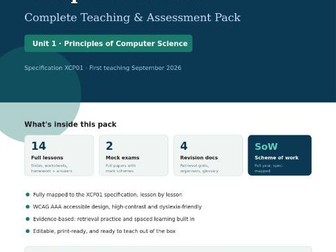
Complete Pearson Edexcel IAL Computer Science Unit 1 (XCP01) pack. 14 full lessons, mock exams and revision, fully spec-mapped and ready to teach.
Everything you need to teach the whole of Unit 1: Principles of Computer Science for the new Pearson Edexcel International Advanced Level specification (XCP01), first teaching September 2026.
What’s included:
14 complete lessons, each with a slide deck, student worksheet, homework, and full answer versions. Topics cover the stored-program concept, von Neumann architecture, CPU registers and memory, the fetch-decode-execute cycle, memory hierarchy, data transmission, the operating system, multitasking, interrupts and process management.
Two full mock exam papers with complete mark schemes.
A full revision pack: knowledge organisers, retrieval-practice grids, a spaced-retrieval schedule, and a glossary with command words.
Why teachers choose this pack:
Fully mapped to the XCP01 specification, lesson by lesson. Built on evidence-based teaching methods including retrieval practice and spaced learning. Designed to a professional, accessible standard. Editable and print-ready, so you can add your own school logo and adapt as needed.
Also available: Unit 2 (Practical Programming) and the complete Year 12 bundle, which includes both units plus the scheme of work at a saving.
About the author:
These resources are created by a qualified Computer Science teacher with a BSc (Hons) in Computer Science, who has taught OCR, AQA and Pearson Edexcel specifications at A Level, GCSE and iGCSE, in British schools in England and, more recently, in international schools. That breadth means every pack is classroom-ready, exam-focused, and accurately aligned to the specification, saving you hours of planning.
Every resource is personally reviewed and checked by the author before it is published, to ensure accuracy, quality, and specification alignment.
Note on creation: these resources were produced with the assistance of AI tools and have been carefully reviewed and edited by a qualified Computer Science teacher to ensure accuracy and alignment with the specification.
GCSE Computer Science Paper 1 Revision Bundle. 5 PPTs for at least 5 lessons in total (over 100 slides).
Includes a range of revision activities in each PPT, from quick quizzes to retrieval questions. Content includes animated demos for some key content. Answers are provided via animations on each of the slides.
Content is aimed at OCR GCSE Computer Science but could be used for some other specs (please cross check the specifications you are using).
Aimed at year 11 revision for the lessons leading upto the exam/mock exam.
This Computer Science Word Search Puzzle is a fun and educational activity for students to review important technology and coding terms. Perfect for classroom use, early finishers, or homework, it helps learners build vocabulary while staying engaged in the world of computers and programming.
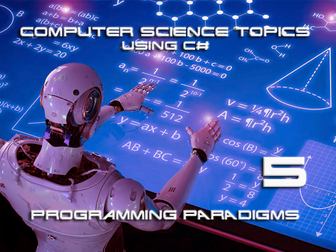
The fifth of the set takes the learner onto the intriguing topic of Programming Paradigms. Updated for Visual Studio 2022.
Paradigms covered include:
• Object Oriented Programming (OOP)
• Event Driven Programming (EDP)
• Procedural Programming
Completely invaluable series of resources for the BTEC National Computing and IT Courses, the Level 3 Cambridge Technical IT, A Level Computer Science as well as many others where Programming and Coding are a required skills set as well as a developed understanding of the concepts.
Programming is now one of the most sought-after skills sets, particularly OOP.
The presentation includes practical activities on each Paradigm and learner challenges to measure learning and distance travelled.
To support the learners and teachers, a learner activity sheet is included to capture learning outcomes from the lesson.
Multi-formats are included to enable customisation (PPT and Word) and avoiding loss of any content (PDF).
All resources in the set are project-based to introduce concepts and embed programming skills.
Great for both teachers and students alike.
There is a combined set of resources available on TES.
See what you think!
This SoW has been developed to fit in with the current National Curriculum for Computer Science, as well as preparing students to study Computer Science at GCSE and beyond. It is designed to be taught in 1 hour of lessons a week, throughout years 7-9, but many topics can be readily adapted and indeed, should be!
Update Sept 2021: Google have recently applied a security update, which means the previously public links no longer work. I have updated them in this document, but if you are using an older version of the PDF, these may no longer work. Please can you use the new links, and let me know if you have any issues accessing the resources.
Please note: As I am no longer teaching, this resource is not being updated or maintained, and some links may no longer be available. If anyone would like to take on the maintenance and update of these, please do let me know, as I just don’t have the time otherwise.
Some units of work included in this have been tested, and developed with students, however, most remain untested, and may need adapting when in front of a class. This SoW has been designed to provide a structured course, which should be developed further within your department.
An outline of the whole 3 years can be found here.
The purpose of this document is to walk through the structure of the course for the 3 years, and provide links to the appropriate documents where available. An online version can be found here.
Teach students about the basics of computer networks. Exploring different computer network types and the way in which they differ according to the type of user.
Also a look at network hardware, security and policies.


 Quick View