Financial Maths - Calculating Wages and Salaries Workbook - Financial LiteracyQuick View
CASTakeonMaths

Financial Maths - Calculating Wages and Salaries Workbook - Financial Literacy

(0)
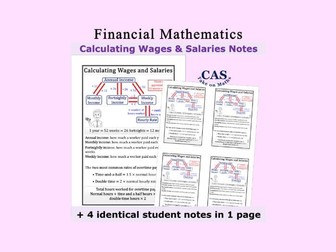
CALCULATING WAGES & SALARIES WORKBOOK Scaffolded Notes + Worksheets + solutions + mini folded notes to learn and practise how to calculate wages and salaries for various time periods. Grades: 9th to 12th Learning Outcomes: Calculate earnings from wages and salaries Calculate earnings from wages for a various time of periods, given an hourly rate of pay. Calculate weekly, fortnightly, monthly and yearly earnings Also comply with Australian Curriculum: Calculate weekly or monthly wage from an annual salary, wages from an hourly rate (ACMGM002) Convert units of rates occurring in practical situations to solve problems (ACMEM015) Financial Maths Resources: Financial Maths: Calculating Wages and Salaries Financial Maths:Comparing Wages and Salaries & Job Advertisements Financial Maths: Calculating Overtime Pay More Resources: Colouring Pages Fun Activity Topics: Numbers Times Table Fractions Decimals Percentages Significant Figures Consumer Maths Financial Maths Algebra Measurement and Geometry Visit my shop :)
Financial Literacy-Calculating Overtime-Timesheets and Payslips-Financial MathQuick View
CASTakeonMaths

Financial Literacy-Calculating Overtime-Timesheets and Payslips-Financial Math

(0)
Financial Mathematics Lesson 4: Timesheets and Payslips This resource includes: Lesson Plan in PowerPoint (Editable). Teachers can edit the lesson plan, the lesson procedure and the duration of the lesson that is suitable for their class. Estimated duration: 40 minutes. Lesson in PowerPoint (Editable and clickable) Teacher follows the PowerPoint slides for the lesson procedure. The student’s workbook Solutions Easy classroom preparation: Print and staple all pages together to make a workbook. Use the PowerPoint slides for the lesson procedure. Grades: 9th to 12th Learning Outcomes: Calculate earnings from wages for various time periods, given an hourly rate of pay, including increased rates for overtime and special rates for Sundays and public holidays. Find the equivalent number of hours worked at normal pay. Read an award or pay scale table and compare pay rates and conditions for different positions. Calculate a variety of time sheets and complete payslips. Skill Focus: Working mathematically, communicating and reasoning Read an award or pay scale table and compare pay rates and conditions for different positions. Calculate a variety of time sheets. Complete a variety of Pay Slips Also comply with Australian Curriculum: Calculate weekly or monthly wage from an annual salary, wages from an hourly rate including situations involving overtime and other allowances and earnings based on commission or piecework (ACMGM002) Convert units of rates occurring in practical situations to solve problems (ACMEM015) Financial Mathematics Lessons: Lesson 1: Calculating Wages and Salaries Lesson 2: Comparing Wages and Salaries & Job Advertisement Lesson 3: Calculating Overtime Lesson 4: Calculating Overtime Timesheets and Payslips Visit my shop for other recources :)
Financial Literacy - Calculating Wages and Salaries Notes - Financial MathsQuick View
CASTakeonMaths

Financial Literacy - Calculating Wages and Salaries Notes - Financial Maths

(0)
Scaffolded Note about how to calculate wages and salaries for various time periods and overtime. Grades: 9th to 12th Learning Outcomes: Calculate earnings from wages and salaries for various time periods, including increased rates for overtime. Find the equivalent number of hours worked at normal pay. Also comply with Australian Curriculum: Calculate weekly or monthly wage from an annual salary, wages from an hourly rate (ACMGM002) More Resources Topics: Numbers Times Table Fractions Decimals Percentages Significant Figures Consumer Maths Financial Maths Algebra Measurement and Geometry Colouring Pages Fun Activity Visit my shop :)
Financial Literacy-Loan Repayments-Calculating Annuity Math Assessment-RevisionQuick View
CASTakeonMaths

Financial Literacy-Loan Repayments-Calculating Annuity Math Assessment-Revision

(0)
Grades: 10th to 12th Financial Mathematics Problem Solving can be used for: Assessment: As a formal task to evaluate student understanding. Revision: For targeted practice and review. As Exam Question The marking scheme is editable. Feel free to adjust it to your preferred criteria or school requirements. Focus Area: Reducing Balance Loans (Loan Repayments) To assess students’ understanding of reducing balance loan calculations, include: Determining the time required to repay a loan based on the interest rate and fixed repayment amount. Calculating the monthly repayment needed to pay off a loan within a specified time frame. Skill Development: Applying algebraic techniques to solve financial problems. Using geometric progressions to model loan repayments. Rounding money to the nearest cent. Converting interest rates and time periods between different formats. Learning Outcomes: Use a recurrence relation to model a reducing balance loan and investigate the effect of the interest rate and repayment amount on the time taken to repay the loan. Solve problems involving reducing balance loans; for example, determining the monthly repayments required to pay off a loan. Also comply with Australian Curriculum: Use a recurrence relation to model a reducing balance loan and investigate (numerically or graphically) the effect of the interest rate and repayment amount on the time taken to repay the loan (ACMGM097) With the aid of a financial calculator or computer-based financial software, solve problems involving reducing balance loans; for example, determining the monthly repayments required to pay off a housing loan. (ACMGM098)
Financial Literacy-Future Value of Annuity-Math Assessment-Revision-Exam StyleQuick View
CASTakeonMaths

Financial Literacy-Future Value of Annuity-Math Assessment-Revision-Exam Style

(0)
Grades: 10th to 12th Financial Mathematics Problem Solving can be used for: Assessment: As a formal task to evaluate student understanding. Revision: For targeted practice and review. As Exam Question The marking scheme is editable. Feel free to adjust it to your preferred criteria or school requirements. Focus Area: Compound Interest Investments with Periodic Deposits (Annuities) To assess students’ understanding of annuity calculations, include: Determining the total investment within a specific period Determining a rule of annuity related to the case Determining time required to achieve a specific amount of investment based on the interest rate and fixed deposits. Calculating the monthly deposit needed to achieve a specific amount of investment within a specified time frame. Skill Development: Applying algebraic techniques to solve financial problems. Using geometric progressions to model an annuity. Rounding money to the nearest cent. Converting interest rates and time periods between different formats. Also comply with Australian Curriculum: Use a recurrence relation to model an annuity, and investigate (numerically or graphically) the effect of the amount invested, the interest rate, and the payment amount on the duration of the annuity (ACMGM099) With the aid of a financial calculator or computer-based financial software, solve problems involving annuities (including perpetuities as a special case); for example, determining the amount to be invested in an annuity to provide a regular monthly income of a certain amount. (ACMGM100) You may also like: Financial Literacy-Loan Repayments-Calculating Annuity Math Assessment-Revision
Financial Maths: Calculating Commission Exit Tickets KS3- KS4Quick View
CASTakeonMaths

Financial Maths: Calculating Commission Exit Tickets KS3- KS4

(0)
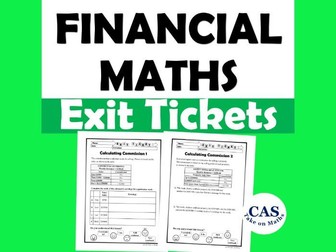
Engaging, Real‑World Financial Maths Practice Financial Maths: Calculating Commission Exit Tickets KS3- KS4 Give your students practical experience with commission calculations using these two quick and effective exit tickets. Each task uses real‑world scenarios (phone sales + real estate) and includes step‑by‑step worked solutions to support both teaching and independent learning. These exit tickets are perfect for checking understanding at the end of a lesson, warm‑ups, revision, homework, or fast formative assessment. What’s Included: 2 × Exit Tickets Commission 1: Tiered commission structure for phone sales Commission 2: Real estate commission with bonus conditions Fully worked, step‑by‑step solutions Student self‑reflection checkboxes Clean, accessible layout Suitable for KS3 & KS4/ Years 9–12 /Grades 8–10 (Common Core) Skills Covered • Calculating percentage commission • Applying tiered commission brackets • Adding retainers and bonuses • Interpreting tables and conditions • Real‑world financial literacy reasoning Perfect For • Quick checks for understanding • Homework, revision, or relief lessons Other Financial Literacy / Financial Maths Exit Tickets You May Like: Calculating Incomes Exit Tickets Calculating Overtime Pay Exit Tickets
Grade 9 - 12 Financial Math Workbook-Calculating Tax on Income in Australia-PAYG TaxQuick View
CASTakeonMaths

Grade 9 - 12 Financial Math Workbook-Calculating Tax on Income in Australia-PAYG Tax

(0)
Grades: 9th to 12th Calculating Tax on Income in Australia Calculating Tax on Income in Australia workbooks to help students learn and understand: how to calculate gross incomes, deductions, individual tax income, tax payable, Medicare levy, etc. to determine tax liability or tax refund from Pay As You Go (PAYG). The workbook in 2 styles. Style A: Cover, fill in the blank notes and worksheets Style B: Cover, completed notes and worksheets Total pages in each workbook: 16 Easy classroom preparation: • For the teacher notes: print the notes on transparencies or display them on a whiteboard. • For the workbook: print and staple all pages together to make a book. • For the folded notes: print, fold and glue the pages to make a folded notes Learning Outcomes: Understand the PAYG Income Tax System in Australia Identify allowable tax deductions Calculate taxable income after all allowable tax deductions are taken from gross pay Calculate tax payable using the current tax scales Calculate the Medicare levy (basic levy only) Determine if more tax is due or if there will be a tax refund Understand Australian tax returns. Comply with Australian Curriculum: F1.2: Earning and managing money More Resources about Financial Literacy