To Kill a Mockingbird by Harper Lee The Character of Jem Finch Reading ComprehensionQuick View
TutorCloud

To Kill a Mockingbird by Harper Lee The Character of Jem Finch Reading Comprehension

(0)
We are delighted to present our latest teaching resource focusing on the character of Jem Finch in Harper Lee’s timeless classic, To Kill a Mockingbird. This comprehensive reading comprehension guide is meticulously designed to aid educators in facilitating in-depth discussions and analysis of one of the novel’s most significant characters. Resource Overview: Title: The Character of Jem Finch Reading Comprehension Author: Harper Lee File Format: PDF Download (non-editable) Resource Highlights: Character Exploration: Delve into the complex persona of Jem Finch, examining his growth throughout the novel and the impact of key events on his character development. Analytical Tasks: Engage students in critical thinking exercises that encourage them to analyse Jem’s actions, motivations, and relationships within the narrative. Discussion Questions: Stimulate classroom discussions with thought-provoking questions that prompt students to reflect on Jem’s role in conveying the novel’s themes Enhance your students’ comprehension of To Kill a Mockingbird and foster a deeper appreciation for Harper Lee’s masterful characterisation with our dedicated resource.
To Kill a Mockingbird Chapters 23-25 PowerPoint (PPT) Summary and AnalysisQuick View
Michaeloza

To Kill a Mockingbird Chapters 23-25 PowerPoint (PPT) Summary and Analysis

(0)
Engage your students with this in-depth and interactive PowerPoint covering Chapters 23-25 of To Kill a Mockingbird! This resource explores Jem’s loss of innocence, the racial injustice of Tom Robinson’s death, and the hypocrisy of Maycomb’s society, while providing engaging activities that promote critical thinking and literary analysis. What’s Included? Do Now Task 5 short-response questions to assess comprehension (with answer key). Warmer Activities Thought-provoking discussion prompts about the mockingbird and Tom Robinson. Detailed Chapter Summaries Key events broken down in clear bullet points, covering Bob Ewell’s threats, Tom’s tragic death, and Maycomb’s reaction. Character Analysis Explore Jem, Atticus, Aunt Alexandra, Bob Ewell, Mr. Underwood, and Helen Robinson with insights into their development. Themes Analysis Racial Injustice & The Failure of the Legal System Loss of Innocence & Jem’s Emotional Growth Hypocrisy in Maycomb’s Society Moral Strength & Courage The Symbolism of the Mockingbird Symbolism Breakdown The Jury’s Deliberation (Symbol of Small Progress in a Biased System) Boo Radley’s Isolation Tom Robinson’s Death The Missionary Society Tea Party The Roly-Poly Bug Mr. Underwood’s Editorial Key Quote Analysis Explanation of powerful lines from Atticus, Jem, Mr. Underwood, and Mrs. Merriweather, highlighting their deeper meanings. Exit Ticket Activity – “Courtroom Headlines” A creative newspaper-writing task where students become reporters covering Tom Robinson’s death.
To Kill a Mockingbird - Chapters 8, 9 and 10Quick View
Online_Teaching_Resources

To Kill a Mockingbird - Chapters 8, 9 and 10

(0)
To Kill a Mockingbird – Chapters 8, 9 and 10 (PowerPoint with 5 worksheets) This comprehensive teaching resource supports the study of To Kill a Mockingbird and focuses on Chapters 8, 9 and 10. The resource features a fully editable PowerPoint packed with engaging discussion prompts, comprehension questions, example answers and a reflective diary writing activity. Key content includes: Chapter-by-chapter reading guidance with comprehension and discussion questions Modelled example answers for scaffolded learning Exploration of character development, symbolism (e.g. the mockingbird metaphor), and themes such as courage, prejudice and justice Focused tasks on key events including the fire at Miss Maudie’s house and the mad dog incident A creative diary writing task from Scout or Jem’s perspective Perfect for classroom use, homework, or independent study, this resource encourages empathy, close reading, and thoughtful analysis of Harper Lee’s iconic novel.
To Kill a Mockingbird - Chapter 7Quick View
stacyleigh1985

To Kill a Mockingbird - Chapter 7

(0)
A focused worksheet analysing how the objects found in the knothole reveal Scout and Jem’s developing characters in Chapter 7. Students explore how each item deepens their understanding of Boo Radley, highlights shifts in maturity, and reflects the children’s growing emotional awareness.
To Kill a Mockingbird - Unit of workQuick View
Online_Teaching_Resources

To Kill a Mockingbird - Unit of work

(0)
To Kill a Mockingbird is a comprehensive teaching resource for Harper Lee's classic American novel. The unit includes a 247-slide PowerPoint presentation, 40 accompanying worksheets and a lesson by lesson unit overview. Each lesson is structured using the four part lesson plan format with a starter, introduction, development and plenary. Teachers can personalise and differentiate the resource as much or as little as they want as all slides in the PowerPoint presentation are fully editable. This To Kill a Mockingbird unit covers: - Context - a biography of Harper Lee and the social and historical context of 1930s Alabama and 1950s/60s American Civil Rights - Character - analysis of Scout, Jem, Atticus, Dill, Boo Radley, Bob Ewell and Miss Maudie. - Themes - exploration of key themes: racism, justice, courage, prejudice, class, innocence and maturity. - Language - examining Lee's use of description, dialogue and action. To preview our To Kill a Mockingbird resource, click on the images.
To Kill a Mockingbird - Chapter 12Quick View
stacyleigh1985

To Kill a Mockingbird - Chapter 12

(0)
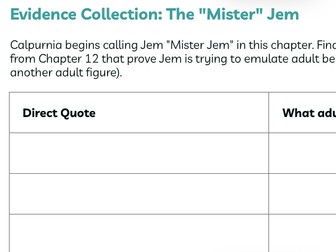
A focused worksheet evaluating Jem’s adolescence and shifting maturity in Chapter 12 through clear textual evidence. Students analyse how his changing behaviour, growing independence, and new emotional responses reveal the early stages of teenage development, highlighting the widening gap between him and Scout.
To Kill a Mockingbird Chapters 20-22 PowerPoint (PPT) Summary and AnalysisQuick View
Michaeloza

To Kill a Mockingbird Chapters 20-22 PowerPoint (PPT) Summary and Analysis

(0)
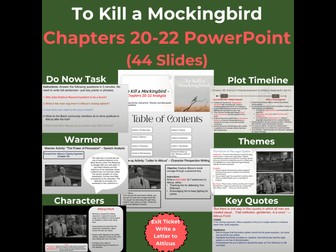
Engage your students with this dynamic and interactive PowerPoint covering Chapters 20-22 of To Kill a Mockingbird! This ready-to-use resource provides a detailed analysis of the trial’s conclusion, the verdict’s impact, and key moral lessons. Featuring comprehensive chapter summaries, critical thinking activities, theme analysis, symbolism breakdowns, and an engaging exit ticket, this PPT ensures student engagement and deeper literary understanding. What’s Included? -Do Now Task – 5 short-response questions to assess comprehension (with answer key). -Warmer Activity: “The Power of Persuasion” – Students analyze Atticus’s closing argument for rhetorical techniques and persuasive strategies. -Detailed Chapter Summaries – Key events, including Atticus’s final plea, the jury’s verdict, and Bob Ewell’s threat, presented in clear bullet points. -Character Analysis – Explore Atticus, Jem, Tom Robinson, Bob Ewell, Miss Maudie, and Dolphus Raymond with insights into their roles and development. -Themes Explored – The Failure of the Legal System Moral Courage & Integrity (Atticus’s Fight for Justice) Societal Hypocrisy (Dolphus Raymond’s Deception) The Power of Empathy & Perspective Hope for Change (Miss Maudie’s Encouragement to Jem) -Symbolism Breakdown – Dolphus Raymond’s Paper Bag (Pretense & Social Facades) The Black Community’s Silent Gratitude (Respect & Strength) Bob Ewell’s Spit (Hatred & Backlash Against Justice) -Key Quote Analysis – Breaks down powerful quotes from Atticus, Jem, and Miss Maudie, helping students connect textual evidence to major themes. -Exit Ticket – Engaging ways to review key ideas before students leave class! Writing a letter to Atticus.
To Kill a Mockingbird Chapters 4-6 PowerPoint (PPT) Summary and AnalysisQuick View
Michaeloza

To Kill a Mockingbird Chapters 4-6 PowerPoint (PPT) Summary and Analysis

(0)
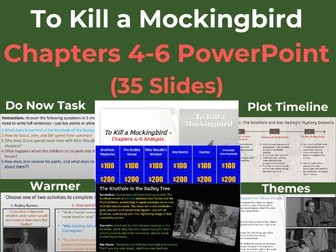
Engage your students with a comprehensive and interactive PowerPoint presentation on Chapters 4-6 of To Kill a Mockingbird! This resource is designed to deepen students’ understanding of the novel by focusing on key events, character development, themes, and symbols introduced in these chapters. It is ideal for middle and high school English classrooms and can be used to supplement discussions or as part of a larger unit on the novel. What’s Included in this Presentation: 1-Section 1: Do Now Task -A quick-start activity featuring five thought-provoking questions to assess students’ comprehension of Chapters 4-6 2-Section 2: Warmer -Two warmer activities. 3-Section 3: Character Analysis -In-depth breakdowns of important characters like Scout, Jem, Dill, Boo Radley, Miss Maudie, and Atticus, exploring their growth and relationships in these chapters. 4-Section 4: Plot Summary -Organized, easy-to-follow bullet points summarizing the events of each chapter. 5-Section 5: Themes -A thorough exploration of major themes like curiosity, empathy, respect for privacy, and the fear of the unknown. 6-Section 6: Themes -An analysis of key symbols such as the knothole, the Radley house, and Jem’s mended pants. 7-Section 7: Key Quotes -Analysis of important quotes from Chapters 4-6, connecting them to the novel’s broader themes and offering insights into character development and the narrative’s moral lessons. Engaging Activities: -Interactive elements, including a Jeopardy-style review game to assess student understanding and encourage class participation. Why This Resource is Valuable: -Student-Centered: This presentation encourages active engagement, making it easy to tailor the lesson to your students’ needs. -Comprehensive: Covers all major plot points, character development, and thematic elements from Chapters 4-6, ensuring students grasp the critical elements of the text. -Ready-to-Use: The presentation is visually appealing, well-organized, and simple to implement, saving you time in preparing lessons and activities. -Versatile: Perfect for whole-class instruction, group activities, or individual review.
To Kill A Mockingbird essayQuick View
Miss_s_k

To Kill A Mockingbird essay

(0)
Essay instruction sheet for essay on To Kill A Mockingbird with hints and tips - good half term hmwk or could be prepared in class as an exercise in essay planning.Question is: 'Explore the ways in which Harper Lee presents the development of Scout and Jem in the first section of ‘To Kill A Mockingbird’.'
To Kill a Mockingbird Chapter 11 Close Reading WorksheetQuick View
inquiringmind44

To Kill a Mockingbird Chapter 11 Close Reading Worksheet

(0)
Help high school students go beyond basic comprehension, practice critical thinking skills, and explore literary elements with this close reading inference worksheet covering chapter 11 of To Kill a Mockingbird by Harper Lee. An answer key is included. Materials are delivered in editable Word Document and printable PDF formats. By engaging with this close reading activity, students will do the following: Read for literal comprehension Consult reference materials to learn and verify word meanings as needed Infer the intended effects of the author’s word choices and narrative techniques Examine how complex characters think, behave, interact, and develop Draw personal connections to Jem Argue whether Jem feels guilty for his treatment of Scout Apply knowledge of literary devices with emphasis on situational irony Support claims and inferences with sound reasoning and relevant evidence Write about literature with clarity, accuracy, and precision Come to class better prepared to discuss works of fiction
To Kill a Mockingbird - Chapter 1Quick View
Online_Teaching_Resources

To Kill a Mockingbird - Chapter 1

(0)
To Kill a Mockingbird – Chapter 1 (3 lessons: a 41-slide PowerPoint presentaion and 8 worksheets) This engaging and fully editable PowerPoint lesson introduces students to To Kill a Mockingbird by Harper Lee, focusing on Chapter 1 and the novel’s social and historical context. Perfect for GCSE English Literature teaching, this resource provides a rich, accessible introduction to the characters, setting, themes, and narrative voice of the novel. What’s included: A detailed lesson on Harper Lee’s background and the influence of the Civil Rights Movement Family tree activity linked to the Finch family and student homework First impressions activities for Scout, Jem, Dill, and Boo Radley Guided paragraph writing with sentence starters Vocabulary tasks and quotation analysis from Chapter 1 ‘Check Your Understanding’ comprehension questions with exemplar answers Extension tasks for deeper analysis of Maycomb and its key characters A creative comic strip activity to summarise Chapter 1 Ideal for: KS4 / GCSE English Literature Introducing the novel and building contextual knowledge Exploring narrative perspective, characterisation and themes Developing inference, analysis and extended writing skills This resource supports a range of learners and is fully editable to suit different classroom needs. A great way to lay the groundwork for deeper analysis later in the novel.
A Novel Unit for Harper Lee’s Go Set a Watchman Quick View
lahill1966

A Novel Unit for Harper Lee’s Go Set a Watchman

(2)
This novel unit for Harper Lee's Go Set a Watchman is intended for older students (high school) who have read To Kill a Mockingbird. It provides a Unit Overview (that is aligned to the Common Core), a PowerPoint Presentation that introduces the novel, a vocabulary list, a reader's log, the prompt for a literary analysis assignment and a research project. This unit also includes a rubric for each assignment.
ISS L.A.B.S. Teacher Resource GuideQuick View
NASAeducation

ISS L.A.B.S. Teacher Resource Guide

(0)
The International Space Station Learning, Achieving, Believing and Succeeding, or ISS L.A.B.S., Educator Resource Guide consists of eight guided educational learning activities. The guide highlights the international collaboration involved in building and operating the space station, and provides an overview of space station construction and assembly. The eight activities in the guide cover topics relating to science, technology, engineering and mathematics. All lessons are aligned with national education standards.
SS L.A.B.S. Educator Resource GuideQuick View
NASAeducation

SS L.A.B.S. Educator Resource Guide

(0)
The International Space Station Learning, Achieving, Believing and Succeeding, or ISS L.A.B.S., Educator Resource Guide consists of eight guided educational learning activities. The guide highlights the international collaboration involved in building and operating the space station, and provides an overview of space station construction and assembly. The eight activities in the guide cover topics relating to science, technology, engineering and mathematics. All lessons are aligned with national education standards.
To Kill a Mockingbird Chapter 22 Close Reading WorksheetQuick View
inquiringmind44

To Kill a Mockingbird Chapter 22 Close Reading Worksheet

(0)
Help high school students go beyond basic comprehension, practice critical thinking skills, and explore literary elements with this close reading inference worksheet covering chapter 22 of To Kill a Mockingbird by Harper Lee. An answer key is included. Materials are delivered in editable Word Document and printable PDF formats. By engaging with this close reading activity, students will do the following: Read for literal comprehension Consult reference materials to learn and verify word meanings as needed Infer the intended effects of the author’s word choices and narrative techniques Explore cause-and-effect relationships Examine how complex characters think, behave, interact, and develop Apply knowledge of literary devices including hyperbole, sarcasm, and simile Consider the thematic significance of the interaction between Jem and Maudie Atkinson (a belief that there is hope for positive change in the American justice system, although that change will probably happen slowly) Come to class better prepared to discuss works of fiction
To Kill a Mockingbird Chapters 26-28 PowerPoint (PPT) Summary and AnalysisQuick View
Michaeloza

To Kill a Mockingbird Chapters 26-28 PowerPoint (PPT) Summary and Analysis

(0)
This comprehensive PPT covers Chapters 26-28, focusing on key themes, symbolism, character development, and critical thinking. What’s Included? -Do Now Task – 5 short-response questions to assess comprehension (with answer key) -Engaging Warmer Activities – Thought-provoking discussions and interactive tasks to spark student engagement. -Detailed Chapter Summaries – Easy-to-follow bullet points breaking down key events in Chapters 26-28. -Character Analysis – Explore Scout, Boo Radley, Jem, Atticus, Bob Ewell, Heck Tate, and Miss Gates -Themes Exploration – In-depth analysis of hypocrisy, justice vs. morality, courage, and the loss of innocence. -Symbolism Breakdown – Boo Radley (Symbol of the Misunderstood and the Silent Protector) The Mockingbird (Symbol of Innocence and the Harmed) Miss Gates’ Lesson on Democracy (Symbol of Hypocrisy) Heck Tate’s Decision (Symbol of Justice vs. Moral Truth) -Key Quote Analysis – Explanation of significant lines from Scout, Heck Tate, and Atticus. -Exit Ticket Activity – Boo Radley’s POV Writing Task – Perspective-taking creative writing. Why This Resource? Saves You Time – Fully prepped lessons with clear explanations and engaging student tasks Common Core-Aligned – Perfect for grades 8-11 ELA with a focus on literary analysis & critical thinking Engaging & Interactive – Beyond simple summaries, this resource challenges students to think deeply about themes and symbols Editable & Customizable – Adapt the content to fit your teaching style and student needs Grade Levels: 8-11 | Great for literature units, classroom discussions, and Socratic seminars Perfect for: Analyzing the novel’s ending, reinforcing symbolism, and engaging students in meaningful discussion.
To Kill a Mockingbird Chapters 1-3 PowerPoint (PPT) Summary and AnalysisQuick View
Michaeloza

To Kill a Mockingbird Chapters 1-3 PowerPoint (PPT) Summary and Analysis

(0)
Engage your students with this comprehensive and visually engaging PowerPoint presentation covering Chapters 1-3 of Harper Lee’s To Kill a Mockingbird. This resource is perfect for middle and high school English Language Arts classrooms and provides a thorough analysis of key events, characters, themes, and literary devices introduced in the opening chapters. What’s Inside: 1-“Do Now” Task: A quick-start activity featuring six thought-provoking questions to assess students’ comprehension of Chapters 1-3. 2-Detailed Summaries: Organized, easy-to-follow bullet points summarizing the events of each chapter, from the introduction of Maycomb and the Finch family to Scout’s early moral lessons. 3-Character Analysis: Key insights into Scout, Jem, Dill, Atticus, Boo Radley, Miss Caroline, Walter Cunningham, and other important characters. 4-Themes and Symbolism: Exploration of motifs such as childhood innocence, social class, empathy, and fear of the unknown, supported by key quotes and analyses. 5-Analyzing Key Quotes: A dedicated section breaking down significant quotes from the chapters, connecting them to themes and character development. 6-Interactive Quiz: An “Identify the Character” quiz to reinforce student understanding and encourage class discussion. Why This Resource? -Aligned with Curriculum Goals: Perfect for introducing the novel’s foundational themes, motifs, and characters while fostering critical thinking and literary analysis skills. -Time-Saving: Ready-to-use and professionally designed to ensure engaging, meaningful lessons. -Visually Appealing: Includes clean, organized slides with relevant visuals to maintain student interest. -Interactive and Thought-Provoking: Activities and discussion prompts encourage active participation and deeper comprehension.
To Kill a Mockingbird Chapters 10-13 PowerPoint (PPT) Summary and AnalysisQuick View
Michaeloza

To Kill a Mockingbird Chapters 10-13 PowerPoint (PPT) Summary and Analysis

(0)
This PPT is designed to deepen students’ understanding of the novel by focusing on key events, character development, themes, and symbols introduced in chapters 10-13. It is ideal for middle and high school English classrooms and can be used to supplement discussions or as part of a larger unit on the novel. What’s Included in this Presentation: Section 1: Do Now Task -A quick-start activity featuring five thought-provoking questions to assess students’ comprehension of Chapters 10-13 Section 2: Warmer -“Group Chats from Maycomb.” Students imagine the characters in To Kill a Mockingbird are part of a group chat discussing recent events in Chapters 10-13 Section 3: Character Analysis -In-depth breakdowns of important characters like Scout, Jem, Atticus, Calpurnia, Mrs. Dubose, and Aunt Alexandra, exploring their roles in these chapters. Section 4: Plot Summary -Organized, easy-to-follow bullet points summarizing the events of each chapter. Section 5: Themes -A thorough exploration of major themes like courage and responsibility, prejudice and inequality, family and identity, and the duality of human nature. Section 6: Symbolism -An analysis of key symbols such as the rabid dog, Mrs. Dubose’s camellias, Calpurnia’s church, and Aunt Alexandra’s arrival. Section 7: Key Quotes -Analysis of important quotes from Chapters 10-13. Exit Ticket: -“Who Am I?” Quiz. Why This Resource is Valuable: -Student-Centered: This presentation encourages active engagement, making it easy to tailor the lesson to your students’ needs. -Comprehensive: Covers all major plot points, character development, and thematic elements from Chapters 10-13, ensuring students grasp the critical elements of the text. -Ready-to-Use: The presentation is visually appealing, well-organized, and simple to implement, saving you time in preparing lessons and activities. -Versatile: Perfect for whole-class instruction, group activities, or individual review.
To Kill a Mockingbird Chapters 7-9 PowerPoint (PPT) Summary and AnalysisQuick View
Michaeloza

To Kill a Mockingbird Chapters 7-9 PowerPoint (PPT) Summary and Analysis

(0)
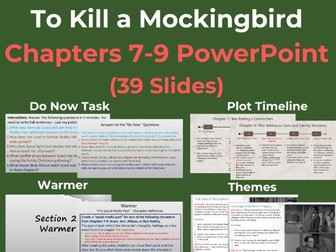
This PPT is designed to deepen students’ understanding of the novel by focusing on key events, character development, themes, and symbols introduced in chapters 7-9. It is ideal for middle and high school English classrooms and can be used to supplement discussions or as part of a larger unit on the novel. What’s Included in this Presentation: Section 1: Do Now Task -A quick-start activity featuring five thought-provoking questions to assess students’ comprehension of Chapters 7-9 Section 2: Warmer -An interesting warmer activity. Section 3: Character Analysis -In-depth breakdowns of important characters like Scout, Jem, Dill, Boo Radley, Miss Maudie, and Atticus, exploring their growth and relationships in these chapters. Section 4: Plot Summary -Organized, easy-to-follow bullet points summarizing the events of each chapter. Section 5: Themes -A thorough exploration of major themes like the loss of innocence, courage and moral integrity, prejudice and social injustice, and isolation and connection. Section 6: Symbolism -An analysis of key symbols such as the gifts, the fire at Miss Maudie’s house, and Atticus’s defense of Tom Robinson. Section 7: Key Quotes -Analysis of important quotes from Chapters 7-9. Exit Ticket: -Mini Quiz. Why This Resource is Valuable: -Student-Centered: This presentation encourages active engagement, making it easy to tailor the lesson to your students’ needs. -Comprehensive: Covers all major plot points, character development, and thematic elements from Chapters 7-9, ensuring students grasp the critical elements of the text. -Ready-to-Use: The presentation is visually appealing, well-organized, and simple to implement, saving you time in preparing lessons and activities. -Versatile: Perfect for whole-class instruction, group activities, or individual review.
To Kill a Mockingbird Chapters 14-15 PowerPoint (PPT) Summary and AnalysisQuick View
Michaeloza

To Kill a Mockingbird Chapters 14-15 PowerPoint (PPT) Summary and Analysis

(0)
This PPT is designed to deepen students’ understanding of the novel by focusing on key events, character development, themes, and symbols introduced in chapters 14-15. It is ideal for middle and high school English classrooms and can be used to supplement discussions or as part of a larger unit on the novel. What’s Included: Do Now Task: -Five short-response questions to check students’ comprehension of the chapters. -An answer key for easy review. Warmer Activity: -Creative prompts to engage students and connect them to the chapters’ themes, such as empathy, family conflict, and childhood innocence. Characters Overview: -Detailed profiles of key characters, including Scout, Jem, Dill, Atticus, Aunt Alexandra, Calpurnia, and the mob. -Analysis of their actions and roles in the chapters. Chapter Summaries: -Comprehensive, bullet-pointed summaries of Chapters 14 and 15 for clear and concise understanding. Themes Analysis: -Exploration of major themes, including family dynamics, moral courage, childhood innocence, prejudice, and mob mentality. -Key quotes paired with themes for deeper analysis. Symbolism Discussion: -Identification and explanation of key symbols, such as Dill’s return, the jail, the mob, and Scout’s innocence. Key Quote Analysis: -Context and significance of pivotal quotes to enhance literary understanding. Exit Ticket Activity: -A creative Exit Slip Pyramid task to help students summarize key events, characters, and themes before leaving class. Why You’ll Love It: Fully aligned with critical thinking and literary analysis objectives. Encourages student engagement with a mix of interactive and reflective activities. Saves time with pre-prepared content and structured discussion points. Perfect for individual or group use in middle and high school English classes.
To Kill a Mockingbird - character study - analysis and evaluationQuick View
unknown22

To Kill a Mockingbird - character study - analysis and evaluation

(0)
To Kill a Mockingbird (GCSE - Higher Paper) A sequence of lessons focused on group work exploration of the characters of Maycomb. Tasks include: - revision of characters - evaluation of their narrative functions - exploring the contexts of TKAM - developing alternative readings of characters - evaluating interpretations - group work / presentation skills