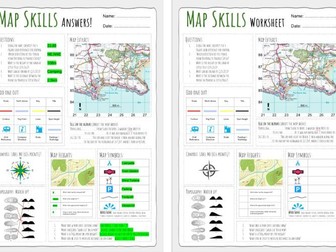
Up to date worksheet for map skills for any Geography curriculum and Key Stage.
Includes:
4fig grid references
6fig grid references
direction
compass
scale
map symbols
and more
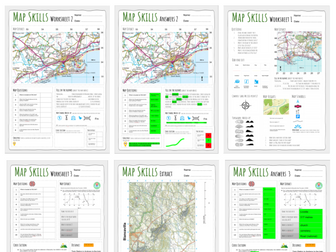
Map Skills Homework 5 - OS Maps
4 and 6 Figure Grid References using an OS Map
As part of the Map Skills Homework Bundle with 4 other worksheets
Can be used as a worksheet in lesson
Here is a bundle of fully resourced map skills worksheets ideal for recapping, revising or challenges a students map skills. They are designed for KS3/4 but have been used as a refresher for A-Level.
This bundle includes all answer sheets and resources with well designed student friendly images.
Full unit of work for map skills and the UK. This unit explores compass points, 4 and 6 figure grid references, scale, distance, longitude, latitude and other core map skills, alongside the UK. All lessons are suitable for 50 minutes to 1 hour of teaching time. Includes supporting worksheets for lessons - no additional resources are required. Most suitable for KS2, years 5 or 6.
All lessons have a starter and lesson aim. All PowerPoints in the same signature style.
Lesson sequence:
1 – Introducing maps
2 – Where is the UK?
3 – Compass points
4 – Map symbols
5 – 4 and 6 figure grid references
6 – Scale and distance
7 – Atlas skills
8 – Longitude and latitude
9 – Design a treasure map
10 – ICT Mapzone
11 – UK and Europe flags
12 – Migration
13 – Human vs physical features
Also includes Geography Literacy mat and Geography Numeracy/Map Skills mat, as well as an extension sheet pack with homework’s and activities to extend pupil skills and knowledge.
Links to National Curriculum:
- Locate the world’s countries, using maps to focus on Europe (including the location of Russia) and North and South America, concentrating on their environmental regions, key physical and human characteristics, countries, and major cities
- Name and locate counties and cities of the United Kingdom, geographical regions and their identifying human and physical characteristics, key topographical features (including hills, mountains, coasts and rivers), and land-use patterns; and understand how some of these aspects have changed over time
- Identify the position and significance of latitude, longitude, Equator, Northern Hemisphere, Southern Hemisphere, the Tropics of Cancer and Capricorn, Arctic and Antarctic Circle, the Prime/Greenwich Meridian and time zones (including day and night)
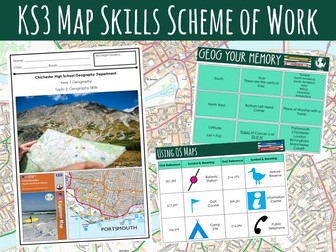
KS3 Geography Map Skills Topic suitable for Year 7 - Good Introduction Topic.
Fully resourced including Assessments, PowerPoints and Booklet
Content Covered:
Latitude and Longitude
Compass Points
Grid References
Scale
Relief
Continents/Countries
This work booklet guides pupils through vital mapping skills by giving them a ‘how to guide’ as well as a chance to practise their new skills in a variety of questions and tasks. The booklet is aimed at children in upper KS2 and lower KS3 and can be easily adapted to suit. The booklet can be given at the end of a unit of work or spread out across several lessons.
The mapping skills included in this work booklet include:
4 Figure Grid References
6 Figure Grid References
Compass Directions
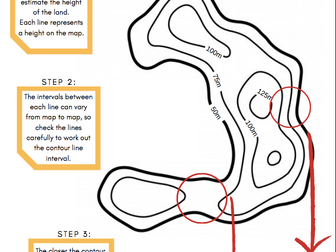
Contour Lines
Calculating Scale
Each topic above includes a one-page ‘how to guide’ and well as a corresponding 'activity sheet.'
Download is in pdf format.
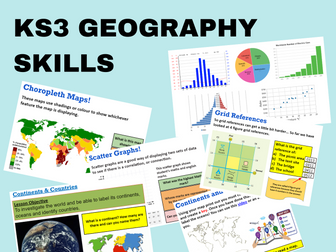
Full unit of work for map and graph skills. All lessons are fully resourced. Lessons are designed to last for 50-60 minutes. Lessons are resourced with videos, extension questioning, deep thinking and uses graphs/images to aid learning.
These lessons follow the Oxford KS3 curriculum and look at;
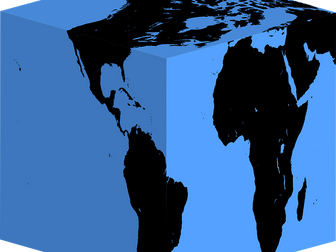
Continents & Countries
Map Skills
Directions
Distance & Scale
Grid References
Longitude & Latitude
Height
OS Symbols
Graph Skills
Each lesson includes a starter, lesson objective, plenary and various student led activities.
If you liked this resource please check out my other resources at https://www.tes.com/teaching-resources/shop/SimpleGeography
Build students’ global awareness and map skills with this engaging geography lesson focused on continents, oceans, and key world locations. Through interactive activities including map labelling, digital exploration (Google Earth), students develop essential location knowledge while making meaningful personal connections to the world. Ideal for KS2–KS3, this lesson combines knowledge recall, spatial thinking, and cultural understanding in a highly engaging format.
Learning Outcomes
Students will know
The names and locations of the seven continents and five oceans
Key countries in Europe, North America, South America, and Asia
That maps and digital tools can be used to explore and understand global locations
Students will understand:
The Earth is divided into continents and oceans to help organise geography
Individuals have global connections through heritage, travel, family, and culture
Students will be able to (Success Criteria):
Accurately label continents and oceans on a world map
Identify and name countries across Europe, North/South America, and Asia
Use digital tools to explore and identify global locations
Create a personalised world map including:
Continents and oceans
Key countries
Personal/global connections
An annotated information box
This is a 10 lesson (End of Unit test) SOW to introduce Geography as a new subject and to develop map skills. There are lessons on;
Introduction / types of geography
continents and oceans
Europe
Physical Geog of Europe
The British Isles
Map symbols
four and six figure grid references
Height on a Map
Scale.
Also included with PP is a 35+ page workbook to match.
I hope you enjoy :)
There are seven (7) lessons in this bundle. It’s the complete set of map skill lessons that is usually taught to year 7s at the beginning of the school year. This bundle will cover your planning for entire first half-term. All the resources to deliver the lessons are included in the ppts. The ppts are very easy to follow and answers to practice tasks are included to make it easy for non-specialist who might be teaching this topic. The lessons are very practical so students will be doing most of the work while the teacher can provide one-one attention. The lessons included are:
Qualities of a good map
Map symbols
Map scales
Compass coordinates
Grid reference
Relief
Contours
A description of each lesson can be found on my page for each individual lesson.
This Map Skill lesson reviews all on the previous Map Skills lessons and test the students skills with increasing difficulty. This lesson reviews all the maps skills covered in the first 5 lessons - Map Symbols, 4 & 6 figure grid references, height, scale and distance
In addition to the lesson you will require an Ordnance Survey Map.
It contains:
Three levels of differentiation
Starter and plenary
Printable resource
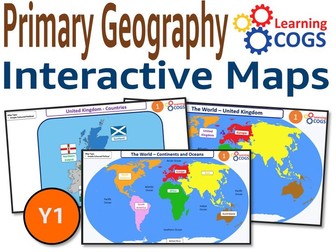
This Year 1 geography timeline builds on global awareness by introducing the continents, oceans, and a more detailed view of the United Kingdom. Children explore the names and locations of the four countries of the UK, as well as simple map features like compass points and surrounding oceans.
The slideshow uses clear, visual maps and simple labels to support pupils in learning key geographical vocabulary. It is fully editable for class displays, retrieval starters, or guided teaching.
A map skills homework booklet for use with KS3 Geography classes.
An amalgamation of worksheets I have gathered over the years to create a comprehensive and easy to mark Map Skills Homework Booklet!
A simple coloured world map with coordinates. Children can use the map to become familiar with countries, continents, oceans and seas! Also using their coordinates skills. Can be printed A4/A3 depending on use.
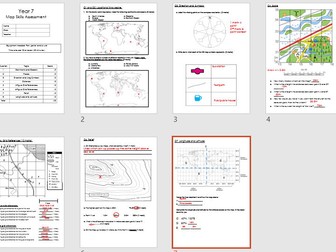
An end of unit test for year 7.
Includes all major map skills such as compass points, grid references, scale, longitude/latitude and relief. Also includes mark scheme, self reflection sheet and differentiated. DIRT tasks require foundations textbook or could be adapted to suit.
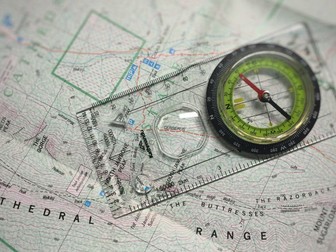
Assessing compass directions, measuring distance, grid references, map symbols, contour lines and describing directions, this workbook is a great revision tool for geographers of any age wanting to hone their OS map skills.
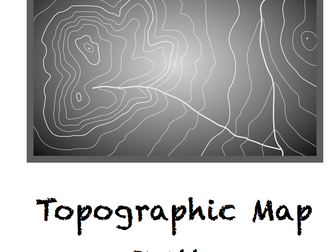
A set of photocopiable masters that takes students through the basic skills involved in reading topographic maps including:
1. Introduction and marginal information
2. Symbols and colours
3. Map direction and bearings
4. Height and slope
5. Landforms
6. Area reference and grid reference
7. Scale
8. Measuring distance
9. Measuring area
10. Constructing cross-sections
11. Gradient
The bundle also includes a series of ten graded topographic maps and exercises which increase in level of difficulty as students progress through them. Answers are provided for all ten of the topographic map exercises.
All resources required for lesson are attached.
The lesson provides scope for AFL and is fully differentiated.
Objectives for lesson:
- Explain what scale is
- Use scale to measure distance on a map
- Label the key cities in the UK
Lesson 3 in Map Skills Unit. This lesson teaches the students how to find 4 figure grid references. All resources included and instructions given for teacher where appropriate at the bottom of the slide.
 Quick View

 Quick View
 Quick View
 Quick View
 Quick View
 Quick View
 Quick View
 Quick View
 Quick View
 Quick View
 Quick View
 Quick View
 Quick View