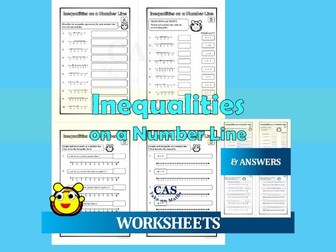
Inequalities on a Number Line Worksheets and Answers
Worksheets to keep your learners engaged in math learning and apply
mathematical strategies to complete a variety of question styles about
inequalities on number lines.
Worksheet A: Describing the inequality represented by each number line.
Worksheet B: MATCHING ACTIVITY
Worksheet C: Graphing inequalities on a number line.
Worksheet D: Graphing inequalities on a number line.
Grades: 6th to 9th
Learning Outcomes:
Describe and write inequalities on a number line
Graph inequalities on a number line
Also comply with for Australian Curriculum
Introduce the concept of variables as a way of representing numbers using letters (ACMNA175).
Communicate and connect mathematical ideas using appropriate terminology, diagrams and symbols (MA4-1WM).
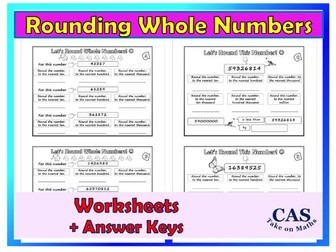
This resource contains worksheets and answers about rounding multi-digit numbers to the nearest any place value.
Level of Difficulty: Beginner
Grades: 5th to 8th
Learning Outcomes:
• Use place value understanding to round whole numbers to the nearest whole number, 10, 100, 1000 or up to million.
Also suitable for Australian Curriculum
Round decimals to a specified number of decimal places (ACMNA156)
More Resources:
Colouring Pages
Fun Activity
Topics:
Numbers
Times Table
Fractions
Decimals
Percentages
Significant Figures
Consumer Maths
Financial Maths
Algebra
Measurement and Geometry
Visit my shop :)
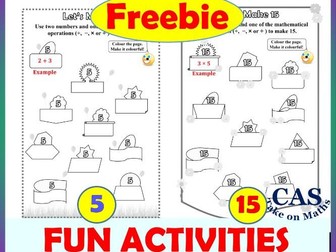
This resource contains two worksheets of Make numbers. Students use the mathematical operations such as addition, subtraction, multiplication and division to make the target numbers: 5 and 15.
Level of Difficulty: Easy
Grades: 3rd - 8th
More Resources
Colouring Pages
Fun Activity
Topics:
Numbers
Times Table
Fractions
Decimals
Percentages
Significant Figures
Consumer Maths
Financial Maths
Algebra
Measurement and Geometry
Visit my shop :)
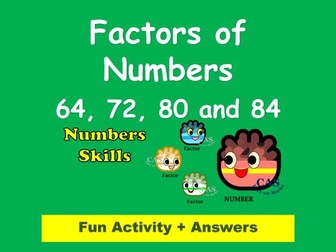
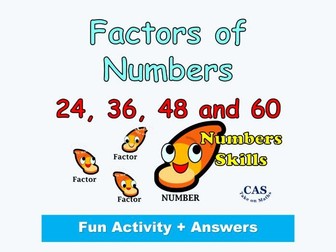
Factors of Numbers Puzzle 2 Activity
A fun activity to keep your learners engaged in math learning and apply mathematical strategies to complete the puzzle.
In this activity learners practise finding factors of a number and arranging the given factors to fill all boxes.
The aims of this activity are:
To increase their fluency and confidence in multiplication and division skills.
To develop understanding of a variety of problems involving factors of a number.
Answer keys are also included.
Teaching Ideas:
Students cut each factor and glue it to the correct box.
Or students write each factor in the correct box.
Grades: 4th to 6th
Learning Outcomes:
• Identify factors of whole numbers in the range 1-100 and use them to solve problems.
• Recognize that a whole number is a multiple of each of its factors.
Also comply with Australian Curriculum:
Identify and describe factors and multiples of whole numbers and use them to solve problems (ACMNA098).
Develop efficient mental and written strategies and use appropriate digital technologies for multiplication and for division where there is no remainder (ACMNA076)
Factors of Numbers:
Factors of Number Puzzle 1
Factors of Number Puzzle 2
Factors of Number Puzzle 3
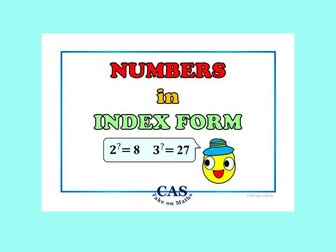
NUMBERS IN INDEX FORM WORKSHEETS & ANSWERS
Students practise:
Identify the base number and index (power or exponent) of numbers written in index form.
Write numbers in index form.
Use BODMAS (PEMDAS) to calculate mathematics operations involving indices.
Use scientific notation to write large and small numbers.
Grade: 6th to 8th
Learning Outcomes:
Describe numbers written in index form.
Write numbers in index form.
Calculate mathematics operations involving indices.
Use scientific notation to write large and small numbers.
Also Comply with Australian Curriculum:
Investigate index notation and represent whole numbers as products of powers of prime numbers (ACMNA149).
Use index notation with numbers to establish the index laws with positive integral indices and the zero index (ACMNA182).
Express numbers in scientific notation (ACMNA210)
Indices (Exponents) Resources:
INTRODUCTION TO INDICES
Numbers in Index Form Worksheets
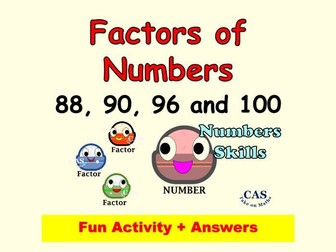
Factors of Numbers Puzzle 3 Activity
A fun activity to keep your learners engaged in math learning and apply mathematical strategies to complete the puzzle.
In this activity learners practise finding factors of a number and arranging the given factors to fill all boxes.
The aims of this activity are:
To increase their fluency and confidence in multiplication and division skills.
To develop understanding of a variety of problems involving factors of a number.
Answer keys are also included.
Teaching Ideas:
Students cut each factor and glue it to the correct box.
Or students write each factor in the correct box.
Grades: 4th to 6th
Learning Outcomes:
• Identify factors of whole numbers in the range 1-100 and use them to solve problems.
• Recognize that a whole number is a multiple of each of its factors.
Also comply with Australian Curriculum:
Identify and describe factors and multiples of whole numbers and use them to solve problems (ACMNA098).
Develop efficient mental and written strategies and use appropriate digital technologies for multiplication and for division where there is no remainder (ACMNA076)
Factors of Numbers:
Factors of Number Puzzle 1
Factors of Number Puzzle 2
Factors of Number Puzzle 3
Factors of Numbers Puzzle 1 Activity
A fun activity to keep your learners engaged in math learning and apply mathematical strategies to complete the puzzle.
In this activity learners practise finding factors of a number and arranging the given factors to fill all boxes.
The aims of this activity are:
To increase their fluency and confidence in multiplication and division skills.
To develop understanding of a variety of problems involving factors of a number.
Answer keys are also included.
Teaching Ideas:
Students cut each factor and glue it to the correct box.
Or students write each factor in the correct box.
Grades: 4th to 6th
Learning Outcomes:
• Identify factors of whole numbers in the range 1-100 and use them to solve problems.
• Recognize that a whole number is a multiple of each of its factors.
Also comply with Australian Curriculum:
Identify and describe factors and multiples of whole numbers and use them to solve problems (ACMNA098).
Develop efficient mental and written strategies and use appropriate digital technologies for multiplication and for division where there is no remainder (ACMNA076)
Factors of Numbers:
Factors of Number Puzzle 1
Factors of Number Puzzle 2
Factors of Number Puzzle 3
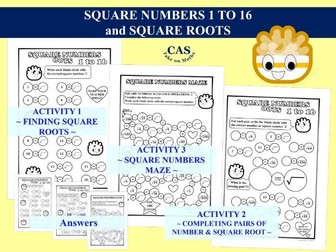
SQUARE NUMBERS 1 to 16 & SQUARE ROOT
Three activities to keep your learners engaged in math learning and apply
mathematical strategies to complete all the activities.
This activity is to increase their fluency and confidence in number skills
involving square numbers and square roots.
Answer keys are also included.
ACTIVITY 1: FINDING SQUARE ROOTS
ACTIVITY 2: COMPLETING PAIRS OF NUMBER & SQUARE ROOT
ACTIVITY 3: SQUARE NUMBERS MAZE (SQUARE NUMBERS WITH FOUR OPERATIONS)
Grade: 5th to 8th
Learning Outcomes:
Investigate and use square roots of perfect square numbers 1 to 16.
Select and apply efficient mental and written strategies and appropriate digital technologies to solve problems involving all four operations with square roots.
Also Comply with Australian Curriculum:
Investigate and use square roots of perfect square numbers (ACMNA150).
Select and apply efficient mental and written strategies and appropriate digital technologies to solve problems involving all four operations with whole numbers (ACMNA123).
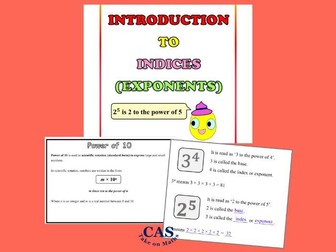
INTRODUCTION TO INDICES (EXPONENTS)
NOTES, WORKSHEETS & ANSWERS.
Students learn to
Understand numbers written in index form and write numbers in index form.
Use BODMAS (PEMDAS) to calculate mathematics operations involving indices.
Use scientific notation to write large and small numbers.
Grade: 6th to 8th
Learning Outcomes:
Describe numbers written in index form.
Write numbers in index form.
Calculate mathematics operations involving indices.
Use scientific notation to write large and small numbers.
Also Comply with Australian Curriculum:
Investigate index notation and represent whole numbers as products of powers of prime numbers (ACMNA149).
Express numbers in scientific notation (ACMNA210).
Indices (Exponents) Resources:
INTRODUCTION TO INDICES
Numbers in Index Form Worksheets
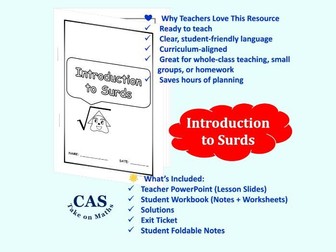
Introduction to Surds-Teaching Pack
This comprehensive resource gives you everything you need to teach an engaging and confidence-building Introduction to Surds lesson.
Perfect for students just starting their lesson about surds, this pack includes
a clear teacher PowerPoint,
a structured student workbook (Notes and worksheets),
full solutions,
an exit ticket, and
foldable notes for revision.
This resource helps learners understand what surds are, why they matter, and how to work with them in a meaningful way.
Skills Covered
Understanding rational vs irrational numbers
Identifying surds
Recognising perfect squares
Interpreting surds on a number line
Why Teachers Love This Resource
Ready to teach
Clear, student-friendly language
Curriculum-aligned
Great for whole-class teaching, small groups, or homework
Saves hours of planning
Also includes:
Exit Ticket for Quick formative assessment and helps check understanding before moving on
Student Foldable Notes: Great for revision and exam prep
Also comply with:
Australian Curriculum (Years 9–10)
AC9M9N01 – Investigate terminating and recurring decimals and their connection to rational numbers
AC9M10A01 – Apply and interpret square roots and irrational numbers
Victorian Curriculum (Levels 9–10)
VCMNA307 – Investigate the concept of irrational numbers
NSW Stage 5.2 / 5.3
N5.2 – Surds and irrational numbers
UK National Curriculum (Key Stage 4)
Simplify and manipulate surds
Apply and interpret irrational numbers
Work with roots and powers
Common Core (USA)
CCSS.MATH.CONTENT.8.NS.A.1 – Know that numbers that are not rational are called irrational
CCSS.MATH.CONTENT.8.NS.A.2 – Use rational approximations of irrational numbers.
Grades: 6th to 8th
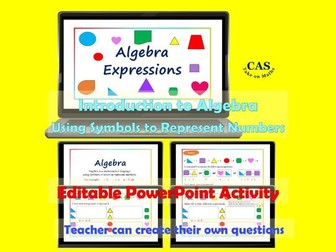
Introduction to Algebra
Using Symbols to Represent Numbers
Algebra PowerPoint activity for students to practise using symbols to create algebraic expressions.
The PowerPoint is editable for teachers can type numbers.
Duplicate the slide to create more questions.
Also Comply with Australian Curriculum
Introduce the concept of variables as a way of representing numbers using letters (ACMNA175)
Create algebraic expressions and evaluate them by substituting a given value for each variable (ACMNA176)
Extend and apply the laws and properties of arithmetic to algebraic terms and expressions (ACMNA177)
More Algebra Resources
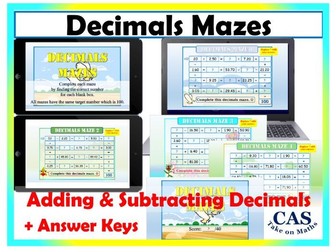
Decimal Mazes is a fun activity to practise adding and subtracting decimals.
All mazes have the same target number which is 100.
Students complete each maze by finding the correct number for each blank box.
Answer keys are also included.
The PowerPoint is editable, teachers can change the numbers to make more decimals mazes.
More Resources:
Colouring Pages
Fun Activity
Topics:
Numbers
Times Table
Fractions
Decimals
Percentages
Significant Figures
Consumer Maths
Financial Maths
Algebra
Measurement and Geometry
Visit my shop :)
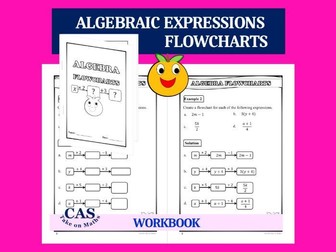
REPRESENT ALGEBRAIC EXPRESSIONS ON FLOWCHARTS WORKBOOK
Scaffolded notes + worksheets + answer keys + mini folded notes + teacher notes to learn and practise:
• The concept of algebra uses variables and numbers
• Represent algebraic expressions using flowcharts
• The concept of variables as a way of representing numbers using letters.
Grades: 7th to 9th
Learning Outcomes:
Understand the concept of algebra uses variables and numbers.
Represent algebraic expressions using flowcharts.
Understand the concept of variables as a way of representing numbers using letters.
Also comply with Australian Curriculum:
Introduce the concept of variables as a way of representing numbers using letters (ACMNA175)
Communicate and connect mathematical ideas using appropriate terminology, diagrams and symbols (MA4-1WM)
Recognise and explains mathematical relationships using reasoning (MA4-3WM)
Generalise number properties to operate with algebraic expressions (MA4-8NA)
More Algebra Resources:
Algebra Mazes | Simplifying Algebraic Expressions
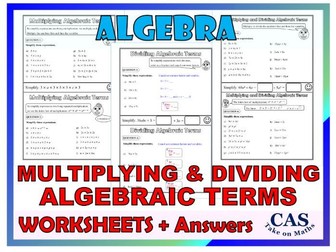
Simplifying Algebraic Expressions
Algebra worksheets and answers to
practise simplifying algebraic expressions that involve multiplication and division.
introduce the index law of multiplication.
Level of Difficulty: Beginner (Easy)
Grades: 7th to 9th
Also suitable for Australian Curriculum
Simplify algebraic expressions involving the four operations (ACMNA192)
More Resources:
Colouring Pages
Fun Activity
Topics:
Numbers
Times Table
Fractions
Decimals
Percentages
Significant Figures
Consumer Maths
Financial Maths
Algebra
Measurement and Geometry
Visit my shop :)
Back to school Freebie :)
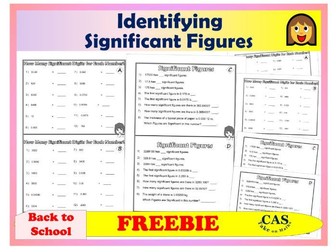
Identifying Significant Figures:
4 tasks (40 questions) for students to practise about significant figures:
Determine the number of significant figures for the given numbers.
Short answer questions to check students’ understanding of significant figures.
Level of Difficulty: Beginner (Easy)
Grades: 8th to 10th
Geometry Resources:
Trapezium Area: Lesson Notes + Worksheets + Answers
Solving Trapezium Problems
Math Manipulatives Part 1 flipbook about the Trapezium Area
Geometry | The Angle Sum of a Triangle | Printable Activity
More Resources:
Colouring Pages
Fun Activity
Topics:
Numbers
Times Table
Fractions
Decimals
Percentages
Significant Figures
Consumer Maths
Financial Maths
Algebra
Measurement and Geometry
Visit my shop :)
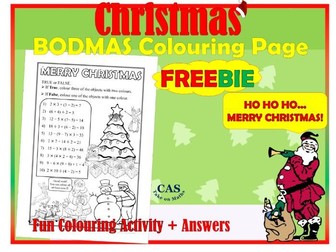
Christmas Colouring page - FREEBIE
A fun classroom activity to practise the order of mathematical operations.
Students practice adding, subtracting, multiplying and dividing numbers using BODMAS or PEMDAS rules and colouring the page.
The answer key is also included.
Level of Difficulty: Beginner (Easy)
Grades: 4th to 8th
Learning Outcomes:
Apply the order of operations to perform calculations involving more than one operation.
Also suitable for Australian Curriculum
Select and apply efficient mental and written strategies and appropriate digital technologies to solve problems involving all four operations with whole numbers (ACMNA123)
More Resources:
Colouring Pages
Fun Activity
Topics:
Numbers
Times Table
Fractions
Decimals
Percentages
Significant Figures
Consumer Maths
Financial Maths
Algebra
Measurement and Geometry
Visit my shop :)
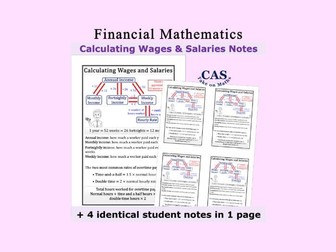
Scaffolded Note about how to calculate wages and salaries for various time periods and overtime.
Grades: 9th to 12th
Learning Outcomes:
Calculate earnings from wages and salaries for various time periods, including increased rates for overtime.
Find the equivalent number of hours worked at normal pay.
Also comply with Australian Curriculum:
Calculate weekly or monthly wage from an annual salary, wages from an hourly rate (ACMGM002)
More Resources
Topics:
Numbers
Times Table
Fractions
Decimals
Percentages
Significant Figures
Consumer Maths
Financial Maths
Algebra
Measurement and Geometry
Colouring Pages
Fun Activity
Visit my shop :)
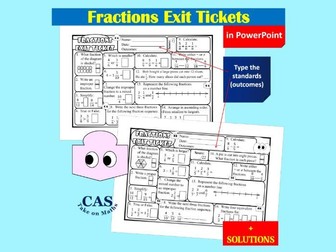
FRACTIONS EXIT TICKETS
Two exit tickets for students to review fractions skills and
understanding:
Write shaded parts of the given diagram as a fraction.
Locate fractions on number lines.
Understand types of fractions: proper, improper and mixed numerals
Identify and write equivalent fractions
Simplifying fractions
Compare and ordering fractions
Write sequence fractions
Add and subtract fractions with like denominators.
Also included: Answer keys
Note: the exit tickets are in PowerPoint format.
Teacher types (inputs) the standards (outcomes) required for their class before printing the exit tickets.
Please read the standards (outcomes) covered in the exit tickets on
the next page.
Grades: 3rd to 7th
Comply with KS2 and KS3 Maths: Fractions.
Also comply with Australian Curriculum:
Count by quarters, halves and thirds, including with mixed numerals; locate and represent these fractions on a number line (ACMNA078)
Investigate equivalent fractions used in contexts (ACMNA077)
Compare and order common unit fractions and locate and represent them on a number line (ACMNA102)
Investigate strategies to solve problems involving addition and subtraction of fractions with the same denominator (ACMNA103)
Compare fractions with related denominators and locate and represent them on a number line (ACMNA125)
Solve problems involving addition and subtraction of fractions with the same or related denominators (ACMNA126)
More Resources:
Colouring Pages
Fun Activity
Topics:
Numbers
Times Table
Fractions
Decimals
Percentages
Significant Figures
Consumer Maths
Financial Maths
Algebra
Pythagoras Theorem
Measurement and Geometry
Area
Functions
Visit my shop :)
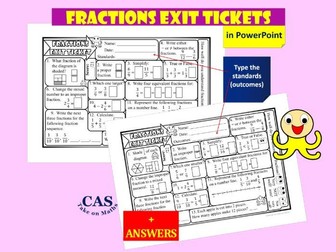
FRACTIONS EXIT TICKETS
Two exit tickets for students to review fractions skills and understanding:
Write shaded parts of the given diagram as a fraction.
Locate fractions on number lines.
Understand types of fractions: proper, improper and mixed numerals
Identify and write equivalent fractions
Simplifying fractions
Compare and ordering fractions
Write sequence fractions
Add and subtract fractions with like denominators.
Also included: Answer keys
Note: the exit tickets are in PowerPoint format.
Teacher types (inputs) the standards (outcomes) required for their class before printing the exit tickets.
Please read the standards (outcomes) covered in the exit tickets on the description page.
Grades: 3rd to 7th
Comply with KS2 and KS3 Maths: Fractions.
Also comply with Australian Curriculum:
Count by quarters, halves and thirds, including with mixed numerals; locate and represent these fractions on a number line (ACMNA078)
Investigate equivalent fractions used in contexts (ACMNA077)
Compare and order common unit fractions and locate and represent them on a number line (ACMNA102)
Investigate strategies to solve problems involving addition and subtraction of fractions with the same denominator (ACMNA103)
Compare fractions with related denominators and locate and represent them on a number line (ACMNA125)
Solve problems involving addition and subtraction of fractions with the same or related denominators (ACMNA126)
More Resources:
Colouring Pages
Fun Activity
Topics:
Numbers
Times Table
Fractions
Decimals
Percentages
Significant Figures
Consumer Maths
Financial Maths
Algebra
Pythagoras Theorem
Measurement and Geometry
Area
Functions
Visit my shop :)
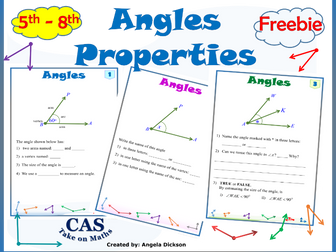
This resources is designed for students’ scaffolded note about angles properties and naming angles.
Level of Difficulty: Beginner (Easy)
Grades: 5th to 8th
Learning Outcomes:
• identify the ‘arms’ and ‘vertex’ of an angle
• Learn to name an angle in four different ways
More Resources
Colouring Pages
Fun Activity
Topics:
Numbers
Times Table
Fractions
Decimals
Percentages
Significant Figures
Consumer Maths
Financial Maths
Algebra
Measurement and Geometry
Visit my shop :)
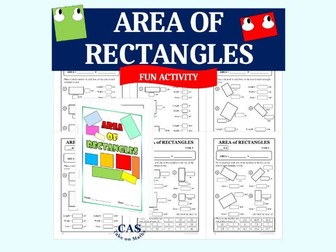
AREA OF RECTANGLES ACTIVITY
6 tasks to practise area of rectangles in a variety of length units. (metric system).
Tasks 1 and 2:
Students place a whole number in each box, so the area of each rectangle is true.
Tasks 3 and 4:
Students place a decimal in each box, so the area of each rectangle is true.
Tasks 5 and 6:
Students fill in each box with one of the numbers in the list, so the
area of each rectangle is true.
Also included: Answer keys for tasks 5 & 6.
Grades: 3rd to 6th
Learning Outcomes:
Understand that the area of a rectangle can be found by multiplying the length by the width.
Calculate the areas of rectangles using familiar metric units.
Establish the relationship between the lengths, widths and areas of rectangles.
Also comply with Australian Curriculum:
Calculate the areas of rectangles using familiar metric units (ACMMG109)
More Resources:
Colouring Pages
Fun Activity
Topics:
Numbers
Times Table
Fractions
Decimals
Percentages
Significant Figures
Consumer Maths
Financial Maths
Algebra
Pythagoras Theorem
Measurement and Geometry
Area and Perimeter
Functions
Visit my shop :)


 Quick View