This field trip will compare how drinking soda compares to what Ocean Acidification is doing to our oceans. It starts with a Flipped Lesson on pH scale, and class demo's comparing acidic drinks to what acids in the ocean are doing to our Biodiversity and fish health.
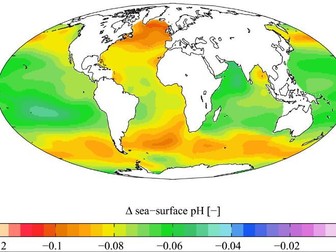
This expedition focuses on the two roles Carbon Dioxide has as a pollutant in the ocean. In the air Carbon Dioxide acts as a greenhouse gas, trapping heat and increasing atmospheric temperatures. This, in turn, increases ocean temperatures which is the leading cause of coral bleaching. Carbon Dioxide also dissolves in the water creating Carbonic Acid. This lowers the pH of the water, leading to ocean acidification.
This lesson includes class activities, demonstrations and expedition slides to showcase how the two roles of Carbon Dioxide are different, but both dangerous to biodiversity and ecosystem stability. A Google Doc lesson is attached in your download for easy use with Google Classroom.
What is a Google Expedition:
* Google Expeditions enable teachers to bring students on virtual trips to places — museums, underwater, outer space. Expeditions are collections of linked VR content and supporting materials that can be used alongside existing curriculum.
*These trips are collections of virtual reality panoramas — 360° panoramas and 3D images — annotated with details, points of interest, and questions that make them easy to integrate into curriculum already used in schools.
Google Expeditions and Tour Creator are shutting down on June 30th, 2021. As all of our lessons are built on these two platforms, from this date our content will no longer be available.
In this lesson students will use Google Expeditions to study coral bleaching events in Haiwaii, American Samoa and Australia.
The Expedition will develop students’ understanding of environmental change.
Students will learn about the impact of carbon dioxide in the atmosphere on the marine environment and in particular the coral ecosystem.
High CO2 has two impacts on the ocean: warming and ocean acidification. This virtual field trip shows the impact of warming oceans in terms of coral bleaching.
Encounter Edu links curriculum aligned education with global burning issues to inspire STEM careers and encourage environmental stewardship. Learn more about what we do at www.encounteredu.com or by visiting our TES Shop, filled with quality, free of charge resources.
This scheme of work would suit ages 11-14 and 14-16 (KS3/4).
Download all the Google Earth activities for exploring the Great Barrier Reef, looking at Classification, Food Webs, Mutualism and Symbiosis, and Threats.
They are designed to be used with the Catlin Seaview Survey Google Earth layer.
Visit the Encounter Edu website to gain access the Catlin Seaview Survey Google Earth Layer at: www.encounteredu.com
An in-depth introduction to the themes of extreme environments and how science is conducted in remote regions, for schools internationally.
The booklet includes lesson plans and activities about current research on snow and ice extent, ocean currents, ocean acidification and marine biology. Designed to be used in conjunction with the Encounter Edu Discovery Zone.
The enquiry-based resources incorporate the scientists’ experiences and research, and include booklets with structured lesson plans, activity and experiment sheets, an interactive Media Player with videos and images from the expeditions, along with posters and other related resources.
This #GoogleExpeditions lesson develops students’ understanding of environmental change.
In this lesson students understand the impact of carbon dioxide in the atmosphere on the marine environment and in particular the coral ecosystem.
High CO2 has two impacts on the ocean: warming and ocean acidification. This virtual field trip shows the impact of warming oceans in terms of coral bleaching.
Google Expeditions are immersive 360 degree photo stories designed for use in the classroom. For more see: https://www.google.com/edu/expeditions/
To download Google Docs versions of the lesson plan go to: https://goo.gl/RhfeXy
Encounter Edu links curriculum aligned education with global burning issues to inspire STEM careers and encourage environmental stewardship. Learn more about what we do at www.encounteredu.com or by visiting our TES Shop, filled with quality, free of charge resources.
Take your pupils on a journey from the classroom – Google Earth can bring the world closer and inspire curiosity as an integral part of lessons.
With tours or layers you can dive into the oceans, track endangered species, monitor earthquakes and weather, keep up-to-date with resource conflicts – or create your very own layers.
The manuals bring together skills for space and mapping, using tech tools and project management.
These resources for ages 7-11 are based on the journeys undertaken by science teams taking part in the Catlin Seaview Survey expeditions. These resources present a complete scheme of work for the science classroom, covering core science and sustainability curriculum areas as well as enhancing students’ creative and communications skills.
Science curriculum topics include:
- habitats and how they provide the basic needs of plants and animals
- identification, classification and the use of keys
- life cycles, anatomy and sexual reproduction
- how animals obtain their food using the idea of food chains
- how animals and plants are adapted to their environment
- human impact on the environment
This project-based learning resource incorporates stunning multimedia resources and is based on recent expeditions to enable students to explore marine life on the reef and the threats facing it.
Explore the world’s newly discovered species and challenge students’ understanding of how scientists discover and classify species previously unknown to science. Students will further their knowledge of classification with two newly discovered species classification key activities and develop independent research skills as they plan their own expedition to discover new species.
Wildscreen ARK, ARKive’s successor is now live - please bear with us while we update our learning resources. In the meantime you can access our growing UK species content hub Wildscreen ARK.


 Quick View