The essential Philosophy for Children (P4C ) tool!
Professionally designed with amazing animations to capture your students’ attention.
This download includes an editable PowerPoint (and a PowerPoint show, for your convenience) featuring over 101 philosophical questions to stimulate discussions in your class tutor-group.
It also has a ‘randomiser’ so that you can randomly select a question each time!
Perfect for form-time, end of lessons, great for any subject! Suitable for KS2-5!
Please leave a rating or review if you liked this product :)
Check-out some of my most popular resources!
GCSE Religious Studies
Buddhism (20 Lesson Unit)
Buddhism (Thematic Studies Units)
Christianity (Thematic Studies Units)
Hinduism (20 Lesson Unit)
Islam (Thematic Studies Units)
.
GCSE Sociology Resources
Complete Units (Whole Course)
.
Philosophy for Children (P4C)
The Ultimate P4C Resource Pack
The Debating Society Toolkit
Philosophy Boxes
.
Other Tools
A3 DIRT Worksheet (15+ 5-star ratings!)
KS3 RE Units
This fun philosophy lesson is focused on ‘Animal Ethics’: the branch of ethics which examines human-animal relationships, the moral consideration of animals and how nonhuman animals ought to be treated. Animal ethics explores topics such as animal rights, animal welfare, animal law, speciesism, animal cognition, wildlife conservation, wild animal suffering, the moral status of nonhuman animals, the concept of nonhuman personhood, human exceptionalism, the history of animal use, and theories of justice.
This download uses our innovative new format for philosophy education, you can download a FREE SAMPLE by clicking here. It is one of over fifty new philosophy & ethics teaching resources that uses this format. The resource cannot be edited.
This philosophy session is of interest to teachers of all school subjects who are hoping to explore ethics with young learners; since it explores moral issues in depth the resource is a great contribution to your schools SMSC remit. This session explores topics such as:
Our moral duties towards animals
The ethics of eating meat
Animal testing
Blood-sports and
Utilitarian theories of animal ethics
The big question asked in this session is “When (if ever) is it morally acceptable to cause an animal to suffer?”. Using a variety of engaging activities students will discuss and debate a wide range of other philosophical and ethical questions such as:
What does the term ‘animal rights’ mean?
To what extent is it morally wrong to eat animals such as cats and dogs?
To what extent is it morally wrong to test cosmetics on animals? and
To what extent is hunting wild animals a moral hobby?
Students will also analyse and evaluate an eclectic mix of philosophical claims such as:
“Humans are inherently superior & valuable to all other animals”
“Animal testing is morally acceptable if the animals are being used to create new medicines”
“All species go extinct eventually: protecting endangered species is a waste of time" and
“An insect does not have an experience of living and cannot feel pain”
This session uses our unique format for philosophy teaching resources and features an integrated menu that allows teachers to select from a variety of starter, main, plenary, assessment and end-of-lesson reflection activities.
This resource is suitable for students aged 8-16; due to the flexible nature of the sessions design it can be used for multiple hour-long sessions or as a short stimulating tutor-group activity.
The file is a non-editable PowerPoint Show: no planning or preparation is required, just run the file and the intuitive menu system will make delivering a powerful philosophy session very easy!
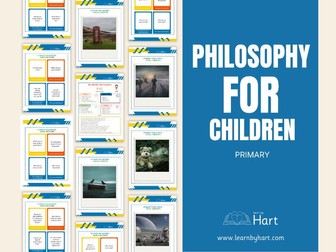
Bring rich, structured philosophical discussion into your primary classroom with this ready-to-use Philosophy for Children (P4C) resource pack. Designed to develop critical thinking and collaborative reasoning skills, this pack gives teachers everything they need to facilitate meaningful enquiry-based dialogue with pupils at KS1 and KS2.
P4C is an evidence-informed approach that encourages children to think carefully, listen actively, and engage respectfully with big ideas and open-ended questions.
What’s Included
A 10 page PDF containing the following:
P4C Sentence Starters – A structured reference sheet organising dialogue prompts into four thinking categories: Caring, Collaborative, Creative, and Critical.
P4C Discussion Rules – A clear, pupil-friendly set of ten ground rules for philosophical enquiry, covering active listening, respectful disagreement, turn-taking, and the use of “I” statements.
Primary Philosophy Question Cards – A set of 16 discussion question cards organised across four philosophical themes
Primary Philosophy Visual Prompts – A collection of five thought-provoking photographic and illustrated images designed to spark philosophical discussion without the need for text.
How to Use
Use the sentence starters and discussion rules together at the start of the year to establish your P4C community of enquiry, then introduce the question cards and visual prompts as stimuli for individual sessions. The question cards can be selected by the teacher to match a current theme or PSHE topic, or offered to pupils as a choice to encourage ownership of the enquiry. Visual prompts work especially well as a low-barrier entry point for KS1 classes or mixed-ability groups. Components can be used individually as standalone lesson starters or combined to run a complete P4C session.
Grade Levels: KS1 and KS2
File Format: PDF (printable and projectable)
Note: This is a digital download only.
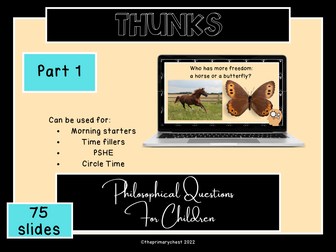
A morning starter ppt with 75 slides of thunks. Can also be used as part of your PSHE or circle time as a starter to get your pupils thinking. The aim is to get the children into a discussion or debate.
Suitable for KS2.
This is part one, with more powerpoints of this kind to come.
Thunks: philosopical questions that make you think.
Please note: this is NOT editable.
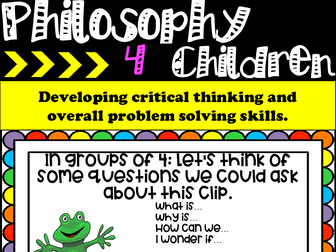
Philosophy 4 Children is being taught across the UK to teach children fundamental skills such as:
critical thinking.
reasoning skills.
empathy.
team work.
In this pack, I have included:
Philosophy Display Cards
Philosophy lesson plan: recycling
Philosophy lesson plan: friendships
Philosophy Powerpoint: recycling
Philosophy Powerpoint: friendships
A document on how to teach philosophy.
I have been teaching Philosophy lessons for a whole term now and the difference it has made in children’s problem solving skills in friendship issues, aswell as mathematical problems is amazing!
We spend an hour a week on P4C and it’s the children’s favourite lesson. Some of them have come out with some cracking conclusions too:
“Crying is an expression of your truest emotions. The body takes over from the mind”. I mean WOW!
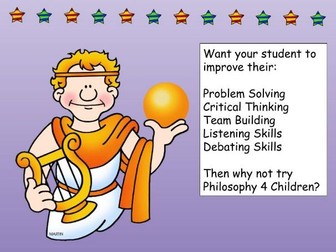
Want to find out more about how to improve the following skills within your classroom:
Improve peer collaboration
Think more critically
Develop problem solving capabilities
Build team working skills
Use a tested and proven format to improve listening skills
Empathize with a range of characters from different narrative stories…
I have been using philosophy for children within my classroom for the last ten years and shared my knowledge recently at a workshop. This presentation contains easy to follow guidelines of how to run a session and includes resource banks and reference points.
Other Related Products that also help with collaboration and critical thinking:
Thunks - Questions that make you thunk!
Lego Therapy
Comments, suggestions, feedback and questions always welcomed!
♦ Do you need some fresh ideas and tips? Then visit MY BLOG
A 35 -60 minute lesson plan aimed at Key Stage 3 but could also be used at Key Stage 4. Included files are a lesson plan and powerpoint file with all necessary questions and linked videos.
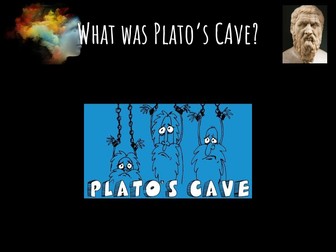
This lesson is an ethical debate based upon the ideas of Plato’s cave.
Philosophy for learning activity in which children discuss whether it would be better to live in the witch's gingerbread house or the king&'s castle, before using an image of Rumplestiltskin as a stimulus for discussion.
This Bundle includes two different lessons sequences, one on Logic and one on Ethic, and easily includes enough content to take up a term of lessons at one hour a week.
Once the students have completed the sequences, they should have a sophisticated understanding of the different ethical theories included, and a strong working knowledge of logical argument.
The lessons were designed for a very gifted KS3 set however, I’ve also used them for KS4 RE Core lessons.
Philosophy For Children: Morality
Using the example of Robin Hood pupils will engage with ideas of what is right and wrong.
Lesson follows a TEEP cycle and is easy to follow using the PowerPoint
Ethics, Morality, P4C, Robin Hood
This resource consists of a lesson plan, that can be done in two sessions, and three presentations.
The lesson plan explains in detail how to deliver the unit, ideally in two sessions, and how to link each activity to the proper slide of the two power points.
The first one of those presentations has an introduction for children (from as young as year 3 in UK and up to year 6) of what is philosophy for children, and three game-activities
The second power point has a story that I have written myself presenting an Ancient Greek problem about the edge of the universe, posited by Archytas of Tarentum. After the story, the presentation has the instructions and materials to do a philosophical inquiry by children following Mathew Lipman´s program.
The third power point has a series of statements to print and laminate to be used in an activity.
All the activities, including the reading of my story, may be done in 90 minutes.
With this lesson I use a fictional situation to reflect about the edge of the universe and the meaning of physical concepts such as space, while using the model of philosophical inquiry for children, this is to play thinking games and to learn dialog expressions in order to solve cooperatively an abstract problem.
A discussion lesson on crime focusing on the question - 'Can children be criminals'.
The stimulus is an article about James Bulger. Students can use this to stimulate other discussion surrounding the theme of crime.
Students should be aiming to talk confidently, question each other and listen to others effectively in order to move the discussion forward.
This is a ppt presenation directed at helpling parents understand what P4C is and how to develop thinking skills in their children, with examples of questions etc.
This can also be used as whole school training with a minimal adaptation.
A useful starter kit for anyone who is due to teach P4C but has not had much experience teaching it. P4C is a great way of getting students discussing key issues and is useful in many subjects across the curriculum. This starter kit gives you:
-useful posters
-blank powerpoint slide format
-5 example P4C lesson plans / powerpoints in full
-resources needed for each lesson
- 'helpful hints' worksheet or poster for students to improve their conversational speech
Image shows a woman praying after the Japanese Tsunami. Good prompt to discuss philosophical questions such as 'What is the purpose of prayer?&' &';Why do we suffer?' &'Does God exist?&'; 'Why does God allow natural disasters?&' &';Why do people pray?' etc
Read the summary of the story and then ask children what questions or issues they think the story brings up. If this is hard try using my questions on the second page. Debate them or discuss as a class.


![101 Philosophical Questions (P4C) [Philosophy for Children]](https://l.imgt.es/resource-preview-imgs/0dc09ed7-5167-4df2-a0fd-4afd987531ec%2FCOVER.crop_800x599_0%2C0.preview.jpg?profile=res-img-med-legacy-v2) Quick View
Quick View![Animal Ethics: Philosophy Lesson for Students Aged 8-16 [P4C, Philosophy for Children, Animals]](https://l.imgt.es/resource-preview-imgs/9f8f9218-2729-4aec-bbd3-1f480efd3318%2FAnimalsPhilosophyP4CAnimalEthicsEthicalMoralDebatesLessonLessonPlanP4C.crop_606x455_0%2C91.preview.jpg?profile=res-img-med-legacy-v2)