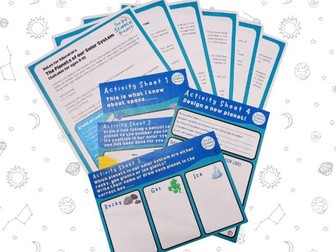
This is a series of A4 fact cards with questions on each of our solar system’s planets. They are designed to be used as part of a circus activity. Answers are included.
These are aimed at higher KS3 and GCSE.
I have provided these in a PPT file so as the colour schemes can be altered depending on printer capability.
This is a sample of the workshops and resources we have available as part of our Outreach program at Aberystwyth University for the Faculty of Business and Physical Sciences.
For more information please visit:
https://outreach-hub.aber.ac.uk
Please ensure you can access the video before you get this resource. Professor Dave demolishes the conceits of astrology with the might of Scientific Method. He discusses: the prevalence and history of astrology, unfalsifiable predictions. What could be the means of planetary “influence”? The four fundamental forces rejected as possible mechanisms. Experimental evidence of the invalidity of horoscopes, statistical significance. Nancy Reagan and the White House astrologer. Why should science destroy the fun of astrology? The importance of scientific method.
Find the film on YouTube by searching Professor Dave’s Channel for “Astrology: Fact or Fiction?”
15 questions for the 18-min film. Differentiated! Both versions look very similar, but “B” version has subtle clues. Questions right up to the end, no slack time! Excellent subtitles, scripted, not auto-generated. Answer sheet. Very easy to mark. .doc & .pdf for all files.
Although planets, stars and other celestial bodies move through space in complicated ways, space is so vast that rarely do such bodies collide. However, when someone watches these movements from a distant vantage point, it sometimes looks as though collisions occur because of the perspective. The introduction of Transit Math clearly explains the apparent 'collisions,' eclipses, transits and occultations to middle school students. The variety of concepts in this 44-problem collection includes synodic periods, planetary conjunctions, geometry, fractions, linear equations and probability.
KS2 Solar System Lesson: Learn planet order with mnemonics, categorise Rock, Gas, and Ice Giants, and design 3D models. Includes 4 worksheets and PPT!
Engage your class with a journey through the stars! This comprehensive resource, Part 1 of a larger Space Unit, is designed for learners aged 8–11 (KS2). It combines scientific inquiry with hands-on creativity, allowing students to explore the composition of our solar system before engaging in hands-on activities.
Unlock the mysteries of the Solar System with this comprehensive KS2 science resource! This lesson (Part 1) focuses on the physical characteristics of the eight planets, teaching pupils how to categorise them by their composition and remember their proximity to the Sun.
What’s Included?
This pack provides a complete toolkit for a 1.5–2 hour session:
Detailed Lesson Plan & Teacher Guide (.pdf): Clear instructions including science facts on gravity, the Milky Way, and the three planet types (Terrestrial, Gas Giants, and Ice Giants).
Classroom Presentation (.pptx): A visual guide to help pupils identify and sequence the planets correctly.
Worksheet 1: Mind-mapping prior knowledge about space.
Worksheet 2: Ordering planets and creating catchy mnemonics (e.g., “My Very Easy Method…”).
Worksheet 3: Categorising planets into Rock, Gas, and Ice groups.
Worksheet 4: Planning and designing a unique 3D planet model.
Classroom Application & Skills
This resource is designed to build a variety of UK National Curriculum skills:
Scientific Classification: Pupils analyse data to group planets by physical properties (Gas vs. Rock).
Literacy & Memory: Using mnemonics to improve information retention and creative writing.
Art & Design: Planning a 3D papier-mâché project, focusing on texture, scale, and colour.
Critical Thinking: Understanding the concept of gravity and how it keeps our solar system in place.
How to Use This Resource
Start with worksheet 1 to capture the knowledge children have about space, then at the end of the session they can add anything new that they have learnt. Next, start with the PowerPoint to introduce the concept of the “Solar System family.” Use Worksheets 2 and 3 to solidify the order and types of planets. Finish the session with Worksheet 4, which serves as the “blueprint” for a hands-on art and design project. This lesson is perfect for a Year 4, 5, or 6 Science unit on Earth and Space.
File Types Included: .pdf and .pptx
Classroom Applications & Skills
This resource is built to encourage cross-curricular learning across several key areas:
Science & Technology: Understanding planetary composition.
Expressive Arts: Designing and painting 3D models.
Literacy: Developing communication skills through group discussions and presentations.
Having read Ian Stewart's book of the same name, I decided to make A4 sized posters summarising each of the equations. They're nice to have up on the walls when kids say 'What's the point of Algebra?'
If you like this resource then please check out my other stuff on here!
In this activity, students will compare surface features on the nucleus of two comets, explain some possible causes for differences between the two nuclei, and then list questions that they have about the surface of comet nuclei.
The activities in this guide promote problem solving, communication skills and teamwork. Earth and space science subjects include lunar geology and regolith, distance to the moon, Apollo landing sites and life support systems.
Imagine being able to monitor the progress of an entire solar storm from the time it erupts from our sun until it sweeps past our small planet effecting enormous changes in our magnetic field. Now imagine being able to do all of this from your classroom-based Space Weather Action Center (S.W.A.C.)! By following the basic steps in the Instructional Guide your class will soon be on its way to accessing, analyzing and recording NASA satellite and observatory data.
Explore the secrets of Jupiter with this resource from NASA Education. The module showcases how the Juno mission will unveil Jupiter's deepest secrets, including clues about how our solar system formed and Jupiter&'s unique traits.
This activity from NASA offers an interesting context in which students may apply their understanding of energy concepts such energy transfer, electrical power and circuits. National Standards state that students in grades 5-8 are to have an understanding of these topics. Trying to solve the problem of how to provide solar energy for the ISS and for research habitats on the moon and Mars presents an excellent way to introduce and reinforce the unique position of Earth in the solar system.
Life After Death is a fascinating aspect of the curriculum, I have selected some interesting and informative articles about reincarnation and Near Death Experiences, looking for the most serious scientific explorations of these important subjects.
'Proof&' includes - writing match from one life to the next,
people born blind who see the room when having out of body NDE&';s and people who are completely brain dead - no activity in the brain at all - when experiencing NDE's
A range of resources to use when planning a unit on questions of human rights justice, suffering and the age old issue of 'Is it Fair?&'
The oxfam unit is excellent and I have made a worksheet for our students to create cards inspired by the ones created by the students at the school in South Africa which is featured in the Oxfam resources.
A resource pack for careers education and information, advice and guidance practitioners. Produced by the Centre for Science Education. (Science, Technology, Engineering & Maths)
in haste - the prev site is full so starting another.
Sorry not a regular blog at the moment, Life is a bit hectic.
Bella-the kitten who just caught a mouse at Mums is sitting on my knee purring like a steam engine, very proud of herself.
Love and Peace
DurgaMata
This teachers guide contains excellent background information accompanied by classroom activities that enable students to experiment with the forces and processes that scientists who study microgravity are investigating today.
This guide contains color and light activities using lenses, prisms and mirrors to create telescopes, periscopes, microscopes and kaleidoscopes. Other activities include finding focal length and understanding reflection, refraction and diffraction. Activities are marked by age level.
One day humans may live and work on the moon for weeks or even months. Energy and power will make it possible to travel to and live on the lunar surface. Humans must choose the appropriate energy source and technological means to produce that power. In this unit of 5E (Engage, Explore, Explain, Elaborate/Extend, Evaluate) lessons, aligned to national education standards, students learn the relationship between power, energy and electricity.


 Quick View