World Red Cross Red Crescent Day is celebrated on 8 May each year. This PowerPoint presentation contains slides introducing the International Committee of the Red Cross (ICRC). Details the history of the ICRC, the emblems of the ICRC and explains a little about their goals. There is also a homework page with 10 questions loosely based on the PowerPoint presentation. The documents are also available in a PDF format or you can contact me for any other format choice.
#TheRedCross
#HenryDunant
These Citizenship and History activities support young people (aged 14 to 19) to learn about the formation of the International Red Cross and Red Crescent Movement. With discussion activities, a written exercise and a short film, learners look at the principles underpinning the humanitarian work of the Movement and see real-life examples of humanitarianism in action.
Learners will:
understand the history and fundamental principles of the International Red Cross and Red Crescent Movement
explore the importance of humanity in the work of the Red Cross
consider how to take humanitarian actions in their own lives and contribute to improving their own communities.
FInd more engaging resources at www.redcross.org.uk/education
Citizenship activities encouraging 14-19 year-olds to consider how humanitarianism can be put into action.
Humanity is one of the Fundamental Principles underpinning the work of the International Red Cross and Red Crescent Movement. The activities in this resource consider how humanitarianism can be put into action, by placing learners in the position of decision makers, enabling them to explore the choices surrounding helping people in need.
Learners will:
explore the term “humanity”
consider dilemmas and consequences that might be faced in situations where a humanitarian response is needed
identify social pressures and barriers to action around helping others
reflect on what motivates people to act to help others.
For more engaging resources please visit www.redcross.org.uk/education
Red Nose Day is an biennial event in which people come together to raise money for important causes in the UK and around the world. This presentation discusses what Red Nose Day is, why we celebrate it and how children can get involved. A fun PowerPoint to celebrate the power of helping others.
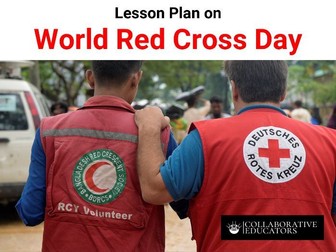
This 90-minute lesson introduces students to World Red Cross Day, celebrated every year on May 8th. Using the educational video World Red Cross Day, students explore the history, principles, and global impact of the International Red Cross and Red Crescent Movement.
The lesson begins with a warm-up discussion to activate prior knowledge, followed by two viewings of the video to support comprehension. Students then engage with a printable worksheet featuring vocabulary activities, comprehension questions, critical thinking prompts, and a creative drawing task where they design a badge or slogan based on Red Cross values. Through collaborative pair work and whole-class discussion, students deepen their understanding of core humanitarian principles such as neutrality, impartiality, and voluntary service. A final quiz section reinforces key facts and encourages reflection on the importance of helping others in times of crisis.
This lesson not only builds language and listening skills but also promotes empathy, civic responsibility, and global awareness. It’s ideal for upper elementary or middle school learners and easily adaptable across different classroom settings. Answer keys are included, and the worksheet can be printed or used digitally for blended learning environments.
An assembly kit exploring the film The Power of Humanity and celebrating the work of the International Red Cross and Red Crescent Movement. This resource can be used as part of Citizenship and PSHE for 11-19 year olds.
Learners will:
consider the term “humanity” and what being a humanitarian means through exploring a range of humanitarian attitudes, behaviours and actions
understand how the Movement started, and some of the work of the Red Cross in the UK and overseas
reflect on their own feelings and reactions/responses to those in need
explore humanitarian actions and attitudes they might take in their own lives.
Find more engaging resources at www.redcross.org.uk/education
✓ Engaging powerpoint
✓ Recaps previous learning
✓ Lots of short AFL tasks
✓ Past paper questions and mark scheme
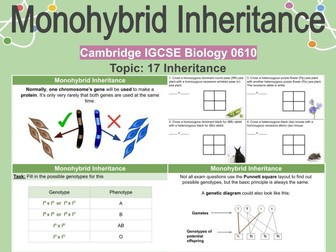
This lesson on Monohybrid Inheritance is designed for KS4 Science students enrolled in the CIE Cambridge IGCSE Biology 0610 (2023-25) course. This is the third and last lesson in the topic 17 Inheritance.
The lesson recaps previous learning from other linked topics to ensure students have a strong foundation before diving into the material. It also includes concise and easy-to-understand information and a variety of quick assessment for learning tasks to help students solidify their understanding of the topic.
This resource also includes past paper questions alongside a mark scheme to further deepen students�� understanding. These questions can be printed on one sheet of A4 (using ‘two pages one sheet’ on your printing settings). These can be used during the lesson, as homework or revision.
Objectives:
Describe inheritance as the transmission of genetic information from generation to generation
Describe genotype as the genetic make-up of an organism and in terms of the alleles present
Describe phenotype as the observable features of an organism
Describe homozygous as having two identical alleles of a particular gene
State that two identical homozygous individuals that breed together will be pure-breeding
Describe heterozygous as having two different alleles of a particular gene
State that a heterozygous individual will not be pure-breeding 8 Describe a dominant allele as an allele that is expressed if it is present in the genotype
Describe a recessive allele as an allele that is only expressed when there is no dominant allele of the gene present in the genotype
Interpret pedigree diagrams for the inheritance of a given characteristic
Use genetic diagrams to predict the results of monohybrid crosses and calculate phenotypic ratios, limited to 1 : 1 and 3: 1 ratios
Use Punnett squares in crosses which result in more than one genotype to work out and show the possible different genotypes
Explain how to use a test cross to identify an unknown genotype
Describe codominance as a situation in which both alleles in heterozygous organisms contribute to the phenotype
Explain the inheritance of ABO blood groups: phenotypes are A, B, AB and O blood groups and alleles are IA , IB and Io
Describe a sex-linked characteristic as a feature in which the gene responsible is located on a sex chromosome and that this makes the characteristic more common in one sex than in the other
Describe red-green colour blindness as an example of sex linkage
Use genetic diagrams to predict the results of monohybrid crosses involving codominance or sex linkage and calculate phenotypic ratios
This lesson would also be adaptable for all GCSE students (whether AQA, Edexcel, OCR) and great for KS3 Science or as a GCSE revision resource.
This Reading Comprehension worksheet is suitable for upper intermediate to proficient ESL learners. The text describes in detail the history and formation of the ICRC and Red Crescent Movement. The text also describes the admirable contribution of the ICRC during WWI and WWII.
After carefully reading a text, students are required to complete some comprehension exercises including: questions, True or False, gap filling exercises, a definitions matching exercise and participate in an in class discussion on the ICRC and the broader concept of volunteer work. The vocabulary used in the text is rather advanced and can also be used for IGCSE, TOEFL or IELTS vocabulary building purposes. The handout can be completed in class or assigned for homework.
This assembly focuses on the Christian Value theme of Courage. It is suitable for the Primary age range.
The story focuses on Moses taking the freed Israelite slaves away from Egypt, pursued by the Pharaoh and his soldiers. This is an interactive assembly, where the children respond to specific words with actions and sounds.
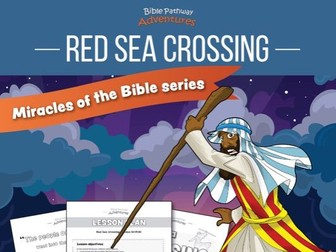
Students will love exploring the Bible’s most incredible miracles with Red Sea Crossing Activity Book. Featuring an easy-to-use teacher lesson plan, fun puzzles, coloring pages, and worksheets, this 14-page Activity Book brings the Bible’s most amazing miracles to life. Scripture references for quick Bible verse look-up and an answer key for educators make this Activity Book a must-have for any family or Bible class.
Very little teacher prep needed. Just print the activity sheets, and go!
What you’ll get…
Easy-to-use Red Sea Crossing teacher lesson plan that includes a carefully written kid-friendly Bible story, key vocabulary review, Bible story comprehension questions, and extra questions to encourage critical thought
Fun & engaging printable activity pages in PDF format (8.5" x 11")
Detailed scripture references for easy Bible verse look-up
Original Bible Pathway Adventures® illustrations
Answer key for educators
What’s inside…
Lesson Plan: Red Sea crossing
Bible quiz: Red Sea crossing
Bible word search puzzle: Red Sea crossing
Coloring page: Red Sea crossing
Worksheet: Free My people!
Worksheet: Red Sea crossing
Worksheet: Red Sea discovery?
Want more Bible miracles? Check out our Miracles of the Bible Activity Book
To be kept informed of new resources click HERE and follow!
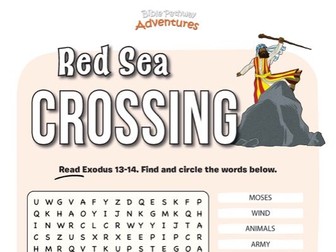
Looking for a Red Sea crossing activity that will excite and engage your Sabbath and Sunday School students? They’ll LOVE learning about the Exodus with our FREE Red Sea crossing word search puzzle. Plus, a Bible Pathway Adventures’ catalog.
Who is it for?
Kids ages 6-12, homeschooling, religious education teachers, and children’s ministry leaders
What’s Inside?
Bible word search puzzle: Red Sea crossing (plus answer key!)
Links to more resources
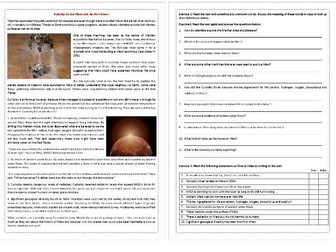
This Reading Comprehension worksheet is suitable for upper intermediate to proficient ESL learners. The text gives an account of all the discoveries the Mars Rover, also known as Curiosity Rover, has helped make. The text also explains what these discoveries mean for the history of the planet and what clues we currently have as to whether the planet could have sustained life.
After carefully reading a text, students are required to complete some comprehension exercises including: questions, True or False, a crossword and finally participate in an in class discussion on the Curiosity Rover, Mars and the broader field of space exploration. The vocabulary used in the text is rather advanced and can also be used for IGSCE, TOEFL or IELTS vocabulary building purposes. The handout can be completed in class or assigned for homework. Ideally, this handout could be used along a #GoogleExpeditions - Exploring the Red Planet with the Mars Rovers - virtual reality trip!
Teaching slides linked to three learning outcomes for Year 4 Branch 1: Creation and Covenant.
U4.1.1 Show some understanding of the historical context of Abraham (and Joseph) and the cultural and religious context out of which he was called. (RVE)
U4.1.2 Retell the story of Abraham, ensuring it is accurate in sequence and detail and shows an understanding of the term ‘covenant’.
R4.1.1. Considering how their own lives and the lives of their communities could be transformed by the virtues of faith, hope, and love. (RVE)
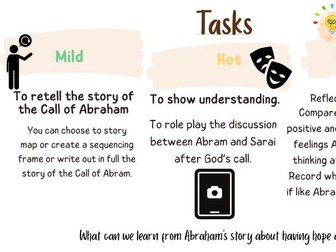
The lessons include activities to build understanding of the historical context of Abraham, as well retelling and analysis of the Biblical story of the ‘Call of Abraham’, with scripture, and supporting scaffolding for whole-class activities.
Differentiated cross-curricular activities are also included for mixed-abilities level.
The pack also includes a Cover Page for this topic Creation and Covenant and templates for prayer intentions linked to Hope to feature on the class Prayer Table and build on learning outcome R4.1.1 on how we consider how hope transforms lives.
4 pages ready for printing
1 poster
Red Cross information in text and symbol supported
All of my resources are created using the Widgit software program ‘Communicate in Print’
Permission has been granted for me to use their symbols and pictures.
Symbols can help many children and young people who struggle with reading or understanding.
Symbols enable communication and can increase independence and build self-esteem.
Please rate if you download
Thanks for looking
 Quick View

 Quick View
 Quick View
 Quick View
 Quick View
 Quick View
 Quick View
 Quick View
 Quick View
 Quick View
 Quick View
 Quick View
 Quick View
 Quick View