Year 3 English Unit Plan Egg Hunt (Short Film)Quick View
bcfcj22

Year 3 English Unit Plan Egg Hunt (Short Film)

(0)
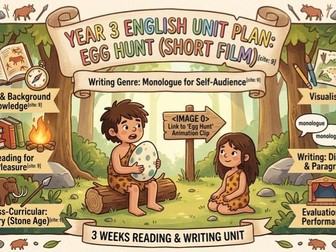
This comprehensive three-week English medium-term plan for Year 3 centers on the YouTube animation clip “Egg Hunt”. The primary writing outcome for this unit is a monologue, written for the “self” as the audience, with the distinct purpose of helping the audience understand a character’s feelings or assisting a character in making a decision. Students will ultimately draft, evaluate, and independently re-draft their own monologues based on feedback, and then perform these monologues for their peers. Reading and Comprehension Focus The reading objectives for this unit emphasize building fluency, engaging with background knowledge, and visualizing the narrative. Students will practice reading prosody passages aloud as a group and read key phrases aloud to partners to develop a reading speed that allows them to focus on understanding rather than just decoding. Because the animation involves a hunter-gatherer theme, pupils will actively link their prior knowledge of the Stone Age to the film to discuss expectations and debate the historical accuracy of the depictions. They will also visualize the narrative by adding captions or speech to images from the film, role-playing, and using “role-on-the-wall” techniques to identify exactly what the characters are thinking, feeling, and doing. Writing and Grammar Integration Throughout the unit, students will immerse themselves in the monologue genre by analyzing examples from animated films like Tangled, Zootopia, and The Emperor’s New Groove to understand key features such as powerful adjectives, rhetorical questions, and the use of exclamation marks to show extreme feelings. The instructional sequence includes shared writing, developing language through paired thought showers, and composing spontaneous monologues based on still images to convey sudden emotion. The foundational grammar objectives dictate that pupils must learn to write simple sentences, identify main clauses, and correctly use capital letters and full stops. To convey emotion effectively within their narratives, the plan explicitly encourages the use of short sentences to show frustration and list sentences to demonstrate either frustration or elation. Assessment and Cross-Curricular Links The suggested marking ladder for this unit ensures that students organize their writing around specific events using paragraphs, write from the first-person perspective, and incorporate different sentence types such as statements, questions, and commands. Vocabulary development is intentionally tied to cross-curricular learning, as both Tier 2 and Tier 3 vocabulary will be drawn directly from the students’ history topic. Finally, to broaden their understanding of the era and support reading for pleasure, the plan recommends supplementary reading texts such as The Stolen Spear by Saviour Pirotta, The First Drawing by Mordicai Gerstein, and Live like a Hunter-Gatherer by Naomi Walmsley.
Year 1 English Unit Plan Cops and Robbers/ Toys and GamesQuick View
bcfcj22

Year 1 English Unit Plan Cops and Robbers/ Toys and Games

(0)
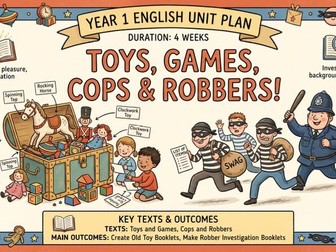
This resource offers a comprehensive Year 1 English MTP (Medium Term Plan) based on the non-fiction text “Toys and Games” by Jane Bingham and Ruth Nason, alongside the classic picture book “Cops and Robbers” by Janet and Allan Ahlberg. This 4-week plan is designed to immerse students in exploring history and narrative, helping them write Information Booklets about toys and narrative Robber Investigation Booklets. What’s Included? The plan features a variety of suggested activities for reading and writing, with a strong focus on phonics, visualizing, and linking reading to background knowledge. Students will have the opportunity to: Explore History and Toys: Investigate old and new toys, write matching labels, and explore Queen Victoria’s life through engaging role-play. Investigate the Robbers: Read Cops and Robbers, hot seat characters like the robbers or Officer Pugh, and play “guess the character” using personality traits and visual descriptions. Write Booklets: Create an information booklet featuring labels and captions for toys, as well as a “Robber Investigation Booklet” detailing lists, labels, and captions about the robbers and what they stole. Develop Reading Skills: Practice prosody aloud as a group, match phonetically decodable words to pictures, and visualize character descriptions by drawing or painting. Focus on Grammar & Phonics: Apply Phase 2 and 3 graphemes to sound out and write words, use capital letters for names, consistently leave spaces between words, and practice writing simple dictated sentences. The resource includes a detailed Marking Ladder to assess foundational writing skills, specific vocabulary lists (Tier 2 and Tier 3), and a curated list of supplementary reading texts. This plan is an excellent tool for teachers who want to blend history and storytelling to develop early literacy and engaging writing outcomes.
Year 1 English Unit Plan Funnybones (Janet and Allan Ahlberg)Quick View
bcfcj22

Year 1 English Unit Plan Funnybones (Janet and Allan Ahlberg)

(0)
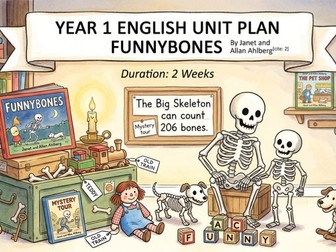
This resource offers a highly engaging Year 1 English MTP (Medium Term Plan) based on the beloved children’s classic “Funnybones” by Janet and Allan Ahlberg. This 2-week plan is designed to immerse students in the silly world of the skeletons, guiding them to confidently retell the story and write sentences describing its beginning, middle, and end. What’s Included? The plan features a variety of suggested activities for reading and writing, with a strong focus on sequencing narratives, visualizing settings, and applying foundational phonics. Students will have the opportunity to: Immerse and Analyze: Share a range of Funnybones books, listen to rhymes, and create the characters using art straws to develop fine motor skills. Develop Reading Skills: Explore key events through role-play, engage with interactive displays like matching characters to their shadows, and build background knowledge about the places the skeletons visit, such as the dark park, street, and zoo. Write and Sequence: Sequence the story using story maps and drama, write labels and captions to match characters, and ultimately create their own Funnybones retell for the reading area. Focus on Grammar & Phonics: Practice essential early writing skills through explicit teaching and games focused on using capital letters for names and at the start of sentences, consistently leaving spaces between words, and checking that their writing makes sense. Pupils will also practice saying their ideas out loud to plan their writing. The resource includes a detailed Marking Ladder to assess early writing foundations, specific Tier 2 and Tier 3 vocabulary lists, and suggestions for additional reading texts from Janet and Allan Ahlberg. This plan is a fantastic tool for teachers looking to inspire young writers through a fun, nostalgic, and wonderfully visual text.
Year 1 English Unit Plan The Something (Rebecca Cobb)Quick View
bcfcj22

Year 1 English Unit Plan The Something (Rebecca Cobb)

(0)
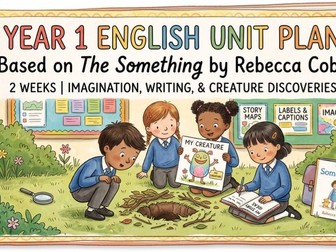
This resource offers an engaging Year 1 English MTP (Medium Term Plan) based on the imaginative text “The Something” by Rebecca Cobb. This 2-week plan is designed to entertain students and immerse them in narrative writing, culminating in an outcome where they create their own creature and write an alternative ending to the story. What’s Included? The plan features a variety of suggested activities for reading and writing, with a strong focus on prediction and linking reading to background knowledge, such as exploring animals that dig holes and discussing discoveries in gardens or parks. Students will have the opportunity to sequence events from the story, match characters to their predictions through interactive displays, and practice prosody aloud as a group to build fluency. In their writing journey, pupils will create and describe their own character that could live in the mystery hole, sequence the story through story maps and drama, and write labels and captions. Foundational grammar and phonics are heavily supported, with activities focusing on writing words with Phase 3 graphemes, forming Set 2 letters correctly, consistently using capital letters and finger spaces, and engaging in peer assessment to check if their sentences make sense. The plan even incorporates fun editing activities like sorting sentences into “trash or treasure”. The resource also includes a detailed Marking Ladder to assess skills such as writing three sentences to describe a picture or part of the story, alongside specific Tier 2 vocabulary words (like “doorway,” “den,” and “peered”) and a curated list of supplementary reading texts by Rebecca Cobb. This plan is a wonderful tool for teachers seeking to nurture early imagination, prediction skills, and foundational sentence construction.
Year 2 English Unit Plan Where the Wild Things Are (Maurice Sendak)Quick View
bcfcj22

Year 2 English Unit Plan Where the Wild Things Are (Maurice Sendak)

(0)
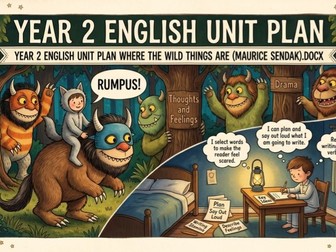
This resource offers a comprehensive 2-week Year 2 English MTP (Medium Term Plan) based on Maurice Sendak’s classic text, “Where the Wild Things Are”. This unit is designed to teach students how to write to inform and entertain through the genre of letters. It culminates in two independent writing outcomes: an apology letter from Max to his mum from the island, and a letter written from the perspective of a Wild Thing begging Max to return. What’s Included? The plan details a variety of engaging activities for reading and writing, with a strong focus on reading fluency, applying phonics, and using prosody. A key element of the reading instruction involves teaching students how to repair breakdowns in meaning by spotting mistakes, self-correcting inaccurate reading, and replacing unknown words with familiar ones. Students will also practice inference skills by exploring the author’s message and using drama to identify how a character’s thoughts and feelings are shown through their actions. In their writing journey, pupils will immerse themselves in the genre by looking at letters from different characters in supplementary books like The Day the Crayons Quit and The Jolly Postman to notice structure and language choices. They will engage in hot-seating in role to explore what feelings they want to convey before planning their ideas out loud. The plan heavily supports Year 2 grammar and spelling, featuring shared writing activities designed to teach the use of co-ordinating and subordinating conjunctions, expanded noun phrases (ENP), and apostrophes for contraction and possession. Students will also learn to differentiate between and use statements, questions, commands, and exclamation sentences. The resource includes a detailed Marking Ladder to assess skills such as selecting words and phrases to make the reader feel scared, using a range of sentence openers, and editing to ensure the correct verb tense is used. Furthermore, it provides specific vocabulary lists split by week—featuring words like “mischief,” “gnashed,” “rumpus,” and “supper”—alongside a curated list of additional Sendak texts to support reading for pleasure.
Year 2 English Unit Plan The Flight of the Honey Bee (Raymond Huber)Quick View
bcfcj22

Year 2 English Unit Plan The Flight of the Honey Bee (Raymond Huber)

(0)
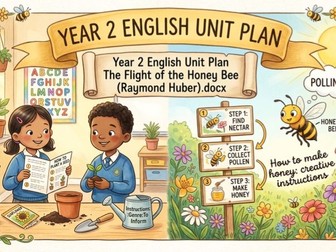
This resource offers an engaging 2-week Year 2 English MTP (Medium Term Plan) based on the text “The Flight of The Honey Bee” by Raymond Huber. Designed to teach students how to write to inform, this procedural writing unit guides pupils through the genre of instructions. It culminates in two independent writing outcomes: a set of instructions on how to plant a seed, and a creative guide explaining to a new bee “How to make honey”. What’s Included? The plan details a variety of engaging activities for reading and writing, with a strong focus on reading fluency, building meaning, and understanding text structures. Students will have the opportunity to: Immerse in Instructions: Explore instructions linked to other curriculum areas like plants, practically follow steps to understand the process, and act out or draw the sequence of a bee’s journey. Develop Reading Skills: Practice prosody and phonics for fluency, write summaries of the story, and answer questions by picking out key words and phrases. Spot VIP Words: Use background knowledge to discuss word meanings, explore synonyms, and analyze the significance of the author’s word choices. Focus on Grammar & Editing: Learn to use adverbials of time to sequence events, adverbs for precision, and differentiate between statements, questions, commands, and exclamations. Practice Spelling: Apply rules for spelling plurals (adding -s, -es, -ies, or -ves) and words with “-ed” and “-ing” suffixes. The resource also includes a comprehensive Marking Ladder to assess skills such as using the language and features of instructions, adding revisions to writing, and demarcating sentences correctly with capital letters, full stops, exclamation marks, and question marks. Furthermore, it provides specific weekly vocabulary words—such as “pollinator,” “produce,” “miniature,” and “swoop”—alongside a curated list of supplementary resources like instructions on how to grow a bean plant and a video on how bees make honey.
Year 2 English Unit Plan Seaside Scientist (Mick Manning)Quick View
bcfcj22

Year 2 English Unit Plan Seaside Scientist (Mick Manning)

(0)
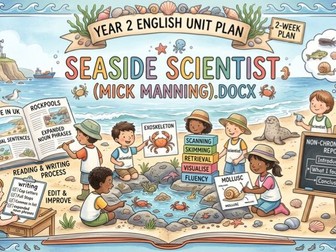
This resource offers a 2-week Year 2 English MTP (Medium Term Plan) based on the text “Seaside Scientist” by Mick Manning. This unit is designed to teach students how to write to inform, specifically focusing on the genre of non-chronological reports. It culminates in two independent writing outcomes: a description of what it is like at the seaside in the UK, and an information text about rockpools. What’s Included? The plan features a variety of engaging activities for reading and writing, with a strong focus on reading fluency, visualizing, and retrieval skills, such as scanning and skimming texts to pick out key words and phrases. Students will have the opportunity to immerse themselves in the topic by analyzing the presentational features of non-chronological reports, watching educational videos about the seaside, and creating a labelled model of a rockpool. To build reading comprehension, pupils will also practice linking the texts they read to other books they have encountered to find common themes. In their writing journey, pupils will practice planning their ideas out loud and learn the crucial difference between writing factual versus fictional sentences. The plan heavily supports foundational Year 2 grammar and spelling, featuring explicit teaching on using expanded noun phrases (ENPs), commas in a list, and distinguishing between statements, questions, commands, and exclamation sentences. Students will also practice organizing information using subheadings, extending ideas with coordinating and subordinating conjunctions, and applying spelling rules for plurals and suffixes like “-ness” and “-ment”. The resource includes a detailed Marking Ladder to assess skills such as using technical vocabulary, proof-reading to make additions and revisions, and maintaining a consistent verb tense. Furthermore, it provides specific topic vocabulary—such as “mollusc,” “surf,” “exoskeleton,” and “beachcombing”—alongside a supplementary reading suggestion for the Bug Club book Rockpools. This plan is a fantastic tool for teachers seeking to develop early report-writing skills and factual communication through an engaging, hands-on science topic.
Year 2 English Unit Plan The Twits (Roald Dahl)Quick View
bcfcj22

Year 2 English Unit Plan The Twits (Roald Dahl)

(0)
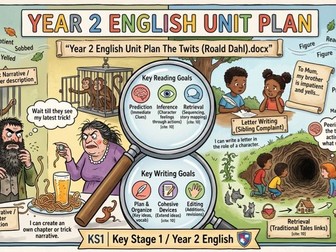
Overview of the Year 2 English Unit Plan This resource outlines a comprehensive 2-week Year 2 English Medium Term Plan designed to teach students how to write to entertain. Although the primary text is listed as The Twits by Roald Dahl, the specific activities heavily feature themes of siblings, traditional tales, and exploring a mysterious tunnel. Unit Outcomes The overall genre focus is on character descriptions and narratives, specifically creating an “own chapter” or trick. The first independent outcome requires students to write a letter in the role of a character complaining about their sibling. Following this, the second independent outcome asks students to write an alternative story ending. Reading and Comprehension Focus During reading sessions, students will focus on fluency by applying phonic knowledge to decode words automatically, recognizing alternative sounds for graphemes, and using prosody to evaluate expression during paired reading. Pupils will also develop their inference skills by identifying how a character’s thoughts and feelings are demonstrated through actions and exploring “show not tell” sentences through drama. To build prediction skills, the unit guides students to use immediate text clues and stem sentences to make plausible predictions, including role-playing what characters might find at the end of a tunnel. Retrieval activities include sequencing events from the story’s ending and recognizing thematic links between the text and a range of traditional tales. Writing and Grammar Focus In their writing journey, students will immerse themselves by hot-seating characters to explore their viewpoints, mapping out ideas for alternative endings, and participating in shared writing exercises, such as drafting a letter to a character’s mum. The grammar component of the unit covers the use of apostrophes for both contraction and possession, as well as distinguishing between statements, questions, commands, and exclamation sentences. Students will also learn to use coordinating and subordinating conjunctions to join ideas and incorporate expanded noun phrases into their writing. The provided marking ladder assesses students on spelling irregular past-tense verbs, using adverbials of time to sequence stories, and re-reading to check for sense and accurate verb tense. Vocabulary and Supplementary Texts To enrich their vocabulary, students will learn words such as “impatient,” “sobbed,” “tumbling,” and “yelled” in the first week, followed by “clearing,” “figure,” “damp,” and “reached” in the second week. To further support the unit, the plan recommends exploring fairy tales like Little Red Riding Hood, Hansel and Gretel, and Jack and the Beanstalk, as well as other narrative books like Gorilla, Zoo, and Into the Woods.
Year 1 English Unit Plan Little Red Riding HoodQuick View
bcfcj22

Year 1 English Unit Plan Little Red Riding Hood

(0)
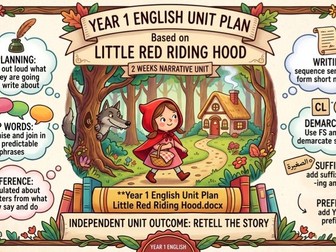
This resource offers a classic 2-week Year 1 English MTP (Medium Term Plan) based on the traditional fairy tale “Little Red Riding Hood”. This narrative unit is designed to entertain students, guiding them to write descriptive sentences matching characters and settings, culminating in an independent retelling of the story. What’s Included? The plan details a variety of engaging activities for reading and writing, with a strong focus on retrieval, making inferences, and recognizing and joining in with predictable phrases (VIP words). Students will have the opportunity to immerse themselves in fairy tales by identifying key characteristics, going on a story hunt to find and sequence hidden parts of the narrative, and using puppets and masks for role-play. In their writing journey, pupils will practice composing sentences orally before writing them down, engaging with adjective games to describe characters, and playing “trash or treasure” linked to proper nouns and capital letters. The plan heavily supports foundational grammar and phonics, featuring activities designed to teach the addition of suffixes like “-er,” “-est,” “-ing,” and “-ed,” as well as the prefix “un-” to root words. Students will also practice extending their ideas using conjunctions like “and,” “but,” or “because,” and correctly demarcating sentences with capital letters, full stops, and question marks. The resource includes a detailed Marking Ladder to assess skills such as using five graphemes to sound out words, correctly applying prefixes and suffixes, and confidently reading their own writing aloud to check that it makes sense. Furthermore, it provides a specific Tier 2 vocabulary list—featuring words like “growled,” “disguised,” “shortcut,” and “leapt”—alongside a curated list of supplementary reading texts such as The Three Little Pigs, Hansel and Gretel, and Honestly, Red Riding Hood was Rotten. This plan is an excellent tool for teachers seeking to develop narrative writing and inference skills through a highly familiar traditional tale.
Year 1 English Unit Plan Julia Donaldson Author StudyQuick View
bcfcj22

Year 1 English Unit Plan Julia Donaldson Author Study

(0)
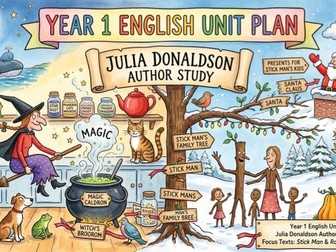
This resource offers an enchanting 4-week Year 1 English MTP (Medium Term Plan) dedicated to the beloved stories of Julia Donaldson, with a special focus on Stick Man and Room on the Broom. Designed to entertain, this comprehensive narrative unit guides students toward multiple exciting independent outcomes: writing a diary entry for Stick Man, creating their own version of the story, and writing a letter to Julia Donaldson. What’s Included? The plan details a variety of engaging activities for reading and writing, with a strong focus on making predictions, asking questions, and retrieving information to clearly explain their understanding of the texts. Students will have the opportunity to immerse themselves in Julia Donaldson’s world by exploring a range of her books, using puppets and masks for role-play, and going on a “story hunt” to find and sequence hidden parts of the narrative. To build inference skills, pupils will read and write thought bubbles, match feeling words to Stick Man at different parts of the story, and match characters with the objects they found in Room on the Broom. In their writing journey, pupils will practice composing sentences orally before writing them down, engage with adjective games to describe characters, and create story maps. The plan heavily supports foundational grammar and phonics, featuring activities designed to teach the addition of suffixes like “-er,” “-est,” “-ing,” and “-ed,” the prefix “un-,” and the correct use of capital letters for proper nouns. Students will also practice extending their ideas by matching chopped-up sentences, focusing on using conjunctions like “and,” “but,” or “because” to link ideas. The resource includes a detailed Marking Ladder to assess skills such as using five graphemes to sound out words, accurately demarcating sentences with capital letters and full stops, and confidently reading their own writing aloud to check that it makes sense. Furthermore, it provides specific vocabulary lists for both Stick Man (featuring words like “frolicking,” “deserted,” and “boomerang”) and Room on the Broom (including “wailed,” “shriek,” and “clambered”). To extend reading for pleasure, the plan also includes a curated list of supplementary texts such as The Gruffalo, Zog, The Highway Rat, and Monkey Puzzle. This plan is a fantastic tool for teachers seeking to develop narrative writing, phonics application, and reading comprehension through the magical worlds of a treasured author.
Year 1 English Unit Plan Blue Penguin (Petr Horacek)Quick View
bcfcj22

Year 1 English Unit Plan Blue Penguin (Petr Horacek)

(0)
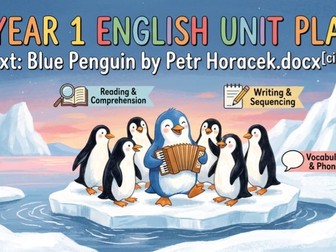
This resource offers a 1-week Year 1 English MTP (Medium Term Plan) based on the narrative text “Blue Penguin” by Petr Horacek. This plan is designed to entertain students, guiding them to write sentences that describe the beginning, middle, and end of a story, culminating in a retell for the Reading Area. What’s Included? The plan features a variety of suggested activities for reading and writing, with a strong focus on inference, learning VIP words, and building background knowledge about the North and South Poles. Explore and Immerse: Students will have the opportunity to explore atlases, make penguins, and read a range of Arctic and Antarctica stories. The immersion phase also suggests sharing books by Judith Kerr, acting out the story through drama, and making story maps to sequence events. Develop Reading Skills: To build reading fluency, pupils will match phonetically decodable words and captions to pictures, and practice prosody aloud as a group. They will also visualize what they are reading by drawing or acting it out. Focus on Grammar & Phonics: Foundational grammar is heavily supported through explicit activities, such as sorting “s” and “es” plural words, playing games linked to “ing” and “ed” endings, and rehearsing the use of capital letters and full stops in simple sentences. Pupils will also practice composing sentences orally before writing them down. The resource includes a detailed Marking Ladder to assess skills such as using four graphemes to sound out words, linking ideas using the word “and,” and correctly applying the suffix “ed” when writing in the past tense. Furthermore, it provides specific Tier 2 vocabulary words—such as “penguin,” “lonely,” “ocean,” and “horizon”—alongside a curated list of supplementary reading texts like Lost and Found and The Emperor’s Egg. This plan is a wonderful tool for teachers seeking to develop early narrative writing and reading comprehension through an engaging polar-themed story.
Year 1 English Unit Plan This Is Not My HatQuick View
bcfcj22

Year 1 English Unit Plan This Is Not My Hat

(0)
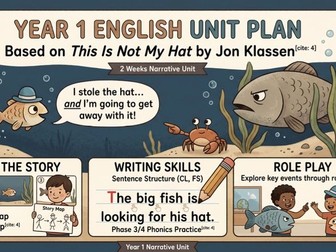
This resource offers a captivating Year 1 English MTP (Medium Term Plan) based on the cleverly illustrated text “This is Not My Hat” by Jon Klassen. This 2-week plan is designed to entertain students and immerse them in narrative writing, culminating in an outcome where they write a first-person retelling of the story’s events. What’s Included? The plan features a variety of suggested activities for reading and writing, with a strong focus on prediction and linking reading to background knowledge, such as exploring sea creatures and discussing how they travel around underwater. Students will have the opportunity to sequence events from the story, match thought bubbles to characters through interactive displays, and practice prosody aloud as a group to build fluency. In their writing journey, pupils will create their own part of the story to describe what happened to the fish, sequence the narrative through story maps and drama, and write thought bubbles for the characters. Foundational grammar and phonics are heavily supported, with explicit activities focusing on writing words with Phase 3 graphemes and Phase 4 blends, forming Set 2 letters correctly, changing sentences into the first person, and linking chopped-up sentences using the word “and” to connect ideas. The resource also includes a detailed Marking Ladder to assess skills such as writing five sentences to retell the story, checking that their writing makes sense through peer assessment, and correctly using capital letters at the start of a sentence. Furthermore, it provides specific Tier 2 vocabulary words (like “worried,” “belong,” and “stole”) alongside a curated list of supplementary reading texts by Jon Klassen. This plan is a fantastic tool for teachers seeking to develop early sequencing skills, first-person writing, and confident sentence construction.
Year 1 English Unit Plan Who Lives Here? Polar Animals (Deborah Hodge)Quick View
bcfcj22

Year 1 English Unit Plan Who Lives Here? Polar Animals (Deborah Hodge)

(0)
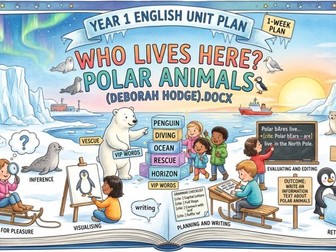
This resource offers a 1-week Year 1 English MTP (Medium Term Plan) based on the text “Who Lives Here? Polar Animals” by Deborah Hodge. This plan is designed to help students write to inform, culminating in the creation of an information text about Polar Animals, alongside sentences to match the main parts of a story for a reading area retell. What’s Included? The plan features a variety of suggested activities for reading and writing, with a strong focus on inference, learning VIP words, and linking reading to background knowledge about the North and South Poles. Students will have the opportunity to explore atlases, make penguins, and practice prosody aloud as a group to build reading fluency. The immersion phase also suggests sharing a range of books by Judith Kerr, making story maps, and acting out stories through drama and role-play. In their writing journey, pupils will sequence events, match phonetically decodable words and captions to pictures, and practice composing a sentence orally before writing it down. Foundational grammar and phonics are heavily supported, with explicit activities focusing on sorting ‘s’ and ‘es’ plural words, playing games linked to ‘ing’ and ‘ed’ endings, and correctly using the suffix ‘ed’ when writing in the past tense. The resource also includes a detailed Marking Ladder to assess skills such as using four graphemes to sound out words, accurately using capital letters and full stops, and linking ideas using the word “and”. Furthermore, it provides specific Tier 2 vocabulary words—such as “penguin,” “ocean,” “horizon,” and “rescue”—alongside a curated list of supplementary reading texts like The Emperor’s Egg and Lost and Found. This plan is a wonderful tool for teachers seeking to develop early information writing and reading comprehension through an engaging, chilly topic.
Year 1 English Unit Plan The Tiger Who Came To Tea (Judith Kerr)Quick View
bcfcj22

Year 1 English Unit Plan The Tiger Who Came To Tea (Judith Kerr)

(0)
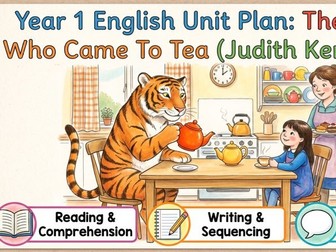
This resource offers a charming 2-week Year 1 English MTP (Medium Term Plan) based on the classic text “The Tiger Who Came to Tea” by Judith Kerr. This narrative unit is designed to entertain students, guiding them to confidently retell the events of the story and write sentences describing its beginning, middle, and end. What’s Included? The plan features a variety of suggested activities for reading and writing, with a strong focus on developing inference, learning VIP words, and linking reading to background knowledge—such as exploring what pupils already know about tigers and looking at non-fiction books about animals. Students will have the opportunity to engage with the story by making shopping lists, creating tigers, and reading a range of Judith Kerr’s books. To build fluency, pupils will practice prosody aloud as a group and match phonetically decodable captions to pictures. In their writing journey, pupils will sequence events from the story, change the character to retell the tale, and ultimately create their own retell for the Reading Area. Foundational grammar and phonics are heavily supported, with activities focusing on sorting and applying ‘ing’ and ‘ed’ suffixes, matching root words with the prefix ‘un’, and linking chopped-up sentences using “and” or “because”. The unit also makes connections to the Science animal topic by discussing how animals behave and what they eat. The resource includes a detailed Marking Ladder to assess foundational writing skills, such as using four graphemes to sound out and write words, consistently checking that writing makes sense, and correctly using capital letters and full stops. Furthermore, it provides specific Tier 2 vocabulary words (like “jungle,” “furry,” “saucepan,” and “supper”) and a list of supplementary reading texts. This plan is a fantastic tool for teachers looking to inspire young writers through a wonderfully nostalgic and imaginative story.
Year 1 English Unit Plan Toby and the Great Fire of London (Margaret Nash)Quick View
bcfcj22

Year 1 English Unit Plan Toby and the Great Fire of London (Margaret Nash)

(0)
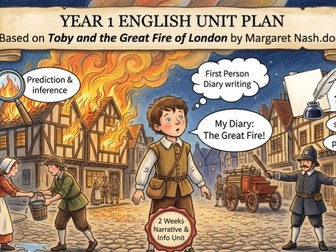
This resource offers a comprehensive 2-week Year 1 English MTP (Medium Term Plan) centered around the historical narrative “Toby and The Great Fire of London” by Margaret Nash. This unit is designed to teach students how to write to inform, culminating in an independent outcome where they write a first-person diary entry from the perspective of the character Toby to describe the Great Fire of London. What’s Included? The plan details a variety of engaging activities for reading and writing, with a strong focus on making predictions, asking questions, and developing inference skills. Students will have the opportunity to immerse themselves in the Great Fire of London by exploring non-fiction texts, engaging in role-play with puppets, reading clues to match characters, and revisiting Samuel Pepys’s famous diary. To build reading comprehension, pupils will participate in freeze frames from the story to write questions and use story maps with missing parts to predict what will happen next. In their writing journey, pupils will practice sequencing events from the story and writing thought bubbles to match characters before tackling their diary entries. The plan heavily supports foundational grammar and phonics, featuring activities designed to teach the use of the suffix ‘ed’ for past tense, the prefix ‘un’, and the correct usage of question marks. Students will also practice extending their ideas by matching chopped-up sentences, focusing on using “and” or “because” as linking words. The resource includes a detailed Marking Ladder to assess skills such as using five graphemes to sound out words, using capital letters for proper nouns, and independently checking that their writing makes sense. Furthermore, it provides a specific Tier 2 vocabulary list—featuring words like “foolish,” “breeze,” “spreading,” “pit,” and “distance”—alongside a curated list of supplementary reading texts such as The Great Fire of London: Samuel’s Story and The Danger Zone - Avoid being in the GFL!. This plan is a fantastic tool for teachers seeking to seamlessly blend history and literacy while developing early diary-writing skills.
Year 1 English Unit Plan There's a Bear on My Chair (Ross Collins)Quick View
bcfcj22

Year 1 English Unit Plan There's a Bear on My Chair (Ross Collins)

(0)
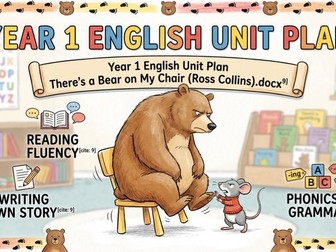
This resource offers a delightful 2-week Year 1 English MTP (Medium Term Plan) centered around the entertaining narrative “There’s a Bear on My Chair” by Ross Collins. This unit is designed to entertain students, culminating in an independent outcome where they write their own version of the story. What’s Included? The plan details a variety of engaging activities for reading and writing, with a strong focus on reading fluency, retrieval, and making inferences based on what characters say and do. Students will have the opportunity to immerse themselves in the story by using puppets and masks, going on a “story hunt” to find and sequence hidden parts of the narrative, and playing phonics games like CEW (Common Exception Word) bingo and TW (Tricky Word) Jenga. In their writing journey, pupils will practice composing sentences orally before writing them down, developing language from character descriptions, and creating story maps. The plan heavily supports foundational grammar and phonics, featuring activities designed to teach the addition of suffixes like “-er,” “-est,” “-ing,” and “-ed” to root words, as well as demarcating sentences correctly with capital letters, full stops, and question marks. Students will also practice extending their ideas by matching chopped-up sentences, focusing on using conjunctions like “and,” “but,” or “because” to link ideas. The resource includes a detailed Marking Ladder to assess skills such as using five graphemes to sound out words, correctly applying suffixes, and confidently reading their own writing aloud to check that it makes sense. Furthermore, it provides a specific Tier 2 and Tier 3 vocabulary list—featuring words like “glare,” “unaware,” “flair,” “despair,” and “lure”—alongside a curated list of supplementary reading texts such as There’s a Mouse in my House and This zoo is not for you. This plan is a fantastic tool for teachers seeking to develop narrative writing and Phase 5 phonics skills through a highly engaging and humorous text.
School Christmas Play The Wonderful Wizard of ChristmasQuick View
bcfcj22

School Christmas Play The Wonderful Wizard of Christmas

(0)
The Wonderful Wizard of Christmas: A Fun-Filled Whole-School Production! Bring a festive twist to a classic tale with “The Wonderful Wizard of Christmas: The Journey to Snowflake City.” This complete Christmas play package is the perfect solution for a memorable Key Stage 2 or whole-school production. Follow Dorothy and her loyal reindeer, Toto, as they are swept away to the magical land of Oz on a quest to get home for Christmas. Along the way, they meet a friendly snowman, a courageous gingerbread man, and a cowardly turkey, learning the true meaning of Christmas through friendship and bravery. Why teachers love this play: Flexible Casting: Easily adaptable for large or small casts with roles for all abilities. Time-Saving: A ready-to-go script with clear staging notes and music suggestions. Engaging and Humorous: Packed with jokes and popular song parodies that will keep both pupils and parents entertained. Heartwarming Message: A powerful story about friendship, giving, and the spirit of Christmas. Save yourself hours of planning and create a magical, stress-free Christmas performance that your school will remember for years to come!
School Christmas Play A Very Villainous ChristmasQuick View
bcfcj22

School Christmas Play A Very Villainous Christmas

(0)
A Very Villainous Christmas: The Funniest School Play You’ll See This Year! What happens when Voldemort, the Grinch, Captain Hook, and Miss Trunchbull team up to ruin Christmas? They discover the true meaning of it, of course! “A Very Villainous Christmas” is a fresh and funny take on the traditional school play, perfect for a Key Stage 2 or whole-school production. In this hilarious tale, the world’s most notorious villains gather at Villain-Con with one goal: to destroy the festive season forever. But as they go about their mischievous missions, they find themselves unexpectedly caught up in the Christmas spirit. This all-in-one resource pack includes: A Complete Script: A brilliant script full of witty dialogue and jokes that will have children and adults laughing out loud. A Large, Flexible Cast: Features a huge cast list of beloved villain characters, with roles for all abilities. Original Plot: A creative and engaging story that delivers a powerful message about kindness and friendship. Popular Songs: Includes a list of well-known festive tunes, making it easy to create a show-stopping performance. Give your pupils a chance to play the characters they love to hate and deliver a Christmas play that is truly unforgettable!
School Christmas Play A Commercial ChristmasQuick View
bcfcj22

School Christmas Play A Commercial Christmas

(0)
A Commercial Christmas: The Hilarious Play that Puts the Christ Back in Christmas! Tired of the same old Nativity story? “A Commercial Christmas” is a hilarious and relevant play that puts a modern spin on the festive season. This satirical comedy follows the biggest names in Christmas advertising (John Lewis, Marks & Spencer, and Coca-Cola) as they race to create the most tear-jerking, profit-driving commercials. But when a group of children put on their school Nativity, they remind everyone that Christmas is about more than just shopping. Perfect for a Key Stage 2 or whole-school production, this play features a large, flexible cast and will have your audience laughing from start to finish. What you’ll get in this all-in-one package: A Complete Script: Full of witty dialogue and jokes that parents and teachers will love. Rewritten Song Lyrics: Included lyrics to popular Christmas and pop songs, perfectly adapted to the play’s theme. Large, Flexible Cast: Accommodates a wide range of students, with speaking and non-speaking roles. Heartwarming Message: A memorable and meaningful conclusion about the true spirit of Christmas. Make this year’s Christmas play a standout performance that everyone will be talking about long after the curtains close!
School Christmas Play The Race for the Christmas Number OneQuick View
bcfcj22

School Christmas Play The Race for the Christmas Number One

(0)
The Race for the Christmas Number 1: A Hilarious and Heartfelt Musical Play This Christmas, the battle for the top of the charts is fiercer than ever! In this witty and musical play, the biggest names in the music industry—from Sir Cliff Richard to Simon Cowell and East 17—are all vying for the coveted Christmas Number 1 spot. But as they chase fame, fortune, and chart success with their festive songs, a group of children remind them what the holiday is truly all about. Perfect for a Key Stage 2, 3 or whole-school production, this play is a hilarious satire on the commercial world of Christmas music. It features a large, flexible cast and a collection of popular songs that have been cleverly rewritten to fit the story. Get ready for a show that’s packed with laughs, great music, and a genuinely heartwarming message.
Year 5 English Unit Plan The Boy in the Tower (Polly Yo-Hen)Quick View
bcfcj22

Year 5 English Unit Plan The Boy in the Tower (Polly Yo-Hen)

(0)
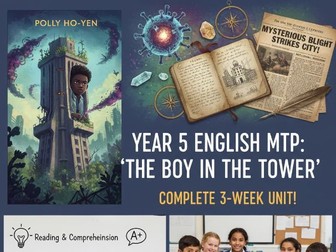
An engaging and comprehensive 3-week Medium Term Plan (MTP) for Year 5 English, centred around the gripping science fiction novel, The Boy in the Tower by Polly Ho-Yen. This MTP is designed to immerse pupils in the text and develop crucial reading, writing, and grammar skills through stimulating activities and clear objectives. The unit culminates in two substantial writing outcomes: a Diary Entry and a Newspaper Report. Key Features Core Text: The Boy in the Tower by Polly Ho-Yen Duration: 3 weeks Writing Outcomes (Genres): Diary Entry and Newspaper Report Learning Objectives Reading & Comprehension Read and discuss a wide range of fiction, including sustaining reading of longer texts. Develop Fluency by practising prosody and accurate word reading. Enhance Prediction skills by using author ‘hints’ (foreshadowing), background knowledge, and comparing predictions to outcomes. Improve Retrieval through scanning, skimming, summarising, and identifying facts/opinions. Writing & Composition Planning: Note and develop initial ideas, and consider how authors develop characters and settings. Writing: Select appropriate grammar and vocabulary. Use devices to build cohesion within paragraphs. Editing: Assess the effectiveness of their own and others’ writing. Ensure consistent and correct use of tense. Proof-read for errors and propose changes to clarify meaning. Grammar Focus on Relative Clauses. Recap and practice using Dashes and Questions. Understanding and using verbs, including auxiliary and modal verbs, and correct subject-verb agreement. Using Command Sentences. Using Apostrophes for Contraction. Exciting Activities Included Immersion: Explore the science fiction genre and the world of The Boy in the Tower. Design and describe their own ‘killer virus’ or problem. Real-World Links: Discuss feelings and thoughts related to being trapped, drawing links to the COVID-19 experience. Role-Play: Hot-seating the character of Ade or a policeman; Role-on-the-wall for Ade’s thoughts and feelings. Modelled Writing: Detailed analysis of exemplary Newspaper Reports (e.g., Barton House) and COVID Diaries to build success criteria and ‘magpie’ language. Assessment: Clear, differentiated success criteria/marking ladders for both the Diary Entry and the Newspaper Report. Download this resource for a high-quality, fully-mapped unit that covers essential Year 5 English standards through an exciting, thought-provoking text!