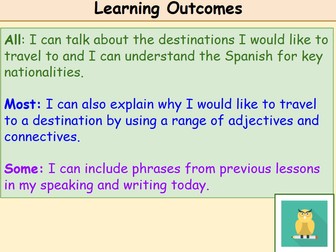
This resource is based on the theme of holidays, with a focus on destinations / countries and nationalities.
The powerpoint begins with a ‘Prepare for Learning’ Task and is followed by differentiated learning outcomes for the students. The activities throughout the lesson may be completed individually, in pairs or in groups.
New vocabulary is presented by match-up tasks. The first is an English/Spanish match-up for the destinations / countries, and the second is a match-up between flags and their nationalities.
There are also sections focused on speaking tasks for the students. The first is a conversation about where they would like to travel to and the second is a speaking drill, focused on the pronunciation of countries and nationalities in Spanish. This is followed by a quiz which tests the students’ knowledge of key flags and their corresponding country / nationality in Spanish.
There are ‘construct’ translation tasks to help further consolidate the learning and these are differentiated.
There is a review wheel included at the end of the powerpoint. There is also a vocabulary grid included for students which they may fill in as they progress through the lesson. A second vocabulary grid has also been included which has been completed.
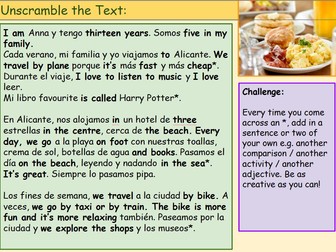
In this lesson, students will learn how to talk about how they travel in Spanish, whether by car, train bus etc. in the context of their holidays. They will also learn how to describe their preferred method of transport by using a variety of adjectives and comparisons in Spanish e.g. The train is less expensive than the plane. The first slide is a ‘prepare for learning’ slide, followed by ‘learning outcomes’, followed by ‘present new information’. The students are presented with the new vocabulary via differentiated readings texts and tasks. There is also a task on the powerpoint which acts a compliment or substitute for the main reading task.
There are two speaking tasks (differentiated) focused on describing and comparing preferred modes of transport. These are followed by two ‘construct / embedding’ tasks which help students to practice utilising the vocabulary they have learnt. There is an accompanying worksheet for one of these tasks. Finally, there is a ‘Learning Review’ slide. The accompanying resources are differentiated and identified as follows: LAT (lower attaining students), MAT (middle attaining students) and HAT (higher attaining students).
This works best as a cover lesson. It is easy for non-specialists to follow but supports and challenges KS3 students of French well. Could also be adapted for use in lessons by specialists.
Lesson involves: Differentiated objectives and starter activity.
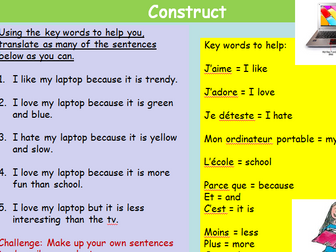
Activity 1: team work to look up adjectives used to describe laptops using dictionaries e.g. practique, lisse etc. (displayed in French on ppt). Higher challenge displayed on slide. Next slide gives answers to students so they can write down the meaning of adjectives they were unable to find.
Activity 2: differentiated translation task using adjectives they have recorded. Key words provided as well as higher challenge. Next slide contains answers for peer / self assessment.
Main activity 3 'apply' task: students design advertisement for best laptop. Key words and higher challenges included.
Pyramid review to finish.
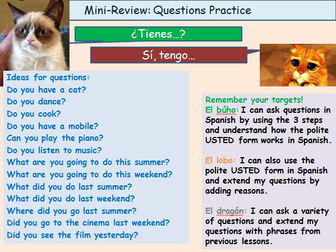
This is for GCSE students and shows them how to form questions in Spanish using three steps, as well as how to form questions using 'usted'.
It is differentiated - I've included a worksheet to support lower ability students with forming questions as well as a key word/verb sheets which students can use for revision / question practice.
My lesson covers:
Intensive revision of forming and using future GOING TO tense in Spanish. Instructions are included on each slide. All activities are differentiated.
Students also revise and practice using vocab from three topics: leisure, environment and holidays.
My lesson includes:
Prepare for learning (two activities: word jumble and time indicators), differentiated objectives.
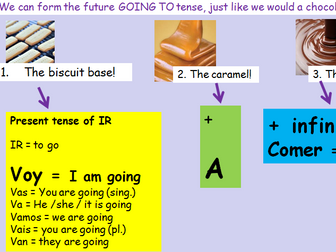
Revision on how to form future GOING TO tense for L.A. students (using TWIX formula) and overview option for all students.
Activity 1: Translation Relay, translations using GOING TO tense based on topic of 'hoildays', OR, translation relay based on topic of 'environment' and use of future GOING TO tense. Instructions are provided.
Activity 2: Reading text, based on topic of 'free time', whereby students have to spot and fix the mistakes. The focus here is on most common mistakes made by GCSE students in writing exam e.g. writing ES SOL instead of HACE sol and of course writing VOY VISITAR instead of VOY A visitar. There is a 'hints' slide provided for students whereby they can study most common mistakes then go back to tackle finding the mistakes again. Answers are provided.
Activity 3: Speaking practice (based on AQA photos speaking question and based on theme of 'holidays' ) in which students have to use future tense. Key vocab is provided for students as is suggestion for how to conduct speaking activity so students practice memorising key vocab and then using it.
Pyramid review at end.
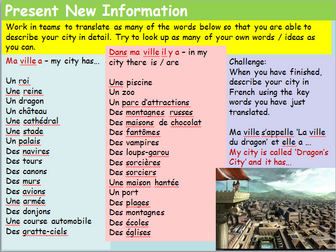
This lesson covers: designing and labeling your own city in French. This is an imaginary city however! Students will learn and use words search as king, queen, city walls, witches, dragons etc. This lesson works really well as a cover lesson. It is easy for non-specialists to follow but supports and challenges KS3 students of French very well. It could also be adapted for use in lessons by specialists in order to introduce / revise places in a town / city. It would be helpful but not necessary if students have learnt the verb ‘avoir’ previously, as well as using adjectives correctly in French.
Lesson involves: Differentiated objectives and starter activity (short translations related to the city).
Activity 1: Students to work in teams looking up what one can find in an imaginary / real city (displayed in French on ppt) in dictionaries, again, differentiated. Next slide gives answers to students so they can write down whatever they were unable to find. Challenges are included on each slide.
Activity 2: Differentiated translation task using key vocabulary they have just looked up in teams. Key words provided as well as higher challenge. Next slide contains answers for peer / self-assessment.
Main activity 3: 'apply' task: students design their own city using key vocabulary they have learnt. Again, this is differentiated by task with key works provided on ppt.
Pyramid review to finish
Lesson covers:
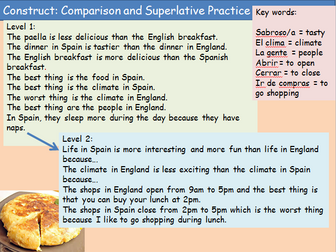
Basics of a typical day in Spain. I created this lesson in place of lesson on Cambian las costumbres in AQA book as I felt that it is more useful for students if they revise and have practice talking about a typical day in Spain using the present tense rather than the preterite, as is the case in the book. So, if a photo / roleplay should come up related to life in Spain, it will be easier for students to use what they have learnt in this lesson.
By the end of this lesson, I want my students to be able to talk about the basics of a typical day in Spain (time Spanish get up, when and a little about what they eat, shops closing at lunch, the siesta etc.) in Spain. It is also good, but not essential, if you have already covered comparisons with your students.
Lesson includes:
Starter based on Tener and Tener que + infinitives.
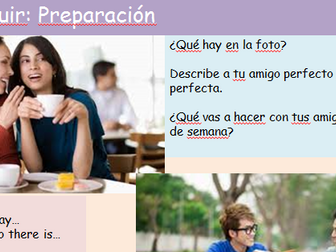
Activity One: Students write what they know about Spain in Spanish using pictures and key words on slide as prompts.
Activity Two: Reading (differentiated resources included with key words / questions in Spanish) about life in Spain.
Activity Three: Students add / improve what they wrote about a day in Spain using what they now have learnt from readings.
Activity Four: Review of comparisons and superlatives as well as practice translating these into English and Spanish.
Final Activity: Speaking practice based on AQA photo style exam. Preparatory slide with some key words students need to describe photo. Then slide with photo and questions as well as option for peer assessment.
Review.
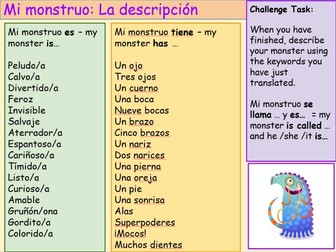
Lesson covers: works best as a cover lesson. It is easy for non-specialists to follow but supports and challenges KS3 students of Spanish well. Could also be adapted for use in lessons by specialists in order to introduce / revise adjectives / body parts. All activities are differentiated.
Lesson involves: Differentiated objectives and starter activity (translations).
Activity 1: Individual / pair / team work to look up adjectives and parts of the body so they can describe / create their monster in final activity. Words are displayed in Spanish and students use dictionaries to translate them. Challenge included on ppt. Next slide gives answers to students so they can write down whatever they were unable to find.
Activity 2: Differentiated translation task using key vocabulary they have just looked up. Key words provided as well as higher challenge. Next slide contains answers for peer / self-assessment.
Main activity 3 ‘apply’ task: students design their own monster. Again, this is differentiated by task with key works provided on ppt.
Student Review to finish.
Lesson covers:
All resources needed for this lesson are included in ppt.
Basics of forming preterite tense as well as most common irregulars.
Practice using the preterite in translations, readings, writings and speakings. All tasks are differentiated for L.A., M.A. and H.A. students.
Lesson includes:
Review of time indicators needed for preterite, review of most common infinitives, review of endings and how to translate preterite sentences using simple and clear 4 step process.
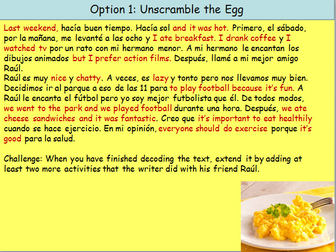
Activity One: Translation relay based on theme of free time - so that students can put their knowledge of preterite into practice (differentiated) with answers provided. Another translation relay is also provided based on topic of IT, testing knowledge of preterite.
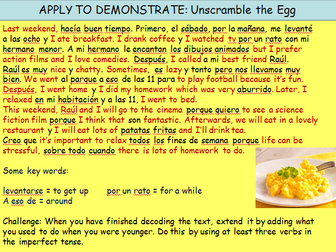
Activity Two: Unscramble the egg translation for L.A. and M.A. students.
Complex, idiomatic expressions for H.A. students followed by text for H.A. students to translate. Answer to translation also provided.
Activity Three: Two speaking options, both based on AQA style photo question in speaking exam. Activity includes vocabulary to help students prepare for photos, as well as photos with sample questions for students to work on.
Review.
This works best as a cover lesson. It is easy for non-specialists to follow but supports and challenges KS3 students of French well. Could also be adapted for use in lessons by specialists.
Lesson involves: Differentiated objectives and starter activity focused on 'translation of key infinitives'. Answers are provided on next slide.
Activity 1: Reading in French based on topic of free time. Students are given questions in English. Key words are provided on ppt, as are higher challenging questions.
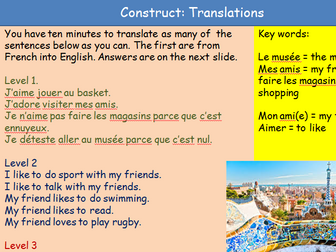
Activity 2: differentiated translation task, again based on free time topic. Students have to translate sentences from French to English e.g. j'aime jouer au basket, and then from English to French. Key words are provided on ppt as are challenges. Answers to all translations are on next slide so students can peer / self assess.
Main activity 3 'apply' task: students to draw and label a poster illustrating what they like to do in their free time. Key words and star phrases are provided to support and challenge.
Bubble snake review at end.
I created these resources for use with my own year 11s coming up to their speaking exams. I wanted to provide them with sample role plays, photos and general conversations so they could physically have the handouts in front of them containing the role play and photo, as well as instructions on the back so they could practice the whole speaking with their partner. The main idea was to facilitate a practice as close to the real thing as possible for my students AND provide them with exemplar answers and key vocab and verbs to help them improve their speaking answers before or after they had practiced with one another.
The handouts include the following:
FOUNDATION STUDENTS: The themes of the photo, role play and general conversation are: Family and relationships (role play) , Technology (Photo) and Where I live (Part 2, general conversation).
HANDOUT 1: Foundation role play and photo for Student A on page 1, with page 2 containing the questions which A will ask their partner B. Clear instructions are there for each part of the speaking exam, together with the unpredicted questions. These will be different from the unpredicted questions which B will have on their handout.
HANDOUT 2: Foundation role play and photo for Student B on page 1, with page 2 containing the questions which B will ask their partner A. Clear instructions are there for each part of the speaking exam, together with the unpredicted questions. These will be different from the unpredicted questions which A will have on their handout.
HANDOUT 3: Sample answers for both A and B foundation students with key vocab provided. In my lessons, I got students to prepare their answers first (gave them 12 minutes) then got them to read through the sample answers and use these to improve their own answers. Then they practiced the speaking with their partners.
HIGHER STUDENTS: The themes are as follows: Future / Marriage (role play) , Technology (Photo) and Where I live (Part 2, general conversation).
HANDOUT 4: Higher role play and photo for Student A on page 1, with page 2 containing the questions which A will ask their partner B. Clear instructions are there for each part of the speaking exam, together with the unpredicted questions. These will be different from the unpredicted questions which B will have on their handout.
HANDOUT 5: Higher role play and photo for Student B on page 1, with page 2 containing the questions which B will ask their partner A. Clear instructions are there for each part of the speaking exam, together with the unpredicted questions. These will be different from the unpredicted questions which A will have on their handout.
HANDOUT 6: Sample answers for both A and B higher students with key vocab provided. You could do as suggested above for foundation students or use it as a reading / translation exercise.
There are two booklets and one power point included. The booklets are based on the theme of technology and include key phrases for use in the writing and speaking exams of the GCSE.
There is a higher and foundation level booklet.
Each contains:
A short 'fix the common mistake' exercise.
Key phrases / vocabulary from technology, for use in writing and speaking (emphasis on complex phrases).
A translation to complete which tests the student's knowledge of key phrases from the booklet. The corresponding translation in English is also included.
A list of sample GCSE speaking questions based on technology.
The power point is a lesson I created to help my students revise for their speaking exam. It includes a review of the gerund, with translation exercises (as they'll need the gerund to describe the photo).
A sample 'photo' exam with sample questions.
A sample 'role play' exam with sample questions.
A list of sample questions based on technology for the 'general conversation' section of the exam, which are the same questions included in both booklets.
This works best as a cover lesson. It is easy for non-specialists to follow but supports and challenges KS3 students of French well. Most effective for students with prior knowledge of connectives and opinions, but these are supplied in ppt. Could also be adapted for use in lessons by specialists.
Lesson involves: Differentiated objectives and starter activity.
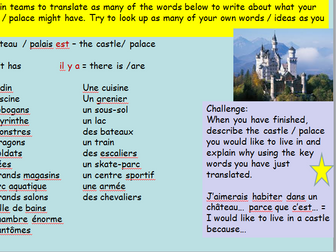
Activity 1: team work to look up words they can use to design / describe a castle (displayed in French on ppt) in dictionaries, again, differentiated. These words include: swimming pool, knights, dragons etc. Next slide gives answers to students so they can write down whatever they were unable to find.
Activity 2: differentiated translation task using castle vocabulary. Key words provided as well as higher challenge. Next slide contains answers for peer / self assessment.
Main activity 3 'apply' task: Differentiated. Students design their own castle or palace. Key words and higher challenges included.
Pyramid review to finish.
These two resources include:
A booklet which includes individual readings describing each of the following festivals in Spain:
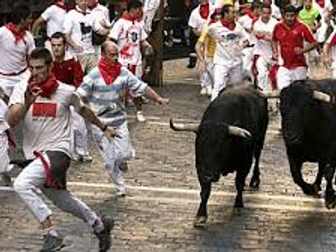
Las torres humanas, el Colacho, Las fiestas de San Fermín, Las fiestas de Moros y Cristianos, Las Fallas, El Día de los Muertos en México, La Tomatina.
Students can work through each text and at the end, there is a summary activity. Here the student completes a grid in Spanish which summarizes the key points of each festival, the aim of which is to help them prepare for their writing and speaking exams. Key words are also provided with each reading to support students.
I have also recently added two other revision resources which I used with my students recently to do further revision on this topic: A vocabulary / translation revision sheet for higher and foundation students. These sheets are focused on some of the key cultural differences between Spain and the UK which the students can use in their speaking / writing exams. They also focus on popular festivals in the UK i.e. Christmas and Glastonbury should students wish to discuss these in their speaking / writing.
I have also included a power point which I have used with my students to practice their speaking on this topic. There is a match-up activity to start - whereby the students match the festival to the region, a photo activity structured on AQA photo exam (this photo is focused on holidays / regions - so it’s best if you’ve covered this already), a role play - AQA exam based (focused on festivals) and a slide with general questions to help students prepare for general conversation based on the topic of festivals / regions.
This is a set of five French cover lessons especially designed for use by non-specialists. Each lesson includes the following:
Differentiated objectives and starter activities.
Activity 1: Students to work in teams looking up key vocabulary in dictionaries, again, differentiated. Next slide gives answers to students so they can write down whatever they were unable to find. Challenges are included on each slide.
Activity 2: Differentiated translation task using key vocabulary they have just looked up in teams. Key words provided as well as higher challenge. Next slide contains answers for peer / self-assessment.
Main activity 3: ‘apply’ task: students design their own city / monster / laptop (whatever lesson is based on) using key vocabulary they have learnt. Again, this is differentiated by task with key works provided on ppt.
Pyramid review to finish
Lesson Covers: How to describe your city (imaginary!) - what's in it and what it has e.g. my city has a king, watchtowers, walls and a dragon.
This works best as a cover lesson. It is easy for non-specialists to follow but supports and challenges KS3 students of Spanish well. Could also be adapted for use in lessons by specialists in order to revise 'what's in one's city / town'. It is helpful, but not necessary, if the students have some knowledge of connectives, adjectives and SER / TENER in Spanish. Important key words are provided in each activity of lesson. Dictionaries needed.
Lesson involves: Differentiated objectives and starter (quick translation) activity.
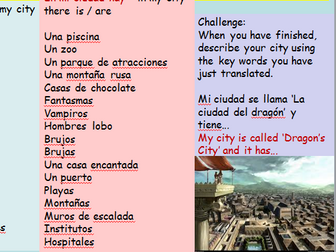
Activity 1: Teams work to look up words (in Spanish) used to describe what's in a city e.g. murallas, atalayas etc. Next slide gives answers to students so they can write down whatever they were unable to find.
Activity 2: Differentiated translation task using key vocabulary they have just looked up in teams. Key words provided as well as higher challenge.
Next slide contains answers for peer / self-assessment.
Main and final activity: students design and label their own city using key words / sentences they have been working on throughout lesson. Again, this is differentiated by task with key works provided on ppt.
Bubble snake review to finish.
Lesson covers: Vocabulary for places in town, how to say there is / are with activities for conversation practice, translation practice, comparisons practice and then a task which enables students to apply what they have learnt to create a dialogue / written piece on their town.
Activities in lesson: Starter activity is a 'word jumble' - students use as many words as they can to make sentences. This enables them to review vocab from previous lessons. The next activity is based on team work and can be done as a competition - first team to look up most of the vocab wins. The extension task: create your own town and write about it. There are vocab grids included to save time / help L.A. students. Next slides focus on pronunciation - places in town are displayed clearly on one slide to facilitate quick pronunciation drill. Then next activity: fun conversation between two cartoon characters about what's in their town with key words / challenges to help students. Student A is cartoon character 1, student B, cartoon character 2. Next activity: comparisons, and final activity, (apply task), option to write dialogue between two cartoon characters or write paragraph. Pyramid review at end.
Challenges / key words / vocab grids are included.
There are two booklets included - one for higher and one for foundation.
There is also a power point included, which can be used in conjunction with the booklets.
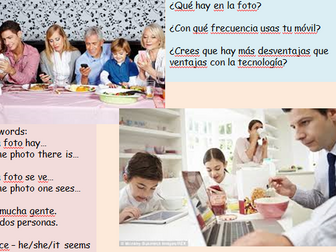
I have used this power point for one lesson (75 minutes) to revise speaking on 'family / friends'. It includes: A review of key questions in Spanish, a sample photo exam question and a sample role play question, which pupils can prepare and then practice together in pairs.
Each booklet includes key phrases based on 'family / friends/ future plans', from theme 1 of new GSCE AQA exam specification.
Each booklet contains:
A short list of common mistakes made by students in writing (based on this topic) which students can discuss and correct themselves.
A list of key phrases which may be used in writing and speaking, and which include complex phrases, based on the topic of family / friends/future plans.
A translation to test students' knowledge of topic with the answer provided.
Sample GCSE speaking questions which teacher and students may use to help them prepare for speaking exam on this topic.
Lesson Covers: For foundation students of Spanish: Revision of present tense, the preterite and future GOING TO tenses. For higher students: Revision of a range of tenses (present, preterite, imperfect, future WILL and conditional WOULD tenses) with complex idiomatic expressions for higher ability students included.
Ideally, this revision session would take place over two lessons.
I have designed this lesson for my year 10 and year 11 students September 2017.
Lesson Includes:
Starter activity - word jumble for students to create own sentences in Spanish.
Differentiated objectives - main purpose - strengthen knowledge of most important verbs and tenses for all GCSE Spanish students.
Activity One: Review of most common infinitives in Spanish - quick translation task.
Activity Two: Review of present tense in Spanish. Students are reminded of what must follow opinions in Spanish as well as other major rules (jugar + A etc.) This is followed by differentiated translation activity for all students with answers provided on next slide.
Carousel Activity - I've provided worksheets here. Class is to be divided into foundation and higher students and worksheets to be given to each. Each worksheet includes a review of how to form a particular tense, with key verbs included e.g. foundation students are provided ONLY with basic verbs / persons they need e.g. fui / fuimos for preterite tense. The worksheets of middle and higher ability students contain all persons of main verbs and are more detailed.
Idea is that each student spends at least 10 - 15 minutes on each worksheet. When they finish or feel confident that they have revised their tense, they move onto next tense. Each worksheet also contains practice exercises for the student. Clear instructions are provided on the ppt. It's important that students are actively learning as they go along - rather than referring to the notes on the worksheet. Clear instructions are provided for students on worksheets too.
Final Task: Students put what they have been learning / working through into practice. This is an 'unscramble the egg' challenge where students have to translate parts of a text in order for it to make sense. This final task is differentiated. I have created separate resources for this task, which are also on the ppt.
Review: Pyramid review.
Lesson covers: It has been designed for use with new higher AQA GCSE Spanish coursebook and is focused on Algunas costumbres regionales chapter of that book.
While my lesson does refer to the reading and listening activities in the book, it does not include these files. However, I've provided alternative readings based on Las fallas, la tomatina and el festival de los patios for higher, middle and lower ability students which you can use instead if you do not have the book.
My lesson includes:
Vocabulary activity related to festivals.
Active learning activity whereby students test each other in pairs following step by step process.
Reading activity (worksheets attached)
Writing activity to review use of verbs, time indicators, opinions etc. based on preterite.
Speaking activity based on festivals.
Review.
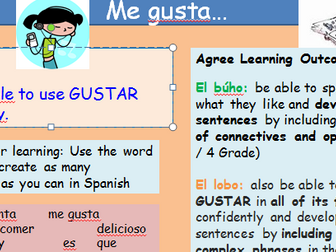
I created this resource to help my GCSE students use Gustar more accurately - I found that many of my students were making mistakes with this verb, especially when talking about what their family and friends like.
It is a whole lesson, which reviews how gustar is conjugated, what happens when you are talking about more than one thing that you like, and finally, how you need 3 parts when using it in your writing / speaking (A part, gusta part and 'the thing you like' part). I've used the Cadbury's crème egg to help students remember the 3 parts :)
Practice translations are included, with the answers, as is a final task, with a support sheet for lower ability students and two complex phrases worksheets, for higher and middle ability students - which they can use in the final activity.


 Quick View