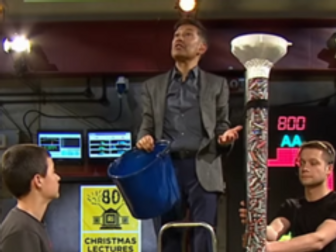
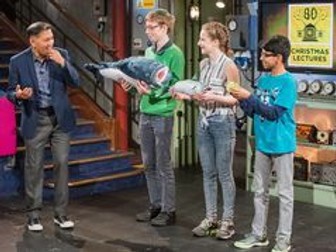
Polar oceanographer and dad of two Mark Brandon does science at home with his daughters. They have fun and investigate physics, engineering and motion by building handmade race cars out of cardboard, straws and a balloon. This experiment you can do at home with your children is great way to get kids thinking like scientists and engineers. Asking questions, modifying your kart designs, and racing against each other makes this a fun and educational activity.
A secondary school resource produced with the support of the Institution of Engineering and Technology to accompany this year's CHRISTMAS LECTURES.
In this activity students get a chance to see the historic demonstration of Alexander Graham Bell’s liquid transmitter and discuss how the setup works, reviewing their knowledge of resistance. Students then get to build a working microphone from pencil leads and consider how to improve their microphone design.
This lesson for students aged 7-11 is about life on extremely long space journeys, and how to provide enough food and water to keep astronauts going. They are based on video clips of the CHRISTMAS LECTURES from the Royal Institution, the UK's iconic science series on TV.
To use the resource, you'll need the PowerPoint presentation to show to your class, alongside the video clips, and the Teachers Guide to help you prepare.
Lesson outline
Step 1: Starter to link to pupil experience
Introduce the topic of extremely long journeys by starting with talking about pupils’ greatest or most extreme experiences.
Step 2: Develop through imagination the concept of ‘space tools’ capable of making food and water
This section is set up as a mystery: what amazing, cutting edge technology could astronauts possibly use to generate their food, oxygen and water on a journey to mars? Encourage pupil’s imagination and then reveal simple ‘space tools’ in the classroom.
Step 3: Main investigation to measure change across a semi-permeable membrane and two solutions of different concentration
Pupils plan, predict and carry out a practical activity to measure and record the changes to a gummy bear (or potato stick).
Step 4: Plenary sets a further amazing possibility
Food, whilst amazing, can possibly be made in space. Water, whilst amazing, can be made safe enough to drink. What about artificial gravity? Leave pupils to wonder: could that be possible too?
Video links
Drinking urine https://youtu.be/qGRYKuVyEGE
Making gravity https://youtu.be/JytmUHNuY48
Objectives
Children will be able to work scientifically by:
- Making systematic and careful observations and, where appropriate, taking accurate measurements using standard units, to make observations over time
Children will learn:
- That animals, including humans, need the right types and amount of nutrition, and that they cannot make their own food; they get nutrition from what they eat
Cross-curricular opportunities:
- Speaking and listening in groups
This resource is part of Tim Peake's Principia mission education programme, supported by the UK Space Agency and ESA.
This lesson for students aged 7-11 is about what it's like to live in space, and what needs to be done to keep people alive in space. They are based on video clips of the CHRISTMAS LECTURES from the Royal Institution, the UK's iconic science series on TV.
To use the resource, you'll need the PowerPoint presentation to show to your class, alongside the video clips, and the Teachers Guide to help you prepare.
Lesson outline
Step 1: Scene setter
A discussion exercise focusing on the human essentials for life, linked to the concept of a vehicle that delivers to the International Space Station (ISS).
Step 2: Explore through mime the effect of weightlessness
Pupils work in teams on developing mimes that explore the effect that microgravity has on everyday activities.
Step 3: Compare and contrast grid
Pupils consider the similarities and differences between emergency health care in 2 distinctly different settings – on Earth and on the ISS.
Step 4: Plenary runner game
A quick-fire true or false game looking at the how healthcare is delivered on the ISS.
Video links
Weightless experiments https://youtu.be/W8XmnWNminY
Astronaut medical kit https://youtu.be/mcqPzBKFNRg
Objectives
Children will be able to work scientifically by:
- Comparing and contrasting two settings and the implications of these differences on humans.
- Children will learn:
The essentials for life and how living on Earth provides for all human needs
- Cross-curricular opportunities:
- Medical emergency response, who, when and how.
This resource is part of Tim Peake's Principia mission education programme, supported by the UK Space Agency and ESA.
In this fun, simple science activity to do at home with children, Sophie Scott and her son investigate static electricity. By rubbing a balloon or straw on a cloth or their clothes, they make balancing pencils, pens, and spoons move without touching them! In these experiments they discover how things with opposite charges attract, and those with the same charge repel. They investigate whether the phenomenon will work with a variety of objects and even a stream of running water, asking questions about the science at play as they go.
A secondary school resource produced with the support of the Institution of Engineering and Technology to accompany this year's CHRISTMAS LECTURES.
In this activity students are introduced to the science behind fibre optic cables. They discuss reflection in glass and water and investigate the critical angle for total internal reflection.
Biology lessons for 11-14 and 14-16 year- olds on the skeleton, physics lessons on structural strength, or chemistry lessons on calcium with short (10-30 minutes), medium (30-60 minutes) and long (60+ minutes) activities. They are based on video clips of the CHRISTMAS LECTURES from the Royal Institution, the UK's iconic science series on TV.
To use the resource, you'll need the Teachers Guide for the length of activity you want, alongside the video clip.
Video link:
Bones in space https://youtu.be/OHDW1B6hQNo
Short activity, view and discuss (10-30 minutes):
View this clip with your class to augment lessons on:
-The human skeleton
-Bone
-Life on board the International Space Station
-Load-bearing structures
-Calcium
A worksheet is available with questions that draw on concepts in the clip. Feel free to distribute this to your class to be filled out after viewing, or simply use it a guide for discussion afterwards.
There is also an information sheet with additional facts, figures, and explanations to help lead the session.
Medium activity: Bone analogs (30-60 minutes)
Tie the clip into a larger lesson on the structure and function of bone. Bone is a living tissue that reforms itself depending on the stresses it is put under. Without the constant force of gravity, bones deteriorate rapidly. Using paper and card, explore the relationship between density and strength and show the surprising strength of structures made from certain shapes.
Long activity: Soft bones (60+ minutes)
Explore calcium, the element that gives bones their strength, by turning chicken bones and eggs rubbery. This activity must take place over the course of at least two days to allow time for the reaction to take place. Consider beginning the activity before a weekend.
These resources can be adapted for any class in KS3 or KS4 and link to working scientifically, biology, physics and chemistry English curriculum objectives.
This resource is part of Tim Peake's Principia mission education programme, supported by the UK Space Agency and ESA.
A secondary school resource produced with the support of the Institution of Engineering and Technology to accompany this year's CHRISTMAS LECTURES.
Conductive dough circuits are an interesting and surprising way to introduce students to circuit building, resistance and conductivity. In this activity students will explore the concept of resistance and how resistance varies for different materials. They will measure voltage and current using an ammeter and voltmeter and use the formula V=IR to calculate resistance. Finally they will investigate how resistance varies with length and width of the conductor.
Build a home-made lava lamp and use a surprising property of citrus fruits to explore the science of floating and sinking
Olympia Brown does science at home with her daughter investigating density.They discover that an orange sinks when it is peeled and try objects from around the home to see if they float or sink. In this fun children's activity, prediction, and asking questions, help to explore the science.
A secondary school resource produced with the support of the Institution of Engineering and Technology to accompany this year's CHRISTMAS LECTURES.
This activity is based on one of the simple tricks or hacks from this year’s Christmas Lectures. It is based upon the historical theatre trick of ‘Pepper’s Ghost’ which uses angles of reflection to make an object appear to float in mid air.
Chemistry lessons for 11-14 and 14-16 year-olds on combustion, carbon chains, or chemical formulae with short (10-30 minutes), medium (30-60 minutes), or long (60+ minutes) activities investigating the properties of RP-1 rocket fuel. They are based on video clips of the CHRISTMAS LECTURES from the Royal Institution, the UK's iconic science series on TV.
To use the resource, you'll need the Teachers Guide for the length of activity you want, alongside the video clip.
Short activity, view and discuss (10-30 minutes):
View this clip with your class to augment lessons on:
- Hydrocarbons
- Combustion and the fire triangle
- Exothermic reactions
- Energy in food
- Boiling point
A worksheet is available with questions that draw on concepts in the clip. Feel free to distribute this to your class to be filled out after viewing, or simply use it a guide for discussion.
There is also an information sheet with additional facts, figures, and explanations to help lead the session.
Medium activity, flashpoint and volatility experiments (30-60 minutes):
Tie the clip into a lesson on the properties of carbon compounds. The reactivity and volatility of carbon compounds depends on their temperature and the length of their carbon chains.
Long activity, distillation lab (60+ minutes):
If there is a full-class chemistry laboratory available, consider exploring how rocket fuel is made with a distillation experiment. This may be done separately or leading on from the flashpoint and volatility experiments above. If linked, consider using a mixture of vegetable oil and the alcohol instead of water and alcohol. The idea of this experiment is to take advantage of the different boiling points of different carbon compounds in order to isolate them.
Video link:
Rocket fuel https://youtu.be/x3F8YxRutn4
English curriculum links can also be downloaded.
This resource is part of Tim Peake's Principia mission education programme, supported by the UK Space Agency and ESA.
A secondary school resource produced with the support of the Institution of Engineering and Technology to accompany this year's CHRISTMAS LECTURES.
3D printing is one of the newest emerging technologies. This technology allows people to easily develop prototypes of their designs and also to personally print 3D objects and machines. In this activity students brainstorm potential uses of 3D printing and debate potential advantages and disadvantages of this technology. This quick starter encourages students to think about the social impacts of emerging technologies.
Biology lessons for 11-14 and 14-16 year olds on DNA damage and repair or physics lessons on the danger of radiation with short (10-30 minutes), medium (30-60 minutes) and long (60+ minutes) activities. They are based on video clips of the CHRISTMAS LECTURES from the Royal Institution, the UK's iconic science series on TV.
To use the resource, you'll need the Teachers Guide for the length of activity you want, alongside the video clip.
Video link
Tardigrades in space: https://youtu.be/4obGAbHIyPU
Short activity: View and discuss (10-30 minutes)
View this clip with your class to augment lessons on:
-Microscopy
-DNA
-Mutation
-Radiation
-Extremophiles
A worksheet is available with questions that draw on concepts in the clip. Feel free to distribute this to your class to be filled out after viewing, or simply use it a guide for discussion afterwards.
There is also an information sheet with additional facts, figures, and explanations to help lead the session.
Medium activity: Chinese whispers (30-60 minutes)
Use the clip as a starting point to discuss the causes and effects of DNA damage. This activity must take place after the class has a solid grounding in DNA as the information-carrying molecule that must be duplicated every time a cell replicates.
With a series of Chinese whispers/broken telephone games, introduce your class to the concept of mutations.
Long activity: Finding tardigrades (60+ minutes)
After watching the clip and learning about the effects of radiation on organisms, go out into the field with your class to find and describe some radiation-resistant tardigrades of your own. This activity requires multiple sessions and a laboratory equipped with microscopes. It will allow students to develop fieldwork and microscopy skills.
English curriculum links can also be downloaded.
This resource is part of Tim Peake's Principia mission education programme, supported by the UK Space Agency and ESA.
Make a really good mixture for blowing soap bubbles, learn why bubbles are always round and find out how to make giant bubbles with a couple of wooden spoons and some string.
Mei and her daughter have played with bubbles before, but in this activity for children they take a few moments to predict what will happen when they change variables during the experiment. The giant bubble wand that Mei makes is easy to make at home.
A secondary school resource produced with the support of the Institution of Engineering and Technology to accompany this year's CHRISTMAS LECTURES.
The ESA ExoMars programme is a topical use of engineering strategies in robotics and mechanical design. Students are presented with an unusual landscape and environment to investigate and are challenged to choose appropriate materials for the specific environment’s conditions.
A primary resource produced by the University of Manchester's Science & Engineering Education Research and Innovation Hub to accompany this year's CHRISTMAS LECTURES.
A revolution is happening. Across the world people are taking control of the devices we use every day, customising them, creating new things and using the sparks of their imagination to change the world. What if we can find new uses for visible light, beyond simply as a means to see in the dark? Can we explore the greater range of uses if light bulbs could be lighter, smaller, coloured and long lasting?
Build a rubber band powered cannon from a crisp tin and a drinks bottle and use it to explore projectile motion and conservation of energy...or just knock down any target you can think of.
In this fun kids activity, Andrea Sella and his children experiment with materials to build the best catapult possible. They then use the slingshot to investigate how things fly through the air. By predicting and altering the variables, Andrea's sons get a feel for the scientific method while doing a great summer activity.
Create a wine glass orchestra in your kitchen and explore how sound is caused by vibrations. Marieke and Tilly experiment with making music and doing science experiments at home. Using wine glasses filled with different volumes of liquids, they investigate how sounds are caused by vibrations and how changing the volume of liquid affects the pitch of the note. Simply rubbing your fingers around the rim of a glass can make an amazing noise. Explore sound, music and science in this fun activity to do with kids.
Lecture 3: Fully charged
Teachers’ notes
Key Stage 2 (7-11 year olds)
Lecture 3 of 3 // Supercharged: Fuelling the future
CHRISTMAS LECTURES 2016
The CHRISTMAS LECTURES at the Royal Institution were started by Michael Faraday in 1825, and are now broadcast on national television every year. They are the UK's flagship science series.
Saiful Islam investigates one of the most important challenges facing humankind – how to generate energy without destroying the planet in the process. A fascinating and stimulating celebration of the stuff that quite literally makes the universe tick, from power for our homes, fuel for our cars and making the most important machine of them all work, the human body.
The Underpinning Big Idea
• Batteries store energy
Children will be able to work scientifically by:
• Gathering, recording, classifying and presenting data in a variety of ways to help in answering questions
Children will learn:
• To associate the brightness of a lamp or the volume of a buzzer with the number and voltage of cells used in the circuit
• To understand the uses and implications of science, today and for the future
Cross-curricular opportunities:
• Numeracy – interpreting graphs
• Literacy- listening attentively to others, seeking clarification and detail.
This lesson for students aged 7-11 is about a rocket launch and the team that it takes to send a rocket to space. They are based on video clips of the CHRISTMAS LECTURES from the Royal Institution, the UK's iconic science TV series.
To use the resource, you'll need the PowerPoint presentation to show to your class, alongside the video clips, and the Teachers Guide to help you prepare.
Lesson outline
Step 1: The lesson starts as a short immersive experience
The classroom tone is set to provoke imaginative consideration of what it might be like to be an astronaut on the launch pad through role play, then hearing from real life astronauts about their experiences of launch.
Step 2: Developing awareness through picture & text matching
Pupils are introduced to the dangers of a launch by matching statements about some of the dangerous aspects of a rocket launch to images of familiar objects and how they might be affected by a rocket launch.
Step 3: The main section of the lesson involves an investigation in role as a safety engineer
Pupils investigate making changes to a simple toy pushchair to improve the safety of the passenger, similar to a rocket engineer thinking of the safety of astronauts during a rocket launch.
Step 4: Lesson plenary takes a fun activity using SPACE as an acronym
Pupils try to think of the roles involved in a space mission by making team badges.
Video links
What's a rocket launch like? https://youtu.be/LU42O8zHkEg
The Sokol Space suit https://youtu.be/5d7huFWyDMU
Objectives
Children will be able to work scientifically by:
- Asking questions and using different types of enquiry
- Setting up simple practical enquiries, comparative and fair tests
Children will learn:
- The interdisciplinary working of scientific teams
Cross-curricular opportunities:
- Development of empathetic responses to the circumstances of others
This resource is part of Tim Peake's Principia mission education programme, supported by the UK Space Agency and ESA.
Lecture 2: People power
Key Stage 2 (7-11 year olds)
Lecture 2 of 3 // Supercharged: Fuelling the future
CHRISTMAS LECTURES 2016
Saiful Islam investigates one of the most important challenges facing humankind – how to generate energy without destroying the planet in the process. A fascinating and stimulating celebration of the stuff that quite literally makes the universe tick, from power for our homes, fuel for our cars and making the most important machine of them all work, the human body.
The CHRISTMAS LECTURES at the Royal Institution were started by Michael Faraday in 1825, and are now broadcast on national television every year. They are the UK's flagship science series.
The underpinning big idea
What is energy and where does it come from, how can we best make use of it, and how can we store energy to use later on?
Children will be able to work scientifically by:
• Asking relevant questions and using different types of scientific enquiries to answer them
• Making systematic and careful observations and, gathering, recording, classifying and presenting data in a variety of ways to help in answering questions
Children will learn to:
• Identify that animals, including humans, need the right types and amount of nutrition, and that they cannot make their own food; they get nutrition (and energy) from what they eat
• Describe how animals obtain their food from plants and other animals, using the idea of a simple food chain, and identify and name different sources of food
Cross-curricular opportunities:
Maths curriculum/measurement
• compare and order mass, volume/capacity
• measure, compare, add and subtract: mass (kg/g); volume/capacity (l/ml)