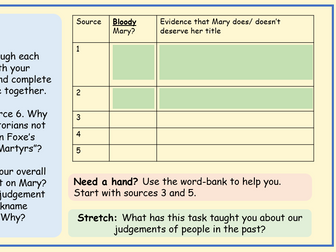
A two lesson series using facts and sources to determine whether ‘Bloody Mary’ was deserving of her nickname. The series ends with an inclass debate, led by the teacher which encourages students to use the facts and sources to support their arguments. Higher order thinking tasks question whether Mary’s gender played a role in the use and continued use of this nickname by historians.
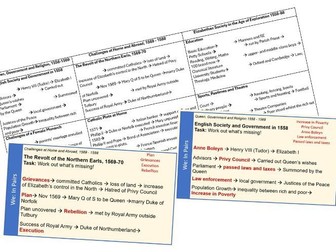
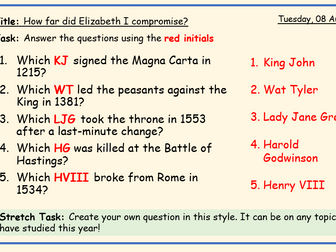
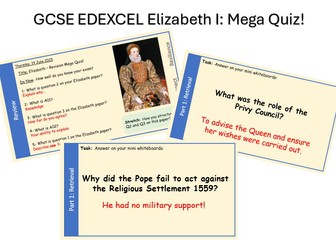
This is a brilliant resource for revision, drop downs or even some end of term fun! The quiz is fully animated with the correct answers appearing on the board. There are 44 questions in total which touch on the powerful knowledge of the spec. The green CGP revision guide accompanies this really nicely, but as mentioned earlier, the questions touch of the key points of knowledge in the exam specification.
TEACHING ADVICE I have used this as a mini whiteboard activity but the powerpoint is very adaptable. Perhaps your class might complete the quiz in teams for a prize? Or perhaps you will cold call for each question! A great way to stretch students is to ask them to provide an additional detail about their answer.
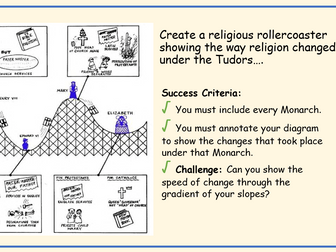
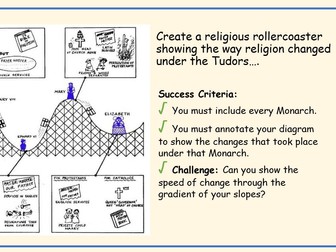
This lesson acts as a summary in a SOL on Religious Changes under the Tudors. It starts with a recap quiz, asking students to identify which monarch implemented each of the religious changes. This is crucial before they complete their religious rollercoaster. There is also an opportunity for modeling in this lesson which may support lower ability students.
This resource is brilliant for anyone running drop down sessions for Y11 in the build up to the final exam. Additionally, it can be used to prepare students for PPEs in Y10 or act as an opportunity to ensure students have understood the chronology of the course.
The powerpoint accompanies the A3 grid, in which students complete the gap fill to be able to leave the session with an overview of the entire course. The lesson has been scaffolded, with words provided on each slide to help students fill the gaps - these could be removed dependent on the ability of the class. At the end of the powepoint is a break down on exam technique - this can be adapted to suit the method taught at your school.
**Advice on teaching: **Give students two minutes to fill their gaps on their first section, cold call for feedback, using the powerpoint to show students the correct answers as you go. Students should correct their work in a different colour which will show them where there revision should focus. Move onto the next section and repeat the process.
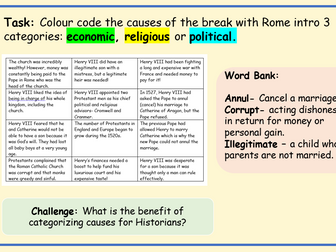
This lesson introduces students to the reasons why Henry VIII broke with Rome. Students categorise the different reasons (economic, political, religious) and decide the most significant cause of the reformation. They also consider the consequences of the break with Rome for different members of society.
A SOL aimed at KS3 that focuses on Religious Change over time during the Tudor Period.
Lessons progress as follows:
What does it mean to believe in something?
Why did Henry VIII break with Rome?
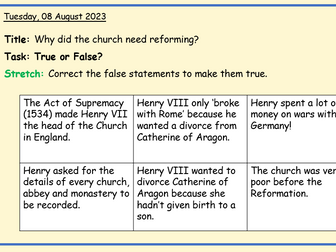
Why did the Church need reforming?
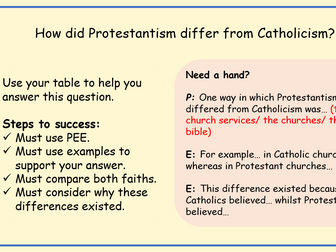
How did Protestant beliefs differ from Catholic beliefs?
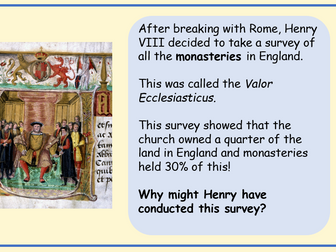
Why did Henry dissolve the monasteries?
To what extent was the Pilgirmage of Grace a threat to Henry VIII?
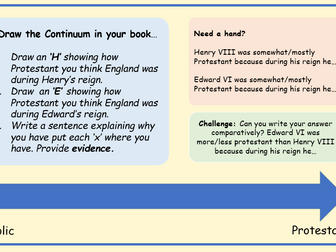
To what extent did England become protestant under Edward VI?
Does Bloody Mary deserve her nickname?
How far did Elizabeth I compromise? (Religious Settlement)
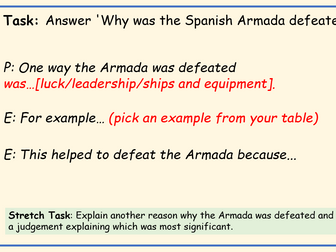
Why did Spain invade England and how was the Armada defeated?
How did religion change under the Tudors?
A two lesson series that starts by considering the reasons for the Spanish invasion. This lesson uses a categorising task and a diamond 9 task to help students asses the most significant reason for the invasion. There is also an opportunity for some independent writing following this. In the second lesson, an around the room task allows students to gather clues to assess how the armada was defeated - a great hit, especially with KS3!
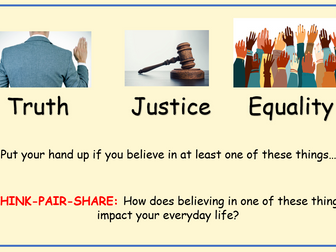
This lesson frames a scheme of learning on religious change in the Tudor period. I created this lesson to help non religious students understand the weight and importance of religion to people in the past. The lesson considers what belief is and where religious ideas come from.
The lesson begins by asking students if they believe that love exists, it then asks them to draw a picture of love privately before sharing it with their table. All student will have drawn a different image - there may some similarities e.g hearts or the colour red. The idea is to explain to students that they have faith that love exists but it is not something they can see or touch,or something that everyone understands in the same way. This shows to them that they have faith, even if they are not religious.
I have found this lesson incredibly useful in getting students to understand the power of belief and religion.
This lesson uses interpretations to allow students to asses how far the Church needed reforming in the 1530s (forming part of a scheme of learning on how far the church changed during the Tudor period). Students work on a learning journal that scaffolds the writing of a PEE based inference. The PowerPoint contains model answers for each interpretation.
The lesson introduces students to Martin Luther and the impact his thesis had on the church in the early 1500s. Students then have the opportunity to read about the different ways protestant and catholic churches functioned in the early modern period before identifying the key differences between the two. Students then have the opportunity to write a PEE paragraph using this learning.
The lesson focuses on the reasons for the dissolution of the monasteries through categorisation. After this, students have the opportunity to create a diamond 9 to illustrate significance, considering the motivations for the dissolution for different people in society. At the end of lesson, students are also able to consider the impact this had on society.
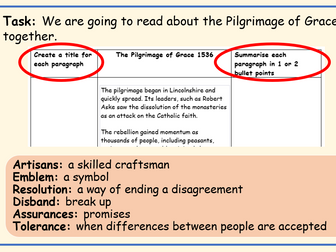
This lesson uses a structured whole class reading task to teach students the story of the pilrgrimage of Grace. Students then use interpretation to assess how much of a threat the rebellion was to Henry VIII. They do this using a scaffolded structure sheet.
Using the King Edward VI and the Pope (1570) painting, students consider the differences between Henry VIII’s changes to the church and that of his son. The notes in the powerpoint provide the teacher with more information about the painting to support their teaching. Students annotate their own copy of the painting with their findings.
This lesson focuses on the religious settlement 1559. The lesson begins with some class reading about the settlement which has been scaffolded to remind students of the difference between catholicism and protestantism. Moving on, there is an opportunity for whole class assessment which focuses on breaking down the settlement. Students need to identify whether each aspect would make Catholics, Protestants or both happy.
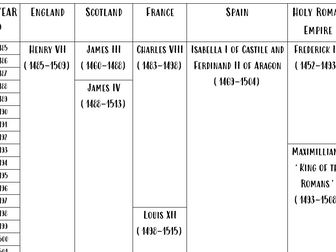
An incredibly useful resource for students of AQA 1C Tudors A level course. This timeline shows who the monarchs were in the main countries discussed by the course from 1485-1603.
Countries and Empires included:
England, France, Spain, Scotland, Holy Roman Empire, Netherlands
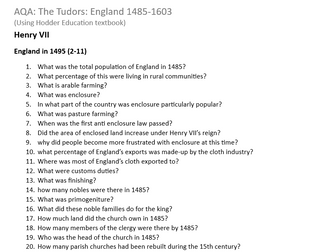
A set of specific questions on Unit 1 Henry VII, taken from the Hodder Education 1C textbook. Each section is titled and linked to the specific pages in the textbook. All answers are provided at the end of the document. There are 8 sub-sections within this set, with between 20-27 questions each.