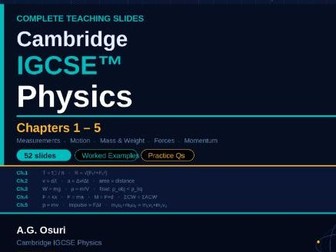
Cambridge IGCSE Physics - Chapters 6–10 Complete Teaching SlidesQuick View
geoffreyosuri

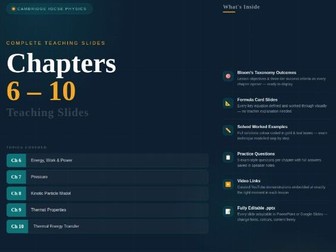
Cambridge IGCSE Physics - Chapters 6–10 Complete Teaching Slides

(0)
Stop building from scratch. Start teaching brilliantly. Classroom-ready slides for Cambridge IGCSE Physics Chapters 6–10 syllabus-aligned, beautifully designed, and packed with everything needed for outstanding lessons. Open the file. Teach. Done. What’s inside: Ch 6 : Energy, Work and Power - Forms of energy · Conservation of energy · W = Fs · KE = ½mv² · GPE = mgh · P = W/t · Efficiency & Sankey diagrams · Renewable vs non-renewable resources Ch 7: Pressure - p = F/A · p = hρg · Pressure in fluids · Hydraulic systems · Atmospheric pressure & manometers Ch 8: Kinetic Particle Model - Solids, liquids & gases · Changes of state · Brownian motion · Diffusion · Particle explanations of pressure & temperature Ch 9: Thermal Properties - Thermal expansion · Specific heat capacity (Q = mcΔθ) · Latent heat (Q = mL) · Heating & cooling curves Ch 10: Thermal Energy Transfer - Conduction · Convection · Radiation · Comparing all three methods · Reducing heat loss: vacuum flasks, double glazing, insulation Every chapter includes: Bloom’s Taxonomy lesson outcome slide - objective + three-tier success criteria, ready to display Formula card slides - every equation defined and worked through visually Fully solved worked examples - question in gold, solution in teal, exam technique modelled 5 exam-style practice questions - answers saved in speaker notes, hidden from students Video links - curated YouTube demonstrations at exactly the right moment Chapter summary - all key formulae in one reference table For teachers: Zero prep. Fully editable. Speaker notes with teaching tips and answers included. Syllabus-matched to Cambridge IGCSE Physics and the Marshall Cavendish Student’s Book. For students: Clear slides, every formula worked through, colour-coded examples, and Bloom’s criteria that tell you exactly what the examiner expects.
Cambridge IGCSE Physics - Chapters 16–22 Complete Teaching SlidesQuick View
geoffreyosuri

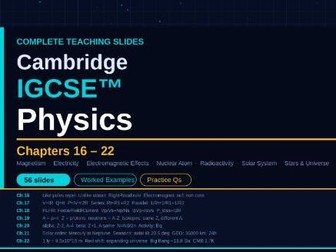
Cambridge IGCSE Physics - Chapters 16–22 Complete Teaching Slides

(0)
This resource is a complete, ready-to-teach PowerPoint presentation covering Chapters 16 to 22 of the Cambridge IGCSE Physics syllabus - the full electricity, magnetism, nuclear physics, and space physics section of the course. With 56 professionally structured slides, this deck picks up seamlessly where the. Every slide is built around a clear lesson outcome and tiered success criteria (Remember / Understand / Apply), supporting differentiation and progress checking throughout.Each chapter includes: A full lesson outcome with tiered success criteria Detailed content slides covering all key definitions, laws, and explanations Worked examples with complete step-by-step solutions and examiner-style commentary Practice questions with full answers embedded in slide notes A formula and concept summary for the chapter Links to embedded video resources for independent revision A comprehensive key formulae reference slide at the end of the deck
Cambridge IGCSE Physics - Chapters 1–5 Complete Teaching SlidesQuick View
geoffreyosuri

Cambridge IGCSE Physics - Chapters 1–5 Complete Teaching Slides

(0)
This resource is a complete, ready-to-teach PowerPoint presentation covering the first five chapters of the Cambridge IGCSE Physics syllabus. With 52 professionally structured slides, this deck is ideal for teachers delivering the course from scratch or looking for a high-quality, comprehensive set of lesson slides to complement their existing materials. Every slide follows a clear lesson outcome and success criteria structure (Remember / Understand / Apply), making it easy to differentiate and check progress during lessons. Each chapter includes: A full lesson outcome and tiered success criteria Detailed content slides with key definitions, formulas, and explanations Worked examples with full step-by-step solutions Practice questions with complete answers (embedded in slide notes) A dedicated formula summary slide Links to embedded video resources for reinforcement A full key formulae reference slide at the end of the deck
Cambridge International A Level Physics – Complete Topics 1–14Quick View
geoffreyosuri

Cambridge International A Level Physics – Complete Topics 1–14

12 Resources
This resource bundle is a comprehensive collection of classroom-ready teaching presentations that fully cover the syllabus. Designed to support both teachers and students, the bundle provides clear explanations, diagrams, worked examples, practical applications, and exam-style questions for every topic. It is ideal for lesson delivery, revision, and independent study. The bundle includes: Motion in a Circle – angular velocity, centripetal force, and applications. Gravitational Fields – Newton’s law, potential, field strength, and orbits. Temperature – thermal equilibrium, specific heat capacity, and latent heat. Thermodynamics – internal energy, first law, and energy transfer. Ideal Gases – gas laws, kinetic theory, and molecular motion. Oscillations – simple harmonic motion, damping, and resonance. Electric Fields – Coulomb’s law, field strength, potential, and uniform fields. Capacitance – energy storage, dielectrics, charging and discharging. Magnetic Fields – flux, force on charges, and electromagnetic induction. Alternating Currents – rms values, power, rectification, and smoothing. Quantum Physics – photons, photoelectric effect, de Broglie wavelength. Nuclear Physics – mass defect, binding energy, radioactivity, fission, fusion. Medical Physics – ultrasound, X-rays, CT scans, PET scans, isotopes. Astronomy and Cosmology – luminosity, Hubble’s law, redshift, Big Bang. This all-in-one resource enables teachers to deliver lessons with confidence and provides students with a structured, exam-focused pathway through the course.
Electricity and DC Circuits: Cambridge International AS Level Physics - Topics 9 & 10Quick View
geoffreyosuri

Electricity and DC Circuits: Cambridge International AS Level Physics - Topics 9 & 10

(0)
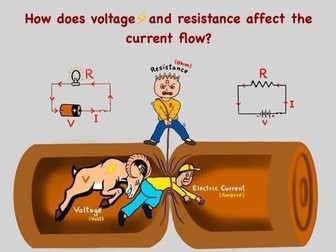
This comprehensive PowerPoint provides a complete suite for teaching core electrical principles, from current and charge to complex circuit analysis using Kirchhoff’s laws. The resource includes detailed lessons on current, charge quantisation, potential difference, power, resistance (Ohmic and non-Ohmic), and resistivity. It features practical guides for investigating IV characteristics and determining EMF/internal resistance. The package thoroughly covers circuit symbols, series and parallel resistor combinations, Kirchhoff’s 1st and 2nd laws, and potential divider circuits, complete with worked examples and practice questions. Perfect for classroom instruction, this PPT saves teachers time with ready-made, curriculum-aligned content. It includes clear diagrams, key definitions, derivations, and problem-solving strategies to effectively prepare students for AS Level exams.
Particle Physics: Cambridge International AS Level Physics - Topic 11Quick View
geoffreyosuri

Particle Physics: Cambridge International AS Level Physics - Topic 11

(0)
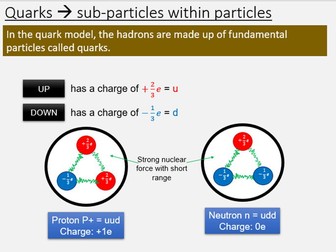
This comprehensive PowerPoint presentation covers Particle & Nuclear Physics for Cambridge International AS & A Level Physics. The resource begins with the Rutherford scattering experiment, detailing the evidence that led to the nuclear atom model and the rejection of the plum pudding model. It thoroughly covers radioactivity, including alpha, beta-minus, and beta-plus decay (with nuclear equations), and analyzes the key difference in the kinetic energy spectra of alpha and beta particles. The module extends into modern physics, explaining the classification of fundamental particles into hadrons (baryons, mesons) and leptons, and introduces the quark model with calculation examples. Perfect for classroom instruction, this PPT saves teachers time with ready-made, curriculum-aligned content. It includes clear diagrams, decay equations, definitions, and thought-provoking questions to effectively prepare students for AS Level exams on this challenging topic.
Dynamics: Cambridge International AS Level Physics - Topic 3Quick View
geoffreyosuri

Dynamics: Cambridge International AS Level Physics - Topic 3

(0)
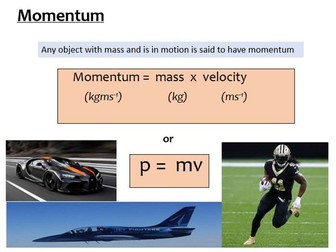
This resource is a complete, classroom-ready PowerPoint designed to help teachers deliver and students master the fundamental principles of forces, motion, and momentum. It builds directly on kinematics and introduces the laws that govern why objects move the way they do. The resource includes: Newton’s Laws of Motion explained with clear examples and applications. Momentum and impulse with worked examples, impact forces, and force–time graphs. Exploration of terminal velocity, drag forces, and air resistance, supported with velocity–time graph analysis. Conservation of momentum in one and two dimensions, with step-by-step problem-solving strategies. Collisions and explosions, distinguishing between elastic and inelastic collisions, with worked examples. 2D collisions and vector resolution for momentum problems, including extension tasks on real-life applications. Safety applications of dynamics, such as car safety features explained through physics principles. Practice questions, extension challenges, and visual diagrams to support deep learning and exam preparation.
Forces, Density and Pressure: Cambridge International AS Level Physics - Topic 4Quick View
geoffreyosuri

Forces, Density and Pressure: Cambridge International AS Level Physics - Topic 4

(0)
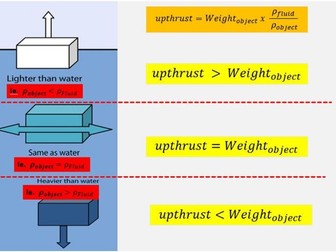
This resource is a complete, teacher-ready PowerPoint designed to explain and apply the principles of forces in equilibrium, moments, density, and pressure. It helps students build strong problem-solving skills and connect theory with practical applications. The resource includes: Centre of gravity and moments explained with diagrams, worked examples, and practical investigations (e.g., finding the centre of gravity of irregular objects). Principle of moments and equilibrium, with calculations for beams, supports, and balanced systems. Torque and couples, explained with real-life contexts such as steering wheels. Step-by-step problem-solving strategies for combining forces, vector resolution, and force diagrams in two dimensions. Worked examples of systems in equilibrium, including bridges and multi-support problems. Introduction to density and pressure (ideal for cross-linking to fluids and mechanics in later topics). Practice questions, extension challenges, and structured activities to reinforce classroom learning.
Energy, Work and Power: Cambridge International AS Level Physics - Topic 5Quick View
geoffreyosuri

Energy, Work and Power: Cambridge International AS Level Physics - Topic 5

(0)
This resource is a complete teaching and learning presentation that introduces the fundamental principles of work, energy transfer, and power. It provides structured explanations, worked examples, and practice questions to help students build both conceptual understanding and problem-solving skills. The resource includes: Work done by forces (against friction, gravity, and at angles), with force–distance graphs. Energy transfers between different forms: kinetic, potential, thermal, chemical, sound, and electrical. Efficiency calculations with real-life applications and exam-style problems. Power as the rate of work done or energy transferred, linked to practical contexts. Detailed coverage of kinetic energy (KE) and gravitational potential energy (GPE) with derivations and problem-solving examples. Conservation of energy explained through worked examples, questions, and exam-style tasks.
Deformation of Solids: Cambridge AS Level Physics - Topic 6Quick View
geoffreyosuri

Deformation of Solids: Cambridge AS Level Physics - Topic 6

(0)
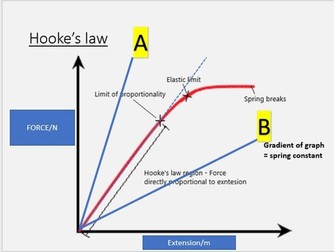
This comprehensive PowerPoint presentation covers provides a complete guide to deformation of materials, Hooke’s Law, Young’s Modulus, and elastic potential energy. The resource includes clear explanations of key concepts: elastic and plastic deformation, the spring constant, the force-extension graph, and calculating strain energy. It features detailed slides on the practical determination of Young’s Modulus and compares stress-strain graphs for different materials. Perfect for classroom instruction, this PPT saves teachers time with ready-made, curriculum-aligned content featuring clear diagrams, definitions, and formulas to effectively teach A-Level Physics.
Waves and Superposition: Cambridge International AS Level Physics - Topics 7 & 8Quick View
geoffreyosuri

Waves and Superposition: Cambridge International AS Level Physics - Topics 7 & 8

(0)
This comprehensive PowerPoint presentation is a complete teaching suite for progressive waves, electromagnetic waves, superposition, stationary waves, diffraction, and interference. The resource includes detailed lessons on wave properties (frequency, period, wavelength, phase difference, intensity), wave types (transverse, longitudinal), and the Doppler effect. It features in-depth explanations and visual aids for core principles like polarisation (Malus’ Law), stationary wave formation in strings and air columns, and interference patterns from Young’s double-slit experiment and diffraction gratings (including worked examples). Perfect for classroom instruction, this PPT saves teachers time with ready-made, curriculum-aligned content. It includes clear diagrams, definitions, key equations (like v = fλ and nλ = d sinθ), practical applications (CRO use, microwave experiments), and textbook questions to effectively prepare students for AS Level exams.
Magnetic Fields and Alternating Currents: Cambridge International A Level Physics - Topics 9 & 10Quick View
geoffreyosuri

Magnetic Fields and Alternating Currents: Cambridge International A Level Physics - Topics 9 & 10

(0)
This resource is a complete teaching presentation that covers the theory, applications, and problem-solving practice needed to master these two core topics. It provides clear explanations, worked examples, diagrams, experiments, and exam-style questions for effective teaching and learning. The resource includes: Magnetic Fields – field patterns, laws of magnetism, electromagnets, right-hand and left-hand rules, and the motor effect. Magnetic Flux and Flux Density – definition, measurement, and the Hall effect. Force on moving charges and current-carrying conductors – applications such as particle deflection. Electromagnetic Induction – Faraday’s law, Lenz’s law, flux linkage, induced emf, and everyday examples. Alternating Current (AC) – time period, frequency, sine wave representation, rms values of current and voltage. Power in AC circuits – calculations using rms values. Rectification and Smoothing – half-wave and full-wave rectification, bridge rectifiers, and smoothing for DC output. Practice and exam-style questions to consolidate learning. This resource can be used by teachers as a lesson presentation, revision guide, or assessment tool, and by students for independent study and exam preparation.
Cambridge International AS & A Level PhysicsQuick View
geoffreyosuri

Cambridge International AS & A Level Physics

9 Resources
This Cambridge International AS Level Physics Complete Bundle (Topics 1–11) is a comprehensive set of classroom-ready PowerPoints designed to fully cover the syllabus with clear explanations, worked examples, practice problems, and visual aids. Perfect for teachers and students, this bundle provides structured content for lessons, revision, and exam preparation. The bundle includes all 11 core topics: Physical quantities and units – SI units, measurement techniques, uncertainties. Kinematics – motion graphs, equations of motion, projectiles. Dynamics – Newton’s laws, momentum, impulse, collisions. Forces, density and pressure – equilibrium, moments, torque, density and pressure. Work, energy and power – conservation of energy, efficiency, KE, GPE, power calculations. Deformation of solids – stress, strain, Young modulus, Hooke’s law. Waves – wave properties, reflection, refraction, diffraction. Superposition – interference, standing waves, diffraction patterns. Electricity – current, resistance, resistivity, electrical energy and power. D.C. circuits – Kirchhoff’s laws, potential dividers, practical applications. Particle physics – atomic models, fundamental particles, interactions. Each presentation is designed for effective teaching, revision, and independent learning, with theory, worked examples, and exam-style questions to strengthen understanding.
Kinematics: Cambridge International AS Level Physics - Topic 2Quick View
geoffreyosuri

Kinematics: Cambridge International AS Level Physics - Topic 2

(0)
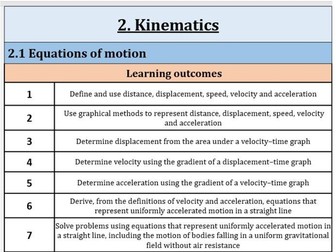
This Cambridge International AS Level Physics – Topic 2: Kinematics resource is a comprehensive, classroom-ready PowerPoint designed to support teachers and students in mastering the key concepts of motion. The resource covers displacement, velocity, acceleration, motion graphs, equations of motion (SUVAT), experimental methods for measuring acceleration due to gravity, and projectile motion. Inside, you will find: Step-by-step explanations of distance–time, displacement–time, velocity–time, and acceleration–time graphs, with worked examples and graphing tasks. A detailed derivation of the kinematic equations (SUVAT) with clear links between graphs and equations. Problem-solving strategies showing how to apply SUVAT equations systematically. Worked examples and practice problems on straight-line motion and uniformly accelerated motion. Practical guidance on measuring gravitational acceleration (g) using timing methods. In-depth exploration of projectile motion, including vertical and horizontal components, vector resolution, and real-life application questions. Scaffolded class activities and extension tasks for stretch and challenge.
Unit 2: Creating Systems to Manage InformationQuick View
geoffreyosuri

Unit 2: Creating Systems to Manage Information

(0)
This comprehensive resource bundle is designed to support the teaching and delivery of Pearson BTEC IT Level 3 unit 2. It includes everything you need to run engaging lessons, guide learners through assessments, and ensure clear, consistent marking. Ideal for new teachers, experienced practitioners, and departments looking for ready-to-use materials. What’s Included ✔ Full Teaching PowerPoint A complete lesson PPT that introduces key concepts, explains required content, and provides examples and visuals that support a wide range of learners. Editable so you can tailor it to your scheme of work. ✔ Official-style Assignment Brief A fully structured assignment brief aligned with Pearson’s expectations, including scenario, tasks, evidence requirements, and clear learner guidance. ✔ CSV Data Files A set of ready-made CSV files to support practical tasks, data handling activities, and assessment work. Perfect for spreadsheet, database, or data analysis units. ✔ Starter Quiz A quick, engaging starter quiz that reinforces prior knowledge and helps students settle, recap, and prepare for the main lesson content. ✔ Task Submission Requirements and Outline A clear, student-friendly document explaining the expected evidence format, submission requirements, and task-by-task breakdown. Helps learners stay on track and reduces repetitive questions. ✔ Marking Rubric A detailed rubric mapped to Pass, Merit, and Distinction criteria to support transparent, consistent grading. Also helps learners understand how to achieve higher grades.
Motion in a Circle: Cambridge International A Level Physics - Topic 1Quick View
geoffreyosuri

Motion in a Circle: Cambridge International A Level Physics - Topic 1

(0)
This resource is a complete teaching presentation designed to explain the principles of uniform circular motion, centripetal force, and angular quantities. It provides clear theory, worked examples, and practice questions to support both teaching and learning. The resource includes: Uniform circular motion explained with real-life examples (wheels, satellites, fairground rides). Angular displacement and angular velocity, including radians and conversions from degrees. Relationship between linear and angular velocity with worked examples. Centripetal acceleration and centripetal force, explained using Newton’s laws and vector diagrams. Application questions such as planets in orbit, cars turning, washing machines, and banked turns for airplanes. Worked examples, extension tasks, and exam-style practice questions to consolidate learning. This presentation can be used as a lesson resource, revision guide, or independent study tool for Cambridge International A Level Physics students.
Nuclear Physics: Cambridge International A Level Physics - Topic 12Quick View
geoffreyosuri

Nuclear Physics: Cambridge International A Level Physics - Topic 12

(0)
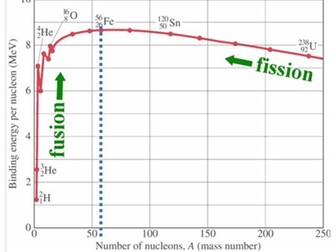
This resource is a complete teaching presentation that explores the structure, stability, and transformations of atomic nuclei. It provides clear explanations, worked examples, graphs, and exam-style questions to help students master this core topic. The resource includes: Atomic structure and particles in nuclear reactions, including balanced nuclear equations. Mass defect and binding energy – definitions, calculations, and their link to nuclear stability. Energy–mass equivalence (E = mc²) – applications with electron volts (eV) and mega-electron volts (MeV). Binding energy per nucleon – graphs, trends, and nuclear stability, with examples of iron and uranium. Nuclear fusion and fission – processes, worked examples, and energy release explanations. Radioactivity – types of decay (α, β, γ), nuclear transmutation, and practical applications. Decay constant, activity, and half-life – equations, exponential decay, and example problems. Detection of radiation – using Geiger–Müller tubes and activity measurements. Worked examples, quizzes, and exam-style practice questions to reinforce understanding. This resource can be used by teachers as a lesson presentation, problem-solving toolkit, or revision guide, and by students for self-study and exam preparation.
Medical Physics: Cambridge International A Level Physics - Topic 13Quick View
geoffreyosuri

Medical Physics: Cambridge International A Level Physics - Topic 13

(0)
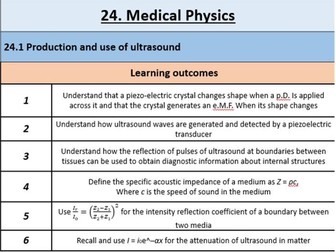
This Cambridge International A Level Physics – Topic 13: Medical Physics resource is a detailed teaching presentation that applies physics principles to medical imaging and diagnosis. It combines clear explanations, worked examples, diagrams, and exam-style questions to help students understand the science behind modern medical technologies. The resource includes: Ultrasound scanning – piezoelectric effect, acoustic impedance, reflection, attenuation, A-scans, B-scans, and medical applications. Use of coupling gel – impedance matching for accurate imaging. X-rays – production, attenuation, half-thickness, contrast, image quality, and the use of contrast media such as iodine and barium. CT (Computerised Axial Tomography) scans – principles, 2D and 3D imaging, advantages, disadvantages, and medical uses. PET (Positron Emission Tomography) scans – principles of β⁺ emission, annihilation, detection of gamma photons, scintillation crystals, and photomultipliers. Radioisotope production and applications in diagnosis and treatment. Worked examples, textbook references, and exam-style practice questions to consolidate understanding. This resource can be used by teachers as a lesson presentation, revision tool, or problem-solving aid, while students can use it for independent study and exam preparation.
Quantum Physics: Cambridge International A Level Physics - Topic 11Quick View
geoffreyosuri

Quantum Physics: Cambridge International A Level Physics - Topic 11

(0)
This resource is a comprehensive teaching presentation that introduces the fundamental concepts of quantum theory, bridging the gap between classical and modern physics. It provides clear explanations, diagrams, worked examples, and practice questions to support both teaching and independent learning. The resource includes: Wave–particle duality of light – photons, Planck’s hypothesis, and Einstein’s extension. Photon energy (E = hf) and calculations using electron volts (eV). Momentum of photons – radiation pressure and worked examples. The Photoelectric Effect – threshold frequency, work function, Einstein’s photoelectric equation, and experimental evidence. Problems with the classical wave model of light vs. the photon model. Wave–particle duality of electrons – de Broglie wavelength, electron diffraction, and supporting experiments. Line spectra – emission and absorption spectra, applications in astrophysics. Atomic structure and energy levels – excitation, de-excitation, photon emission, and absorption. Worked examples, quizzes, and problem-solving exercises to reinforce learning. This resource is ideal for teachers as a lesson presentation, revision guide, or assessment aid, and for students as a self-study tool to master quantum concepts and prepare for exams.
Gravitational Fields: Cambridge International A Level Physics -  Topic 2Quick View
geoffreyosuri

Gravitational Fields: Cambridge International A Level Physics - Topic 2

(0)
This resource is a comprehensive teaching presentation that introduces students to the fundamental principles of gravity, field strength, and potential. It explains concepts clearly with diagrams, worked examples, and practice questions, making it an ideal tool for both classroom delivery and independent study. The resource includes: Gravitational fields: definition, radial and uniform fields, and field line diagrams. Newton’s law of gravitation: force between masses, proportionality, and universal gravitational constant. Worked examples: calculating gravitational attraction between objects from small particles to planets. Gravity and orbits: satellites, centripetal force, geostationary orbits, and orbital motion calculations. Gravitational field strength: variation with distance, near-Earth uniform fields, and planetary differences. Gravitational potential and gravitational potential energy, including negative potential and escape velocity. Exam-style questions, extension problems, and textbook references for practice and consolidation. This resource can be used by teachers as a lesson presentation, revision guide, or problem-solving toolkit, while students can use it for exam preparation and self-study.
Temperature and Thermodynamics: Cambridge International A Level Physics - Topics 3 & 4Quick View
geoffreyosuri

Temperature and Thermodynamics: Cambridge International A Level Physics - Topics 3 & 4

(0)
This resource is a complete teaching presentation designed to introduce and explain the principles of thermal physics, internal energy, and the laws of thermodynamics. It blends theory, worked examples, experiments, and practice questions to support both teaching and independent study. The resource includes: Thermal energy and thermal equilibrium: heat transfer, molecular collisions, and energy flow between systems. Temperature scales and absolute zero: Kelvin scale, thermometric properties, thermocouples, and thermistors. Specific heat capacity: definitions, experiments, worked calculations, and results analysis. Latent heat and phase changes: energy required for fusion and vaporization, particle explanations, and practical investigations. Internal energy: kinetic and potential contributions, molecular interpretation, and energy changes in heating and compression. First Law of Thermodynamics: statement, applications, and exam-style calculation questions. Worked examples, practical activities, and extension problems to strengthen conceptual understanding and exam readiness. This resource can be used by teachers as a lesson presentation, problem-solving toolkit, or revision guide, while students can benefit from it as a structured self-study aid.