pptx, 1.2 MB
pptx, 1.2 MB

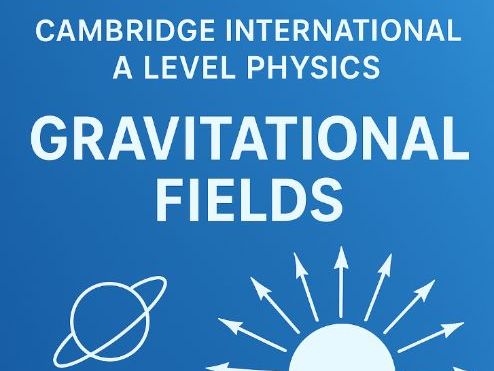
This resource is a comprehensive teaching presentation that introduces students to the fundamental principles of gravity, field strength, and potential. It explains concepts clearly with diagrams, worked examples, and practice questions, making it an ideal tool for both classroom delivery and independent study.

The resource includes:

  • Gravitational fields: definition, radial and uniform fields, and field line diagrams.
  • Newton’s law of gravitation: force between masses, proportionality, and universal gravitational constant.
  • Worked examples: calculating gravitational attraction between objects from small particles to planets.
  • Gravity and orbits: satellites, centripetal force, geostationary orbits, and orbital motion calculations.
  • Gravitational field strength: variation with distance, near-Earth uniform fields, and planetary differences.
  • Gravitational potential and gravitational potential energy, including negative potential and escape velocity.
  • Exam-style questions, extension problems, and textbook references for practice and consolidation.

This resource can be used by teachers as a lesson presentation, revision guide, or problem-solving toolkit, while students can use it for exam preparation and self-study.

Get this resource as part of a bundle and save up to 29%

A bundle is a package of resources grouped together to teach a particular topic, or a series of lessons, in one place.

Bundle

Cambridge International A Level Physics – Complete Topics 1–14

This resource bundle is a comprehensive collection of classroom-ready teaching presentations that fully cover the syllabus. Designed to support both teachers and students, the bundle provides clear explanations, diagrams, worked examples, practical applications, and exam-style questions for every topic. It is ideal for lesson delivery, revision, and independent study. The bundle includes: 1. Motion in a Circle – angular velocity, centripetal force, and applications. 2. Gravitational Fields – Newton’s law, potential, field strength, and orbits. 3. Temperature – thermal equilibrium, specific heat capacity, and latent heat. 4. Thermodynamics – internal energy, first law, and energy transfer. 5. Ideal Gases – gas laws, kinetic theory, and molecular motion. 6. Oscillations – simple harmonic motion, damping, and resonance. 7. Electric Fields – Coulomb’s law, field strength, potential, and uniform fields. 8. Capacitance – energy storage, dielectrics, charging and discharging. 9. Magnetic Fields – flux, force on charges, and electromagnetic induction. 10. Alternating Currents – rms values, power, rectification, and smoothing. 11. Quantum Physics – photons, photoelectric effect, de Broglie wavelength. 12. Nuclear Physics – mass defect, binding energy, radioactivity, fission, fusion. 13. Medical Physics – ultrasound, X-rays, CT scans, PET scans, isotopes. 14. Astronomy and Cosmology – luminosity, Hubble’s law, redshift, Big Bang. This all-in-one resource enables teachers to deliver lessons with confidence and provides students with a structured, exam-focused pathway through the course.

£21.00

Reviews

Something went wrong, please try again later.

This resource hasn't been reviewed yet

To ensure quality for our reviews, only customers who have purchased this resource can review it

Report this resourceto let us know if it violates our terms and conditions.
Our customer service team will review your report and will be in touch.