Exploring Break-Even Analysis – WorksheetQuick View
samueldarko

Exploring Break-Even Analysis – Worksheet

(0)
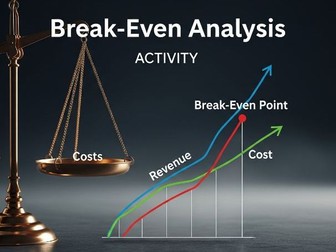
This resource is a comprehensive worksheet designed to help students understand and apply the concept of break-even analysis in business and economics. Through structured activities, calculations, and discussion questions, students develop both conceptual understanding and practical analytical skills. The resource begins with key definitions such as fixed costs, variable costs, contribution, sales revenue, and margin of safety. Students then progress through guided sections that explore contribution calculations, break-even formulas, and cost–revenue relationships. Learners complete a cost and revenue table activity, calculate contribution, break-even output, and target profit, and apply formulas to realistic business scenarios. The worksheet also includes a graphing activity where students draw and interpret a break-even chart, identifying profit, loss, and margin of safety areas. In the final sections, students analyze how changes in price, variable costs, and fixed costs affect profitability, and evaluate the limitations of break-even analysis in real business contexts. The task concludes with a challenge activity where students apply all concepts to a custom T-shirt business scenario, calculating contribution, break-even output, target profit, and creating a break-even chart. Ideal for: IGCSE Business Studies IB Business Management (introductory cost and revenue analysis) BTEC Business / Entrepreneurship High school economics or business courses Skills developed: Break-even and contribution calculations Data interpretation and financial analysis Graph construction and interpretation Business decision-making and evaluation Format: Printable worksheet / classroom activity (6 pages) Level: Upper secondary (ages 14–18)
Industrial / Employee Relations – IB Business Management HLQuick View
samueldarko

Industrial / Employee Relations – IB Business Management HL

(0)
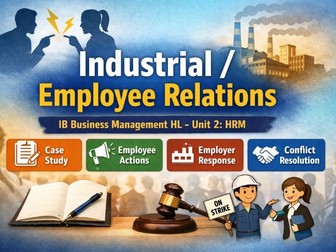
This resource supports IB Business Management HL – Unit 2: HRM, Industrial / Employee Relations. It includes: A structured independent investigation where students research a real workplace conflict A peer teaching activity to present findings Guidance for final output in PPT or Word (DOCX) A glossary of key terms in clear, simple language, useful for all learners including SEND Students will: Identify sources of workplace conflict Analyse employee and employer actions Explore conflict resolution methods Evaluate outcomes and justify decisions This resource is easy to use and adaptable, helping teachers guide students through HL-level content with clarity and structure.
IB_Motivation Theories in HRM: Taylor, Maslow & HerzbergQuick View
samueldarko

IB_Motivation Theories in HRM: Taylor, Maslow & Herzberg

(0)
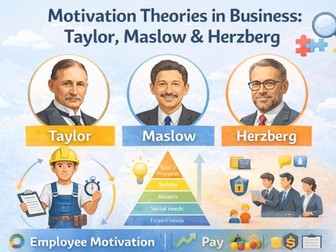
This resource explores key motivation theories within Human Resource Management, including Frederick Taylor – Scientific Management, Abraham Maslow – Hierarchy of Needs, and Frederick Herzberg – Motivation–Hygiene Theory. The lesson materials include clear explanations in student-friendly language, structured activities, real-world business scenarios, analytical discussion questions, reflection tasks, and engaging visual infographics to support understanding. Activities are scaffolded to move learners from knowledge and understanding to application, analysis, and evaluation. Suitable for BTEC Level 3 Business, IGCSE Business Studies, and other vocational or academic business courses, this resource supports learners in connecting theory to real business practice while developing critical thinking skills around employee motivation and business performance. Ideal for classroom teaching, revision, homework, or flipped learning.
Unit 3_Budgeting and Variance Analysis Worksheet – IB Business Management / IGCSE (SEND-Friendly)Quick View
samueldarko

Unit 3_Budgeting and Variance Analysis Worksheet – IB Business Management / IGCSE (SEND-Friendly)

(0)
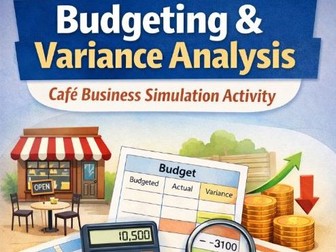
This engaging and structured worksheet helps students develop a clear understanding of budgeting, cost centres and profit centres, and variance analysis within a realistic café business scenario. Designed with SEND learners in mind, the resource includes: • Simple, clear instructions • Key word definitions • Step-by-step calculation guidance • Scaffolded budget template • Variance analysis table with structured support • Creative thinking prompts for business decision-making Students will: ✔ Identify cost and profit centres in a hotel ✔ Construct a monthly budget ✔ Calculate revenue, costs, and profit ✔ Analyse variances as favourable or adverse ✔ Suggest realistic business actions Ideal for IB Business Management, IGCSE Business Studies, BTEC, or KS4/KS5 learners. This resource supports numeracy skills, financial literacy, and applied business thinking in an accessible and student-friendly format. Perfect for lesson activities, homework, revision, or cover work.
Human Resources: Leadership Styles Classroom ActivityQuick View
samueldarko

Human Resources: Leadership Styles Classroom Activity

(0)
This Human Resource Management: Leadership Styles classroom activity is designed for the IB Business Management syllabus and supports learners in understanding and applying key leadership styles and their impact on motivation and performance. The resource includes structured, scaffolded tasks that guide students from knowledge and understanding to application and evaluation, making it suitable for mixed-ability classes. An adapted SEND version is included to ensure accessibility and inclusion, using simplified language, clear instructions, sentence starters, and reduced cognitive load. Students explore leadership styles such as autocratic, paternalistic, democratic, laissez-faire, and situational leadership, and examine how each style affects employee motivation and business performance. Activities include matching tasks, tables, short written responses, role play, and reflection, allowing for written, verbal, or creative outcomes. What’s included General learner worksheet with scaffolded tasks SEND-adapted worksheet with simplified language and support Leadership styles definitions and characteristics Activities linking leadership styles to motivation and performance Role play task to apply leadership styles in a workplace context Reflection task suitable for written, verbal, or video responses Specification / Curriculum IB Business Management (Human Resource Management) Also suitable for IGCSE Business, BTEC Business, and KS4/KS5 Business Studies How it can be used Classroom lesson or cover work Differentiated group activities SEND-inclusive teaching Revision or consolidation lesson Assessment for learning (AfL) File types included PDF worksheets (printable and digital use) Key search terms IB Business Management, HRM, leadership styles, motivation, performance, SEND business studies, inclusive teaching, differentiated worksheets, role play activity, business management classroom activity
Motivation Theories in HRM: McClelland, Deci & Ryan, Equity and Expectancy_HLQuick View
samueldarko

Motivation Theories in HRM: McClelland, Deci & Ryan, Equity and Expectancy_HL

(0)
This resource explores three contemporary motivation theories within Human Resource Management: • David McClelland – Acquired Needs Theory • Edward Deci and Richard Ryan – Self-Determination Theory • John Stacey Adams and Victor Vroom – Equity and Expectancy Theory The pack includes clear, student-friendly explanations, structured notes, contextualised business scenarios, analytical discussion questions, evaluation tasks, and reflection prompts. Activities are scaffolded to move learners from knowledge and understanding to application, analysis and evaluation. Suitable for BTEC Level 3 Business, IGCSE Business Studies, and IB Business Management (HL and SL), this resource supports learners in applying motivation theory to real business contexts and developing higher-order evaluation skills required for extended response and case study examination questions. Ideal for classroom teaching, revision, homework, flipped learning, or independent study.
Unit 3_Ratio Analysis_HLQuick View
samueldarko

Unit 3_Ratio Analysis_HL

(0)
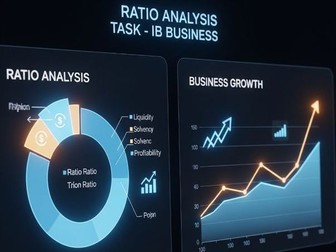
This resource is a structured, SEND-accessible Financial Ratio Analysis activity based on real published financial statements from Samsung Electronics. It is designed for IB Business Management (Unit 3 – Finance and Accounts) and links explicitly to Unit 1 (Types of Business), highlighting the reporting responsibilities of public limited companies. Students calculate and interpret key profitability, liquidity, and efficiency ratios using adapted extracts from the company’s published final accounts for the three-month periods ended March 31. The activity encourages real-world application of financial theory, analytical writing, and evaluation of business performance across two years. The resource includes: Scaffolded ratio calculation tables Key financial terminology with interchangeable terms (e.g., debtors/trade receivables) Structured analytical writing prompts Clear guidance for comparison and judgement Teacher-ready academic disclaimer This task moves beyond textbook examples and allows students to apply financial analysis to a real multinational public company, supporting exam preparation and deeper conceptual understanding. Important Copyright Notice Selected sections of the published financial statements of Samsung Electronics are included in an adapted format for educational purposes only. These documents remain the intellectual property of Samsung Electronics and were sourced from publicly available reports. Only relevant sections have been selected and adapted to support this classroom activity. This is not the complete set of financial statements, and accompanying notes and disclosures (such as detailed footnotes) have not been fully included. Therefore, any judgement made from this analysis may not fully reflect the company’s true financial standing. This resource is intended strictly for academic use.
Unit 2 HRM – Exploring Key HR and Organisational PracticesQuick View
samueldarko

Unit 2 HRM – Exploring Key HR and Organisational Practices

(0)
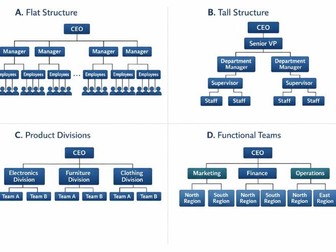
This resource pack includes two differentiated worksheets designed to support teaching and learning in Unit 2: Human Resource Management. The materials guide students through key HR concepts using clear explanations, applied tasks, and structured critical-thinking questions. Topics covered: Types of training: induction, on-the-job, and off-the-job Recruitment methods: internal and external recruitment Organisational structures: flat, tall, product-based, function-based, and region-based What’s included: Main worksheet with applied and evaluative questions Adapted version with simplified language and additional scaffolding Case study on recruitment decisions Organisational structure analysis task using company scenarios Short critical-thinking questions suitable for discussion or written responses Suitable for: BTEC Business (Unit 2 HRM) KS4–KS5 Business Studies Mixed-ability classes SEND and EAL learners through differentiation These resources help students understand, apply, and explain key HR and organisational practices, while allowing teachers to easily differentiate within the same lesson.
Human Resource Management: Organisational Structure classroom activityQuick View
samueldarko

Human Resource Management: Organisational Structure classroom activity

(0)
This Human Resource Management: Organisational Structure classroom activity is designed to support teaching of the IB Business Management syllabus and helps students understand how businesses organise their workforce to achieve efficiency, accountability, and clear lines of communication. The resource includes a range of engaging and scaffolded activities that guide learners through identifying, interpreting, and applying different types of organisational structures, with a clear focus on how structure affects decision-making, communication, motivation, and business performance. A fully adapted SEND version is included, featuring simplified language, visual prompts, sentence starters, and structured tasks to ensure inclusive access for all learners. Students explore key organisational structures such as hierarchical, flat, and matrix structures, as well as important concepts including span of control, chain of command, delegation, levels of hierarchy, and centralisation vs decentralisation. Interactive activities such as a picture-based quiz and “Who am I?” identification task support knowledge retention and vocabulary development, while a higher-level evaluative task challenges high-achieving students to analyse the suitability of different structures for specific business contexts. The resource also includes application-based and evaluative tasks, encouraging learners to justify organisational choices and assess the advantages and disadvantages of different structures, supporting both exam preparation and deeper conceptual understanding. All images used in this resource are royalty-free icons, illustrations, or diagrams sourced from open educational or free-use image libraries (e.g. Freepik, Flaticon, Pixabay, Vecteezy, The Noun Project) and are used for educational purposes only. No copyrighted photographs or proprietary images are included.
Human Resources: Motivation_Financial and Non Financial RewardQuick View
samueldarko

Human Resources: Motivation_Financial and Non Financial Reward

(0)
This Human Resource Management: Financial and Non-Financial Rewards classroom activity is designed to support teaching of the IB Business Management syllabus and helps students understand how different reward systems are used to motivate employees and impact business performance. The resource includes carefully scaffolded tasks that guide learners through identifying, classifying, and applying financial and non-financial rewards, with a clear focus on employee motivation and business outcomes such as productivity, costs, and retention. A fully adapted SEND version is included, featuring simplified language, sentence starters, matching activities, and structured tables to support inclusive learning. Students explore key financial rewards such as salary, wages, commission, performance-related pay, profit-related pay, employee share ownership schemes, and fringe benefits, alongside non-financial rewards including job enrichment, job enlargement, job rotation, teamwork, empowerment, and purpose. The activities encourage learners to consider why businesses use a mix of reward systems rather than relying on pay alone. The resource also includes application-based tasks, including a board meeting role play and reflection activities, allowing students to demonstrate understanding through written, verbal, audio, or video responses. What’s included General learner worksheet with scaffolded HRM reward tasks SEND-adapted worksheet with simplified definitions and sentence starters Matching and classification activities Tables linking rewards to motivation and business impact Role play task applying wage systems and fringe benefits Reflection tasks suitable for written, verbal, audio, or video responses SEND-friendly glossary of financial and non-financial rewards Specification / Curriculum IB Business Management (Human Resource Management) Suitable for IGCSE Business Studies, BTEC Business, and KS4/KS5 Business How it can be used Classroom lesson or cover work Differentiated and SEND-inclusive teaching Group discussion and role play activities Revision or consolidation of HRM rewards Assessment for learning (AfL) File types included PDF worksheets (printable and digital use) Key search terms IB Business Management, HRM rewards, financial rewards, non-financial rewards, motivation, employee motivation, SEND business studies, differentiated worksheets, reward systems, business management classroom activity