AQA P2 Electricity - Ohms Law and Non Ohmic ConductorsQuick View
SamirMouladad

AQA P2 Electricity - Ohms Law and Non Ohmic Conductors

(0)
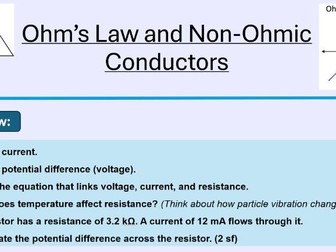
**Lesson for both Combined and Triple AQA Physics: ** This lesson introduces Ohm’s Law and the difference between ohmic and non-ohmic conductors. Students recall current, voltage, and resistance before exploring how a fixed resistor shows a proportional I–V relationship. They then learn why components like filament bulbs, LDRs, thermistors, and diodes do not obey Ohm’s Law, focusing on how temperature or light affects resistance. Students interpret I–V graphs, explain resistance changes using particle ideas, and practise setting up circuits to measure component characteristics. **This lesson includes: ** Strong retrieval practice Clear explanation of Ohm’s Law Strong focus on misconceptions Exam preparation built in High challenge but well scaffolded **Aimed to hit the following spec points: ** 4.2.2.3 Resistance Students understand resistance as the opposition to current. Investigate how current varies with potential difference for a resistor, filament lamp, and diode (qualitative). Describe I–V characteristics for ohmic and non-ohmic components. 4.2.2.4 Resistors Current through a resistor (at constant temperature) is directly proportional to potential difference. Recognise and interpret linear and non-linear I–V graphs. 4.2.2.5 Filament Lamp, Diode Describe how resistance changes in a filament lamp as temperature increases. Explain how a diode allows current in one direction only. 4.2.1 Current, potential difference and resistance
AQA B2- Enzymes in the digestive systemQuick View
SamirMouladad

AQA B2- Enzymes in the digestive system

(0)
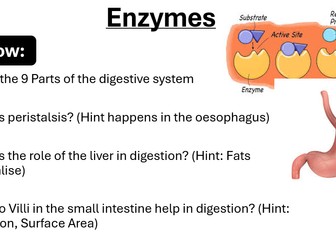
A KS4 lesson aimed at a mixed ability/Middle ability (MAP) pupils. Students learn what enzymes are, how they work, and their role in digestion. The lesson introduces enzymes as biological catalysts, explains the lock and key model, and explores the roles of amylase, protease, lipase, and bile in the digestive system. From AQA GCSE Combined Science / Biology (Digestive Enzymes): Enzymes catalyse specific reactions in living organisms due to the shape of their active site. Use of the lock and key theory as a simplified model to explain enzyme action. Recall of enzyme production sites and functions: Amylase (carbohydrase) breaks down starch into sugars. Proteases break down proteins into amino acids. Lipases break down lipids into glycerol and fatty acids. Understanding of word equations for enzyme reactions (no symbols required). Digestive enzymes convert food into small soluble molecules that can be absorbed into the bloodstream. Bile functions: neutralises stomach acid and emulsifies fats to increase surface area for lipase.
AQA B2 Organisation - Digestive SystemQuick View
SamirMouladad

AQA B2 Organisation - Digestive System

(0)
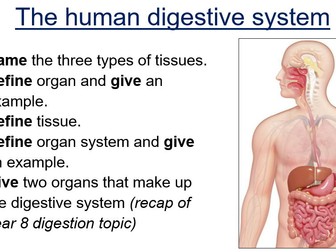
A full (1 hours) lesson based on the AQA spec for B2: Organisation (4.2.2.1 The human digestive system) A 5 Question: Starter/Do Now Labelling the Digestive system Function of the parts of the digestive system Adaptation of the digestive system Exam Practice AfL MWB Knowledge Checks This lesson is to be served as the second lesson in the topic, following an intro lesson on the organisaion of the human body. The lesson proceding this will dive into details surronding enzymes, the enzymes involved in digestion and the food test RP. Please do leave feedback and ideas for improvements!