“Changing States of Matter Worksheet: NGSS-aligned for grades 5-9! Interactive diagrams, real-world examples & critical thinking. Print & go—download now!”
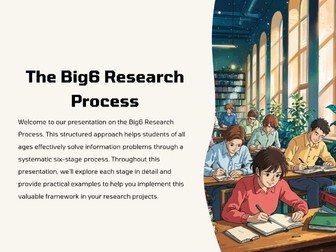
This presentation introduces the Big6 Research Process, a six-stage information literacy model that helps students develop research and problem-solving skills.
The Big6 Research Process is a structured method for teaching students how to effectively approach research projects. This resource is designed for library or ICT classes and includes an overview of each step in the Big6 model:
Task Definition – Understand the problem and define what information is needed.
Information Seeking Strategies – Identify and select the best sources of information.
Location and Access – Locate sources and find information within them.
Use of Information – Extract and evaluate relevant data.
Synthesis – Organize and present information clearly.
Evaluation – Reflect on both the process and the final product.
The resource includes real-life examples for each step, classroom reflection prompts, and suggestions for customizing the template for different subjects. Students are guided to practice critical thinking, develop a growth mindset, and become more independent learners.
Ideal for:
Primary and secondary teachers
ICT, Library, or Project-Based Learning (PBL) programs
Cross-curricular use to improve research competency
Keywords:
information literacy, research process, Big6, critical thinking, primary research, student reflection, ICT, digital literacy, project-based learning
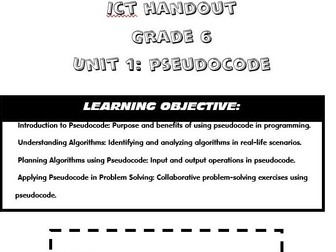
Pseudocode for Grades 4–6 (English-Language File)
This material is provided in an English-language file to help students become familiar with basic programming terms commonly used worldwide. Although the file is in English, the explanations and structure are designed using simple, easy-to-understand language suitable for students in Grades 4 to 6.
Key Features of This Material:
English-Language File: Introduces students to programming vocabulary that is frequently used internationally.
Simple Approach: Clear and accessible explanations to help students quickly grasp the basic concepts of logic and computational thinking.
Preparation for Coding: Serves as an effective entry point before students advance to learning more complex programming languages.
This material is ideal for Grade 4–6 students who want to explore the fundamentals of programming through pseudocode, with content presented in English to help prepare them for the global digital world.


 Quick View
 Quick View