T Level DSD: Computational Thinking Full Unit Bundle (Lessons 1–5) — Problem SolvingQuick View
jfids19

T Level DSD: Computational Thinking Full Unit Bundle (Lessons 1–5) — Problem Solving

5 Resources
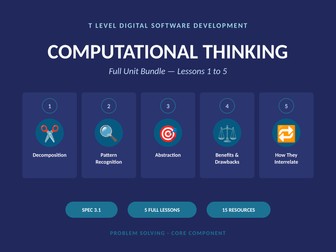
The complete Computational Thinking sub-unit for T Level Digital Software Development — Problem Solving (spec point 1.1), covering all five lessons as a single discounted bundle. Save 43% compared to buying the lessons individually. This bundle takes students from first principles through to full exam-ready understanding of computational thinking: Lesson 1 — Introduction & Decomposition (AO1b): what computational thinking is, its four components, and how to break a problem into manageable sub-problems. Lesson 2 — Pattern Recognition (AO1b): spotting trends and similarities to reuse solutions and make predictions from data. Lesson 3 — Abstraction (AO1b/AO2): filtering relevant from irrelevant information, plus a synthesis lesson linking all four components together. Lesson 4 — Benefits & Drawbacks (AO3a): the strengths and limitations of each component, and how to analyse which drawback matters most in a given scenario. Lesson 5 — How They Interrelate (AO3a): a case-study-driven lesson showing that real problem solving loops back between components rather than following a fixed order. Every lesson is a complete, ready-to-teach package: a detailed 12-slide PowerPoint (starters, modelled worked examples, guided and independent practice, a mark-schemed exam-style question, and a plenary exit ticket), a full lesson plan written to a standard Content Area 1 template, and a matching practice worksheet — 15 files in total (5 PowerPoints, 5 lesson plans, 5 worksheets). By the end of the unit, students can define and apply all four components of computational thinking, evaluate their benefits and drawbacks, and analyse how they interrelate in real problem solving — covering AO1a, AO1b, AO2, AO3a and AO3b across the sequence, and fully preparing them for Paper 1 questions on this spec point. Ideal for T Level Digital Software Development (Core Component, Problem Solving) teachers wanting a coherent, fully resourced run of lessons rather than piecing together individual resources. Part of a growing 20-lesson full scheme of work — Lesson 6 onward (Algorithmic Design) coming soon.
T Level DSD: How Computational Thinking Components Interrelate – Full Lesson (Lesson 5)Quick View
jfids19

T Level DSD: How Computational Thinking Components Interrelate – Full Lesson (Lesson 5)

(0)
Lesson 5 of a full T Level Digital Software Development Problem Solving scheme of work, covering spec point 1.1 Computational Thinking — how decomposition, pattern recognition, abstraction and algorithmic design interrelate. Completes the computational thinking sub-unit that began in Lesson 1. This is a complete, ready-to-teach lesson: a 12-slide PowerPoint (a “Sequential or Not?” poll, a loop diagram replacing the straight-line view of the four components, a six-stage case study — “Mrs Osei’s Clubs Sign-Up System” — showing a developer looping back to an earlier component when new information comes to light, guided practice matching a second case study’s stages to components, independent practice ordering and labelling a jumbled case study while spotting its loop-back moment, a mark-schemed AO3a exam question, and a plenary exit ticket), a detailed lesson plan using a standard Content Area 1 template, and a matching practice worksheet. Students will be able to explain that the four components aren’t used in a strict, one-way order, analyse a case-study narrative to identify which component is being applied at each stage (including loop-back moments), and evaluate whether a solution could be reached by skipping one or more components — completing their understanding of computational thinking ahead of algorithmic design. Perfect for T Level Digital Software Development (Core Component, Problem Solving) teachers wanting a genuinely discussion-led lesson that consolidates the whole computational thinking topic before moving on to algorithms. Part of a growing 20-lesson full scheme of work — see my shop for Lessons 1–4 (decomposition, pattern recognition, abstraction, benefits/drawbacks), available individually or as a discounted bundle.
T Level DSD: Computational Thinking Benefits & Drawbacks – Full Lesson (Lesson 4)Quick View
jfids19

T Level DSD: Computational Thinking Benefits & Drawbacks – Full Lesson (Lesson 4)

(0)
Lesson 4 of a full T Level Digital Software Development Problem Solving scheme of work, covering spec point 1.1 Computational Thinking — the benefits and drawbacks of decomposition, pattern recognition, abstraction and algorithmic design. Builds on Lessons 1–3. This is a complete, ready-to-teach lesson: a 12-slide PowerPoint (an “Only One Tool?” hook, direct teaching giving one benefit and one drawback for each of the four components — each tied back to a scenario from earlier lessons — a guided card-match task, independent analysis of which component’s drawback poses the biggest risk across three new scenarios, a mark-schemed AO3a exam question on a bank fraud-detection system, and a plenary exit ticket), a detailed lesson plan using a standard Content Area 1 template, and a matching practice worksheet. Students will be able to state a benefit and drawback for each computational thinking component, explain why a specific benefit or drawback applies in context, and analyse which component’s drawback is most likely to cause a problem in a given scenario — a key AO3 analysis skill for Paper 1. Perfect for T Level Digital Software Development (Core Component, Problem Solving) teachers looking for a detailed, exam-focused lesson that builds AO3 analysis skills around computational thinking. Part of a growing 20-lesson full scheme of work — see my shop for Lessons 1–3 (decomposition, pattern recognition, abstraction) and Lesson 5 (how the four components interrelate), available individually or as a discounted bundle.
T Level DSD: Computational Thinking & Abstraction – Full Lesson (Lesson 3)Quick View
jfids19

T Level DSD: Computational Thinking & Abstraction – Full Lesson (Lesson 3)

(0)
Lesson 3 of a full T Level Digital Software Development Problem Solving scheme of work, covering spec point 1.1 Computational Thinking — abstraction, plus a synthesis section linking all four components of computational thinking together. Builds on Lessons 1–2 (decomposition and pattern recognition). This is a complete, ready-to-teach lesson: a 12-slide PowerPoint (a “Two Maps” hook comparing a street map to a tube diagram, direct teaching with a real worked example on filtering a student record down to only what’s relevant, a four-step pipeline slide showing decomposition → pattern recognition → abstraction → algorithmic design in action on one brief, guided and independent practice, a mark-schemed AO1b exam question, and a milestone recap before the plenary), a detailed lesson plan using a standard Content Area 1 template, and a matching practice worksheet. Students will be able to define abstraction, explain how it filters out irrelevant detail, and independently apply it to a scenario by identifying which details are relevant to a specific problem and which can be filtered out — while also seeing how all four components of computational thinking fit together. Perfect for T Level Digital Software Development (Core Component, Problem Solving) teachers looking for a detailed, exam-focused lesson on abstraction that also consolidates the whole computational thinking topic. Part of a growing 20-lesson full scheme of work — see my shop for Lessons 1–2 (decomposition, pattern recognition) and Lessons 4–5 (benefits/drawbacks, and how the four components interrelate), available individually or as a discounted bundle.
T Level DSD: Computational Thinking & Pattern Recognition – Full Lesson (Lesson 2)Quick View
jfids19

T Level DSD: Computational Thinking & Pattern Recognition – Full Lesson (Lesson 2)

(0)
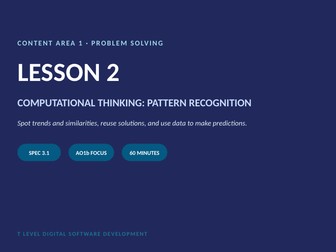
Lesson 2 of a full T Level Digital Software Development Problem Solving scheme of work, covering spec point 1.1 Computational Thinking — pattern recognition, with fully worked examples and exam-style assessment. Builds directly on Lesson 1 (decomposition). This is a complete, ready-to-teach lesson: a 12-slide PowerPoint (a recall-and-hook starter, direct teaching with two worked examples — comparing decomposed briefs for repeated sub-problems, then spotting a trend in real attendance data — guided and independent practice, a mark-schemed AO1b exam question, and a plenary exit ticket), a detailed lesson plan using a standard Content Area 1 template, and a matching practice worksheet. Students will be able to define pattern recognition, explain how it’s used to spot trends, similarities and repeated sub-problems, and independently use a spotted pattern in data or in a decomposed problem to make a reasonable prediction. Perfect for T Level Digital Software Development (Core Component, Problem Solving) teachers looking for a detailed, exam-focused lesson on pattern recognition. Part of a growing 20-lesson full scheme of work — see my shop for Lesson 1 (decomposition) and Lessons 3–5 (abstraction, benefits/drawbacks, and how the four components interrelate), available individually or as a discounted bundle.
T Level DSD: Computational Thinking & Decomposition – Full Lesson (Lesson 1)Quick View
jfids19

T Level DSD: Computational Thinking & Decomposition – Full Lesson (Lesson 1)

(0)
Lesson 1 of a full T Level Digital Software Development Problem Solving scheme of work, covering spec point 1.1 Computational Thinking — decomposition, with fully worked examples and exam-style assessment. This is a complete, ready-to-teach lesson: a 12-slide PowerPoint (starter, direct teaching with two worked examples, guided and independent practice, a mark-schemed AO1b exam question, and a plenary exit ticket), a detailed lesson plan using a standard Content Area 1 template, and a matching practice worksheet. Students will be able to define computational thinking and its four components, explain what decomposition is and why it’s used, and independently decompose a real-world problem brief into manageable sub-problems. Perfect for T Level Digital Software Development (Core Component, Problem Solving) teachers looking for a detailed, exam-focused introduction to computational thinking. Part of a growing 20-lesson full scheme of work — see my shop for Lessons 2–5 covering pattern recognition, abstraction and how the four components interrelate, available individually or as a discounted bundle.