From why the Arctic warms three times faster than the rest of the planet to real ice sheet mass loss and where the ocean’s extra heat actually goes, this booklet digs into the real mechanisms behind global warming. It uses genuine, current data from NOAA, Copernicus, and peer-reviewed research throughout.
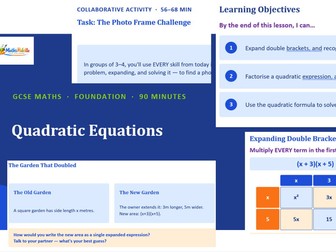
This lesson takes GCSE Foundation students through the full arc of quadratics - expanding double brackets, spotting and expanding the difference of two squares, factorising and solving via the zero product rule, and finally the quadratic formula for equations that won’t factorise neatly. It opens with a genuine real-life hook: a garden extended by (x+3)(x+5), which becomes the exact worked example in Topic 1 once students have had a go at it themselves.
The lesson is built around one native, editable area-model diagram that reappears and does more work each time it’s used - the same grid that expands double brackets in Topic 1 is reused to show visually why the middle terms cancel in the difference of two squares, rather than asking students to memorise a shortcut. The Exploration has students calculate discriminants across a family of equations and discover the rule for themselves - positive means two solutions, zero means one, negative means none - before the rule is ever stated. The Collaborative Activity, The Photo Frame Challenge, runs the whole pipeline in one real problem: forming a quadratic from a word problem, expanding it, factorising it, solving it, and rejecting the solution that isn’t a physically valid length. A short history section covers a genuinely striking fact: Babylonian mathematicians were solving quadratic-type problems using this same area-model geometry around 2000 BCE, nearly 4000 years before algebraic notation existed.
Includes the complete slide deck plus a full set of matching resources: Student Handout, tiered Independent Practice, the Photo Frame Challenge collaborative activity, Peer Assessment, Exit Ticket, Loop Cards, Teacher’s Handout with a complete answer key, and a Teacher’s Lesson Plan with full timing across every phase of the lesson.
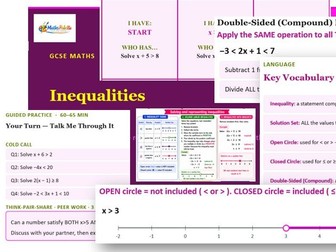
This lesson takes GCSE Foundation students beyond the equals sign - representing inequalities on a number line, listing integer solutions, solving one-step and two-step inequalities, handling negative coefficients (the sign-flip rule), double-sided inequalities, inequalities with brackets, and forming and solving inequalities from real-life contexts.
Every topic is taught with a fully worked example followed immediately by its own practice question, and number lines are built as genuine, geometrically accurate diagrams throughout - not decoration, but the actual working. A Think-Pair-Share has students discover that x>5 and x<2 can never both be true at once, a real “empty set” moment that gets revisited in the Exploration activity, where students find the overlap (or lack of one) between pairs of inequalities. The Collaborative Activity puts everything to work: groups investigate two real gym membership plans, testing values by hand before forming and solving the inequality that reveals the exact point where one plan becomes more expensive than the other.
Includes the complete slide deck plus a full set of matching resources: Student Handout, tiered Independent Practice, the Gym Membership Investigation collaborative activity, Peer Assessment, Exit Ticket, Loop Cards, Teacher’s Handout with a complete answer key, and a Teacher’s Lesson Plan with full timing across every phase of the lesson.
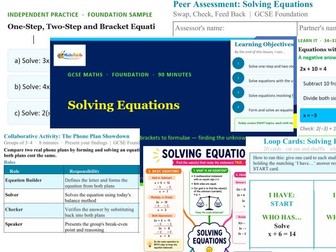
This lesson takes GCSE Foundation students through the full toolkit for solving equations: one-step and two-step equations, equations with brackets, equations with the unknown on both sides, negative solutions, equations with fractions, rearranging formulae, and forming and solving equations from real-life contexts.
Each topic is taught with a fully worked example followed immediately by two dedicated practice questions. A genuine discovery activity has students attempt to solve 2(x+3)=2x+6 and find it’s an identity - true for every value of x - while the Exploration activity (“Solution Detective”) has students catch two deliberately planted errors by checking claimed solutions against the original equations. The Collaborative Activity has groups compare two real phone plans to find the exact point where both cost the same.
This pack includes the complete slide deck plus a full set of matching resources: Student Handout, tiered Independent Practice, the Phone Plan Showdown collaborative activity, Peer Assessment, Exit Ticket, Loop Cards, Teacher’s Handout with a complete answer key, and a Teacher’s Lesson Plan with full timing across every phase of the lesson. In addition, there is a Solving Equation mindmap, highlighting key points of the topic.
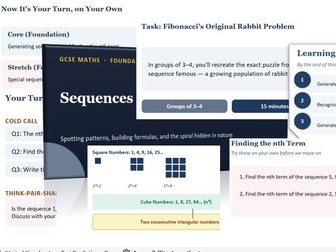
2, 5, 8, 11, 14… what’s the 50th term, without counting that far? This lesson gives GCSE Foundation students the tools to answer that properly: generating a sequence from its nth term and finding the nth term from a sequence, recognising special sequences by shape (square, cube, triangular, powers of 2), and the Fibonacci sequence as a fourth, distinct pattern worth knowing in its own right.
Every topic is taught with a fully worked example followed immediately by its own practice question, keeping pace brisk across genuinely varied content. A real discovery activity has students uncover for themselves that two consecutive triangular numbers always sum to a square number, and a Think-Pair-Share sets a deliberate trap - testing whether 1, 4, 9, 16 is really the same as nth term = 4n (it isn’t, and the near-miss is exactly the point). The lesson closes with a collaborative activity built around Fibonacci’s own 1202 rabbit-breeding puzzle, letting the pattern reveal itself rather than handing it to students upfront.
Includes the complete slide deck plus a full set of matching resources: Student Handout, tiered Independent Practice, the Fibonacci Rabbit Problem collaborative activity, Peer Assessment, Exit Ticket, Loop Cards, Teacher’s Handout with a complete answer key, and a Teacher’s Lesson Plan with full timing across every phase of the lesson. In addition, there is an extra sheet with key learning points, which can be printed on a label, and can be placed in students’ exercise books -saving time and avoiding incorrect copying.
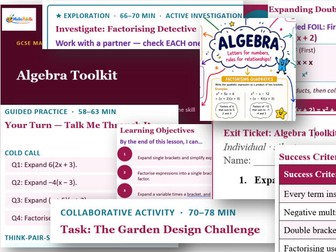
This lesson takes GCSE students who already have basic algebra fluency and pushes them into genuinely higher-level territory: expanding and factorising, treated as two directions of the exact same skill. Students expand single and double brackets (using FOIL - First, Outer, Inner, Last), factorise back into single brackets with one and two variables, handle the sign-error-prone case of negative multipliers, and finish by applying everything to real contexts where they have to work out which tool a problem actually needs.
The lesson leans hard into the “toolkit” idea rather than teaching skills in isolation. A Think-Pair-Share has students expand an expression, then factorise their own answer straight back - landing exactly where they started, real proof that these two operations are genuine inverses. An exploration activity, Factorising Detective, has students catch a subtle but common exam-marking trap: a factorised expression that’s mathematically correct but not fully factorised. It all builds to the Garden Design Challenge, where groups expand double brackets to find a patio’s area and factorise a cost formula in the same real design - discovering along the way that the two answers connect in a way that’s satisfying rather than coincidental.
Includes the complete slide deck plus a full set of matching resources: Student Handout, tiered Independent Practice, the Garden Design Challenge, Peer Assessment, Exit Ticket, Loop Cards, Teacher’s Handout with a complete answer key, and a Teacher’s Lesson Plan with full timing across every phase of the lesson.
This booklet uses a single, continuous garden design project to give students a genuinely varied tour of GCSE shape, space, and measure, grounded in real UK landscaping and horticultural standards rather than arbitrary textbook numbers. Every chapter reflects a convention real gardeners and landscapers actually follow - from the Royal Horticultural Society’s hedge-spacing guidance to standard turf roll sizes and fence panel widths used across the UK trade - so students are applying maths to genuine industry practice, not simplified fiction.
The six chapters follow the natural order of a real garden project: starting with a budget split by percentage, then moving through turf and lawn area, fencing perimeter and panel counts, hedge planting spacing (a nice application of ratio), decking area and board calculations, and finishing with the volume of a circular pond. This gives a genuinely broad mathematical spread - percentages, area, perimeter, ratio, and volume of a cylinder - all held together by one coherent, visual project students can picture from start to finish.
As with the rest of the series, each chapter is self-contained with a worked example and practice exercise, so it can be used as a single lesson, a short homework sequence, or a full six-lesson unit, with a mini project and complete answer key at the back.
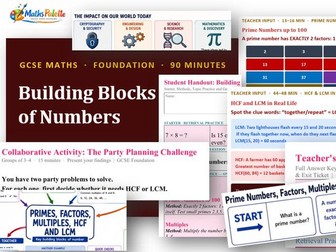
This lesson takes GCSE Foundation students through the fundamental pieces every number is built from - primes, multiples, factors, prime factorisation, and both the highest common factor and lowest common multiple, taught through three different methods including Venn diagrams. It’s a genuinely comprehensive tour of number theory’s basics, moving from “what is a prime number?” all the way to real-world problems that require identifying which method a situation actually calls for.
That last skill is the lesson’s real test, and it’s put directly to work in the Party Planning Challenge: groups tackle two genuine planning problems - one that needs HCF, one that needs LCM - and have to work out for themselves which method fits before they can even start solving it, rather than being told which tool to reach for.
Includes the full slide deck plus a matching set of resources: Student Handout, tiered Independent Practice, the Party Planning Challenge collaborative activity, Exit Ticket, Loop Cards, Peer Assessment, Teacher’s Handout with a full answer key, and a Teacher’s Lesson Plan with complete timing across every phase of the lesson. In addition, there is a MindMap to summarise key points of the topic.
This booklet uses a single, continuous scenario - organising a school charity fair from first planning meeting to final cheque - to give students a genuinely broad tour of GCSE maths without the topics feeling disconnected. Rather than six unrelated worksheets, each chapter represents a real job on an event organising committee’s to-do list, so students see how percentages, profit, geometry, probability, and data handling all sit within the same practical process.
The sequence moves from setting a budget and fundraising target (percentages), through pricing stalls and tickets (revenue and profit), to a scale drawing of the fair layout (area and perimeter). It then turns to probability without replacement through a raffle, data handling through a visitor survey (averages and a bar chart), and finishes with final accounts and sharing funds by ratio - closing the loop on the event the students have followed throughout.
One point worth flagging for your own planning: unlike most other booklets in this series, this one is built around illustrative, self-contained scenarios rather than externally sourced statistics - there was no natural real-world dataset for a fictional school fair, so realistic figures were constructed instead of drawn from a referenced source. It therefore works well as a standalone practical unit, but if you’re using it alongside the more source-referenced booklets in the series, it’s worth noting the distinction to students.
As with the rest of the series, each chapter is self-contained with a worked example and practice exercise, so it can be used as a single lesson, a short homework sequence, or a full six-lesson unit, with a mini project and complete answer key at the back.
This booklet uses the UK’s real recycling performance - and how it compares internationally - to give students a genuinely current, data-led context for GCSE maths. Every figure is drawn from official sources (Defra, Eurostat, the European Environment Agency, and the International Aluminium Institute), so students are working with real published statistics rather than simplified textbook numbers, and the booklet is explicit about where each figure comes from.
The six chapters move outward in scope: starting with the four UK nations’ own recycling rates (using range and mean to compare them), then placing the UK in a European context against Germany, Austria, and the EU average. From there it narrows into specifics - Germany’s deposit return scheme, material-by-material recycling rates, and the real energy savings from recycling aluminium - before closing with the UK’s own progress toward its published 2035 target. Mathematically, this gives a genuinely broad spread: bar charts and horizontal bars, percentages and percentage points, and a pictogram, alongside the range/mean work in Chapter 1.
One thing worth flagging before teaching this: the booklet itself notes that recycling statistics are updated annually and that measurement methodologies differ between UK nations and European countries, so direct comparisons are imperfect. This is a useful, honest teaching point in its own right - a good opportunity to discuss with students why comparing real-world statistics across different reporting systems needs some care, rather than treating every number as perfectly equivalent.
As with the rest of the series, each chapter is self-contained with a worked example and practice exercise, so it can be used as a single lesson, a short homework sequence, or a full six-lesson unit, with a mini project and complete answer key at the back.
This booklet uses genuine historical price data - house prices, everyday shopping items, and official Bank of England inflation figures - to give students a tangible, personally engaging route into ratio, percentages, and multiplicative reasoning. Rather than presenting “real terms” comparison as an abstract concept, each chapter grounds it in a concrete, recognisable historical contrast: what a house cost in 1975, what bread and petrol cost in 1970, and what Decimal Day actually changed overnight in 1971.
The six chapters build on each other mathematically. Early chapters establish raw historical prices and percentage change, before Chapter 3 introduces the inflation multiplier - the single idea (using real Bank of England CPI/RPI data) that the whole booklet turns on. This multiplier is then reused in Chapter 4 to answer a genuinely interesting question: did house prices rise faster than inflation, or merely keep pace with it? The booklet closes with decimalisation (a real, historically significant currency conversion) and house price-to-earnings affordability, giving students a rounded picture of how “expensive” a historical period actually was, beyond the headline price alone.
It’s worth telling students upfront what the booklet itself is honest about: historical prices varied by region, shop, and exact date, so the figures used are the most reliable published estimates available rather than a single universal price. This is a genuine feature of working with real historical data, and worth discussing as part of the lesson rather than treating the figures as exact.
As with the rest of the series, each chapter is self-contained with a worked example and practice exercise, so it can be used as a single lesson, a short homework sequence, or a full six-lesson unit, with a mini project and complete answer key at the back.
This booklet uses the real scale and economics of the UK’s offshore wind and solar industries to give students a genuinely current, evidence-based context for GCSE maths. Every figure is drawn from named industry and government sources - RenewableUK, Ørsted’s real Hornsea wind farm data, S&P Global Platts’ auction results, and current 2026 solar industry pricing - so students are working with real, up-to-date figures on a topic that carries obvious relevance to their own futures.
The six chapters build from the concrete to the national in scale: starting with the output of a single real 8MW turbine, moving through domestic solar panel payback periods, then scaling up to a real named wind farm (Hornsea 2), before turning to the economics of green energy (the real, striking fall in offshore wind’s Contracts for Difference price since 2017), a comparison with electric vehicle demand, and finishing with the UK’s own real progress toward its published 2030 offshore wind target. This gives a genuinely wide mathematical spread - unit rates, division, multiplication, percentages, and percentage points - while keeping every chapter anchored in the same real, ongoing UK energy story.
Worth using as a discussion point: the booklet notes upfront that energy costs, capacity figures, and targets change as new projects complete and new auctions take place, so the figures reflect the most recent published data at the time of writing rather than a fixed, permanent picture. This is a natural opening to ask students to look up more recent figures themselves as an extension activity, since the underlying data (wind farm capacities, auction prices, national targets) is publicly tracked and updated regularly.
As with the rest of the series, each chapter is self-contained with a worked example and practice exercise, so it can be used as a single lesson, a short homework sequence, or a full six-lesson unit, with a mini project and complete answer key at the back.
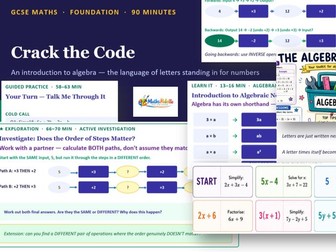
A 90-minute GCSE Foundation lesson introducing the fundamentals of algebra. It covers eight topics in sequence: algebraic notation, terms/expressions/identities, collecting like terms, substitution, function machines, and simplifying expressions by addition, subtraction, multiplication, and division.
Each topic is taught with a worked example followed immediately by a dedicated practice question. The lesson also includes a starter diagnostic on collecting like terms, a Think-Pair-Share testing an algebraic identity across multiple values, an exploration into function machine order, and a collaborative activity (the Mystery Machine Challenge) where groups work out a hidden rule from given input/output pairs. A short history section covers the origin of the word “algebra.”
Includes the full slide deck plus a complete set of matching resources: Student Handout, tiered Independent Practice, the Mystery Machine Challenge collaborative activity, Peer Assessment, Exit Ticket, and a Teacher’s Handout with a complete answer key.
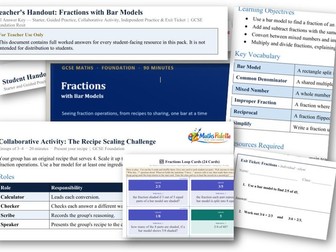
This lesson uses bar models to make fraction operations genuinely visible for GCSE Foundation students - turning “why does this work?” into something students can actually see, rather than a rule to memorise. Across the 90 minutes, it builds from finding a fraction of an amount, through adding and subtracting fractions with different denominators, converting between mixed numbers and improper fractions, right up to multiplying and dividing fractions with correct mathematical vocabulary.
Each stage is taught with a worked example modelled through the bar itself, so students see the same visual thread running from the simplest fraction-of-an-amount question through to full mixed-number arithmetic. The lesson closes with a Quick Reference summary pulling every method together, then puts it into practice with a Recipe Scaling Challenge — groups scale a recipe up and down using real fraction operations, justifying each step with a bar model.
Includes the full slide deck plus a matching set of resources: Student Handout, tiered Independent Practice, the Recipe Scaling Challenge collaborative activity, Exit Ticket, Teacher’s Handout with a complete answer key, and a Teacher’s Lesson Plan with full timing and adaptive teaching strategies and Loop Cards.
Real life scenarios for best value calculation on cards, enabling learners to pick and choose a card they prefer to work on. Ideal for peer work or workshop based lessons.
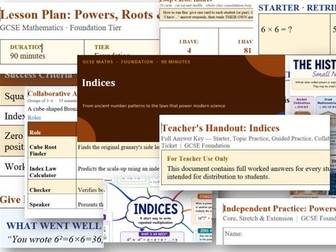
This lesson takes GCSE Foundation students from square and cube numbers through to the three index laws and the trickiest topic of all - zero and negative indices - and makes every rule feel earned, not memorised. Real mathematical history runs through the whole lesson: Babylonian clay tablets, the 2,000-year unsolved Delian Problem, Descartes inventing modern notation in 1637. Students aren’t just learning rules; they’re seeing where the rules came from.
The lesson’s standout moment is a genuine discovery activity: rather than being told why anything to the power 0 equals 1, students uncover the pattern themselves, working out the missing values in a sequence of powers of 2 with a partner before the rule is ever named. It’s the kind of “aha” moment that makes an abstract rule stick. From there, everything builds toward the Bronze Age Granary Challenge - groups become archaeologists, using a cube root to uncover an ancient granary’s true size, then applying an index law to predict a larger one without recalculating from scratch.
Every topic is taught with a full worked example followed immediately by its own practice question, keeping pace brisk without losing anyone. Includes the complete slide deck plus a full set of matching resources: Student Handout, tiered Independent Practice, the Bronze Age Granary Challenge, Peer Assessment, Exit Ticket, Loop Cards, Teacher’s Handout with a complete answer key, and a Teacher’s Lesson Plan with full timing across every phase of the lesson. Beside these, there are Loop cards, a Mind Map, a History Poster to enhance students’ learning experience and engagement.
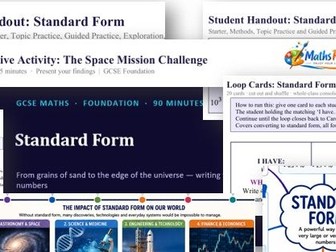
This lesson gives GCSE Foundation students a genuinely practical answer to a real problem: how do you write down a number too big or too small to count the zeros on? From the distance to the Sun to the width of a virus, students learn to convert huge and tiny numbers into standard form, then add, subtract, multiply and divide with them - directly building on the index laws from the previous lesson.
Real history runs through the lesson with genuine stakes attached. Archimedes’ Sand Reckoner opens the conversation on naming impossibly large numbers, but the lesson’s sharpest hook is what happens when a zero goes missing: a 2005 Tokyo Stock Exchange trading error that cost a firm over $300 million in minutes, and NASA’s Mars Climate Orbiter, lost in 1999 because two teams tracked orders of magnitude in different units. Standard form stops being abstract notation the moment students see what getting it wrong actually costs.
The lesson builds to a genuine discovery activity - students order four real quantities spanning from a proton’s mass to the Earth’s, working out for themselves that comparing the powers of 10 first is the fast way to make sense of wildly different scales - before applying everything in the Space Mission Challenge, calculating real fuel masses and how far light travels toward another planet.
Includes the complete slide deck plus a full set of matching resources: Student Handout, tiered Independent Practice, the Space Mission Challenge collaborative activity, Peer Assessment, Exit Ticket, Loop Cards, Teacher’s Handout with a complete answer key, and a Teacher’s Lesson Plan with full timing across every phase of the lesson.
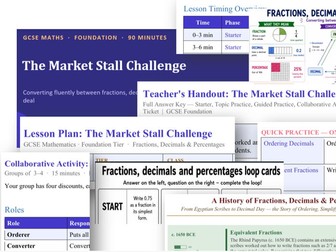
This lesson takes GCSE Foundation students through the full toolkit for working confidently between fractions, decimals and percentages — ordering decimals by place value, finding equivalent and simplified fractions, converting fluently in both directions between all three forms, and solving money problems without a calculator. Every method builds toward the same destination: real market stall pricing, where being able to move between number forms isn’t an abstract skill but the difference between spotting the genuinely better deal.
Each of the eight topics is taught with a fully worked example followed immediately by its own dedicated practice question, keeping pace brisk across a lot of ground. The lesson’s centrepiece is its own namesake: groups take on roles - Orderer, Converter, Money Calculator, Speaker - to sort four real discounts (a quarter off, 30%, a decimal, and a fraction) into order, spot a deliberately hidden equal pair among them, and apply the biggest saving to a real purchase, entirely without a calculator.
Includes the full slide deck plus a complete set of matching resources: Student Handout, tiered Independent Practice, the Market Stall Challenge collaborative activity, Peer Assessment, Exit Ticket, Loop Cards, Teacher’s Handout with a full answer key, and a Teacher’s Lesson Plan with complete timing across every phase of the lesson.
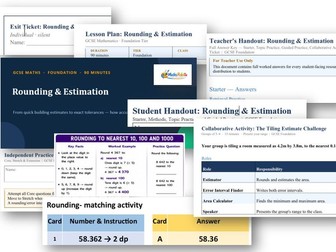
This lesson takes GCSE Foundation students through nine interconnected skills for handling accuracy with confidence - rounding to 10, 100 and 1000, rounding to decimal places and significant figures, estimating with numbers above and below 1, error intervals, truncation, and choosing an appropriate degree of accuracy for a given context. It’s all framed through a construction theme, tackling the genuinely practical question builders face every day: how accurate is accurate enough?
Each topic is taught with a fully worked example followed immediately by its own dedicated practice question, keeping momentum through a wide span of related skills. The lesson builds toward its own centrepiece, the Tiling Estimate Challenge: groups estimate the area of a room to be tiled, then use error intervals to work out the true minimum and maximum possible area - turning rounding and estimation from an abstract exam technique into the real margin a builder has to plan around.
Includes the full slide deck plus a complete set of matching resources: Student Handout, tiered Independent Practice, the Tiling Estimate Challenge collaborative activity, Exit Ticket, Teacher’s Handout with a full answer key, and a Teacher’s Lesson Plan with complete timing across every phase of the lesson.
This booklet uses two genuinely popular garden projects- building a shed and building a rabbit hutch - to give students a concentrated, real-world tour of shape, space, and measure at GCSE level. Rather than treating geometry topics in isolation, each of the six chapters follows a single, physical build from start to finish, so students see why a particular calculation is needed before they’re asked to do it.
The shed sequence takes students from a straightforward area calculation (working out how many paving slabs are needed for a base, including a realistic wastage allowance) through perimeter and timber quantities, and finishes with a genuine application of Pythagoras’ theorem to find the rafter length of a pitched roof. The rabbit hutch sequence mirrors this progression on a smaller scale - area and volume are grounded in real RWAF/RSPCA welfare guidelines rather than arbitrary numbers, before moving into nets and surface area for the hutch construction itself, and closing with a percentage comparison between a proposed run size and the real recommended minimum.
Each chapter is self-contained, with a fully worked example followed by a practice exercise, so chapters can be used independently as short enrichment tasks, a substantive homework set, or as a linked six-lesson unit. A mini project and complete answer key are provided at the back, and all real-world figures (slab sizes, timber standards, and animal welfare minimums) are referenced to their sources, so students encounter genuine standards rather than simplified textbook fictions.