Perfectionism KS2 PSHE Guide & ActivitiesQuick View
Kidsbooks

Perfectionism KS2 PSHE Guide & Activities

(0)
Free 7-page PSHE / wellbeing pack on perfectionism for ages 8-12 (upper KS2 and early KS3): teacher notes, 8 discussion questions, a 30-minute lesson plan, 4 practical tools and 2 pupil worksheets. Sixty cupcakes that tasted good - thrown away. This pack turns the story of Lena, baking for a bake sale and unable to hand in anything with one small flaw, into a ready-to-teach session on perfectionism: the Inspector with the magnifying glass, the three steps Fix - Stay - Move, and why ‘finished’ can be the bravest word a capable child ever says. Written for PSHE, RSHE and wellbeing time, guided reading, and one-to-one ELSA or SENCO sessions. What’s inside (7 printable A4 pages) Teacher notes: story summary, learning objectives, curriculum links and the psychology of the redo loop 8 discussion questions for circle time, guided reading or a wellbeing lesson A 30-minute lesson plan 4 practical tools with ‘try saying’ scripts for teachers, TAs and parents 3 activities: the Most Beautiful Mistake (with cut-out cards), an eight-step drama activity and a retelling task 2 pupil worksheets pitched at ages 8-12: “Fix - Stay - Move” and “Good Enough, Decided in Advance” How to use it You do not need the book to run this session: page 2 summarises the story and the questions stand on their own. It is especially useful before assessments, competitions or any ‘best work’ display. Print pages 6 and 7 for pupils; everything else is for the adult. The tools on page 4 are written so they can be sent home to parents as well. Curriculum links PSHE Association Programme of Study, KS2 - Health and Wellbeing (H27: recognising their individuality and qualities; H28: personal strengths and achievements and how these contribute to self-worth; H29: how to manage setbacks and perceived failures, including reframing unhelpful thinking; H17-H20: recognising and managing feelings). DfE statutory Health Education, Mental wellbeing. Also supports metacognition and self-regulation, and English reading comprehension (inference and discussion). About the story Sixty Cakes in the Bin is Book 7 of the Lena series by Kidsbooks - ten short, illustrated chapter books written for ages 8-12 and read comfortably up to Year 8, each about one feeling: procrastination, anger, worry, perfectionism, boredom and screen time, gratitude, feeling left out, online safety and self-worth. Every book has a Parent & Educator Guide bound into the back, with discussion questions, puzzles, activities and an original song, and is mapped to the PSHE Association Programme of Study. The stories are secular and every page is open to parents. Discussion guides for the other books in the series are in this shop.
Social Media & Self-Worth KS2 PSHE PackQuick View
Kidsbooks

Social Media & Self-Worth KS2 PSHE Pack

(0)
Free 7-page PSHE / wellbeing pack on social media, comparison and self-worth for ages 8-12 (upper KS2 and early KS3): teacher notes, 8 discussion questions, a 30-minute lesson plan, 4 practical tools and 2 pupil worksheets. One night of scrolling and a warm home suddenly looks ‘faded’. This pack turns the story of Lena, who discovers the dazzling online life of influencer Ella Rose and starts copying a polished stranger, into a ready-to-teach media-literacy session: highlights versus backstage, how to catch a comparison thought, and where self-worth really comes from. Written for PSHE, RSHE and wellbeing time, guided reading, and one-to-one ELSA or SENCO sessions. What’s inside (7 printable A4 pages) Teacher notes: story summary, learning objectives, curriculum links and the psychology of the comparison loop 8 discussion questions for circle time, guided reading or a PSHE lesson A 30-minute lesson plan 4 practical tools with ‘try saying’ scripts for teachers, TAs and parents 3 activities: the Unfiltered Album (with cut-out prompt cards), an eight-step drama activity and a retelling task 2 pupil worksheets pitched at ages 8-12: “Highlights vs Backstage” and “The And-Then-What Ladder” How to use it You do not need the book to run this session: page 2 summarises the story and the questions stand on their own. If you do read the story first, the pack works as a follow-up guided-reading or PSHE lesson. Print pages 6 and 7 for pupils; everything else is for the adult. The tools on page 4 are written so they can be sent home to parents as well. Curriculum links PSHE Association Programme of Study, KS2 - Living in the wider world, Media literacy and digital resilience (L11: how the internet and social media can be used both positively and negatively; L12: assessing the reliability of what is seen online; L16: how images and text online can be manipulated or invented); Health and Wellbeing (H27: recognising their own individuality and different qualities; H28: personal strengths and achievements and how these contribute to self-worth; H18-H20: what affects feelings and how to manage them). DfE statutory RSE and Health Education: Online relationships; Internet safety and harms; Mental wellbeing. Also supports English reading comprehension (inference and discussion). About the story A Dress Like Ella’s is Book 4 of the Lena series by Kidsbooks - ten short, illustrated chapter books written for ages 8-12 and read comfortably up to Year 8, each about one feeling: procrastination, anger, worry, perfectionism, boredom and screen time, gratitude, feeling left out, online safety and self-worth. Every book has a Parent & Educator Guide bound into the back, with discussion questions, puzzles, activities and an original song, and is mapped to the PSHE Association Programme of Study. The stories are secular and every page is open to parents. Discussion guides for the other books in the series are in this shop.
Hope, Wishes & Worry KS2 PSHE GuideQuick View
Kidsbooks

Hope, Wishes & Worry KS2 PSHE Guide

(0)
Free 7-page PSHE / wellbeing pack on wishes, worry and real hope for ages 8-12 (upper KS2 and early KS3): teacher notes, 8 discussion questions, a 30-minute lesson plan, 4 practical tools and 2 pupil worksheets. When something is too big to fix, children reach for magic. This pack turns the story of Lena - who, after her mother collapses, follows a classmate’s tale of a wish-granting pendant into the forest alone - into a ready-to-teach session on real hope: how the shortcut reflex works, three questions for any exciting claim (who told you, how do they know, what do they gain), how to turn an impossible wish into one small real step, and how to repair harsh words with an action. Written for PSHE, RSHE and wellbeing time, guided reading, and one-to-one ELSA or SENCO sessions. What’s inside (7 printable A4 pages) Teacher notes: story summary, learning objectives, curriculum links and the psychology of the shortcut loop 8 discussion questions for circle time, guided reading or a wellbeing lesson A 30-minute lesson plan 4 practical tools with ‘try saying’ scripts for teachers, TAs and parents 3 activities: the Chest and the Steps (with cut-out cards), an eight-step drama activity and a retelling task 2 pupil worksheets pitched at ages 8-12: “Who Told You, and How Do They Know?” and “The Empty Chest, the Real Steps” How to use it You do not need the book to run this session: page 2 summarises the story and the questions stand on their own. The story includes a parent’s sudden illness - check your class list first, and let any child with a poorly relative know they can step out or talk to you afterwards. Print pages 6 and 7 for pupils; everything else is for the adult. The tools on page 4 are written so they can be sent home to parents as well. Curriculum links PSHE Association Programme of Study, KS2 - Health and Wellbeing (H21: recognising warning signs about mental health and how to seek support; H23: change and loss, including illness, and how these affect feelings; H24: problem-solving strategies for emotions, challenges and change; H17-H20: recognising and managing feelings); Relationships (R17: resolving disputes and reconciling; R18: recognising when a friendship is making them feel unsafe); Living in the wider world (L12 and L14: judging the reliability of information and claims). DfE statutory Health Education, Mental wellbeing. Also supports English reading comprehension (inference and discussion). About the story The Empty Wish Chest is Book 10 of the Lena series by Kidsbooks - ten short, illustrated chapter books written for ages 8-12 and read comfortably up to Year 8, each about one feeling: procrastination, anger, worry, perfectionism, boredom and screen time, gratitude, feeling left out, online safety and self-worth. Every book has a Parent & Educator Guide bound into the back, with discussion questions, puzzles, activities and an original song, and is mapped to the PSHE Association Programme of Stu
Boredom & Screen Time KS2 PSHE PackQuick View
Kidsbooks

Boredom & Screen Time KS2 PSHE Pack

(0)
Free 7-page PSHE / wellbeing pack on boredom and screen time for ages 8-12 (upper KS2 and early KS3): teacher notes, 8 discussion questions, a 30-minute lesson plan, 4 practical tools and 2 pupil worksheets. ‘There’s nothing to do.’ This pack turns the story of Lena - desperate to buy the season’s game before the discount ends, and stuck with a summer that feels empty - into a ready-to-teach session on boredom: why it is a bell and not a captain, how to stay two minutes while the urge passes, and how one small first step turns ‘nothing to do’ into the best summer number of all. Written for PSHE, RSHE and wellbeing time, guided reading, and one-to-one ELSA or SENCO sessions. What’s inside (7 printable A4 pages) Teacher notes: story summary, learning objectives, curriculum links and the psychology of the boredom loop 8 discussion questions for circle time, guided reading or a wellbeing lesson A 30-minute lesson plan 4 practical tools with ‘try saying’ scripts for teachers, TAs and parents 3 activities: the Boredom Jar (with cut-out slips), an eight-step drama activity and a retelling task 2 pupil worksheets pitched at ages 8-12: “Spot - Stay - Start” and “The Fun-Meter” How to use it You do not need the book to run this session: page 2 summarises the story and the questions stand on their own. It works well in the last week before a holiday, or as a wet-break plan. Print pages 6 and 7 for pupils; everything else is for the adult. The tools on page 4 are written so they can be sent home to parents as well. Curriculum links PSHE Association Programme of Study, KS2 - Health and Wellbeing (H16: strategies and behaviours that support mental health, including hobbies, time outdoors and doing things for others; H18-H20: what affects feelings and how to manage them; H24: problem-solving strategies); Living in the wider world (L11: positive and negative uses of the internet and screens; L20-L24: attitudes to saving and spending money, and how money can affect feelings). DfE statutory Health Education: Internet safety and harms (time online and its effect on wellbeing); Mental wellbeing. Also supports English reading comprehension (inference and discussion). About the story Who Will Save Me From Boredom is Book 6 of the Lena series by Kidsbooks - ten short, illustrated chapter books written for ages 8-12 and read comfortably up to Year 8, each about one feeling: procrastination, anger, worry, perfectionism, boredom and screen time, gratitude, feeling left out, online safety and self-worth. Every book has a Parent & Educator Guide bound into the back, with discussion questions, puzzles, activities and an original song, and is mapped to the PSHE Association Programme of Study. The stories are secular and every page is open to parents. Discussion guides for the other books in the series are in this shop.
Gratitude KS2 PSHE Guide & ActivitiesQuick View
Kidsbooks

Gratitude KS2 PSHE Guide & Activities

(0)
Free 7-page PSHE / wellbeing pack on gratitude for ages 8-12 (upper KS2 and early KS3): teacher notes, 8 discussion questions, a 30-minute lesson plan, 4 practical tools and 2 pupil worksheets. It starts with a complaint about yellow cheese and ends with a thank-you that changes a whole breakfast table. This pack turns the story of Lena - whose mind is tuned to the ‘bad-news station’, where twenty blessings pass unseen and one missing thing fills the screen - into a ready-to-teach session on gratitude: ask, think, feel, thank; the fairness note; and the question ‘what is your request?’ Written for PSHE, RSHE and wellbeing time, guided reading, and one-to-one ELSA or SENCO sessions. What’s inside (7 printable A4 pages) Teacher notes: story summary, learning objectives, curriculum links and the psychology of the bad-news station 8 discussion questions for circle time, guided reading or a wellbeing lesson A 30-minute lesson plan 4 practical tools with ‘try saying’ scripts for teachers, TAs and parents 3 activities: the Thank-You Hunt (with cut-out cards), an eight-step drama activity and a retelling task 2 pupil worksheets pitched at ages 8-12: “Ask - Think - Feel - Thank” and “The Fairness Note” How to use it You do not need the book to run this session: page 2 summarises the story and the questions stand on their own. It works well as a harvest, Thanksgiving-week or end-of-term session, or any time a class has slipped into grumbling. Print pages 6 and 7 for pupils; everything else is for the adult. The tools on page 4 are written so they can be sent home to parents as well. Curriculum links PSHE Association Programme of Study, KS2 - Health and Wellbeing (H16: behaviours that support mental health, including doing things for others; H18-H20: what affects feelings and how to express them); Relationships (R32-R33: respecting and valuing others, and the effect of our words and behaviour on others); Living in the wider world (L4: the importance of having compassion towards others and shared responsibilities). DfE statutory Health Education, Mental wellbeing. Also supports English reading comprehension (inference and discussion). About the story Never Insult the Yellow Cheese is Book 8 of the Lena series by Kidsbooks - ten short, illustrated chapter books written for ages 8-12 and read comfortably up to Year 8, each about one feeling: procrastination, anger, worry, perfectionism, boredom and screen time, gratitude, feeling left out, online safety and self-worth. Every book has a Parent & Educator Guide bound into the back, with discussion questions, puzzles, activities and an original song, and is mapped to the PSHE Association Programme of Study. The stories are secular and every page is open to parents. Discussion guides for the other books in the series are in this shop.
Anger Management KS2 PSHE Guide & ActivitiesQuick View
Kidsbooks

Anger Management KS2 PSHE Guide & Activities

(0)
Free 7-page PSHE / wellbeing pack on anger for ages 8-12 (upper KS2 and early KS3): teacher notes, 8 discussion questions, a 30-minute lesson plan, 4 practical tools and 2 pupil worksheets. One explosive moment in a school corridor - and a long road back. This pack turns the story of Lena, who throws a classmate’s bag and then spends four hard days repairing it, into a ready-to-teach session on anger: the wave that rises faster than the brakes, the body’s early warning signs, and the three steps - spot, stop and breathe, choose - that let a child lead their anger instead of being led by it. Written for PSHE, RSHE and wellbeing time, guided reading, and one-to-one ELSA or SENCO sessions. What’s inside (7 printable A4 pages) Teacher notes: story summary, learning objectives, curriculum links and the psychology of the anger wave 8 discussion questions for circle time, guided reading or a wellbeing lesson A 30-minute lesson plan 4 practical tools with ‘try saying’ scripts for teachers, TAs and parents 3 activities: the Anger Notebook (with cut-out cards), an eight-step drama activity and a retelling task 2 pupil worksheets pitched at ages 8-12: “My Body Radar & Choice Menu” and “The Anger Notebook” How to use it You do not need the book to run this session: page 2 summarises the story and the questions stand on their own. If you do read the story first, the pack works as a follow-up guided-reading or PSHE lesson. Print pages 6 and 7 for pupils; everything else is for the adult. The tools on page 4 are written so they can be sent home to parents as well. Curriculum links PSHE Association Programme of Study, KS2 - Health and Wellbeing, Mental health (H17: feelings can range in intensity; H18: everyday things that affect feelings; H19: vocabulary for feelings; H20: strategies to respond to intense or conflicting feelings; H24: problem-solving strategies for emotions and challenges); Relationships (R17: friendships have ups and downs - strategies to resolve disputes and reconcile differently and safely). DfE statutory Health Education, Mental wellbeing: recognising and talking about emotions; simple self-care techniques. Also supports English reading comprehension (inference and discussion). About the story A Volcano Inside Me is Book 5 of the Lena series by Kidsbooks - ten short, illustrated chapter books written for ages 8-12 and read comfortably up to Year 8, each about one feeling: procrastination, anger, worry, perfectionism, boredom and screen time, gratitude, feeling left out, online safety and self-worth. Every book has a Parent & Educator Guide bound into the back, with discussion questions, puzzles, activities and an original song, and is mapped to the PSHE Association Programme of Study. The stories are secular and every page is open to parents. Discussion guides for the other books in the series are in this shop.
Worry & Overthinking KS2 PSHE GuideQuick View
Kidsbooks

Worry & Overthinking KS2 PSHE Guide

(0)
Free 7-page PSHE / wellbeing pack on worry and overthinking for ages 8-12 (upper KS2 and early KS3): teacher notes, 8 discussion questions, a 30-minute lesson plan, 4 practical tools and 2 pupil worksheets. A few small clues - tears, long sleeves, one overheard word - and a child builds a terrifying certainty. This pack turns the story of Lena, who becomes convinced her mother is dying, into a ready-to-teach wellbeing session on worry: how catastrophising works, why strong fear can produce real headaches and stomach aches, and how to put a scary thought on trial with the question ‘fact or guess?’ Written for PSHE, RSHE and wellbeing time, guided reading, and one-to-one ELSA or SENCO sessions. What’s inside (7 printable A4 pages) Teacher notes: story summary, learning objectives, curriculum links and the psychology of the worry loop 8 discussion questions for circle time, guided reading or a wellbeing lesson A 30-minute lesson plan 4 practical tools with ‘try saying’ scripts for teachers, TAs and parents 3 activities: the Court of Thoughts (with role cards), an eight-step drama activity and a retelling task 2 pupil worksheets pitched at ages 8-12: “Fact or Guess?” and “The Four Questions Card” How to use it You do not need the book to run this session: page 2 summarises the story and the questions stand on their own. The story touches on serious illness in the family - check your class list first, and let any child who has a poorly relative know they can step out or talk to you afterwards. Print pages 6 and 7 for pupils; everything else is for the adult. The tools on page 4 are written so they can be sent home to parents as well. Curriculum links PSHE Association Programme of Study, KS2 Health and Wellbeing - Mental health (H17: feelings change and vary in intensity; H18: everyday things that affect feelings; H19: vocabulary for feelings; H20: strategies to respond to feelings; H21: recognising warning signs about mental health and how to seek support; H23: change and loss, including illness and bereavement; H24: problem-solving strategies for emotions, challenges and change). DfE statutory Health Education, Mental wellbeing: recognising and talking about emotions; simple self-care techniques. Also supports English reading comprehension (inference - the whole story is about evidence). About the story The Hospital Secret is Book 3 of the Lena series by Kidsbooks - ten short, illustrated chapter books written for ages 8-12 and read comfortably up to Year 8, each about one feeling: procrastination, anger, worry, perfectionism, boredom and screen time, gratitude, feeling left out, online safety and self-worth. Every book has a Parent & Educator Guide bound into the back, with discussion questions, puzzles, activities and an original song, and is mapped to the PSHE Association Programme of Study. The stories are secular and every page is open to parents. Discussion guides for the other books in the series are in thi
Online Safety & Blackmail KS2 PSHE PackQuick View
Kidsbooks

Online Safety & Blackmail KS2 PSHE Pack

(0)
Free 7-page PSHE / wellbeing pack on online safety and blackmail for ages 8-12 (upper KS2 and early KS3): teacher notes, 8 discussion questions, a 30-minute lesson plan, 4 practical tools and 2 pupil worksheets. Someone online asks a child to keep a secret - and then uses it. This pack turns the story of Lena, who is tricked and then blackmailed by a stranger she met online, into a calm, ready-to-teach online-safety session: how manipulation works (fear + shame + secrecy), why telling a trusted adult breaks the blackmailer’s power, and the Stop - Don’t Reply - Tell plan every child can remember. Written for PSHE, RSHE and wellbeing time, guided reading, and one-to-one ELSA or SENCO sessions. What’s inside (7 printable A4 pages) Teacher notes: story summary, learning objectives, curriculum links and the psychology of the secrecy loop 8 discussion questions for circle time, guided reading or an online-safety lesson A 30-minute lesson plan 4 practical tools with ‘try saying’ scripts for teachers, TAs and parents 3 activities: the Tell List (with cut-out cards), an eight-step drama activity and a retelling task 2 pupil worksheets pitched at ages 8-12: “My Tell List & Safety Plan” and “Warning Signs Detective” How to use it You do not need the book to run this session: page 2 summarises the story and the questions stand on their own. The topic is sensitive - read the teacher notes first, keep the tone calm, and make sure pupils know they will never be in trouble for telling. Print pages 6 and 7 for pupils; everything else is for the adult. The tools on page 4 are written so they can be sent home to parents as well. Curriculum links PSHE Association Programme of Study, KS2 - Health and Wellbeing, Keeping safe (H42: keeping personal information private and managing requests for images; what to do if worried by something online); Relationships (R24: responding safely to adults met online; R29: where to get advice and report concerns about personal safety, including online); Living in the wider world, Media literacy (L15: what is and is not appropriate to share; L16: how images and messages can be manipulated or invented). DfE statutory RSE: Online relationships; Being safe. Also supports English reading comprehension (inference and discussion). About the story The Trap in My Phone is Book 2 of the Lena series by Kidsbooks - ten short, illustrated chapter books written for ages 8-12 and read comfortably up to Year 8, each about one feeling: procrastination, anger, worry, perfectionism, boredom and screen time, gratitude, feeling left out, online safety and self-worth. Every book has a Parent & Educator Guide bound into the back, with discussion questions, puzzles, activities and an original song, and is mapped to the PSHE Association Programme of Study. The stories are secular and every page is open to parents. Discussion guides for the other books in the series are in this shop.
Feeling Left Out: Anti-Bullying KS2 PSHE PackQuick View
Kidsbooks

Feeling Left Out: Anti-Bullying KS2 PSHE Pack

(0)
Free 7-page PSHE / wellbeing pack on feeling left out (anti-bullying) for ages 8-12 (upper KS2 and early KS3): teacher notes, 8 discussion questions, a 30-minute lesson plan, 4 practical tools and 2 pupil worksheets. A name crossed off a list. Practice times changed without telling her. Two girls whispering and glancing over. This pack turns the story of Lena - who decides to withdraw before anyone can reject her - into a ready-to-teach session on feeling left out: separating what happened from what the mind added, checking before believing, climbing hard situations one rung at a time, and knowing when harm is real and an adult must be told. Ideal for Anti-Bullying Week and friendship weeks. Written for PSHE, RSHE and wellbeing time, guided reading, and one-to-one ELSA or SENCO sessions. What’s inside (7 printable A4 pages) • Teacher notes: story summary, learning objectives, curriculum links and the psychology of the ‘film in my head’ • 8 discussion questions for circle time, guided reading or an anti-bullying lesson • A 30-minute lesson plan • 4 practical tools with ‘try saying’ scripts for teachers, TAs and parents • 3 activities: the Misunderstanding List (with cut-out cards), an eight-step drama activity and a retelling task • 2 pupil worksheets pitched at ages 8-12: “The Three-Line Card” and “The Five-Rung Ladder” How to use it You do not need the book to run this session: page 2 summarises the story and the questions stand on their own. Use it in Anti-Bullying Week, in a friendship unit, or after a playground fall-out - the story separates misunderstandings (most cases) from deliberate, repeated harm (tell an adult). Print pages 6 and 7 for pupils; everything else is for the adult. The tools on page 4 are written so they can be sent home to parents as well. Curriculum links PSHE Association Programme of Study, KS2 - Relationships (R14: healthy friendships make people feel included; R17: friendships have ups and downs - resolving disputes; R18: recognising a friendship that feels unsafe and asking for support; R19: the impact of bullying, including online; R20: responding to hurtful behaviour, reporting concerns and getting support); Health and Wellbeing (H17-H20, H24: recognising and managing feelings; problem-solving). DfE statutory RSE: Caring friendships; Respectful relationships (bullying). Also supports English reading comprehension (evidence versus interpretation). About the story Who Erased My Name? is Book 9 of the Lena series by Kidsbooks - ten short, illustrated chapter books written for ages 8-12 and read comfortably up to Year 8, each about one feeling: procrastination, anger, worry, perfectionism, boredom and screen time, gratitude, feeling left out, online safety and self-worth. Every book has a Parent & Educator Guide bound into the back, with discussion questions, puzzles, activities and an original song, and is mapped to the PSHE Association Programme of Study. The stories are secular and ever
Procrastination KS2 PSHE Guide & ActivitiesQuick View
Kidsbooks

Procrastination KS2 PSHE Guide & Activities

(0)
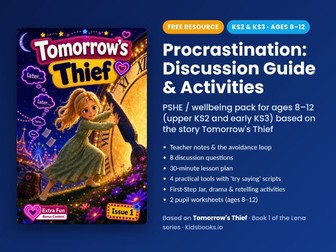
Free 7-page PSHE / wellbeing pack on procrastination for ages 8-12 (upper KS2 and early KS3): teacher notes, 8 discussion questions, a 30-minute lesson plan, 4 practical tools and 2 pupil worksheets. Why do children put things off - and how do we help them start? This pack turns the story of Lena, a bright girl who freezes before a maths championship, into a ready-to-teach session on procrastination: what it really is (fear-driven avoidance, not laziness), how to spot the “worry voice”, and how to take a five-minute first step. Written for PSHE, RSHE and wellbeing time, guided reading, and one-to-one ELSA or SENCO sessions. What’s inside (7 printable A4 pages) Teacher notes: story summary, learning objectives, curriculum links and the psychology of the avoidance loop (thought - feeling - escape - relief - repeat) 8 discussion questions for circle time, guided reading or a wellbeing lesson A 30-minute lesson plan 4 practical tools with “try saying” scripts for teachers, TAs and parents: catch the worry voice, put the thought on trial, the five-minute first step, the “If… then…” plan 3 activities: the First-Step Jar (with cut-out slips), an eight-step drama activity and a retelling task 2 pupil worksheets pitched at ages 8-12: “My Five-Minute First Step” and “Lena’s Notebook” (a five-day tracker) How to use it You do not need the book: page 2 summarises the story and the questions stand on their own. If you have read the story, it works as a follow-up guided-reading or PSHE lesson. Print pages 6-7 for pupils; the rest is for the adult. Page 4 can be sent home to parents. Curriculum links PSHE Association Programme of Study, KS2 Health and Wellbeing - Mental health (H17, H18, H19, H20, H24), continuing into the KS3 Mental health strand; DfE statutory Health Education - Mental wellbeing; also supports metacognition and self-regulation, and English reading comprehension (inference and discussion). About the story Tomorrow’s Thief is Book 1 of the Lena series by Kidsbooks - ten short, illustrated chapter books written for ages 8-12 and read comfortably up to Year 8, each about one feeling: procrastination, anger, worry, perfectionism, boredom and screen time, gratitude, feeling left out, online safety and self-worth. Every book has a Parent & Educator Guide bound into the back, with discussion questions, puzzles, activities and an original song, and is mapped to the PSHE Association Programme of Study. The stories are secular and every page is open to parents. Discussion guides for the other nine books will be added to this shop.