Year 11 countdown: GCSE English revision planQuick View
btl-education

Year 11 countdown: GCSE English revision plan

(0)
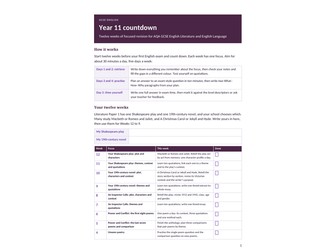
Year 11 students are often told to revise English without being told what that means for a subject with no list of facts to learn. This free Year 11 countdown turns it into twelve weeks, one focus a week, about thirty minutes a day, five days a week. Each week follows the same pattern. Days 1 and 2, retrieve: students write down everything they remember about the focus, check their notes and fill the gaps in a different colour, and test themselves on quotations. Days 3 and 4, practise: they plan an answer to an exam-style question in ten minutes, then write paragraphs from the plan. Day 5, time yourself: one full answer in exam time, marked against the level descriptors or handed to the teacher for feedback. The twelve weeks cover the whole of AQA GCSE English Literature and English Language: the Shakespeare play and the 19th-century novel for Literature Paper 1, An Inspector Calls, Power and Conflict poetry and unseen poetry for Paper 2, and the reading and writing questions for both Language papers. Students write their own set texts in at the top, so the plan works whichever Shakespeare play and novel your school teaches (Paper 2 weeks are written for An Inspector Calls and Power and Conflict, and are easy to change in the Word version). Each week has a tick box so progress is visible, the last week is a light one of short timed tasks and sleep, and a final section plans the days between papers, with the 2027 exam dates. How to use it: start twelve weeks before the first English exam and count down, or start it before mocks and run it twice. It works as a form-time or homework programme, as the backbone of a revision evening for parents, or as a plan that intervention tutors and students share. Teachers can set the Day 5 answer as a weekly homework and mark a sample. Why a countdown works: revision that is spread out and returns to each text more than once is far more effective than cramming, and short daily sessions are easier for a busy sixteen-year-old to keep up than long weekend blocks. The weekly routine also moves from remembering to applying to performing under time pressure, which is exactly the shift students need to make before the exam. Because every week ends with one timed answer, students build up a set of practice pieces that can be marked, compared and improved. What you get: the plan in Word, so you can change the order or the texts to suit your scheme, and as a print-ready PDF. Written by an experienced secondary English teacher for the AQA specification, and free to use and adapt in your school. It pairs well with our free Thesis Statement Builder for the essay practice days.
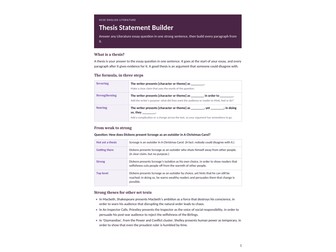
Thesis Statement Builder: GCSE English LiteratureQuick View
btl-education

Thesis Statement Builder: GCSE English Literature

(0)
Students who write good Literature essays nearly always know what they are arguing before they start. This free Thesis Statement Builder teaches them to answer any AQA GCSE English Literature essay question in one strong sentence, then build every paragraph from it. It explains what a thesis is in plain words: the answer to the question in one sentence, an argument that someone could disagree with, placed at the start of the essay so that every paragraph gives evidence for it. The formula comes in three steps, matching the three levels of support we use in all our lessons. Securing: the writer presents a character or theme as something, using the words of the question. Strengthening: add the writer’s purpose, what they wanted the audience or reader to think, feel or do. Soaring: add a complication or a change across the text, so the argument has somewhere to go. Each level has a sentence frame and a one-line explanation, so students can see exactly what the next step up looks like. A worked example on A Christmas Carol takes one question from a fact that nobody could disagree with, to a clear claim, to a thesis with a purpose and a turn. Students can then practise on their own set texts, and the frames work for any Shakespeare play, 19th-century novel, modern text or poetry comparison question on the AQA papers. How to use it: as a starter before essay practice, as a planning sheet stuck in books, in intervention sessions where students write only the thesis and the opening of a paragraph, or as a homework task in which students write three theses for three past questions. Why it matters: the AQA level descriptors reward a critical, exploratory response with a clear line of argument. Students who start with a thesis tend to select quotations that support a point rather than quotations they happen to remember, they write fewer paragraphs that simply retell the plot, and their conclusions say something rather than repeating the introduction. Also in the guide: strong example theses for Macbeth, An Inspector Calls and Ozymandias, so students can see the formula working on other texts; a Your turn section with five questions on A Christmas Carol, Macbeth and An Inspector Calls; and a five-point checklist students use to test their own thesis: does it answer the question that was asked, use the words of the question, make an argument someone could disagree with, name the writer’s purpose, and will every paragraph support it? That checklist on its own is a quick way to tackle the most common problems: a fact instead of an argument, a thesis that ignores the question, and an essay that forgets its own opening. What you get: the guide in Word, so you can change the examples to your own texts, and as a print-ready PDF. Written by an experienced secondary English teacher for the AQA specification, and free to use and adapt in your school.
Language Paper 2 intervention drill: free (AQA GCSE)Quick View
btl-education

Language Paper 2 intervention drill: free (AQA GCSE)

(0)
A complete, ready-to-teach 30-minute intervention session for AQA GCSE English Language Paper 2: Question 3: analysing how a writer uses language to describe a disaster, using Edward Whymper’s account of the 1865 Matterhorn accident. It is the first drill in our Raising Achievement set for Language Paper 2, a series of thirty short sessions built for Year 11 intervention, revision lessons and small-group catch-up. The set builds short, precise analysis of the language in Source A. Students zoom in on single words, name each word class with an adjective (the violent verb, the bleak adjective) and explain what the reader sees or feels and why the writer wants that, with one comment on a sentence form as well. Every drill runs the same routine, so students know what is coming and the session starts on time. A Do Now of five quick retrieval questions, answered in silence and self-marked. A focus reminder: what the question asks for, in three or four plain points. Read and check: an unseen public-domain extract with line numbers, then quick questions to make sure everyone has understood it. Zoom in: single words, their connotations, then a What, How, Why sentence. One technique, modelled on the extract. Then one timed exam question in AQA’s format, with a model answer to compare against, and a green pen checklist so students improve their answer before the sheets are collected. The drills are matched to the question formats examined from June 2026. Why short drills? Year 11 intervention often turns into a second go at the lesson, or an hour of essay writing that leaves no time for feedback. These sessions are deliberately narrow: one moment, one quotation or one question type, practised at pace. Literature drills stop at the plan or the introduction because that is where marks are usually won or lost, and because a plan can be checked and improved in the same session. The routine also makes the drills easy to hand to a colleague, a cover teacher or a tutor, since the slides carry teacher notes on every slide. What you get: the editable PowerPoint slides with notes on every slide, the printable student sheet in Word and PDF, and a short teacher guide that explains the routine, the common errors to watch for in this topic and how to run the session at pace. Answers and a model are included, so the drill can be self-marked or peer-marked. Who it is for: Year 10 and Year 11 classes, intervention groups, revision sessions and post-16 resit groups where relevant. It works with a whole class on the board or with a small group round a table, and it needs nothing but the sheet and a pen. Written by an experienced secondary English teacher for the AQA specification, and free to use and adapt in your school.
Unseen poetry intervention drill: free (AQA GCSE)Quick View
btl-education

Unseen poetry intervention drill: free (AQA GCSE)

(0)
A complete, ready-to-teach 25-minute intervention session for AQA GCSE English Literature Paper 2, Section C: how Emily Dickinson presents the speaker’s feelings about a snake. It is the first drill in our Raising Achievement set for Unseen poetry, a series of thirty short sessions built for Year 11 intervention, revision lessons and small-group catch-up. The set trains a reading routine for unseen poems about the natural world: what happens, who speaks, how it feels, then how the poet does it. The most common error is describing the creature and forgetting the speaker, so the drill keeps returning to what the poem makes the speaker, and the reader, feel. Every drill runs the same routine, so students know what is coming and the session starts on time. A Do Now of five quick retrieval questions, answered in silence and self-marked. A focus reminder: what the skill or exam question asks for, in three or four plain points. Read and check: the extract with line numbers, then quick questions to make sure everyone has understood it. A quotation explosion: one important quotation, exploded through AO1 and AO2 questions (AO3 is not assessed in this section). One technique, modelled on the extract. Then the question itself, in AQA’s wording: students plan an answer or write the introduction in eight minutes, never a full essay, and compare their work with a model. A second short task, Have a go, applies the same skill to a new moment, and a green pen checklist lets students improve their answer before the sheets are collected. Why short drills? Year 11 intervention often turns into a second go at the lesson, or an hour of essay writing that leaves no time for feedback. These sessions are deliberately narrow: one moment, one quotation or one question type, practised at pace. Literature drills stop at the plan or the introduction because that is where marks are usually won or lost, and because a plan can be checked and improved in the same session. The routine also makes the drills easy to hand to a colleague, a cover teacher or a tutor, since the slides carry teacher notes on every slide. What you get: the editable PowerPoint slides with notes on every slide, the printable student sheet in Word and PDF, and a short teacher guide that explains the routine, the common errors to watch for in this topic and how to run the session at pace. Answers and a model are included, so the drill can be self-marked or peer-marked. Who it is for: Year 10 and Year 11 classes, intervention groups, revision sessions and post-16 resit groups where relevant. It works with a whole class on the board or with a small group round a table, and it needs nothing but the sheet and a pen. Written by an experienced secondary English teacher for the AQA specification, and free to use and adapt in your school.
Power and Conflict poetry intervention drill: free (AQA GCSE)Quick View
btl-education

Power and Conflict poetry intervention drill: free (AQA GCSE)

(0)
A complete, ready-to-teach 28-minute intervention session for AQA GCSE English Literature Paper 2, Section B: how Shelley shows that a ruler’s power does not last in Ozymandias. It is the first drill in our Raising Achievement set for Power and Conflict poetry, a series of thirty short sessions built for Year 11 intervention, revision lessons and small-group catch-up. The set covers ‘Ozymandias’, ‘My Last Duchess’ and ‘London’: rulers and systems that control other people. The most common error is retelling the story of the statue instead of saying how the poet presents power, so the drill keeps asking who holds power in the poem and who pays for it. Every drill runs the same routine, so students know what is coming and the session starts on time. A Do Now of five quick retrieval questions, answered in silence and self-marked. A focus reminder: what the skill or exam question asks for, in three or four plain points. Read and check: the extract with line numbers, then quick questions to make sure everyone has understood it. A quotation explosion: one important quotation, exploded through AO1, AO2 and AO3 questions. One technique, modelled on the extract. Then the question itself, in AQA’s wording: students plan an answer or write the introduction in eight minutes, never a full essay, and compare their work with a model. A second short task, Have a go, applies the same skill to a new moment, and a green pen checklist lets students improve their answer before the sheets are collected. Why short drills? Year 11 intervention often turns into a second go at the lesson, or an hour of essay writing that leaves no time for feedback. These sessions are deliberately narrow: one moment, one quotation or one question type, practised at pace. Literature drills stop at the plan or the introduction because that is where marks are usually won or lost, and because a plan can be checked and improved in the same session. The routine also makes the drills easy to hand to a colleague, a cover teacher or a tutor, since the slides carry teacher notes on every slide. What you get: the editable PowerPoint slides with notes on every slide, the printable student sheet in Word and PDF, and a short teacher guide that explains the routine, the common errors to watch for in this topic and how to run the session at pace. Answers and a model are included, so the drill can be self-marked or peer-marked. Who it is for: Year 10 and Year 11 classes, intervention groups, revision sessions and post-16 resit groups where relevant. It works with a whole class on the board or with a small group round a table, and it needs nothing but the sheet and a pen. Written by an experienced secondary English teacher for the AQA specification, and free to use and adapt in your school.
Jekyll and Hyde intervention drill: free (AQA GCSE)Quick View
btl-education

Jekyll and Hyde intervention drill: free (AQA GCSE)

(0)
A complete, ready-to-teach 30-minute intervention session for AQA GCSE English Literature Paper 1, Section B: how Stevenson presents Hyde when Utterson meets him for the first time. It is the first drill in our Raising Achievement set for The Strange Case of Dr Jekyll and Mr Hyde, a series of thirty short sessions built for Year 11 intervention, revision lessons and small-group catch-up. The set follows Hyde from his first meeting with Utterson to the hotel in Chapter 10, as an outsider, an animal and a figure of evil. The most common error is describing Hyde’s looks in detail when the novel refuses to; this drill pushes students to write about how other characters react to him instead. Every drill runs the same routine, so students know what is coming and the session starts on time. A Do Now of five quick retrieval questions, answered in silence and self-marked. A focus reminder: what the skill or exam question asks for, in three or four plain points. Read and check: the extract with line numbers, then quick questions to make sure everyone has understood it. A quotation explosion: one important quotation, exploded through AO1, AO2 and AO3 questions. One technique, modelled on the extract. Then the question itself, in AQA’s wording: students plan an answer or write the introduction in eight minutes, never a full essay, and compare their work with a model. A second short task, Have a go, applies the same skill to a new moment, and a green pen checklist lets students improve their answer before the sheets are collected. Why short drills? Year 11 intervention often turns into a second go at the lesson, or an hour of essay writing that leaves no time for feedback. These sessions are deliberately narrow: one moment, one quotation or one question type, practised at pace. Literature drills stop at the plan or the introduction because that is where marks are usually won or lost, and because a plan can be checked and improved in the same session. The routine also makes the drills easy to hand to a colleague, a cover teacher or a tutor, since the slides carry teacher notes on every slide. What you get: the editable PowerPoint slides with notes on every slide, the printable student sheet in Word and PDF, and a short teacher guide that explains the routine, the common errors to watch for in this topic and how to run the session at pace. Answers and a model are included, so the drill can be self-marked or peer-marked. Who it is for: Year 10 and Year 11 classes, intervention groups, revision sessions and post-16 resit groups where relevant. It works with a whole class on the board or with a small group round a table, and it needs nothing but the sheet and a pen. Written by an experienced secondary English teacher for the AQA specification, and free to use and adapt in your school.
A Christmas Carol intervention drill: free (AQA GCSE)Quick View
btl-education

A Christmas Carol intervention drill: free (AQA GCSE)

(0)
A complete, ready-to-teach 27-minute intervention session for AQA GCSE English Literature Paper 1, Section B: how Dickens presents Scrooge’s attitude to Christmas. It is the first drill in our Raising Achievement set for A Christmas Carol, a series of thirty short sessions built for Year 11 intervention, revision lessons and small-group catch-up. The set follows Scrooge from the miser of Stave 1 to the generous man of Stave 5. The most common error is writing about Scrooge as a real person (‘Scrooge is mean’) instead of Dickens’s creation (‘Dickens presents Scrooge as…’), and this drill uses one of his sharpest early lines to practise exactly that shift. Every drill runs the same routine, so students know what is coming and the session starts on time. A Do Now of five quick retrieval questions, answered in silence and self-marked. A focus reminder: what the skill or exam question asks for, in three or four plain points. Read and check: the extract with line numbers, then quick questions to make sure everyone has understood it. A quotation explosion: one important quotation, exploded through AO1, AO2 and AO3 questions. One technique, modelled on the extract. Then the question itself, in AQA’s wording: students plan an answer or write the introduction in eight minutes, never a full essay, and compare their work with a model. A second short task, Have a go, applies the same skill to a new moment, and a green pen checklist lets students improve their answer before the sheets are collected. Why short drills? Year 11 intervention often turns into a second go at the lesson, or an hour of essay writing that leaves no time for feedback. These sessions are deliberately narrow: one moment, one quotation or one question type, practised at pace. Literature drills stop at the plan or the introduction because that is where marks are usually won or lost, and because a plan can be checked and improved in the same session. The routine also makes the drills easy to hand to a colleague, a cover teacher or a tutor, since the slides carry teacher notes on every slide. What you get: the editable PowerPoint slides with notes on every slide, the printable student sheet in Word and PDF, and a short teacher guide that explains the routine, the common errors to watch for in this topic and how to run the session at pace. Answers and a model are included, so the drill can be self-marked or peer-marked. Who it is for: Year 10 and Year 11 classes, intervention groups, revision sessions and post-16 resit groups where relevant. It works with a whole class on the board or with a small group round a table, and it needs nothing but the sheet and a pen. Written by an experienced secondary English teacher for the AQA specification, and free to use and adapt in your school.
Romeo and Juliet intervention drill: free (AQA GCSE)Quick View
btl-education

Romeo and Juliet intervention drill: free (AQA GCSE)

(0)
A complete, ready-to-teach 25-minute intervention session for AQA GCSE English Literature Paper 1, Section A: how the Prince presents the feud as a danger to the whole city. It is the first drill in our Raising Achievement set for Romeo and Juliet, a series of thirty short sessions built for Year 11 intervention, revision lessons and small-group catch-up. The set covers the feud, Tybalt, Mercutio, the Prince and the fight at the tomb, so students can trace how violence spreads from servants to masters to the lovers themselves. A common error is treating the feud as background; this drill puts it at the centre, through the Prince’s speech in Act 1. Every drill runs the same routine, so students know what is coming and the session starts on time. A Do Now of five quick retrieval questions, answered in silence and self-marked. A focus reminder: what the skill or exam question asks for, in three or four plain points. Read and check: the extract with line numbers, then quick questions to make sure everyone has understood it. A quotation explosion: one important quotation, exploded through AO1, AO2 and AO3 questions. One technique, modelled on the extract. Then the question itself, in AQA’s wording: students plan an answer or write the introduction in eight minutes, never a full essay, and compare their work with a model. A second short task, Have a go, applies the same skill to a new moment, and a green pen checklist lets students improve their answer before the sheets are collected. Why short drills? Year 11 intervention often turns into a second go at the lesson, or an hour of essay writing that leaves no time for feedback. These sessions are deliberately narrow: one moment, one quotation or one question type, practised at pace. Literature drills stop at the plan or the introduction because that is where marks are usually won or lost, and because a plan can be checked and improved in the same session. The routine also makes the drills easy to hand to a colleague, a cover teacher or a tutor, since the slides carry teacher notes on every slide. What you get: the editable PowerPoint slides with notes on every slide, the printable student sheet in Word and PDF, and a short teacher guide that explains the routine, the common errors to watch for in this topic and how to run the session at pace. Answers and a model are included, so the drill can be self-marked or peer-marked. Who it is for: Year 10 and Year 11 classes, intervention groups, revision sessions and post-16 resit groups where relevant. It works with a whole class on the board or with a small group round a table, and it needs nothing but the sheet and a pen. Written by an experienced secondary English teacher for the AQA specification, and free to use and adapt in your school.
Language Paper 1 intervention: 30 drills (AQA GCSE)Quick View
btl-education

Language Paper 1 intervention: 30 drills (AQA GCSE)

(0)
Thirty short intervention sessions for AQA GCSE English Language Paper 1, each built for 25 to 30 minutes with Year 11 intervention groups, revision lessons or small-group catch-up. Every drill comes with editable slides with notes on every slide, a printable student sheet in Word and PDF, and answers, and a teacher guide explains the routine and the common errors to watch for. Every drill runs the same routine, so students know what is coming and the session starts on time: a Do Now of five retrieval questions, a reminder of what the question asks for, an unseen public-domain extract with quick checking questions, close work on single words, one technique modelled on the extract, then one timed question in AQA’s format with a model answer and a green pen checklist. The drills match the question formats examined from June 2026, and the writing drills end with a self-check against AQA’s levels. The thirty drills: 1. Toad sets off on the open road; 2. The red grass of the prairie; 3. Waiting in the hut on the moor; 4. Matthew meets Anne at the station; 5. Kew Gardens in July; 6. Buck’s first night in the snow; 7. The red flags on the line; 8. Hannay on the run in the hills; 9. Collision in the fog; 10. Dawn on the moon; 11. Valentin watches the passengers; 12. The figure on the shore; 13. The stranger on the night train; 14. The tripod in the storm; 15. The stranger at the Coach and Horses; 16. Back to the empty camp; 17. Sara and the girl on the area steps; 18. A sky full of feathers; 19. The beach at the end of the world; 20. It is nearer; 21. Digging to Australia; 22. Della’s decision; 23. A town trying not to blow away; 24. The wall of the world; 25. Moulsey Lock on a Sunday; 26. Carol arrives at Gopher Prairie; 27. The wagon trails on the windy ridge; 28. The fog rolls in; 29. Lily on the train; 30. Watched by the wolf pack. Why short drills? Intervention often turns into a second go at the lesson, or an hour of essay writing that leaves no time for feedback. These sessions are deliberately narrow: one moment, one quotation or one question type, practised at pace. Because the slides carry notes on every slide, the drills are easy to hand to a colleague, a cover teacher or a tutor. What you get: one zip with the 30 slide decks (PowerPoint and PDF), the 30 student sheets (Word and PDF) and the teacher guide with answers, plus the teacher guide on its own so you can see it before you unzip. Licence: this is the Tes licence for one teacher, for use with their own classes. Tes also offers a school licence at checkout if your whole department will use it. The Word files are editable, so you can adapt them for your groups. Written by an experienced secondary English teacher for the AQA specification.
Macbeth intervention drill: free (AQA GCSE)Quick View
btl-education

Macbeth intervention drill: free (AQA GCSE)

(0)
A complete, ready-to-teach 25-minute intervention session for AQA GCSE English Literature Paper 1, Section A: how Macbeth reacts when the first prophecy comes true. It is the first drill in our Raising Achievement set for Macbeth, a series of thirty short sessions built for Year 11 intervention, revision lessons and small-group catch-up. The set follows Macbeth from the shaken man of Act 1 to the tyrant of Act 5, one big moment at a time. The most common error is writing about him as a real person (‘Macbeth is evil’) rather than as Shakespeare’s creation (‘Shakespeare presents Macbeth as…’), and the teacher guide shows how to push students away from retelling the plot and towards one word and what it suggests. Every drill runs the same routine, so students know what is coming and the session starts on time. A Do Now of five quick retrieval questions, answered in silence and self-marked. A focus reminder: what the skill or exam question asks for, in three or four plain points. Read and check: the extract with line numbers, then quick questions to make sure everyone has understood it. A quotation explosion: one important quotation, exploded through AO1, AO2 and AO3 questions. One technique, modelled on the extract. Then the question itself, in AQA’s wording: students plan an answer or write the introduction in eight minutes, never a full essay, and compare their work with a model. A second short task, Have a go, applies the same skill to a new moment, and a green pen checklist lets students improve their answer before the sheets are collected. Why short drills? Year 11 intervention often turns into a second go at the lesson, or an hour of essay writing that leaves no time for feedback. These sessions are deliberately narrow: one moment, one quotation or one question type, practised at pace. Literature drills stop at the plan or the introduction because that is where marks are usually won or lost, and because a plan can be checked and improved in the same session. The routine also makes the drills easy to hand to a colleague, a cover teacher or a tutor, since the slides carry teacher notes on every slide. What you get: the editable PowerPoint slides with notes on every slide, the printable student sheet in Word and PDF, and a short teacher guide that explains the routine, the common errors to watch for in this topic and how to run the session at pace. Answers and a model are included, so the drill can be self-marked or peer-marked. Who it is for: Year 10 and Year 11 classes, intervention groups, revision sessions and post-16 resit groups where relevant. It works with a whole class on the board or with a small group round a table, and it needs nothing but the sheet and a pen. Written by an experienced secondary English teacher for the AQA specification, and free to use and adapt in your school.
Language Paper 2 intervention: 30 drills (AQA GCSE)Quick View
btl-education

Language Paper 2 intervention: 30 drills (AQA GCSE)

(0)
Thirty short intervention sessions for AQA GCSE English Language Paper 2, each built for 25 to 30 minutes with Year 11 intervention groups, revision lessons or small-group catch-up. Every drill comes with editable slides with notes on every slide, a printable student sheet in Word and PDF, and answers, and a teacher guide explains the routine and the common errors to watch for. Every drill runs the same routine, so students know what is coming and the session starts on time: a Do Now of five retrieval questions, a reminder of what the question asks for, an unseen public-domain extract with quick checking questions, close work on single words, one technique modelled on the extract, then one timed question in AQA’s format with a model answer and a green pen checklist. The drills match the question formats examined from June 2026, and the writing drills end with a self-check against AQA’s levels. The thirty drills: 1. The rope broke on the Matterhorn; 2. Buying Modestine; 3. Two nights in Japan; 4. Meeting a hero; 5. In praise of doing nothing; 6. The preposterous box; 7. A palace on a temple; 8. Canoeing in the rain; 9. Learning to read; 10. Last bus home; 11. Trapped in the mangroves; 12. A shave in Paris; 13. Two climbs in the mist; 14. The boy who got the dream; 15. The cost of tea; 16. Into the courts; 17. Rules for the mistress; 18. First day of school; 19. Falling in; 20. Save our pool; 21. To the brim of the volcano; 22. The daffodils by the lake; 23. Two trains; 24. Lost on the hills; 25. Let them climb trees; 26. The top of the storm; 27. The road to Haworth; 28. A night outdoors; 29. Ancient stones; 30. Keep the field. Why short drills? Intervention often turns into a second go at the lesson, or an hour of essay writing that leaves no time for feedback. These sessions are deliberately narrow: one moment, one quotation or one question type, practised at pace. Because the slides carry notes on every slide, the drills are easy to hand to a colleague, a cover teacher or a tutor. What you get: one zip with the 30 slide decks (PowerPoint and PDF), the 30 student sheets (Word and PDF) and the teacher guide with answers, plus the teacher guide on its own so you can see it before you unzip. Licence: this is the Tes licence for one teacher, for use with their own classes. Tes also offers a school licence at checkout if your whole department will use it. The Word files are editable, so you can adapt them for your groups. Written by an experienced secondary English teacher for the AQA specification.
Unseen poetry intervention: 30 drills (AQA GCSE)Quick View
btl-education

Unseen poetry intervention: 30 drills (AQA GCSE)

(0)
Thirty short intervention sessions for Unseen poetry, AQA GCSE English Literature Paper 2, Section C, each built for 25 to 30 minutes with Year 11 intervention groups, revision lessons or small-group catch-up. Every drill comes with editable slides with notes on every slide, a printable student sheet in Word and PDF, and answers, and a teacher guide explains the routine and the common errors to watch for. Every drill runs the same routine, so students know what is coming and the session starts on time: a Do Now of five retrieval questions, a reminder of what the exam question asks for, the extract with quick checking questions, one important quotation exploded through AO1 and AO2 (AO3 is not assessed in this section), one technique modelled on the extract, then an exam-style question in AQA’s wording. Students plan an answer or write the introduction, never a full essay, compare their work with a model, try a second short task on a new moment, and improve their answer in green pen before the sheets are collected. The thirty drills: 1. A narrow fellow in the grass; 2. Spring; 3. Two Pewits; 4. Stars; 5. Signs of spring; 6. When You Are Old; 7. The Voice; 8. Time does not bring relief; 9. Sea Love; 10. When I am dead; 11. Arms and the Boy; 12. Returning, We Hear the Larks; 13. In Time of ‘The Breaking of Nations’; 14. Two sonnets for the dead; 15. Gone too young; 16. Into my heart an air that kills; 17. Beeny Cliff; 18. Places; 19. The Manor Farm; 20. Hills of home; 21. I’m nobody! Who are you?; 22. I Am; 23. Up-Hill; 24. Afterwards; 25. Young and foolish; 26. Strength in hard times; 27. Meeting a bird; 28. Treasured things; 29. Alone; 30. Changed places. Why short drills? Intervention often turns into a second go at the lesson, or an hour of essay writing that leaves no time for feedback. These sessions are deliberately narrow: one moment, one quotation or one question type, practised at pace. Literature drills stop at the plan or the introduction because that is where marks are usually won or lost, and because a plan can be checked and improved in the same session. Because the slides carry notes on every slide, the drills are easy to hand to a colleague, a cover teacher or a tutor. What you get: one zip with the 30 slide decks (PowerPoint and PDF), the 30 student sheets (Word and PDF) and the teacher guide with answers, plus the teacher guide on its own so you can see it before you unzip. Licence: this is the Tes licence for one teacher, for use with their own classes. Tes also offers a school licence at checkout if your whole department will use it. The Word files are editable, so you can adapt them for your groups. Written by an experienced secondary English teacher for the AQA specification.
A Christmas Carol: a quotation a day for DecemberQuick View
btl-education

A Christmas Carol: a quotation a day for December

(0)
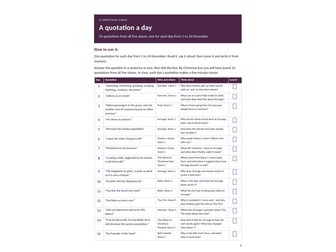
A Christmas Carol is the obvious text to revise in December, and this free resource turns the run-up to Christmas into a quotation a day. There are 24 quotations from all five staves, one for each day from 1 to 24 December. Each day has the quotation, who says it and where it comes in the novella, and a short question to think about, so students do more than memorise the words: they connect the quotation to character, theme and Dickens’s purpose. The routine is simple. Read it, say it aloud, cover it and write it from memory, answer the question in a sentence or two, then tick the box. By Christmas Eve, students have learnt 24 quotations spread across the whole text, which is far more useful in the exam than a long list of quotations from Stave 1. In class, each day’s quotation makes a ready-made five-minute starter. Put it on the board, cold-call the who-and-where, and ask two or three students for their answer to the question. Across December that is the best part of two hours of retrieval practice without planning anything new. At home, it works as a light, regular homework over the last weeks of the autumn term, or as something families can do together. It suits Year 10 classes who have just finished the text and Year 11 classes revising for mocks or for Literature Paper 1, Section B. Why quotations, and why spread out: in Literature Paper 1, Section B, students write about an extract and the whole novella, and the strongest answers move confidently to other moments in the text. That depends on having short, well-chosen quotations ready from every stave, not just the opening. Learning one a day, and returning to it with a question, is a small habit that adds up. The questions also prompt students to think about context and Dickens’s purpose, which is where many answers lose marks. The quotations are deliberately short, mostly a few words to a single line, so they can be remembered accurately and embedded in a sentence. They cover Scrooge before and after his change, the three spirits, Marley, the Cratchits, Fred, and Ignorance and Want, so together they support answers on character, theme and structure as well as on Christmas itself. What you get: the calendar in Word, so you can swap in the quotations you have taught, and as a print-ready PDF. Written by an experienced secondary English teacher for the AQA specification, and free to use and adapt in your school.
Language Paper 1 intervention drill: free (AQA GCSE)Quick View
btl-education

Language Paper 1 intervention drill: free (AQA GCSE)

(0)
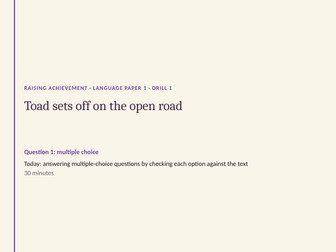
A complete, ready-to-teach 30-minute intervention session for AQA GCSE English Language Paper 1: answering the Question 1 multiple-choice format by checking each option against the text, using an extract from The Wind in the Willows. It is the first drill in our Raising Achievement set for Language Paper 1, a series of thirty short sessions built for Year 11 intervention, revision lessons and small-group catch-up. Question 1 looks like easy marks, and it is, as long as students check every option against the lines they have been given rather than answering from memory or general impression. This drill builds that habit with a short, lively public-domain extract. Every drill runs the same routine, so students know what is coming and the session starts on time. A Do Now of five quick retrieval questions, answered in silence and self-marked. A focus reminder: what the question asks for, in three or four plain points. Read and check: an unseen public-domain extract with line numbers, then quick questions to make sure everyone has understood it. Zoom in: single words, their connotations, then a What, How, Why sentence. One technique, modelled on the extract. Then one timed exam question in AQA’s format, with a model answer to compare against, and a green pen checklist so students improve their answer before the sheets are collected. The drills are matched to the question formats examined from June 2026. Why short drills? Year 11 intervention often turns into a second go at the lesson, or an hour of essay writing that leaves no time for feedback. These sessions are deliberately narrow: one moment, one quotation or one question type, practised at pace. Literature drills stop at the plan or the introduction because that is where marks are usually won or lost, and because a plan can be checked and improved in the same session. The routine also makes the drills easy to hand to a colleague, a cover teacher or a tutor, since the slides carry teacher notes on every slide. What you get: the editable PowerPoint slides with notes on every slide, the printable student sheet in Word and PDF, and a short teacher guide that explains the routine, the common errors to watch for in this topic and how to run the session at pace. Answers and a model are included, so the drill can be self-marked or peer-marked. Who it is for: Year 10 and Year 11 classes, intervention groups, revision sessions and post-16 resit groups where relevant. It works with a whole class on the board or with a small group round a table, and it needs nothing but the sheet and a pen. Written by an experienced secondary English teacher for the AQA specification, and free to use and adapt in your school.
An Inspector Calls intervention drill: free (AQA GCSE)Quick View
btl-education

An Inspector Calls intervention drill: free (AQA GCSE)

(0)
A complete, ready-to-teach 25-minute intervention session for AQA GCSE English Literature Paper 2, Section A: how Sheila begins to change in Act 1. It is the first drill in our Raising Achievement set for An Inspector Calls, a series of thirty short sessions built for Year 11 intervention, revision lessons and small-group catch-up. The set tracks Sheila and Eric, the clearest examples of change in the play, from Act 1 to the final curtain. Students often say Sheila changes all at once; this drill starts the work of showing her change in stages, act by act, with a quotation for each. Every drill runs the same routine, so students know what is coming and the session starts on time. A Do Now of five quick retrieval questions, answered in silence and self-marked. A focus reminder: what the skill or exam question asks for, in three or four plain points. Read and check: the extract with line numbers, then quick questions to make sure everyone has understood it. A quotation explosion: one important quotation, exploded through AO1, AO2 and AO3 questions. One technique, modelled on the extract. Then the question itself, in AQA’s wording: students plan an answer or write the introduction in eight minutes, never a full essay, and compare their work with a model. A second short task, Have a go, applies the same skill to a new moment, and a green pen checklist lets students improve their answer before the sheets are collected. Why short drills? Year 11 intervention often turns into a second go at the lesson, or an hour of essay writing that leaves no time for feedback. These sessions are deliberately narrow: one moment, one quotation or one question type, practised at pace. Literature drills stop at the plan or the introduction because that is where marks are usually won or lost, and because a plan can be checked and improved in the same session. The routine also makes the drills easy to hand to a colleague, a cover teacher or a tutor, since the slides carry teacher notes on every slide. What you get: the editable PowerPoint slides with notes on every slide, the printable student sheet in Word and PDF, and a short teacher guide that explains the routine, the common errors to watch for in this topic and how to run the session at pace. Answers and a model are included, so the drill can be self-marked or peer-marked. Who it is for: Year 10 and Year 11 classes, intervention groups, revision sessions and post-16 resit groups where relevant. It works with a whole class on the board or with a small group round a table, and it needs nothing but the sheet and a pen. Written by an experienced secondary English teacher for the AQA specification, and free to use and adapt in your school.
Power and Conflict poetry intervention: 30 drills (AQA GCSE)Quick View
btl-education

Power and Conflict poetry intervention: 30 drills (AQA GCSE)

(0)
Thirty short intervention sessions for Power and Conflict poetry, AQA GCSE English Literature Paper 2, Section B, each built for 25 to 30 minutes with Year 11 intervention groups, revision lessons or small-group catch-up. Every drill comes with editable slides with notes on every slide, a printable student sheet in Word and PDF, and answers, and a teacher guide explains the routine and the common errors to watch for. Every drill runs the same routine, so students know what is coming and the session starts on time: a Do Now of five retrieval questions, a reminder of what the exam question asks for, the extract with quick checking questions, one important quotation exploded through AO1, AO2 and AO3, one technique modelled on the extract, then an exam-style question in AQA’s wording. Students plan an answer or write the introduction, never a full essay, compare their work with a model, try a second short task on a new moment, and improve their answer in green pen before the sheets are collected. The thirty drills: 1. Look on my Works; 2. The lone and level sands; 3. The curtain I have drawn; 4. I gave commands; 5. Marks of weakness, marks of woe; 6. A huge peak, black and huge; 7. Huge and mighty forms; 8. Space is a salvo; 9. We are prepared; 10. Merciless iced east winds; 11. Theirs not to reason why; 12. Honour the charge they made; 13. Dropped like luxuries; 14. Slowly our ghosts drag home; 15. Probably armed, possibly not; 16. Steeled the softening; 17. Like a wishbone; 18. Spools of suffering; 19. Between the bath and pre-lunch beers; 20. As though he no longer existed; 21. An impression of sunlight; 22. My city hides behind me; 23. Bandage up me eye; 24. Toussaint de beacon; 25. Who was born to whom; 26. Mind-forg’d manacles; 27. Cold clockwork; 28. My bloody hands; 29. The dark prince; 30. The shapes that pride can make. Why short drills? Intervention often turns into a second go at the lesson, or an hour of essay writing that leaves no time for feedback. These sessions are deliberately narrow: one moment, one quotation or one question type, practised at pace. Literature drills stop at the plan or the introduction because that is where marks are usually won or lost, and because a plan can be checked and improved in the same session. Because the slides carry notes on every slide, the drills are easy to hand to a colleague, a cover teacher or a tutor. What you get: one zip with the 30 slide decks (PowerPoint and PDF), the 30 student sheets (Word and PDF) and the teacher guide with answers, plus the teacher guide on its own so you can see it before you unzip. Licence: this is the Tes licence for one teacher, for use with their own classes. Tes also offers a school licence at checkout if your whole department will use it. The Word files are editable, so you can adapt them for your groups. Written by an experienced secondary English teacher for the AQA specification.
Romeo and Juliet intervention: 30 drills (AQA GCSE)Quick View
btl-education

Romeo and Juliet intervention: 30 drills (AQA GCSE)

(0)
Thirty short intervention sessions for Romeo and Juliet, AQA GCSE English Literature Paper 1, Section A, each built for 25 to 30 minutes with Year 11 intervention groups, revision lessons or small-group catch-up. Every drill comes with editable slides with notes on every slide, a printable student sheet in Word and PDF, and answers, and a teacher guide explains the routine and the common errors to watch for. Every drill runs the same routine, so students know what is coming and the session starts on time: a Do Now of five retrieval questions, a reminder of what the exam question asks for, the extract with quick checking questions, one important quotation exploded through AO1, AO2 and AO3, one technique modelled on the extract, then an exam-style question in AQA’s wording. Students plan an answer or write the introduction, never a full essay, compare their work with a model, try a second short task on a new moment, and improve their answer in green pen before the sheets are collected. The thirty drills: 1. Rebellious subjects; 2. An artificial night; 3. Thy swan a crow; 4. Thus then in brief; 5. That villain Romeo; 6. My only love; 7. Juliet is the sun; 8. A wanton’s bird; 9. They stumble that run fast; 10. The clock struck nine; 11. Jesu, what haste; 12. The mad blood stirring; 13. Romeo must not live; 14. Come, night; 15. My three-hours wife; 16. Heaven is here; 17. Art thou a man?; 18. A Thursday let it be; 19. It was the lark; 20. An ill-divining soul; 21. I have done with thee; 22. What must be shall be; 23. This bloody knife; 24. Ever ruled by you; 25. The world is not thy friend; 26. Unhappy fortune; 27. Savage-wild; 28. Tempt not a desperate man; 29. A greater power; 30. O happy dagger. Why short drills? Intervention often turns into a second go at the lesson, or an hour of essay writing that leaves no time for feedback. These sessions are deliberately narrow: one moment, one quotation or one question type, practised at pace. Literature drills stop at the plan or the introduction because that is where marks are usually won or lost, and because a plan can be checked and improved in the same session. Because the slides carry notes on every slide, the drills are easy to hand to a colleague, a cover teacher or a tutor. What you get: one zip with the 30 slide decks (PowerPoint and PDF), the 30 student sheets (Word and PDF) and the teacher guide with answers, plus the teacher guide on its own so you can see it before you unzip. Licence: this is the Tes licence for one teacher, for use with their own classes. Tes also offers a school licence at checkout if your whole department will use it. The Word files are editable, so you can adapt them for your groups. Written by an experienced secondary English teacher for the AQA specification.
A Christmas Carol intervention: 30 drills (AQA GCSE)Quick View
btl-education

A Christmas Carol intervention: 30 drills (AQA GCSE)

(0)
Thirty short intervention sessions for A Christmas Carol, AQA GCSE English Literature Paper 1, Section B, each built for 25 to 30 minutes with Year 11 intervention groups, revision lessons or small-group catch-up. Every drill comes with editable slides with notes on every slide, a printable student sheet in Word and PDF, and answers, and a teacher guide explains the routine and the common errors to watch for. Every drill runs the same routine, so students know what is coming and the session starts on time: a Do Now of five retrieval questions, a reminder of what the exam question asks for, the extract with quick checking questions, one important quotation exploded through AO1, AO2 and AO3, one technique modelled on the extract, then an exam-style question in AQA’s wording. Students plan an answer or write the introduction, never a full essay, compare their work with a model, try a second short task on a new moment, and improve their answer in green pen before the sheets are collected. The thirty drills: 1. Boiled with his own pudding; 2. Keep its distance; 3. Picking a man’s pocket; 4. Poor boy; 5. Not a farthing less; 6. The chain I forged; 7. The light I give; 8. My life is very brief; 9. One great heap of black; 10. Lost the power for ever; 11. A sort of tank; 12. Brave in ribbons; 13. A little crutch; 14. Still as statues; 15. My little, little child; 16. Rich enough; 17. No more work tonight; 18. Home, home, home; 19. Weigh everything by Gain; 20. The haggard winter of his life; 21. Are there no prisons?; 22. The Insect on the leaf; 23. Ignorance and Want; 24. Reeked with crime; 25. A happier house; 26. A shame to quarrel; 27. Kind to me in this or that; 28. His own to make amends in; 29. Won-der-ful happiness; 30. Barred the Spirit out. Why short drills? Intervention often turns into a second go at the lesson, or an hour of essay writing that leaves no time for feedback. These sessions are deliberately narrow: one moment, one quotation or one question type, practised at pace. Literature drills stop at the plan or the introduction because that is where marks are usually won or lost, and because a plan can be checked and improved in the same session. Because the slides carry notes on every slide, the drills are easy to hand to a colleague, a cover teacher or a tutor. What you get: one zip with the 30 slide decks (PowerPoint and PDF), the 30 student sheets (Word and PDF) and the teacher guide with answers, plus the teacher guide on its own so you can see it before you unzip. Licence: this is the Tes licence for one teacher, for use with their own classes. Tes also offers a school licence at checkout if your whole department will use it. The Word files are editable, so you can adapt them for your groups. Written by an experienced secondary English teacher for the AQA specification.
Language Paper 1 revision set: AQA GCSE EnglishQuick View
btl-education

Language Paper 1 revision set: AQA GCSE English

(0)
A complete revision set for AQA GCSE English Language Paper 1, ready to print for a class or set as independent work. It has three parts: a 64-page revision workbook, a 31-page model answer pack and independent practice booklets at three levels, every file in Word and PDF. The revision workbook covers the paper question by question, the methods to know and 17 extracts to practise on. It then gives practice tasks at three levels, a guide to the exam, a timed question and suggested answers at the back, so students can check and correct their own work. The model answer pack sets 4 exam-style questions, each answered three times, at Securing, Strengthening and Soaring. Each model is labelled with the AQA level and a mark within it, never a grade. Numbered annotations show what each answer does well, a box explains why it sits in its level, and upgrade tasks ask students to move their own answer up. Students write their own answer first, then compare it with the models, which is far more useful than reading a model cold. The independent practice booklets come at Securing, Strengthening and Soaring, in a six-week version. Each week has one short text on reading and writing fiction and four questions, and takes about 20 minutes, so they work as homework alongside the scheme or as a revision programme in Year 11. Every task in the set comes at three levels around the same content. Securing tasks aim for a grade 4: check what happens and explain a quotation or a method clearly. Strengthening tasks aim for grades 5 to 6: explain the writer’s methods, their effects and the writer’s purpose. Soaring tasks aim for grades 7 to 9: build an argument, weigh up readings and write with control and precision. Because every level works on the same content, a class can answer one shared question while each student works at the right level, and students can move up a level whenever they are ready. How teachers use it: print the workbook for a revision fortnight before mocks; use one model answer as a whole-class lesson on what moves an answer up a level; set the independent practice weekly as homework; or give the set to intervention groups and tutors so everyone works from the same material. What you get (10 files): the revision workbook, the model answer pack and the independent practice booklets at three levels, each in editable Word and print-ready PDF. Licence: this is the Tes licence for one teacher, for use with their own classes. Tes also offers a school licence at checkout if your whole department will use it. The Word files are editable, so you can adapt them for your groups. Written by an experienced secondary English teacher for the AQA specification.
Language Paper 2 revision set: AQA GCSE EnglishQuick View
btl-education

Language Paper 2 revision set: AQA GCSE English

(0)
A complete revision set for AQA GCSE English Language Paper 2, ready to print for a class or set as independent work. It has three parts: a 61-page revision workbook, a 32-page model answer pack and independent practice booklets at three levels, every file in Word and PDF. The revision workbook covers the paper question by question, the methods to know, the forms for Question 5 and 11 extracts to practise on. It then gives practice tasks at three levels, a guide to the exam, a timed question and suggested answers at the back, so students can check and correct their own work. The model answer pack sets 4 exam-style questions, each answered three times, at Securing, Strengthening and Soaring. Each model is labelled with the AQA level and a mark within it, never a grade. Numbered annotations show what each answer does well, a box explains why it sits in its level, and upgrade tasks ask students to move their own answer up. Students write their own answer first, then compare it with the models, which is far more useful than reading a model cold. The independent practice booklets come at Securing, Strengthening and Soaring, in a six-week version. Each week has one short text on reading and writing non-fiction and four questions, and takes about 20 minutes, so they work as homework alongside the scheme or as a revision programme in Year 11. Every task in the set comes at three levels around the same content. Securing tasks aim for a grade 4: check what happens and explain a quotation or a method clearly. Strengthening tasks aim for grades 5 to 6: explain the writer’s methods, their effects and the writer’s purpose. Soaring tasks aim for grades 7 to 9: build an argument, weigh up readings and write with control and precision. Because every level works on the same content, a class can answer one shared question while each student works at the right level, and students can move up a level whenever they are ready. How teachers use it: print the workbook for a revision fortnight before mocks; use one model answer as a whole-class lesson on what moves an answer up a level; set the independent practice weekly as homework; or give the set to intervention groups and tutors so everyone works from the same material. What you get (10 files): the revision workbook, the model answer pack and the independent practice booklets at three levels, each in editable Word and print-ready PDF. Licence: this is the Tes licence for one teacher, for use with their own classes. Tes also offers a school licence at checkout if your whole department will use it. The Word files are editable, so you can adapt them for your groups. Written by an experienced secondary English teacher for the AQA specification.
Power and Conflict poetry revision set (AQA GCSE)Quick View
btl-education

Power and Conflict poetry revision set (AQA GCSE)

(0)
A complete revision set for Power and Conflict poetry, AQA GCSE English Literature Paper 2, Section B, ready to print for a class or set as independent work. It has three parts: a 48-page revision workbook, a 26-page model answer pack and independent practice booklets at three levels, every file in Word and PDF. The revision workbook covers all fifteen poems, how to compare two poems and 30 quotations to learn. It then gives practice tasks at three levels, a guide to the exam, a timed question, a glossary of the vocabulary taught in the lessons, and suggested answers at the back so students can check and correct their own work. The model answer pack sets 3 exam-style questions, each answered three times, at Securing, Strengthening and Soaring. Each model is labelled with the AQA level and a mark within it, never a grade. Numbered annotations show what each answer does well, a box explains why it sits in its level, and upgrade tasks ask students to move their own answer up. Students write their own answer first, then compare it with the models, which is far more useful than reading a model cold. The independent practice booklets come at Securing, Strengthening and Soaring, in six-week and nine-week versions. Each week has one short text on the context and ideas behind the poems and four questions, and takes about 20 minutes, so they work as homework alongside the scheme or as a revision programme in Year 11. Before each week, students meet the next part of the text and answer five check questions, with answers at the back. Every task in the set comes at three levels around the same content. Securing tasks aim for a grade 4: check what happens and explain a quotation or a method clearly. Strengthening tasks aim for grades 5 to 6: explain the writer’s methods and link them to context and purpose. Soaring tasks aim for grades 7 to 9: build an argument, weigh up readings and connect ideas across the whole text. Because every level works on the same content, a class can answer one shared question while each student works at the right level, and students can move up a level whenever they are ready. How teachers use it: print the workbook for a revision fortnight before mocks; use one model answer as a whole-class lesson on what moves an answer up a level; set the independent practice weekly as homework; or give the set to intervention groups and tutors so everyone works from the same material. What you get (16 files): the revision workbook, the model answer pack and the independent practice booklets at three levels in six-week and nine-week versions, each in editable Word and print-ready PDF. Licence: this is the Tes licence for one teacher, for use with their own classes. Tes also offers a school licence at checkout if your whole department will use it. The Word files are editable, so you can adapt them for your groups. Written by an experienced secondary English teacher for the AQA specification.