


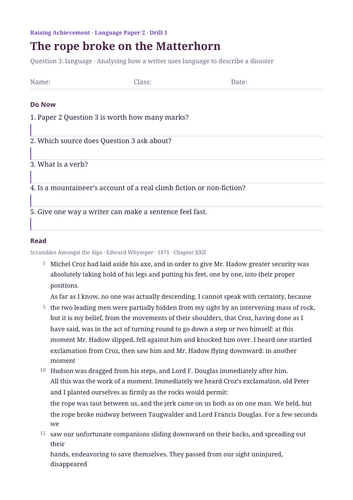
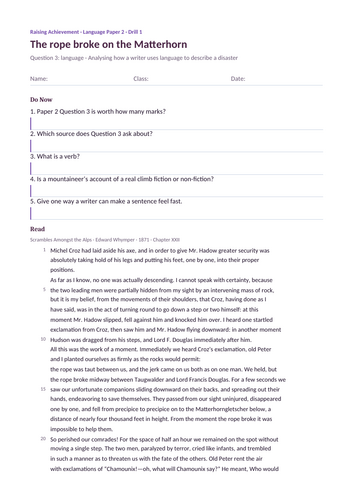
A complete, ready-to-teach 30-minute intervention session for AQA GCSE English Language Paper 2: Question 3: analysing how a writer uses language to describe a disaster, using Edward Whymper’s account of the 1865 Matterhorn accident. It is the first drill in our Raising Achievement set for Language Paper 2, a series of thirty short sessions built for Year 11 intervention, revision lessons and small-group catch-up.
The set builds short, precise analysis of the language in Source A. Students zoom in on single words, name each word class with an adjective (the violent verb, the bleak adjective) and explain what the reader sees or feels and why the writer wants that, with one comment on a sentence form as well.
Every drill runs the same routine, so students know what is coming and the session starts on time. A Do Now of five quick retrieval questions, answered in silence and self-marked. A focus reminder: what the question asks for, in three or four plain points. Read and check: an unseen public-domain extract with line numbers, then quick questions to make sure everyone has understood it. Zoom in: single words, their connotations, then a What, How, Why sentence. One technique, modelled on the extract. Then one timed exam question in AQA’s format, with a model answer to compare against, and a green pen checklist so students improve their answer before the sheets are collected. The drills are matched to the question formats examined from June 2026.
Why short drills? Year 11 intervention often turns into a second go at the lesson, or an hour of essay writing that leaves no time for feedback. These sessions are deliberately narrow: one moment, one quotation or one question type, practised at pace. Literature drills stop at the plan or the introduction because that is where marks are usually won or lost, and because a plan can be checked and improved in the same session. The routine also makes the drills easy to hand to a colleague, a cover teacher or a tutor, since the slides carry teacher notes on every slide.
What you get: the editable PowerPoint slides with notes on every slide, the printable student sheet in Word and PDF, and a short teacher guide that explains the routine, the common errors to watch for in this topic and how to run the session at pace. Answers and a model are included, so the drill can be self-marked or peer-marked.
Who it is for: Year 10 and Year 11 classes, intervention groups, revision sessions and post-16 resit groups where relevant. It works with a whole class on the board or with a small group round a table, and it needs nothing but the sheet and a pen. Written by an experienced secondary English teacher for the AQA specification, and free to use and adapt in your school.
Something went wrong, please try again later.
This resource hasn't been reviewed yet
To ensure quality for our reviews, only customers who have downloaded this resource can review it
Report this resourceto let us know if it violates our terms and conditions.
Our customer service team will review your report and will be in touch.
£0.00