Writing to DescribeQuick View
ClareJaap

Writing to Describe

(0)
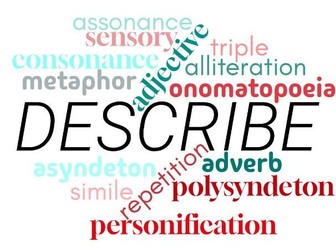
These resources are aimed at students in years 10-11 who are sitting GCSE English exams, and in FE or Adult Education who are resitting or taking the exams for the first time. Resources include PDF and Word documents: Information sheet: a list of 10 descriptive language devices. PDF and Word. Worksheet: Identify the language devices used in 12 sentences . PDF and Word. Game: Descriptive Language Pelmanism (aka Pairs) - with an instruction sheet. PDF only. PowerPoint presentation: Descriptive Language Devices.pptx. 9 language devices with explanation, examples and quotes from well-known authors, interspersed with short tasks. Editable file. PowerPoint presentation: Developing Descriptive Writing.pptx. Building up descriptive writing skills through example. Ends with an independent writing task. Editable file.
Persuasive language sorting/matching taskQuick View
ClareJaap

Persuasive language sorting/matching task

(1)
Designed for GCSE English Language groups, this is a useful plenary task, or revision/recap task at the start of a session. It comprises tiles divided into 3 categories: persuasive technique, example and why it is effective. Print, laminate if you wish, and cut out tiles. You could add images as well. Mix them up and ask students in pairs or groups to sort out and match up the tiles . My students in years 10-11,post-16 and adult education always enjoy this task, and it promotes discussion and peer learning.
Wordsearch - Features of an articleQuick View
ClareJaap

Wordsearch - Features of an article

(0)
Aimed at GCSE English Language and Functional Skills Level 1 and 2 English students. Students search the grid for nine key elements of articles. This is a useful opening task to start a session about article writing. It familiarises students with the key elements, and because they are focussed on searching for the terms, they begin to commit them to memory. On top of that, it is well received by students who find it challenging as well as those who just find it fun. I have used this example with post-16 students, who like to compete with each other and to help each other out.