History by John Burnside - PresentationQuick View
laurieashwell

History by John Burnside - Presentation

(3)
This resource is a presentation on History - a poem by John Burnside. Please note that although this resource could be used as the basis for a lesson it does not contain extensive tasks for students to do. What it does contain is a close analysis of the poem, stanza by stanza, helping students to understand the poem and understand how the poet uses methods (such as enjambment, contrasts, alliteration, imagery, tonal shifts and symbolism etc) to assist in the communication of his ideas. The presentation would probably take at least 40 minutes and slides are animated to reveal more and more analysis and explanation as and when the teacher feels ready to move on. The PPT includes 14 slides: Slide 1: title slide Slide 2: homework review slide (This slide can be used in the previous lesson for setting homework on student’s initial response to ‘History’. It has 4 short answer questions to get students thinking about the poem.) Slides 3-12: each slide looks at a stanza in close detail. The stanza is featured on the slide for ease of reference. Animated green text boxes appear with a click of the mouse/space bar to provide an analytical observation on a specific feature of the stanza. After all green text boxes have been revealed a yellow text box is revealed that lists all of the methods the poet has used in the stanza, all of which will have been covered by the green text boxes. This is simply to draw students’ attention towards acknowledging that what has been discussed is intimately linked to the ‘methods’ the poet uses - something that is crucial for students’ success in the exam. Finally a grey text box is revealed which summarises what the stanza is about. Slide 13: time for Q&A on the poem - students could write their questions on a post-it note Slide 14: possible examination questions I am a qualified English teacher working in the UK state school system.
'A Taste of Honey'- SOW Lessons and ResourcesQuick View
laurieashwell

'A Taste of Honey'- SOW Lessons and Resources

(1)
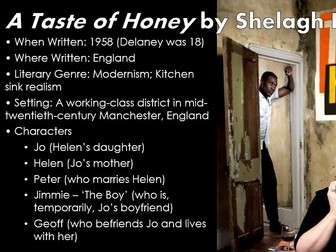
All lessons and resources for ‘A Taste of Honey’ for CIE IGCSE English Lit. All the lesson slides are within a single PPT (87 slides). The lessons are clearly divided. I hope the lessons are engaging, providing tasks for students to complete that get them thinking. As well as the teaching resources for lessons, there are also 6 exam papers that I have created which, for me, were useful having finished the ‘teaching’ of the play and exam technique became a bigger focus in lessons. (And, I have also included one model answer which I enjoyed writing under timed conditions, alongside my students!) UPDATE: I’ve also added an updated version of the PPT for all lessons with a workbook rather than all of the separate resources. If you can print the workbook as a booklet, preparation of resources will be much easier.
TOK AOK: History and Knowledge - LessonsQuick View
laurieashwell

TOK AOK: History and Knowledge - Lessons

(0)
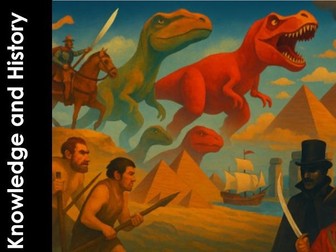
A PPT with 3 lessons for exploring the nature of historical knowledge. Part 1: How certain can we be that our historical knowledge is the truth? Part 2: What is the relationship between power and historical knowledge? Part 3: How has the production of historical knowledge developed over time?
William Wordsworth - A ComplaintQuick View
laurieashwell

William Wordsworth - A Complaint

(2)
The resource is a PowerPoint presentation. The lesson's objective is to get students to understand and explore the poem, and to get students writing about poetry in an appropriate style for the GCSE English literature exam. The Edexcel English Literature GCSE requires students to include reference to contextual factors. The PPT therefore includes a slide summarising contextual factors that are relevant to this poem. This PowerPoint provides a way in to the poem, a slide summarising relevant contextual information (see above), slides that display each of the poem's 3 stanzas, a task slide for independent exploration lesson time (this could easily be adapted for group/pair work), a piece of model writing that explores and discusses a single phrase from the poem in detail (160 words), a prompt for students to produce their own piece of analysis in a similar style with a paragraph starter and target words, and finally a plenary where students quickly summarise their understanding of the poem's speaker. The lesson would take an hour to complete if the writing task was set for homework. Alternatively, the tasks could be stretched over two lessons. Please note, all animations will appear automatically except the animations on the first and final slides which require a click of the mouse or space bar. I am a qualified English teacher working in the UK.
TOK: Mathematics & Knowledge (AOK)Quick View
laurieashwell

TOK: Mathematics & Knowledge (AOK)

(0)
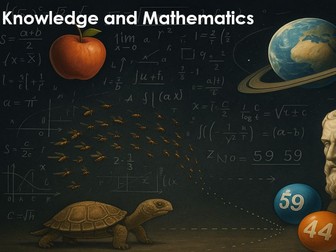
2 extended lessons (around 50 minutes each) plus one shorter lesson (around 30 minutes) with some general discussion questions on knowledge and mathematics. Lesson 1: We will identify how mathematics produces knowledge of our world and knowledge for our world. Lesson 2: We will identify the limits of mathematical knowledge. Lesson 3: We will explore mathematical knowledge in connection to perspectives, methods & tools, and ethics. One PPT with all the lessons clearly separated. (I am an English teacher so, if you are like me and not a mathematician, this PPT might be relatively accessible for you.)
Essay: The Theme of Isolation in 1984 by George OrwellQuick View
laurieashwell

Essay: The Theme of Isolation in 1984 by George Orwell

(0)
Essay Title: How does Orwell present the reader with the theme of isolation in Nineteen Eighty-Four? PDF Document Word Count: 2639 The essay is divided into sections with the following sub-headings: 1] Introduction 2] Social Isolation of Individuals 3] Social Isolation of Groups 4] Social Isolation through Compartmentalization (Isolation Between Genders) 5] Psychological Isolation 6] Isolation of Memories 7] Isolation of History and Ideas 8] Conclusion If required, the sub-headings could be omitted. All quotations are accompanied by chapter and part reference numbers in parenthesis following the quotation. I wrote the essay as a model essay for students and is my own original work. The essay does not quote or reference other scholars' works. I am an English literature graduate and qualified English teacher in the UK.
Non Fiction Extracts: Complete Mock for Edexcel Eng. Lang. GCSE, Paper 2, Section A (Inc Comparison)Quick View
laurieashwell

Non Fiction Extracts: Complete Mock for Edexcel Eng. Lang. GCSE, Paper 2, Section A (Inc Comparison)

(1)
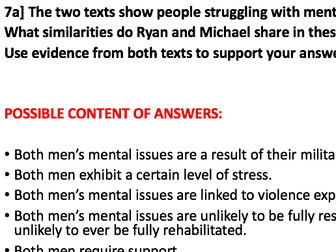
Complete mock practice paper in the style of Edexcel English Language GCSE, Paper 2, Section A. This is not simply 2 extracts - this has questions (1 to 7) and a mark scheme including indicative content. Can be used in lessons or as an assessment. Includes: 2 non fiction extracts - both about veterans' mental health conditions arising from combat overseas. Question and Answer Paper set out in the style of the examination board's Question and Answer Paper with space to write answers. Full mark scheme, including indicative content for all the extended answer questions (questions 3, 6, 7a and 7b).
TOK: The Arts and Knowledge (3 Lessons)Quick View
laurieashwell

TOK: The Arts and Knowledge (3 Lessons)

(0)
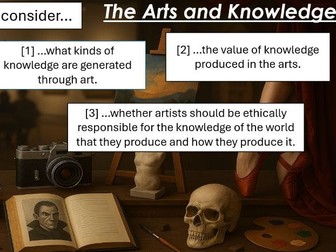
This PPT provides a series of 3 lessons for covering ‘The Arts and Knowledge’. The PPT is clearly split into 3 sections, exploring these 3 questions: 1] What kinds of knowledge are generated through art. 2] What is the value of knowledge produced through the arts. 3] Should artists be ethically responsible for the knowledge of the world that they produce and how they produce it. In terms of the TOK Framework: Part 1, therefore, relates mainly to scope. Part 2, therefore, relates mainly to perspective. Part 3, therefore, relates mainly to methods and tools & ethics. I would expect that each of the 3 lessons would take 45-60 minutes of lesson time. Each lesson ends with a plenary slide. The PPT contains 41 slides.
TOK - The Natural Sciences (AOK - 4 Lessons)Quick View
laurieashwell

TOK - The Natural Sciences (AOK - 4 Lessons)

(0)
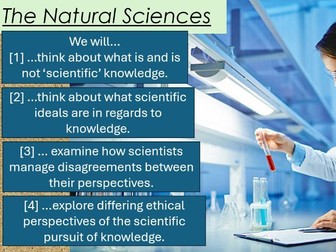
A set of four lessons on The Natural Sciences, aiming to develop students’ understanding of the nature of knowledge in this AOK. The PPT is split clearly into 4 parts: 1] Thinking about what is and is not knowledge in the natural sciences (with a focus on the concept of falsifiability). 2] Thinking about what scientific ideals are in regards to knowledge (and how and why those ideals, such as transparency or precision, for example, are not upheld). 3] Examine examine how scientists manage disagreements between their perspectives (with reference to phenomenon such as a paradigm shift or a reproducibility crisis, for example). 4] Explore differing ethical perspectives of the scientific pursuit of knowledge (with reference to deontological and utilitarian standpoints). The lessons include tasks that students work on independently and not overly didactic in nature - there are opportunities for students to apply the understanding they have gained, problem-solve and debate. Teaching time: probably around 3 hours 30 minutes.
The Wife of Bath (Edexcel English Lit. A Level) - 13 lessons on the Prologue (PPT) & 13 assessmentsQuick View
laurieashwell

The Wife of Bath (Edexcel English Lit. A Level) - 13 lessons on the Prologue (PPT) & 13 assessments

(1)
The PPT is very long and a large file. It has 13 lessons clearly ordered and takes students through the Prologue. Each lesson (except the first) would be taught after pupils read/studied the appropriate section independently for homework - each lesson is designed to develop their understanding of the section. Included are also 13 'assessments'. However, I have used them as a resource for lessons whereby the question provided is discussed, especially in regards to context and then pupils explore the given passage, paying particular attention to the AO2 (The Writer's Craft). Working through the 13 passages over a number of lessons, the pupils also kept a record of their understanding of each passage using the crib sheet template (also attached). This, and the 13 passages serves as a useful revision resource, and helps pupils feel confident about being about to select a 2nd passage in the exam.
Eat Me, The Lammas Hireling and Chainsaw Versus the Pampas Grass - 3 LessonsQuick View
laurieashwell

Eat Me, The Lammas Hireling and Chainsaw Versus the Pampas Grass - 3 Lessons

(1)
PPT for 3 lessons on 3 poems in the Edexcel A Level English Literature modern poetry component. Please note that possible answers to almost all of the shorter style questions that are asked can be found in the notes section at the bottom of the PPT screen. Also, the lessons on all 3 poems are sequenced on the same PPT file, starting with Eat Me, moving on to The Lammas Hireling and finishing with Chainsaw Versus the Pampas Grass. Homework tasks are included in the PPT. 1] Eat Me by Patience Agbabi - The lesson involves the following: - starter considering the title - 9 quick questions (for example, locating the use of certain methods in the text, such as assonance) - small group writing, continuing on from topic sentences that have been provided for students - an example of model writing - slide that sets homework on preparatory work forThe Lammas Hireling - slide prompting disucssion on the post-colonial interpretation of Eat Me 2] The Lammas Hireling by Ian Duhig - reviewing the homework that was set - task investigating students' basic comprehension of the poem's narrative - discussion including an investigation into the blurring of lines between opposing ideas and concepts, such as the real and the supernatural - task requiring students to review the importance of using topic sentences and then, using an examination style question, requiring students to come up with 3 suitable topic sentences that reference the methods of the poet - slide that sets homework on preparatory work for Chainsaw Versus the Pampas Grass 3] Chainsaw Versus the Pampas Grass by Simon Armitage - reviewing the homework that was set - discussion leading to short written task aimed at developing the depth of response students produce. Students look at a range of quotations in which personification is used, prompting them to broaden their analysis through consideration of nuances of meaning - task requiring students to identify the use of a range of poetic methods and make notes on the effects of those methods. Completion of this task to be set for homework I am a qualified English teacher working within the UK state school system.
(Hard Times) Edexcel English Language GCSE - Unseen 19th Century ExtractQuick View
laurieashwell

(Hard Times) Edexcel English Language GCSE - Unseen 19th Century Extract

(0)
The resources make use of an extract from Dickens' Hard Times for the purpose of preparing students for Section A of Paper 1 of the Edexcel English Language GCSE. The following are included: A PowerPoint presentation and an extract from Hard Times in various formats - 1] The 594 word extract, full size on a page of A4 in both Word and PDF formats 2] The same extract reduced in size and copied, fitting twice onto a page of A4 (for the purposes of saving on printing) in PDF format 3] The same extract followed by 4 questions set out over five A4 pages in the style of the Sample Assessment Materials provided by the board. (This resource could therefore be used as a mock paper.) It is provided in both the form of a Word document and a PDF document. 4] PPT: For teachers not wishing to use the resource as a mock paper and wishing to utilize the extract as a resource for their teaching, a PowerPoint presentation is also included. The PPT has 25 slides. It includes the following: i] Slides featuring each of the four questions ii] For each question tips and guidance is provided for students iii] Slides that set tasks to scaffold and plan their responses to questions 3 and 4 iv] 2 paragraphs of a model answer for question 4 v] The answers to questions 1 and 2 for students to self-assess vi] The generic mark schemes for questions 3 and 4 vii] Advice for students on common errors and an example of what to avoid doing If the PPT is used, the content could easily be spread over 3 lessons, perhaps in the following way: Lesson 1] Students familiarize themselves with the extract, answer questions 1 and 2 and plan their answers for question 3. Lesson 2] Students review their plan for answering question 3, write their answers and self-, peer or class assess. Lesson 3] Students plan their answers for question 4 in small groups and write their answers individually. The PPT can be used in all 3 lessons. Please note that animated timers are used within the PPT and teachers should click on the timer in order to activate it. Timers can only be activated in Slide Show mode. I am a qualified English teacher working in the UK's secondary state school education system.
Things Fall Apart - Lessons for the Whole UnitQuick View
laurieashwell

Things Fall Apart - Lessons for the Whole Unit

(0)
The PPT contains lessons that I created for an entire study of the whole novel. It contains 168 slides and lessons are clearly separated by lesson title slides. The PPT was designed for other teachers to be able to follow as I was creating this for the other teachers of the Grade 10 to follow. The final assessment at the end of the unit is a writing assessment that requires students to retell a narrative event of their choice from a specific character’s point-of-view, and include content that shows an understanding of the cultural practices of the tribe. I have also included the overview of the scheme of work. The lessons are ‘IB MYP’ style lessons. The Statement of Inquiry: Stories are an effective way to communicate a society’s cultural beliefs, traditions and values. Global Concepts: Personal and Cultural Expression Key concept: Communication Related concepts: Character & Context
I Wanna Be Yours - Edexcel GCSE English Lit. PoemQuick View
laurieashwell

I Wanna Be Yours - Edexcel GCSE English Lit. Poem

(0)
PPT includes: 1] Context Slide 2] Slide looking at homework that should be set in preparation for studying the poem - a list of keywords that aide discussion and communication of understanding. Students should check the definitions for homework before the lesson. 3] Slide for developing understanding of social realism 4] Slide that considers the title and what it tells the reader about the speaker 5] 1st stanza preceeded by key words to prompt class discussion/annotations and pictures to prompt exploration of imagery 6] 2nd stanza followed by key words to prompt independent annotations and pictures to prompt exploration of imagery 7] 3rd stanza with pictures to prompt exploration of imagery 8] Main task - 5 questions prompting students to develop their interpretation of the whole poem (questions could be assigned to groups) 9] Link to Youtube video of the Arctic Monkeys musical version of the poem 10] Plenary
TOK: Language and Knowledge - ScopeQuick View
laurieashwell

TOK: Language and Knowledge - Scope

(0)
This lesson explores the scope of language to create and share knowledge. Two central questions are addressed: 1] To what extent does language shape and limit the way we construct and share knowledge? 2] Are there forms of knowledge that cannot be adequately expressed through language? Students are directed to participate in collaborative tasks that seek to address the above questions.
Crow's Fall by Ted Hughes - Worksheet for Unseen PoemQuick View
laurieashwell

Crow's Fall by Ted Hughes - Worksheet for Unseen Poem

(0)
Crow's Fall is a short poem by Ted Hughes. This worksheet, featuring the poem on page 1 and a series of 17 questions on page 2, could be used by KS3 or KS4 while working on independence and confidence in forming intelligent responses to unseen poems. The worksheet could easily be set as work for a cover lesson. I have included a PPT that could accompany the worksheet and has a couple of swift starter activities. However, the final 4 slides of the PPT include the worksheet questions and, in animated text boxes, provide notes on possible answers to all of the questions on the worksheet. A teacher using this resource may, therefore, want to freeze the projection of these slides when going over students' answers to the worksheet. I am a qualified English teacher working in the UK state school system.
(Ligeia) Edexcel English Language GCSE - Unseen 19th Century ExtractQuick View
laurieashwell

(Ligeia) Edexcel English Language GCSE - Unseen 19th Century Extract

(0)
The lesson introduces pupils to the structure of Section A of Paper 1 of the Edexcel English Language GCSE. It uses a challenging extract from Edgar Allan Poe's 'Ligeia'. The Word Document is set out in the style of the Sample Assessment Materials provided by the board. The PPT is designed to guide students through the examination question by question - what to do and when to do it. I have used this resource successfully with a top year 10 set and a middle-ability year 10 set and used it over three 1 hour lessons. I am a qualified English teacher working in UK secondary state school education. Resources Included: 1] Word Document: 500 word extract from 'Ligeia' by Edgar Allan Poe. This is followed by 4 questions in the style of the Section A of Paper 1 of the Edexcel English Language GCSE. For example, the first question is worth 1 mark, the second question is worth 2 marks, the 3rd question is worth 6 marks and the 4th question is worth 15 marks. The document is set out like the sample assessment materials provided by the exam board with similar amounts of space for students to write their answers. The document is 5 pages in length as questions 3 and 4 combined require 3 pages of space for answers. 2] PowerPoint Presentation (15 slides): The PPT takes students through the examination focusing on examination technique and providing them with understanding of the examination. It includes model writing for explaining the effect of a structural feature for question 3 and a model paragraph as an example of how to answer question 4. It includes the mark schemes for question 3 and question 4. Answers for questions 1 and 2 are provided in the notes sections. It includes a list of possible structural features. It includes a list of ways in which writers create tension. It includes prompting for the planning of responses to question 4.
Frankenstein Extract & Worksheet - Cover Lesson ResourceQuick View
laurieashwell

Frankenstein Extract & Worksheet - Cover Lesson Resource

(0)
A resource that would be useful to set as work during a cover lesson. Most suitable for KS3 but could still be used by a KS4 class. Some of the tasks assume the student has access to the internet using a tablet device but, with the exception of the final 'extension' task which is a research task, all other tasks could be completed without access to the internet. The resource is a 6 page Microsoft Word document. Pages 1 and 2 feature an extract from Mary Shelley's Frankenstein. The next 4 pages feature a series of tasks: Task 1 - simply to read through the extract. Task 2 - vocabulary search - find words in the extract that match the given definitions. Task 3 - finding specific kinds of words, e.g. an adverb beginning with 'n' in paragraph 2. Task 4 - looking at the more challenging vocabulary used in a particular paragraph and providing definition of that vocabulary. (NOTE: the instruction for this task assumes students have access to the internet, or a dictionary, in order to look up the selected words, but the instruction could be adapted to ask students to make educated guesses.) Task 5 - identification of alliteration, a description of the sound of the alliteration and a comment on the affect of that alliteration. Task 6 - a closer look at how one paragraph presents the narrator and making alternative interpretations regarding the emotions of the narrator. Task 7 - simply re-reading the end of the extract. Task 8 - a short creative writing task that swaps the narrator's voice for the creature's. Task 9 - a research task (that assumes students have access to the internet) asking students to research who Dante was an what Dante's Inferno was about (it is referred to in the extract). I have used this resource with my year 8 students when setting cover work - they access the worksheet on their iPads and complete the tasks in their exercise books. It challenges them in different ways and, because of the large number of short answer questions and the variation between questions, keeps them engaged. A document providing answers for tasks 2 to 6 is also included. I am a qualified English teacher working in the UK state school system.
Introduction to Imaginative Writing (Edexcel GCSE English Language) - Teaching PPTQuick View
laurieashwell

Introduction to Imaginative Writing (Edexcel GCSE English Language) - Teaching PPT

(0)
This PPT aims to provide students with information about how to be successful in the exam, gain an idea of what to expect in the exam and provide guidance on how to plan in the exam. It includes: An introductory slide placing the component within the structure of the exams Example questions A brainstorming activity that gets students thinking about how to be successful in the exam Mark Schemes and AOs for students to develop their thoughts on the previous task Two example questions which students should choose from for practice A model example (albeit incomplete) of imaginative writing in response to one of the two example questions Scaffolded planning task Plenary I am a qualified English teacher working within the UK state school education system.
TOK: Knowledge and the Knower - PerspectiveQuick View
laurieashwell

TOK: Knowledge and the Knower - Perspective

(0)
A series of lessons on perspective, within the theme of ‘knowledge and the knower’. The PPT is split into 4 sections forming the 4 lessons: 1] What is, and is not, a perspective? 2] What shapes our perspectives? 3] Explore the relationship between culture and perspectives using an artifact to exemplify your thoughts. 4] Consider the importance of perspective in conjunction with mathematics. The PPT has 48 slides and I estimate that teaching time would be at least four hours.
Love's Dog - Jen Hatfield (PowerPoint)Quick View
laurieashwell

Love's Dog - Jen Hatfield (PowerPoint)

(0)
This PPT is designed to be used for teaching GCSE students the poem 'Love's Dog' by Jen Hatfield. The PPT was created in order to be user-friendly. It could, in theory, be used by an English teacher that has not even read the poem. It has the following main steps: 1] A starter that considers the poem's title. 2] A presentation of the poem itself that provides visuals and explanation of challenging vocabulary and references. 3] Focus on the form and structure of the poem, prompting interpretation - opportunity for short differentiated group work task. 4] A piece of model writing on the poem (188 words) that explores the imagery of one stanza and sets up further written responses from students. 5] A plenary. I am a qualified English teacher working in the UK.