This is a useful checklist for students as they progress through the IB Maths AA SL course. It maybe especially useful in the run up to mock exams and final exams.
A useful fill-in sheet to introduce histograms by first looking at equal class intervals and then by looking at changing them. The ‘answer’ sheet helps to see how I have used it in the classroom.
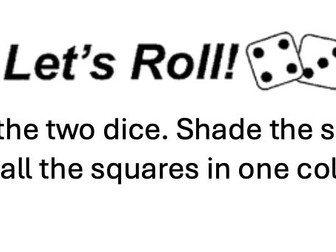
A worksheet to compare theoretical probability (calculated probability) with experimental probability. Students roll two dice (or a die twice) and add up the numbers on them. Starting from the bottom of the grid, they shade in their results until one column is filled up. They can compare their answers with others in the class and discuss their results. Note: Online dice can be used if there are not enough dice available.
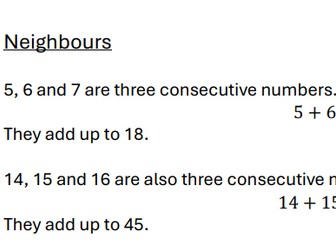
I have taken the ‘Three Neighbours’ investigation from nrich (https://nrich.maths.org/problems/three-neighbours) and scaffolded the investigation to guide students through the task.
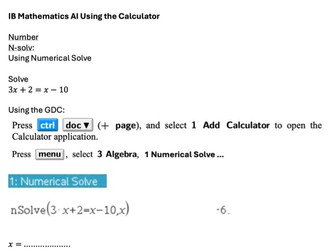
These notes introduce students to solving linear equations and polynomial equations using the TI-Inspire graphical calculator. I go through the first example and then the try one on their own.
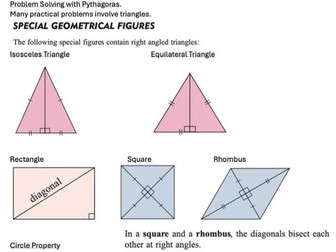
Going beyond finding the hypotenuse and a shorter side, this worksheet links Pythagoras’ theorem to geometric shapes and helps students to make connections between different topic areas.
First I explained the first page, showing how to find right angled triangles and then asked the class to use the first page to help them answer the questions on the second page. Each question requires more than just finding a missing side. The task should take around 20 minutes or so. Some questions came from TES author steele1989.
A useful fill-in sheet for explaining independent events and how they appear with tree diagrams. I have included my explanations on the teacher notes provided.
A short general knowledge quiz with questions based on sport, film and music. Suitable for use with a form class. Should take approximately 10 to 15 minutes.
This is an interesting question that requires students to think deeply about the problem. As a hint, you can ask the students to split the rectangle horizontally through the point P and look at the right-angled triangles formed. I have provided a solution to the problem too.