Market Research Workbook – Overview
This self-guided workbook introduces learners to the purpose and methods of market research, including primary and secondary research and quantitative and qualitative data.
Designed for independent completion, it is ideal for cover lessons, remote learning, revision, or coursework support. Activities build from knowledge checks to applied tasks, culminating in learners planning research for their own enterprise idea.
The workbook also supports preparation for Component 1 Learning Outcome 2, helping students develop research evidence that can feed directly into their coursework business planning.
Workbook Overview – SWOT and PESTLE Analysis
This workbook is a self-guided cover lesson designed to help learners understand and apply two key business analysis tools: SWOT and PESTLE. IT could also be used as part of a scheme of learning when teaching about SWOT and PESTLE analysis tools.
There are 9 pages - working though some theory and definitions of both SWOT and PESTLE analysis, some worked examples and then tasks for pupils to complete a SWOT and PESTLE analysis on a business of their choosing.
It has been created so that students can work through the material independently without teacher input, making it suitable for cover lessons, remote learning, revision, or coursework support.
It is also ideal preparation for Component 1 Learning Outcome 3 and can be used as part of controlled assessment preparation or for general revision of enterprise analysis skills.
PDF and Word document included so you can edit the booklet as needed.
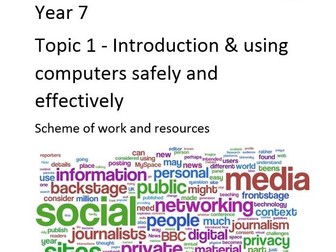
Complete collection of Scheme of work, lesson plans, Power Points and homework for Year 7 introduction to computing and ICT.
Includes:
Topic 1 - Introduction & using computers safely and effectively
• 7 Lessons, Power Points, Assessment, Homework and Pupil Progress Diary
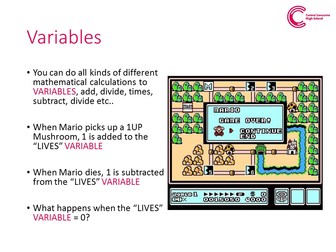
Topic 2 - Introduction to coding through Scratch
• 5 Lessons (can be stretched depending on pupil progress), Power Points, Assessment, homework and Pupil Progress Diary
Topic 3 - Spreadsheet Modelling
• 6 Lessons, Power Points, Assessment, homework and Pupil Progress Diary
All lessons are ready to teach and require minimal, if any preparation (may need tweaking to work with your school system) - everything is provided!
Pack includes a scheme of work with lesson objectives and lesson overview and how these lessons fit into and satisfy the new National Curriculum for Computing. Ideal resource for non-specialists to follow, or for a specialist to pick up and run with. Feel free to adapt the resources as needed. All lessons are ready to teach.
Year 8 and Year 9 packs also available, as is a bundle of all three.
Resources and past papers for the BTEC First Award in Business unit 2 exam.
** NEW ** UPDATED with presentations and worksheets for Learning aim A. learning aim B and C to follow once they are complete. There is also a tracking document for you to track individual student progress against each topic. **NEW**
Contains:
Scheme of work for the full unit
Unit introduction and overview
10+ Mock exams with answers
Specific unit content questions and worksheets (cashflow, budgets, breakeven etc...)
We have used these resources with Y10 and Y11 students to help them revise and gain confidence before taking the exam.
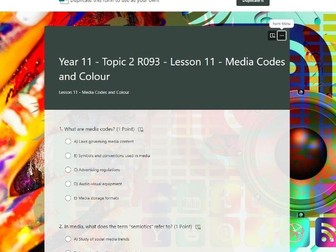
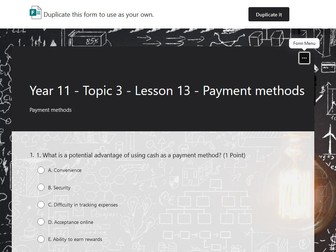
A series of low stake retrieval quizzes for use when teaching R093 (Exam unit) for the new iMedia Course.
Each quiz is 10 questions, multiple choice for use in Microsoft Forms.
These can be duplicated to your own account and distributed on your own homework/class work platform. They are self marking and allow quick and easy assessment of the key topics form this component.
When you click the link you will see a DUPLICATE IT button at the top, click this will add it to your Office 365 account for you to use as you wish.
You can edit them once they are duplicated to fit your needs.
Topics covered are as follows:
Lesson 1 - Media Sectors
Lesson 2 - Media Products
Lesson 3 - Creative Roles in the Media Industry
Lesson 4 & 5- Technical roles in the Media Industry
Lesson 6 - Purpose of media products
Lesson 7 - Genre, Language, and Tone
Lesson 8 - Style and layout
Lesson 9 - Audience
Lesson 10 - Client briefs
Lesson 11 - Media Codes and Colour
Lesson 12 - Graphics and typography
Lesson 13 - Lighting, Movement, and Mise-en-scène
Lesson 14 - Camera techniques and transitions
Lesson 15 - Audio
Lesson 16 - Animations and Interactivity
Lesson 17 - Work Plans and Gantt Charts
Lesson 18 - Mind Maps and Mood Boards
Lesson 19 - Storyboards and Scripts
Lesson 20 - Visualization Diagrams and Wireframes
Lesson 21 - Intellectual Property
Lesson 22 - Health and Safety
Lesson 23 - Regulation, Certification, and Classification
Lesson 24 - Distribution Platforms
Lesson 25 - Distribution Media
Lesson 26 - File Compression
Lesson 27 - Image File Types
Lesson 28 - Audio File Types
Lesson 29 - Video File Types
Full assignment brief and SOW for Unit 1 - Enterprise in the Business World
This passed the External Verification this year. Feel free to edit the work to suit your own needs.
Contains:
Scheme of work for the full unit
Unit introduction and overview
Assessment overview table
Assignment 1
Assignment 2
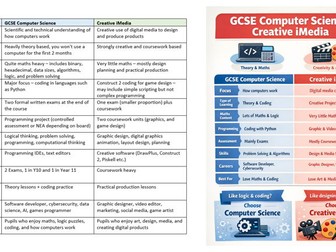
Edit for 2026 - Now includes a comparison between iMedia and Computer Science to help pupils make the right choice for their interests.
This interactive PPT presentation and comprehensive worksheet are designed to provide Year 9 students with an exciting introduction to the world of number systems. Ideal for a GCSE Computer Science taster session, this lesson offers a hands-on approach to mastering Decimal to Binary and Hex conversions.
Lesson Overview:
Course Introduction: Start with an overview of the GCSE Computer Science curriculum, showcasing its relevance to real-world technology and computing.
Conversion Mastery: Dive into the heart of the lesson by teaching students how to seamlessly convert between Decimal, Binary, and Hexadecimal number systems. This critical skill forms the foundation of computer science.
Interactive Learning:
The attached worksheet is designed for active learning, allowing students to immediately apply the concepts they’ve learned. As they follow the lesson, they’ll work through step-by-step exercises that reinforce their understanding.
Engaging Challenges:
Spot the Difference Challenge: A fun and interactive way for students to spot and correct mistakes in number conversions.
Mystery Box Puzzle: A captivating puzzle where students apply their new knowledge to uncover hidden hexadecimal values, adding an element of intrigue and excitement to the lesson.
Why This Lesson?
Interactive and Student-Centered: Encourages active participation with practical exercises.
Clear Learning Path: Guides students from understanding the basics of number systems to solving challenges using their new skills.
Perfect for Year 9 Students: Tailored to give students a taste of GCSE Computer Science and build their interest in the subject.
Can also be used for any lesson introducing the concept of Decimal, Binary and Hex number systems!
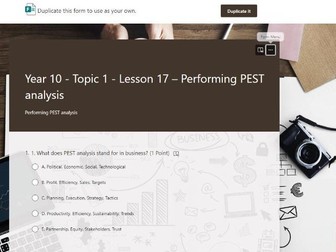
A series of low stake retrieval quizzes for use when teaching Component 1 (Exploring Enterprises) for the BTEC Tech Award in Enterprise.
Each quiz is 10 questions, multiple choice for use in Microsoft Forms.
These can be duplicated to your own account and distributed on your own homework/class work platform. They are self marking and allow quick and easy assessment of the key topics form this component.
When you click the link you will see a DUPLICATE IT button at the top, click this will add it to your Office 365 account for you to use as you wish.
You can edit them once they are duplicated to fit your needs.
Topics covered are as follows:
Lesson 1 – Size & type of enterprise
Lesson 2 – Features of SMEs
Lesson 3 – Business models
Lesson 4 – Sectors and industries
Lesson 5 – Aims of enterprises
Lesson 6 – Impact of activities on aims
Lesson 7 – Reasons why entrepreneurs start enterprises
Lesson 8 – Skills and characteristics of an entrepreneur
Lesson 9 – Understanding market research
Lesson 10 – Primary research methods
Lesson 11 – Secondary research methods
Lesson 12 – The importance of information about customers
Lesson 13 – Understanding the market
Lesson 14 – Competitive advantage
Lesson 15 – Suitability of market research methods
Lesson 16 – Understanding PEST analysis
Lesson 17 – Performing PEST analysis
Lesson 18 – Understanding SWOT analysis
Lesson 19 – Performing SWOT analysis
The other 2 components will be coming soon - keep an eye out.
A series of low stake retrieval quizzes for use when teaching Component 2 (Marketing and Finance for Enterprise) for the BTEC Tech Award in Enterprise.
Each quiz is 10 questions, multiple choice for use in Microsoft Forms.
These can be duplicated to your own account and distributed on your own homework/class work platform. They are self marking and allow quick and easy assessment of the key topics form this component.
When you click the link you will see a DUPLICATE IT button at the top, click this will add it to your Office 365 account for you to use as you wish.
You can edit them once they are duplicated to fit your needs.
Topics covered are as follows:
Lesson 1 - Types of Market
Lesson 2 - Segmenting the Market
Lesson 3 - The Marketing Mix & Multichannel Marketing
Lesson 4 - Product
Lesson 5 - Price
Lesson 6 - Place
Lesson 7 - Promotion
Lesson 8 - Choice of Marketing Methods
Lesson 9 - Importance of Brand Image
Lesson 10 - Importance of Reputation
Lesson 11 - Financial Documents
Lesson 13 - Payment Methods
Lesson 15 - Sources of Revenue & Costs
Lesson 16 - Profit & Loss Account
Lesson 17 - Balance Sheet
Lesson 18 - Stakeholders
Lesson 19 - Profitability & Liquidity
Lesson 20 - Expenditure & Revenue Budgets
Lesson 22 - Cash Flow Forecasts
Lesson 23 - Cash Flow Problems
Lesson 24 - Cash Flow Solutions
Lesson 25 - Break Even Point
Lesson 26 - Break Even Analysis
Lesson 27 - Internal Sources of Finance
Lesson 28 - External Sources of Finance
Complete collection of Scheme of work, lesson plans, Power Points and homework for Year 9 Computing and ICT. Lesson use the Socrative website for quick and easy assessment and feedback to the students, tracking document and full Scheme of Work included.
Includes:
Topic 1 - Graphic Design and Manipulation
• 7 Lessons (can be extended), Power Points, Assessment, Homework. Uses the Serif suite, but can be applied to any graphics package.
Topic 2 - Advanced Game Programming
• 14 Lessons (many with video examples), Power Points, Assessment, homework etc. Uses Construct 2 as the game making software (Free version will work), techniques and themes can be applied to any other software.
Topic 3 - HTML and Website development
• 14 Lessons, Power Points, Assessment, homework and student progress Diary.
All lessons are ready to teach and require minimal, if any preparation (may need tweaking to work with your school system) - everything is provided! Cover lesson ideas also included to make setting cover work quick and easy.
Pack includes a scheme of work with lesson objectives and lesson overview and how these lessons fit into and satisfy the new National Curriculum for Computing. Ideal resource for non-specialists to follow, or for a specialist to pick up and run with. Feel free to adapt the resources as needed. All lessons are ready to teach.
I would really appreciate a 5* review (or some constructive feedback!) if this had been useful for you in anyway!
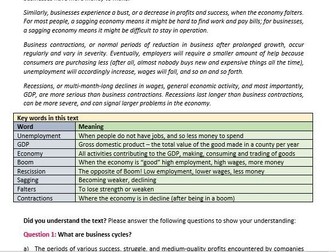
Two reading comprehension homework/class tasks.
A selection of text to read and then several follow-up questions.
Key words from the text are also included in a table.
Topics covered are: B2B vs B2C and Business Economic cycles.
Full assignment brief and SOW for Unit 8 - Recruitment, Selection and Employment
This passed the External Verification this year. Feel free to edit the work to suit your own needs.
Contains:
Scheme of work for the full unit
Unit introduction and overview
Assessment overview table
Assignment 1
Assignment 2
Assignment 3
Full assignment brief and SOW for Unit 3 - Promoting a Brand
This passed the External Verification this year. Feel free to edit the work to suit your own needs.
Contains:
Scheme of work for the full unit
Unit introduction and overview
Assessment overview table
Assignment 1
Assignment 2
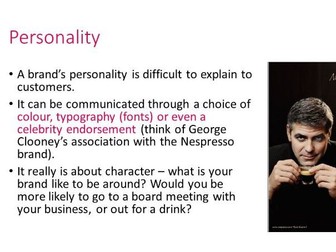
One off lesson to teach students the idea and theory behind the Branding Prism as developed by professor Jean-Noël Kapferer.
Theory notes and then a template for students to create their own version.
Examples included.
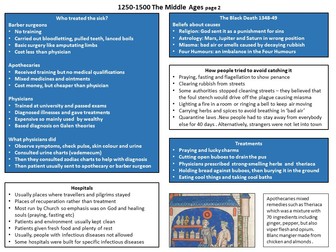
A collection of powerpoint slides to help revise the new Medicine through time topic for History GCSE.
Includes:
Section B
c1250-1500: The Middle Ages
Section B
c1500-1700: The Renaissance
Section B
1700-1900: 18th and 19th Century
Section B
c1900-present: Modern Britain
Section A
The British sector of the Western Front,1914-18: injuries, treatment and the trenches
Exam tips and model answers
One powerpoint has all topics in one. There is also individual powerpoints for each topic where you can click on a topic and have it enlarge for focused revision. Click again to go back!
Covers every topic needed for the exam - excellent revision tool.
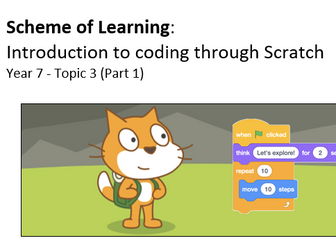
Complete SOL + resources for “Programming Essentials in Scratch” unit of work.
Ideal for Y7/Y6 depending on skill level and prior knowledge.
Two part SOL:
Part 1: - Introduction to programming essentials
Lesson 1: Introduction to programming and sequencing
Lesson 2: Sequence and variables
Lesson 3: Selection
Lesson 4: Operators
Lesson 5: Count-controlled iteration
Lesson 6: Problem-solving
Part 2: - Applying the knowledge
Lesson 7: You’ve got the moves!
Lesson 8: Fly cat fly!
Lesson 9: Loop the loop!
Lesson 10: Treasure those lists!
Lesson 11: Translate this! (Part 1)
Lesson 12: Translate this! (Part 2)
Lesson by lesson breakdown including all PowerPoints and worksheets. fully editable for your use and customisation.
Assessment grid and key words list included.
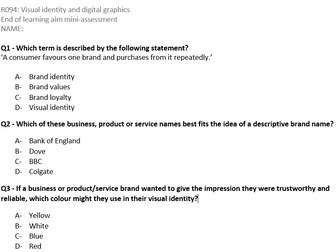
19 question multiple-choice quiz covering content from the first topic are for the new “Unit R094 – Visual identity and digital graphics” unit for Creative iMedia. Useful for end of topic recap and recall.
Space for teacher feedback at the end of the quiz. Answers included on second version.
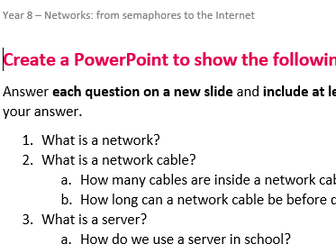
A simple cover lesson that prompts pupils to research a range of questions about computer networks and hardware. 12 points/questions for them to research and then a fill in the blanks activity to summarise
Has been used successfully as one off cover lessons and part of a larger scheme of work.
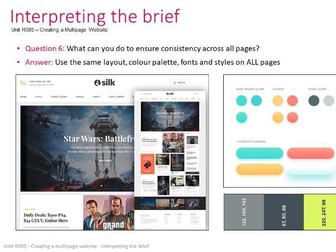
Lesson for iMedia R085 - Creating a multipage website - L02
PowerPoint and worksheet to introduce the client brief and show examples of how to discuss the client brief fully to achieve top marks in this task.
Used to good effect with a range of groups.
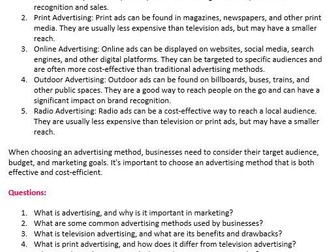
A collection of 10 work sheets on various topics for Component Three - Marketing and Finance for Enterprise from the new BTEC Tech Award in Enterprise.
These have been used to good effect as homework tasks, or starters to lessons. These are provided as Word documents so you can edit them as needed.
Each task has a read comprehension style section of text and then 10 associated questions.
File included:
Homework & Reading Tasks - Advertising Methods.docx
Homework & Reading Tasks - Breakeven.docx
Homework & Reading Tasks - Cashflow Forecast.docx
Homework & Reading Tasks - Financial Documents.docx
Homework & Reading Tasks - Payment Methods.docx
Homework & Reading Tasks - Revenue and Profit.docx
Homework & Reading Tasks - The Marketing Mix.docx
Homework & Reading Tasks - Understanding Gross and Net Profit - Definitions and Calculations.docx
Homework & Reading Tasks - Understanding Liabilities, Debtors, and Creditors.docx
Homework & Reading Tasks - Understanding Turnover, Cost of Sales, and Gross Profit.docx
A simple cover lesson that can be delivered by a non-specialist teacher.
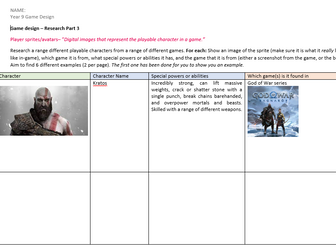
Pupils are asked to research a range of playable characters used in games to help them come up with ideas for their own games. One example is complete for them to show them what information to include. This should be uploaded somewhere where the pupils can access it on their own devices.
At the end pupils need to explain which is their favourite character and why and then they have the chance to draw and design their own character and explain it’s special abilities.
Have used this as successful cover lesson, and part of a larger scheme of work in game design.